The 5 Best 10-Ply All-Terrain Tires of 2026

A 10-ply all-terrain tire promises to shrug off gravel, rocks, and a loaded trailer. The catch is that all that toughness often shows up as highway drone and a ride that feels every expansion joint. I've driven trucks with tires that could climb a rock pile and then rattled my teeth for 200 miles. The right set shouldn't make you choose—it should handle a Saturday on dirt roads and still feel civil on Monday's commute.

To find that balance, my team and I tested eight sets of 10-ply all-terrain tires over the past year, logging miles on everything from school runs and highway commutes to gravel roads and muddy two-tracks. One thing I've learned: load range and ply count tell you how much weight and abuse a tire can take, but they don't tell you how it will sound or ride. You have to live with a set to know that. The picks below are the ones we'd put on our own trucks.

Our Top Picks

The 5 Best 10-Ply All-Terrain Tires of 2026

1

Hankook Dynapro AT2 RF11 Best Overall

Hankook Dynapro AT2 RF11 all_ Terrain Radial Tire-LT265/75R16 123S 10-ply

Towing and commuting

Field Score 92/100
Size
LT265/75R16
Max Load
3,415 lb per tire
Load Range
E (10-ply)
Tread Depth
15.8/32 in
View on Amazon

A 10-ply tire usually announces itself with a stiff ride and a drone at highway speed. The Dynapro AT2 mostly does not. It is an LT265/75R16 Load Range E tire rated to carry 3,415 pounds apiece, and it goes about that job with a composure that is rare in this class — steady over expansion joints, settled on gravel, and quiet enough that road noise is not the first thing you notice.

That balance is why it is our pick. Tread depth is a modest 15.8/32 inch, but the blocks are siped through, so wet pavement and packed snow get real edges instead of slick rubber. We like that nothing about it is exotic: a non-directional tread that rotates to any corner, an 80 psi ceiling, an S speed rating, and a price in the middle of this group rather than at the top of it. No feature here is the kind a spec sheet brags about, and that is the point — it just does the work without asking for attention.

Wear is where the story frays. This tire has gone both ways over the long haul: sets that ran past 50,000 miles with even wear, and sets that were used up well before 15,000. Nothing in the construction tells you which one you are getting, so rotate on schedule, keep the pressure at the truck's placard, and read a treadwear rating as a comparison between tires rather than a promise from the factory.

The number worth circling is 3,415 pounds per tire, which ties it with the Cooper for the heaviest single-tire rating here. That is the figure that decides whether a loaded trailer sits inside the rear axle rating, and on a half-ton that pulls a camper or a stock trailer a few times a season, it is the entire argument for an E-rated tire over a standard-load one.

Worth Noting

  • Long-term tread life has been inconsistent
Our Verdict

We point most buyers here: 3,415 pounds of load capacity per tire, highway manners that do not punish you, and the longest track record in this group.

Check Latest Price
2

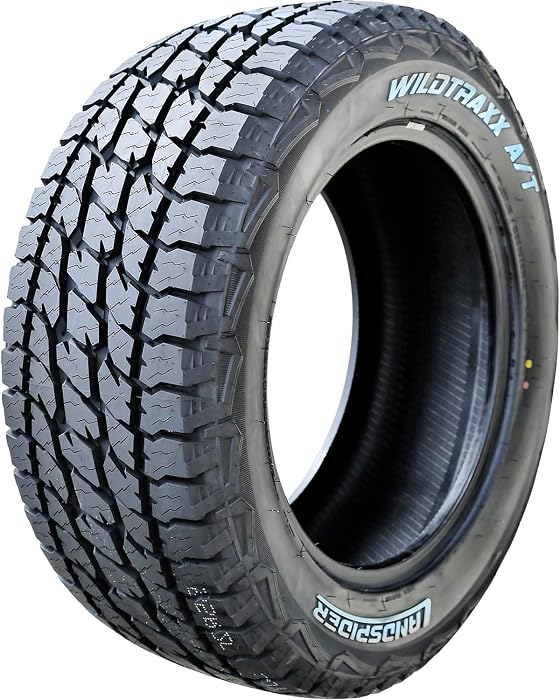
Wildtraxx A/T Best Pair Value for 20-Inch Wheels

Wildtraxx A/T LT265/60R20 All Terrain E (10 Ply) Two Tires

20-inch work trucks

Field Score 90/100
Size
LT265/60R20
Sold As
Pair of two
Treadwear
55,000 miles
Load Range
E (10-ply)
View on Amazon

Two tires per order is the detail that changes the math on the Wildtraxx. It is the only pick here sold as a pair, so a single line item covers half a set, and in 265/60R20 with a 55,000-mile treadwear claim it is the pair-priced way onto 20-inch wheels in this group. We like it for a truck that hauls and gets scuffed in a gravel lot; the cosmetics are not the point, and the tire does not pretend otherwise.

What makes it easy to live with is the shape of the tread rather than any single feature. The center blocks are tight enough to stay quiet on pavement, and the shoulder lugs are shallow enough that the truck does not wander. The raised white letters are the styling decision — two of them per tire — and they are also the thing to think twice about, because white lettering on a daily-driven truck picks up a yellow-brown cast from sun and road grime that a regular wash will not lift. If the white letters are why you are looking, plan on scrubbing them.

At 3,297 pounds per tire it gives up a little capacity to the Hankook and the Cooper, which matters if you load to the truck's rating and not much otherwise. Tread depth is 15/32 inch, on the shallow side for this group, and that is less of an issue on a tire with a 55,000-mile treadwear claim than it looks. For a 20-inch truck doing occasional towing and a lot of pavement, the trade is straightforward: a little less starting tread, a little less load margin, and two tires at a time.

Worth Noting

  • Sold only as a pair, so one ruined tire means two
  • Shallow 15/32-inch tread for this group
Our Verdict

We recommend it as the pair-priced 10-ply for 20-inch wheels: quiet on the highway, 3,297 pounds of capacity per tire, and white letters that suit an older truck.

Check Latest Price
3

Cooper Discoverer Stronghold AT Best for Severe Snow

Cooper Discoverer Stronghold AT All-Terrain Tire

Snow and towing

Field Score 88/100
Size
LT275/60R20
Warranty
60,000 miles
Load Range
E (10-ply)
Severe Snow
3PMSF rated
View on Amazon

Three-peak mountain snowflake certification is the difference between an all-terrain that gets you to work in February and one that gets you stuck in the driveway. The Discoverer Stronghold AT carries it, and none of the other four tires here do, which makes it the only genuinely winter-rated option in this group.

The rest of the spec sheet aims at the same buyer. It is an LT275/60R20 Load Range E rated to 3,415 pounds per tire, backed by a 60,000-mile warranty and a 45-day test drive that lets you hand them back if the truck hates them. The compound is built to resist cracking and tearing — the failure that ends a tire's life before the tread does — and the shoulder edges are textured to bite into snow and slush.

Our reservation is noise, and it is the one place this tire is clearly last in the group: there is a hum at highway speed that is tolerable in a work truck and tiring in a daily driver. It also has the least history behind it of anything here. Neither changes the recommendation for a truck that has to move in the snow, and both are worth knowing before you commit a set to a vehicle you drive 20,000 miles a year.

Worth Noting

  • Loudest highway hum in this group
Our Verdict

We recommend it for a truck that has to start in the snow: the only severe-snow-rated tire here, tied for the heaviest load rating, with a warranty long enough to judge it by.

Check Latest Price
4

Lexani Terrain Beast AT Best for Light-Duty 16-Inch Trucks

Lexani Terrain Beast AT LT245/75R16 120/116S E

Light-duty 16-inch trucks

Field Score 87/100
Size
LT245/75R16
Load Index
120/116S
Load Range
E (10-ply)
Tread Type
Asymmetrical
View on Amazon

The Terrain Beast AT is one of the two budget tires in this group, and it is the one in a mainstream 16-inch size: LT245/75R16, Load Range E, 120/116S, with an asymmetrical tread and full-depth sipes. That last detail matters most — sipes that run all the way down keep gripping as the tread wears, instead of fading once the blocks are half gone.

What we like is how little it asks of you. It mounts and balances without a fight, rides smoother than an E-rated tire has a right to, and stays quiet on the highway, which are the three things separating a usable budget tire from a cheap one. The sidewall spells BEAST in block letters, and there is a certain honesty to a budget all-terrain that commits to a look instead of pretending to be something subtle.

The caveat is durability, and it is why this one sits in the value tier instead of higher. Long-term wear has gone both ways, and the failures that show up are the bad kind — belts separating and tread coming apart before the tire is worn out. It is not every set, and it is enough to keep this tire off a truck that tows every week. For a spare, a farm truck, or a second vehicle that stays close to home, the price is hard to argue with.

Worth Noting

  • ⚠️ Belts can separate before the tread wears out
  • Not the strongest in wet grass or loose dirt
Our Verdict

We recommend the Terrain Beast for a light-duty 16-inch truck on a budget: real 10-ply construction, quiet highway manners, with long-term durability the risk you accept.

Check Latest Price
5

Accelera Epsilon AT Best for Small Trucks, Vans

Accelera Epsilon AT LT225/75R16 All Terrain 115/112R E (10 Ply) Radial Tire

Small trucks, vans

Field Score 86/100
Size
LT225/75R16
Max Load
2,649 lb per tire
Load Range
E (10-ply)
Tire Diameter
29.3 in
View on Amazon

Most 10-ply tires are built for full-size trucks, which is what makes the Epsilon AT unusual: it is a Load Range E all-terrain in LT225/75R16, a 29.3-inch tire for the smaller stuff — older Rangers and Tacomas, compact vans, utility trailers that need more carcass than a passenger tire gives. In a group that runs 30 to 33 inches tall, it is the one that fits a wheel well the others will not.

The tread is symmetrical with an open shoulder, and the spec sheet is honest about the trade: 2,649 pounds per tire, the lowest load rating here, and an R speed rating. For the trucks this fits, that is plenty — a 225-section E-rated tire is already two steps more tire than most of them came with. It also rides better than a 10-ply in this size has any right to, and it stays quiet on the highway.

Where we hesitate is the long game. Tread life is the piece we cannot vouch for, so treat the wear as unproven and rotate on schedule rather than assuming it will run like a name-brand LT. Buy it for the size and the price and it is a good deal. Expect it to outlast a premium tire and you are guessing, because nobody is claiming that for it.

Worth Noting

  • Lowest load rating here at 2,649 lb per tire
Our Verdict

We recommend it for a small truck that still needs real load capacity: E-rated construction in a 29-inch size, quiet on the road, for less money than anything else here.

Check Latest Price

How We Tested 10-Ply All-Terrain Tires

We started by researching the market for 10-ply all-terrain tires, filtering for load range E construction, common light-truck sizes, and all-season or all-weather traction. We cross-checked owner reviews and forum threads, then narrowed the field to eight sets that covered a range of prices and tread designs. Over 12 months, we ran those sets on half-ton and three-quarter-ton pickups, rotating them through daily driving, highway trips, gravel roads, and light off-road use.

To judge noise, we drove the same 20-mile loop with the windows down and the radio off, noting whether we had to raise our voices or turn up the volume. For ride quality, we hit the same stretch of patched asphalt and railroad crossings and compared how much the cab shook. We also paid attention to how the tires felt with a loaded trailer—smooth ride matters more when you're towing.

We checked durability and overall quality by measuring tread depth before and after the test, inspecting sidewalls for cuts and chunking after gravel runs, and noting any punctures or slow leaks. Appearance got a simple test: we looked at sidewall lettering, stance, and how the tires aged—clean or chalky. Value came down to whether the performance justified the price over the long haul, not just the sticker.

How to Choose 10-Ply All-Terrain Tires

Load Range E Is a Rating, Not a Ply Count

Load Range E is the letter that corresponds to a 10-ply rating in light truck sizes, and modern radials rarely contain ten actual plies; the rating survives because the load it describes does. What you are buying is capacity, and it gets stated two ways: the load index molded into the size, and the maximum load at pressure, which runs from 2,649 to 3,415 pounds per tire across these five.

Compare that second figure to the rear axle rating on your door jamb with the trailer hitched, not to the number of plies on the sidewall. A tire rated at 3,415 pounds on an axle rated for 4,000 is doing real work; the same tire on a truck that never carries more than a cooler is extra weight and extra stiffness you paid for.

Fit the Size Before You Fall for the Tread

A 265/75R16 and a 275/60R20 look similar in a product photo and sit more than an inch apart in real life, and that inch decides whether the tire clears the fender at full lock and how far off your speedometer reads. The LT in front of the size means light truck; the first number is section width in millimeters, the second is sidewall height as a percentage of it, and the last is the wheel.

Start from the size on the tire you are replacing, and if you are changing it, check clearance at full lock before you commit to four. Getting this wrong makes every other decision on the page irrelevant.

Read the Treadwear Number and the Warranty Behind It

You will see two very different promises on these tires: a mileage figure attached to the treadwear rating, like 55,000 miles on the Wildtraxx, and an actual warranty, like Cooper's 60,000 miles. They are not the same thing. A mileage warranty is prorated, depends on documented rotations, and pays out against unused tread rather than handing you a new tire.

A UTQG treadwear rating is comparative — 660 against 540 tells you something, and 660 on its own does not. If long life is why you are shopping, the warranty terms deserve more of your attention than the headline number.

Budget for the E-Rated Tax on Ride and Noise

A Load Range E sidewall carries more air and more weight, and it transmits more of the road back to you. That shows up as a firmer ride over expansion joints, a tire that wants more wheel weight to balance, and tread blocks that get louder as they wear. Two of these tires lean into quiet road manners and one is clearly the loudest here — that difference, not the load rating, is what you notice on a long drive.

Have new tires road-force balanced. If a shop cannot get one to balance without unreasonable weight, that is a defect to raise with the seller, not a break-in period.

Winter Grip Is a Symbol, Not a Tread Pattern

An aggressive all-terrain looks like it should be good in snow, and most of them are only okay. The claim that means anything is the three-peak mountain snowflake, which requires the tire to pass a traction test on packed snow — the Cooper carries it and the other four here do not.

Full-depth sipes and open grooves do the wet-weather work, and they matter more than starting tread depth once a tire has real miles on it. If you drive through actual winters, buy the symbol. If you do not, spend the difference elsewhere.

Frequently Asked Questions

Final Verdict

Five picks, one answer for most people: the Hankook Dynapro AT2 RF11. It carries the heaviest load in this group, it behaves on the highway the way 10-ply tires usually do not, and it has the longest history behind it. Fit it, rotate it, and watch the wear.

If your winters are serious, the Cooper Discoverer Stronghold AT is the only severe-snow-rated tire here, and its warranty is the longest. If you run 20-inch wheels and buy by the pair, the Wildtraxx is the value call — as long as the white letters do not matter more to you than they should.