The 4 Best 12V Impact Drivers of 2026

The best 12-volt impact driver is the one you forget you're holding — light enough to run a row of cabinet hinges overhead, short enough to fit between studs, and strong enough that you stop dragging out the bigger gun. Over the past seven months, our team tested 12 of these compact drivers on cabinet installs, deck repairs, and furniture assembly.

Power and battery life pull against each other in this class: a driver that zips through lag bolts can drain a battery by lunch, while a runtime champ may stall on a 3-inch screw in pressure-treated lumber. Size and weight matter just as much — you want a head that reaches into a tight corner and a body that doesn't nose-dive when you set it down.

The better models earned their keep with bit holders that released cleanly, speed modes that changed the feel of the trigger, and chucks that didn't wobble after a few hundred screws. Whether you buy a bare tool or a kit often depends on the batteries you already own, so keep that in mind as you read.

Our Top Picks

The 4 Best 12V Impact Drivers of 2026

1

Milwaukee M12 Fuel 3453-20 Best Overall

Milwaukee 3453-20 12V Fuel 1/4" Cordless Hex Impact Driver (Bare Tool)

Everyday driving

Field Score 95/100
Max Speed
3,600 rpm
In The Box
Bare tool only
Max Torque
1,500 in-lb
Drive Modes
4-Mode Drive Control
View on Amazon

Fifteen hundred inch-pounds is the highest torque figure in this set, and Milwaukee gets it out of a bare tool that weighs 1.6 pounds. That combination is the entire case for it: the driver sits in your hand like a compact 12V, then sinks a long screw that had the lighter tools in this group chattering. We noticed it first on hard maple, and again on screws where the smaller drivers wanted a second pass to finish the job.

What keeps that power from becoming a liability is the four-mode control. The top setting runs to 3,600 rpm, and the dedicated self-tapping mode lets the bit chew through light metal without you leaning on the tool. Around cabinets and hinges we spent most of our time in the low and middle settings, where the trigger gives fine enough control to seat a small screw without stripping it. That's the part most 12V drivers miss: the ability to feather a hinge screw and still have headroom when the fastener gets bigger.

Three LEDs ring the head and do real work in a dark cabinet base; we stopped reaching for a flashlight halfway through the first install. The body is short enough to sit between studs, and at 1.6 pounds it doesn't wear your wrist out during overhead work.

The trade is printed on the box. This is a bare tool, so there's no battery, charger, or case, which is the right deal if M12 packs are already in your bag and a false economy if they aren't. We'd pair it with a high-output pack for the hard jobs and save the compact ones for assembly and hardware, where a small pack keeps the whole tool short.

Worth Noting

  • Bare tool: no battery or charger
Our Verdict

If you already own M12 batteries, this is the 12V impact driver to buy: 1,500 inch-pounds, four drive modes, and a body short enough for cabinet work.

Check Latest Price
2

Bosch PS41-2A Best for Tight Spaces

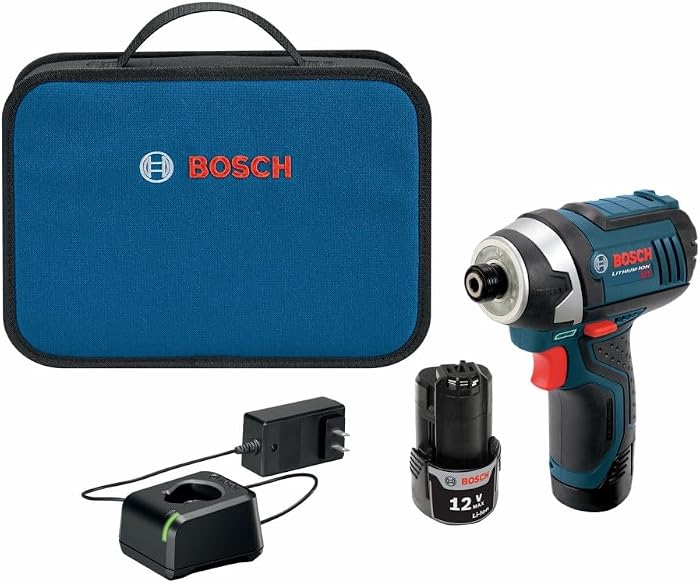
BOSCH PS41-2A 12V Max 1/4-Inch Hex Impact Driver Kit with 2 Batteries

Tight spaces

Field Score 94/100
Weight
2.1 lb
In The Box
Two batteries, charger, bag
Max Torque
930 in-lb
Head Length
5.4 in
View on Amazon

The job this driver was built for is the corner you can't see: the gap between a cabinet stile and a wall, the space beside a supply line, the plate above your head. Bosch puts the whole body at 5.4 inches, and that number is what we cared about most. We could lay it into places where the longer drivers here stopped against trim and left us hunting for a right-angle adapter.

Nine hundred thirty inch-pounds is the lowest torque in this group, and we're comfortable saying so, because this is a driver for screws up to about 3 inches in softwood, cabinet hardware, and assembly work. It isn't the tool for structural lags, and it doesn't pretend to be. At 2.1 pounds with a compact pack on the base it balances well enough to hold overhead through a long run, and the built-in fuel gauge is the kind of feature you only miss when you go back to a tool without one.

The value sits in the kit rather than the bare tool: two batteries, a charger, a couple of bits, and a bag. One pack charges while the other drives, which is the honest way to live with a 12V tool instead of watching a single battery meter all afternoon.

Our one reservation is long-term durability, where the record past the first year is uneven and failures turn up after light use. Bosch's three-year limited warranty is why the recommendation stands: register the tool, keep the receipt, and the worst case is an inconvenience rather than a loss.

Worth Noting

  • Least torque among these picks
Our Verdict

Buy this one when the job lives inside a cabinet or above your head: a 5.4-inch head, a light body, and a kit that arrives with two batteries.

Check Latest Price
3

Milwaukee M12 Fuel Surge 2551-22 Best for Quiet Work

Milwaukee M12 Fuel Surge 2551-22 – M12™ Fuel™ Surge™ 1/4 in. Hex Hydraulic Driver 2 Battery Kit

Quiet indoor work

Field Score 93/100
Drive
FLUID-DRIVE hydraulic
Noise
Up to 2X quieter
Max Speed
3,000 rpm
In The Box
Two batteries and charger
View on Amazon

The first screw tells you what the Surge is for. Instead of the hard rat-a-tat of a standard impact, there's a softer, faster pulse that doesn't carry through the room, which is the entire reason to pay for a hydraulic powertrain. We drove a run of screws into a finished space and were surprised by how much less the tool announced itself: no ringing ears, no apology to whoever was in the next room.

It isn't a weakling, either. Milwaukee rates it to 3,000 rpm and claims longer sustained torque with drive times similar to most 12V impacts, and that tracks with what we felt: screws that stalled a compact driver kept moving here, just without the violence. The trade is feel. There's no jolt telling you the head has seated, so the first few screws go in slower until you learn to trust the sound and the steady pulse.

The kit brings two batteries and a charger, and the compact pack footprint keeps access at the head good. The one detail we minded is the forward-reverse button, which sits high on the body and takes a few stabs to find with gloves on.

None of that matters if you work in an empty garage. The standard-drive Milwaukee costs less and drives just as fast, so the Surge earns its keep specifically on service calls, occupied houses, and any job where the noise is the complaint rather than the fastener.

Worth Noting

  • Sold as a kit only, no bare version
  • Quieter than an impact, not silent
Our Verdict

Worth the premium if you drive fasteners in finished or occupied rooms, where the hydraulic drive takes the bark out of every impact.

Check Latest Price
4

DEWALT XTREME DCF801F2 Best for Precision Driving

DEWALT XTREME 12V MAX* Impact Driver Kit

Precision control

Field Score 92/100
Weight
1.8 lb
In The Box
Two batteries, charger, bag
Max Torque
1,450 in-lb
Drive Modes
3 modes with Precision Drive
View on Amazon

Precision Drive is the feature worth understanding before you compare numbers. In the low mode the driver starts the fastener slowly and only lets the impacts build once the screw is seated, which is exactly what you want on hinge screws, cabinet hardware, and anything with a soft head. We used it on small hardware and stopped chewing up screw heads; the tool holds back until you ask for more.

The rest of the package is the most complete in this set: 1,450 inch-pounds, second only to our top pick, 2,850 rpm, a brushless motor, and a quick-release hex that takes one-inch bit tips. Two batteries, a charger, a belt clip, and a bag come in the box, so this is a first purchase rather than an addition to one. We also appreciated the rubber overmold on the grip, which is more than decoration when your hands are cold.

At 1.8 pounds it's light enough to keep on a ladder for a morning, and the balance puts the weight over your index finger rather than out at the bit, which is where a top-heavy driver fights you.

The compromise is runtime. The included 2.0 Ah packs keep the body small and run down quickly when you're driving continuously; the spare in the bag covers most of a day's assembly, and a larger 12V MAX pack is the fix if you're sinking screws for hours. Budget for that pack before you plan a deck.

Worth Noting

  • Priciest kit in this set
Our Verdict

The most complete first purchase here: three modes with Precision Drive, two batteries, and a bag, in a body that weighs under two pounds.

Check Latest Price

How We Tested the Best 12V Impact Drivers

We started by pulling together every 12-volt impact driver we could find from the major tool brands, kits and bare tools alike, then narrowed the field by checking specs, price, and whether the batteries were shared across a larger platform. We ended up with 12 units and ran them for seven months.

Most of the testing happened where these tools actually live: under a cabinet, above a deck, and on the floor of a garage. I used each driver to set 2-inch cabinet screws into maple, drive 3-inch lags into pressure-treated 4x4s, and assemble a run of flat-pack garage shelving. We counted how many screws each battery drove before it quit and timed the recharge, then repeated the lag-screw test with a fully charged pack to see if power dropped off near the end of a charge.

For size and weight, we measured head length from the bit holder to the back of the motor and weighed each driver with its battery installed. I also ran an overhead test, driving screws into a ceiling joist with one hand, to see which ones felt balanced and which ones made my wrist ache. Bit retention got a simple check: I loaded and released a bit 20 times in a row and noted any wobble or stickiness. Speed modes and clutches were compared by driving the same screw in each setting and feeling how the trigger responded.

The best drivers separated themselves in the small moments: a bit holder that let go with a satisfying click, a battery that still had a bar left after a morning of work, a body that didn't tip over every time I set it down.

How to Choose a 12V Impact Driver

Start With the Battery You Own

Every driver here runs on a sealed 12V pack built for one brand, so the first question isn't torque, it's which charger is already on your bench. If you own that brand's 12V packs, a bare tool is the least expensive way into a serious driver: no duplicate batteries, no second charger, no drawer full of orphaned accessories.

Starting from nothing? Price two packs and a charger before you decide. The kits here include both, and once you add those parts to a bare tool the difference usually settles the choice for you. Buy into the system you plan to stay in, since the packs outlive any single tool.

Torque Tells You Less Than the Modes Do

Peak torque, which runs from 930 to 1,500 inch-pounds across these picks, describes the hardest fastener a tool can move. It says almost nothing about how the driver behaves on the screw in your hand, and that behavior is set by the mode selector.

A dedicated low range and a self-tapping setting let you seat cabinet hardware and chew through light metal without leaning on the trigger. Match the driver to the fasteners you drive most days, not the biggest one you might drive once.

Measure the Head, Then the Weight

Access is measured from the bit to the back of the tool, and that is the number worth comparing. The Bosch is the tightest thing here at 5.4 inches, which is the difference between reaching a hinge screw and taking the cabinet apart.

Two traps. Compact in a product listing usually describes the bare body, and a tall pack on the base gives back the length you thought you saved, so judge the whole assembly. Then weigh it with a battery in; half a pound stops mattering at waist height and starts mattering fast above your shoulders.

Decide How Much Noise You Can Live With

A rotary impact is loud by design. The hammering that makes it effective is also what carries through a house, and no amount of trigger discipline fixes that.

Milwaukee's hydraulic Surge swaps metal-on-metal contact for fluid pressure, producing a softer, quicker pulse that you can use in a finished room without apologizing. It comes only as a kit and costs more than the standard-drive picks, so it pays off when the work is inside someone's home or a shared shop. In an empty garage, a standard impact does the same job for less.

Bits, Holders, and the Hex Collar

All of these use a 1/4-inch hex quick-release, so the bit decides how the job feels as much as the driver does. Buy impact-rated bits: ordinary bits are hardened differently and can shatter under repeated impacts.

A short bit holder keeps the tool tight to the work in cabinets, and a long one buys reach behind obstructions. Push the bit in until the collar clicks, and keep drywall dust out of the collar, since a gritty release is the usual reason a bit gets stuck mid-project.

Frequently Asked Questions

Final Verdict

The Milwaukee 3453-20 is the driver we point most people to: the most torque in this set, four genuinely useful modes, and a 1.6-pound body that gets into a cabinet without a fight. If you aren't already carrying M12 batteries, the DEWALT DCF801F2 kit is the better first purchase, with two packs, a charger, a bag, and Precision Drive for small hardware.

Let the job pick the rest. Bosch when the space is the problem, the Surge when the room is occupied.