The 8 Best 12X50 Binoculars of 2026

Twelve-power binoculars exist for the bird that won't come closer. They're what you reach for when the warbler is 40 feet up and the hawk is a speck over the ridge, and they come with a catch: every bit of reach multiplies your own hand tremor too. Add the 50mm lenses that keep the view bright at dusk and you're holding real weight. A good 12x50 beats that tradeoff — sharp at distance, steady enough in your hands to actually use.

I've owned binoculars that looked fine in the store and fell apart at dusk, so I came in with opinions. My team and I have spent the past six months with 12 pairs, from budget glass to premium, and the gaps showed up fastest in low light and at the focus wheel. The diopter ring, which corrects for the difference between your eyes, drifts on cheap pairs — you won't notice until you've missed three birds refocusing. Everything below earned its spot on clarity, build, and what comes in the box.

Our Top Picks

The 8 Best 12X50 Binoculars of 2026

1

Vortex Crossfire HD 12x50 Best Overall

Vortex Crossfire HD 12x50 Binoculars

All-around hunting glass

Field Score 96/100
Weight
1.8 lb
Sealing
Waterproof and fogproof
Eye Relief
15 millimeters
Field Of View
273 feet
View on Amazon

Hand a 12x50 to someone who has never glassed and the first thing they do is wobble. This is the pair we hand over anyway, because at 1.8 pounds it settles down fast in two hands, and the chest harness in the box takes the weight off your neck when you are walking in. Of everything here, it is the best all-around 12x50 for a hunter who wants one pair to do everything.

What you are paying for is glass that holds up after the sun drops. The HD optical system and fully multi-coated lenses keep detail from smearing at the edges of the day, which is when the 50mm objective earns its size, and the roughly 4.2mm exit pupil is why the image stays usable in timber shadow. In flat midday light almost any binocular looks fine; this is the sort of glass that still looks good when the shadows go blue.

Adjustment is straightforward in the way that matters after a long walk: twist-up eyecups, a center focus wheel you can work with a gloved hand, and a ±5 diopter that lets you set the right barrel to your eye and leave it. Eye relief is 15mm, which is fine bare-eyed and tight behind thick glasses. The chassis is nitrogen purged, o-ring sealed, and rubber armored, so rain and a wet saddlebag are not a disaster, and the tripod mount is there when you want to sit behind it.

Then there is the warranty, which is unlimited and unconditional, and it is the reason this stays the pick for people who are hard on gear. Fog it, drop it, send it in. On a tool that lives in a truck, that coverage is worth more than another point of light transmission.

Worth Noting

  • 15mm eye relief is tight behind thick glasses
Our Verdict

We tell most hunters to start here: sealed, sharp, steady in the hand, and sold with the harness you would otherwise buy separately.

Check Latest Price
2

Vortex Viper HD 12x50 Best for Low Light

Vortex Viper HD Roof Prism Binoculars 12x50

Dawn and dusk

Field Score 93/100
Diopter
Locking, right eye
Sealing
Argon purged, waterproof
Eye Relief
16 millimeters
Prism Coating
Fully multi-coated, dielectric
View on Amazon

Everything the Crossfire does, the Viper HD does with better glass, and you pay for it. The step up is a high-density optical system with XR anti-reflective coatings and a dielectric prism coating, which is the specification that decides whether the edge of the view stays as clean as the center. Glass a ridgeline for an hour and that difference stops being academic.

We think it is worth the money for one buyer in particular: the hunter who does most of their looking in the last twenty minutes of legal light. This pair holds color and detail deeper into dusk than the midrange options here, and the locking right-eye diopter means your setting survives a bump behind the seat. If you glass mostly at noon, put the difference into fuel and boots.

The rest of the build matches the glass. Argon purging instead of nitrogen, ArmorTek on the exterior lenses to shrug off scratches and fingerprints, and the same GlassPak chest harness as the Crossfire. The 16mm eye relief and twist-up eyecups work with or without glasses, and the focus wheel is smooth enough to fine-tune one-handed while the binoculars are still at your eyes.

Weight is the trade-off. This is a full-size pair, heavy enough that a neck strap stops being fun by mid-afternoon, so plan on the harness. And 12x is the ceiling for hand-held glassing: if you are picking apart a basin a mile wide, add a tripod adapter and give the view a rest.

Worth Noting

  • Lens covers fit loosely and come off easily
Our Verdict

If your glassing happens in the last twenty minutes of light and you want the edge of the image as clean as the middle, this is the pair we point you to.

Check Latest Price
3

Celestron Nature DX ED 12x50 Best for Birding

Celestron Nature DX ED 12x50 Premium Long-Range Binoculars with ED Glass

Birding and wildlife

Field Score 87/100
Glass
ED objective lenses
Prisms
Phase-coated BaK-4
Sealing
Waterproof and fogproof
Eye Relief
14.3 millimeters
View on Amazon

Extra-low dispersion glass is the reason to look at the Nature DX ED. At 12x, color fringing shows up first on exactly the subjects birders care about: a dark hawk against a bright sky, a magpie on a wire, antlers against snow. ED objective lenses are what pull that purple-green halo back out of the image, and they are why this pair punches above its shelf position.

Celestron pairs the ED glass with phase-corrected, dielectric-coated BaK-4 prisms, and the result is a bright, high-contrast view through a 4.1mm exit pupil. At 806 grams it is one of the lighter full-size pairs in this group, which matters more at 12x than it does at 8x. Eye relief is 14.3mm, so glasses wearers should twist the eyecups down and check before committing.

We think this is the best birding-first 12x50 here. The catch is fit: the hinge takes real effort to close down to a narrow eye width, and the barrels can end up needing a squeeze before both eyes see one circle. If your interpupillary distance is on the small side, or you share the pair with a kid, handle one in person before you buy.

The accessories are basic, which is fair at this price: a carrying case, neck strap, objective caps, rainguard, and lens cloth, with no harness. The tripod mount is there if you want to stake out a feeder and wait. For a dedicated birding pair that lives in a daypack rather than on a saddle horn, it is a lot of optical quality for the money.

Worth Noting

  • Twist-up eyecups do not lock in place
Our Verdict

For birding and wildlife, the ED glass here buys the cleanest high-contrast image in this group for midrange money, as long as the hinge fits your face.

Check Latest Price
4

Bushnell Prime 12x50 Best for Wet Weather

Bushnell Prime 12x50 Binocular

Wet-weather spare

Field Score 86/100
Prism
Roof prism
Coating
Fully multi-coated, EXO Barrier
Sealing
IPX7 waterproof
View on Amazon

If the Crossfire is more glass than you want to pay for, the Prime is the sensible step down. It is IPX7 rated, which means it survives a dunk in the creek, and Bushnell coats the exterior lenses with EXO Barrier so rain beads and wipes instead of smearing. For a pair that lives behind the truck seat, that matters more than another point of light transmission.

What sold us is the combination: fully multi-coated roof-prism optics, an aluminum chassis, and genuine sealing at the bottom of the midrange. It is a plain, honest binocular that will not make you nervous about handing it to a buddy or setting it on a wet tailgate, and the armor takes a knock without a scar worth mentioning.

Bushnell does not claim ED glass or dielectric prism coatings here, and at this price that is expected. The Prime gives up a little contrast in the last ten minutes of light to the pairs above it, which you will notice if you are a dusk hunter and never notice if you are glassing pastures at nine in the morning. As a spare, a loaner, or a first set of sealed glass, that is a fair trade.

Worth Noting

  • Limited lifetime warranty, not unconditional
Our Verdict

Our pick for the truck seat and the rainy morning: the Prime is sealed, armored, and priced to leave in the rig without flinching.

Check Latest Price
5

Occer 12x50 Best Budget

Occer 12x50 Binoculars for Adults High Powered for Bird Watching Green

First-time buyers

Field Score 85/100
Prism
Porro prism
Exit Pupil
4.17 millimeters
Field Of View
6.8 degrees
View on Amazon

These binos live by the porch rail, in the door pocket of the truck, on the boat seat: the pair you grab for whatever is out there right now. The Occer is a porro-prism 12x50 with a wide 6.8-degree view, and that width is what makes it easy to find a bird or a deer before it moves out of the frame.

The details are what make it usable at the price. Each eyepiece adjusts separately, so a household can pass it around without re-teaching anybody, and it ships with a case, a neck strap, an eyepiece cover, and a cloth. The view is bright and sharp in daylight, and the 4.17mm exit pupil keeps it serviceable well past sunrise.

What it is not is sealed. The listing puts water resistance at none, so rain, boat spray, and a fogged lens are genuine risks, and the warranty runs one year rather than a lifetime. It is also a full-size porro body at 800 grams, which is a lot of binocular to hang on your neck on a long hike up a ridge.

We were surprised by how much view you get at the entry price, and how little the wide field gives up to the big names in good light. It will not replace a sealed pair on a November hunt, but as the binocular everyone in the house can use without supervision, it is hard to argue with.

Worth Noting

  • Not sealed against rain or fog
  • Bulky full-size porro body to carry
Our Verdict

For entry money you get a bright, wide view and a pair you will not fret over loaning to a neighbor or leaving on the porch.

Check Latest Price
6

IBQ 12x50 UHD

IBQ 12x50 UHD – 12x50 UHD Binoculars for Adults High Powered with Upgraded Phone Adapter

Phone photography

Field Score 84/100
Sealing
IPX7 waterproof
Eyepiece
22 millimeters
Included
Phone adapter and carry bag
Field Of View
5.8 degrees
View on Amazon

The phone adapter is the whole pitch here, and it is a decent one: a bracket clamps your phone over the eyepiece so you can take a picture of what you are looking at instead of describing it later. It takes some fiddling to line the camera up with the exit pupil, and once it is set, a 12x image needs a rest under it, whether that is a fence post, a truck hood, or a tripod.

The rest of the package is more than the price suggests: an IPX7-rated body, a 22mm eyepiece, a 5.8-degree field, and a body light enough to carry on a neck strap all afternoon without complaint. It ships with a crossbody bag, a padded strap, and a cleaning cloth, and the two-year warranty is longer than most entry-level coverage.

The view is a daylight instrument. In good light it is bright and clean enough for feeder birds, buoys, and the far end of a cut cornfield; as the light thins it gives up ground quickly to the coated midrange pairs, which is true of most glass at this price. The build feels tight in the hand, and the rubberized surfaces are easy to grip with gloves.

The combination that works is low weight plus that bracket, because a phone-scoping rig you will actually carry beats a better one you leave at home. Set it up on a fence post at a prairie dog town or over a feeder and it does something nothing else in this guide does. Judge it as a daylight photo tool and it makes sense.

Worth Noting

  • Hinge will not close narrow enough for some faces
  • Strap can arrive without its buckles
Our Verdict

The one we suggest to people who want their binocular view on a phone screen without turning photography into a second hobby.

Check Latest Price
7

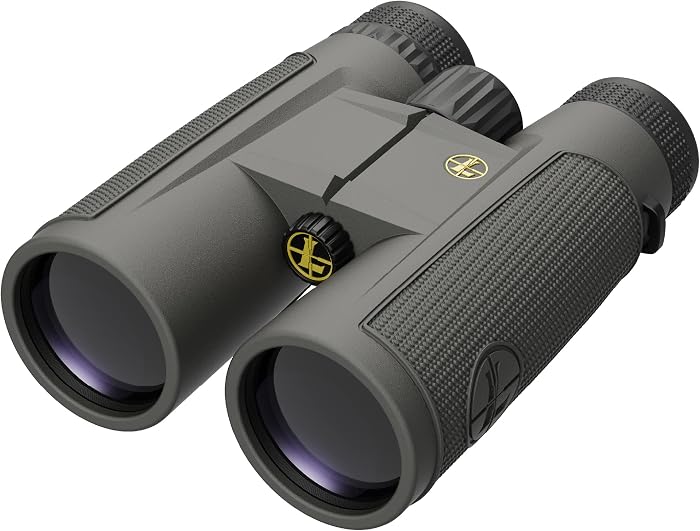
Leupold BX-1 McKenzie HD 12x50

Leupold BX-1 McKenzie HD Binoculars

Open-bridge ergonomics

Field Score 83/100
Design
Open-bridge roof prism
Prisms
BaK-4
Weight
2 lb
Warranty
Full lifetime guarantee
View on Amazon

Shooters with big hands and thick gloves spend a lot of time fighting closed-barrel binoculars, and the open bridge on this Leupold is the answer to that. The gap under the hinge gives your fingers somewhere to wrap, which turns a two-handed hold into something closer to a locked-in grip, and we appreciated it most in offhand positions where the glass stays up longer than planned.

Optically it is fully multi-coated BaK-4 glass in a roof prism, waterproof and fogproof, with a ±5 diopter and a strap, case, and tripod adapter in the box. At 2 pounds it is stable without being a brick, and Leupold's Full Lifetime Guarantee stands behind it the way a hunter expects from a company that also builds scopes.

The trade-off is length. At 8.2 inches it is the longest body in this group, which you notice in a chest rig and when you are stuffing it into a daypack lid. Handle one before you commit if compact packing matters. Otherwise it is a sound buy for a rifle hunter who wants a lifetime guarantee and a grip that fits his hands.

Worth Noting

  • Longest body here at 8.2 inches
Our Verdict

We like the BX-1 McKenzie for shooters who want an open-bridge grip and a full lifetime guarantee without flagship money.

Check Latest Price
8

Bushnell Spectator Sport 12x50 Best for Stadium and Arena

Bushnell Spectator Sport 12x50 Binoculars

Stadium and arena

Field Score 82/100
Focus
PermaFocus fixed focus
Prism
Porro prism
Weight
1.9 lb
Field Of View
273 feet
View on Amazon

PermaFocus is Bushnell's name for fixed focus, and it is the entire argument for this pair. There is nothing to adjust: you raise them and the far sideline, the far green, or the far bank is sharp, which means you never miss a play while hunting for the wheel. At a stadium that is exactly right, and it is why these get passed around a tailgate without instruction.

The rest of the spec sheet is stadium-shaped too: porro prisms, a 273-foot field, waterproof sealing, 14mm eye relief, and a set of colored tiles you can swap onto the barrels to match a team. At 1.9 pounds it is stable enough to hold through a fourth quarter, and the wide field makes it easy to follow a ball in flight.

Where it falls down is anything close. A fixed-focus binocular cannot be pulled into the near field, so a bird at the feeder, a deer at 40 yards, or a subject that moves from far to near will stay soft, and no amount of turning a wheel fixes it because there is no wheel. For the stands, the arena, and open water, it is a bargain. For the whitetail stand, it is the wrong tool.

Worth Noting

  • Close subjects stay soft with no way to focus
Our Verdict

We like these for stadium and arena seats where everything worth watching is far away, and for a boat where the shoreline never gets close.

Check Latest Price

How We Tested the Best 12x50 Binoculars

We built the shortlist by pulling every 12x50 we could find from makers with a reputation for honoring a warranty, then cutting anything with vague magnification claims, unlisted eye relief, or a plastic prism housing. That left 12 pairs, from budget glass to premium, and every one got the same treatment: unpacked, adjusted to each tester's eyes, and used until the novelty wore off.

Testing ran six months and followed the binoculars into real use rather than a lab bench. We watched a backyard feeder at dawn, a wetland at last light, a college football game under stadium lights, an October hawk-watch ridge, and one clear night of stargazing. On hikes we carried each pair on its strap or harness for four miles to see where the weight landed and whether the strap cut into a shoulder.

For clarity and image quality, we taped a dollar bill to a fence post 60 yards out and read the serial number through each pair, first in full sun and again as the light failed, noting when the print stopped resolving. For focus, we counted how far the wheel traveled from eight feet to infinity, turned it bare-handed and in gloves, and checked for backlash. Each locking diopter got set once and left alone for a week to see if it drifted. We noted how the barrels fit smaller hands, how the eyecups felt with and without glasses, and what came in the box, since that's usually where value hides. Two pairs spent a night on a porch in freezing fog so we could see what fogged internally.

How to Choose 12X50 Binoculars

Why 12x50, and When to Step Down

At 12x, a buck on the far fence line is workable, and so is every tremor in your hands. The 50mm objective holds the exit pupil around 4.2mm, which is what keeps the format usable at first light; a 10x42 gives you similar brightness with less shake and a wider field. Our rule: open country, bean fields, western basins, and shorelines call for 12x. Timber, close cover, or a pair a kid will carry is easier at 10x.

Nearly every 12x50 here is tripod adaptable, and using that mount is the single biggest upgrade you can make to a high-power view. A window mount or a lightweight tripod turns a shaky 12x into a glassing tool you can sit behind for an hour.

What HD and ED Glass Actually Buy You

Glass and coating quality show up at the edges of the day and against bright backgrounds. Fully multi-coated surfaces lift light transmission, phase-corrected or dielectric prism coatings keep contrast from washing out, and ED objective lenses pull the purple-green fringe off a bird against the sky.

If you glass into dusk or spend mornings on high-contrast country, pay for the glass. If the binocular lives behind the truck seat for the occasional look, a clean multi-coated pair will do the job, and the money is better spent on sealing.

Sealing and Warranty Are the Long Game

Nitrogen or argon purging plus o-ring seals is what keeps internal fog from ending a hunt, because once a barrel fogs inside there is nothing you can do about it in the field. Look for waterproof and fogproof in the same sentence, and rubber armor over an aluminum or polycarbonate chassis that can take a tailgate drop.

Warranty terms are not equal. Vortex's unlimited, unconditional coverage is the most generous in this group; a limited lifetime warranty still gets a repair done but leaves the judgment call with the maker. Read that line before you read the price.

Weight, Harness, and Holding Still

A 12x50 runs somewhere between a pound and a half and nearly three pounds, and that weight does two jobs: it steadies the view and it drags on your neck. A chest harness beats a neck strap every time for anything longer than a walk to a stand, which is why we count what comes in the box.

Decide whether you will carry it or post up with it, then buy accordingly. Posted glassing rewards a heavier pair; all-day carry rewards a lighter one. And ignore the compact label that turns up on some 12x50 listings, because the format is full-size by definition.

Eye Relief, Eyecups, and Sharing the View

Eye relief is the distance your eye sits behind the lens, and 14mm to 16mm is the working range in this group. If you wear glasses, look for 15mm or more and twist-down eyecups, then set the diopter once with the center wheel and leave it alone.

Two people sharing one pair want a diopter that locks or resets easily. Anyone with a narrow eye width should check the hinge closes far enough before ordering, since that is the fit problem that shows up most often at this size.

Frequently Asked Questions

Final Verdict

The Vortex Crossfire HD is the pair we recommend to most people: sealed, steady in the hand, sharp enough for the last light, and sold with the harness that makes a full-size binocular wearable. It is the safest place to put your money in this category.

If your season is built around the final twenty minutes of daylight, the Viper HD's premium glass is the upgrade that pays for itself. If the budget is set, the Occer will still get you outside with a bright, wide view, as long as you keep it out of the weather.