The 5 Best ATV Broadcast Spreaders of 2026

A broadcast spreader covers an acre in about the time it takes to refill a push spreader twice, and it will also throw pelletized lime straight into your fence line if the gate and the spinner aren't set right. That's the bargain with these machines: enormous coverage, very little forgiveness. What you're actually paying for is control — a gate that shuts completely when you back off, a hopper that doesn't dump its load on the first bump, and a mount that stays put when you cross a rut at speed.

My team and I have spent the past eight months running nine of these spreaders — both 12-volt rack-mounted and tow-behind — through a two-acre pasture, a gravel driveway in February, and a rutted lane, assembling each one out of the box and then spreading seed, fertilizer, and ice melt. The ones worth their price share one habit: you can dial the gate down low and still get an even pattern at half throttle. Plenty of them can't, and the picks below are the ones that could.

Our Top Picks

The 5 Best ATV Broadcast Spreaders of 2026

1

Yard Commander 80 lb ATV/UTV Spreader Best Overall

Yard Commander 80 lb ATV/UTV Spreader – 80 LB ATV/UTV Broadcast Spreader

Most ATV owners

Field Score 86/100
Mount
Front or rear utility rack
Weight
12.1 lb
Hopper Capacity
80 lb
Handlebar Switch
On/off switch on the bars
View on Amazon

The switch on the handlebar is the detail that decided this one for us. Plenty of rack spreaders make you set the gate and then twist around to find a lever while the machine is rolling; here, power is a thumb press and the drop rate is a lever within reach of the seat. Stop at a fence post, close the gate, roll on. That's the whole job, and it's why this one stays mounted on the quad.

Eighty pounds is the right hopper for a food plot, a long driveway, or a yard you cross in a few passes. The corrosion-resistant hopper, powder-coated steel frame, and vinyl-coated 12-volt motor are built for the seed-and-salt rotation rather than one season of either, and the rain cover comes in the box — the kind of thing you're glad to have in November. One fix before the first fill: the hopper fasteners are short. Longer bolts and washers at the corners take ten minutes.

Fine seed is where it surprised us. The adjustment handle has enough range to drop fescue at a light rate and then open up for pelleted fertilizer without the gate binding, which is the failure that ruins an afternoon. Assembly is straightforward, and the mount goes on fast enough that moving it between a quad and a side-by-side isn't a project.

At 12.1 pounds it comes off the rack and onto a shelf without a second pair of hands, which is the difference between a tool you use twice a year and one that lives on the machine.

Worth Noting

  • Switch wiring instructions are thin
Our Verdict

Our pick for most ATV owners: the handlebar switch and a flow lever you can reach from the seat make it the easiest 12-volt rack spreader here to run.

Check Latest Price
2

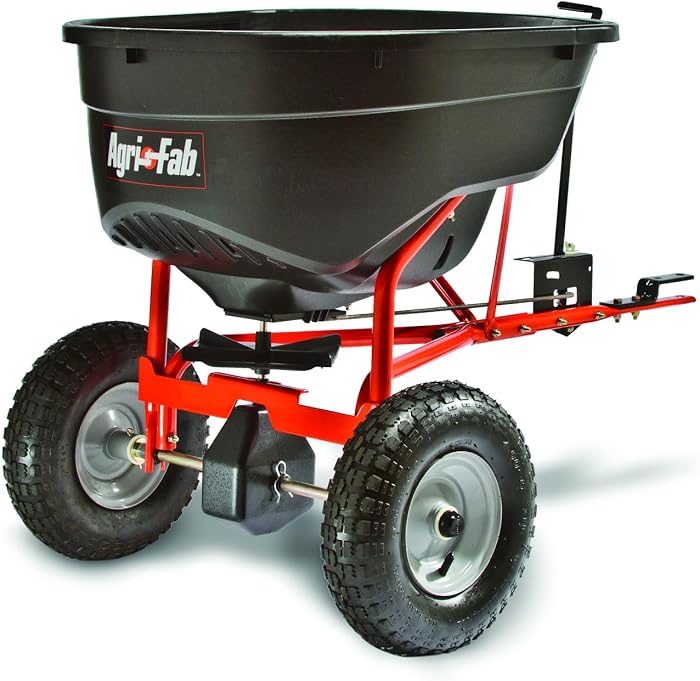
Agri-Fab 130 lb Tow-Behind Spreader Best for Large Properties

Agri-Fab Pull Behind Broadcast Spreader for Seed

Large properties

Field Score 83/100
Hitch
Universal, fits riding mowers and tractors
Wheels
13 in x 4 in pneumatic
Spread Width
10 to 12 ft
Hopper Capacity
130 lb
View on Amazon

One hundred and thirty pounds is the whole argument. A full hopper is rated to cover up to a half acre, roughly 25,000 square feet, so a pasture or a big lawn gets finished in a run of passes instead of a morning of refills. The 10- to 12-foot spread overlaps cleanly, and the 13-inch pneumatic tires roll over ruts that would bounce a smaller unit off line.

Behind a lawn tractor this is a genuinely good tool: stable, easy to steer into a pattern, and covered by a three-year warranty. Behind an ATV, the long tow bar puts the gate lever at the far end of your reach. You set the opening before you pull away and live with it, or you stop every time the material changes. That's the honest trade for the capacity, and it's why ATV-only owners belong with the rack-mounted picks.

Assembly is the other chore, and it's the part of this spreader we like least: a lot of bolts, several of them close in size, and instructions that misplace a step often enough that sorting the hardware into cups first is worth the ten minutes. The gear box is the one component to keep an ear on, and the warranty is what turns that from a dealbreaker into a manageable risk. Keep the receipt and the manual in the same drawer.

Worth Noting

  • Gate lever is out of reach from an ATV
  • Assembly runs long with vague instructions
Our Verdict

For a half acre or more behind a lawn tractor, the 130-pound hopper and three-year warranty make this the tow-behind we reach for.

Check Latest Price
3

Yard Commander 125 lb Tow-Behind Spreader Best Tow-Behind Value

Yard Commander 125 lb Tow-Behind Spreader – 125 LB Tow Behind Lawn & Garden Broadcast Spreader

Tow-behind value

Field Score 80/100
Gears
Cast aluminum gear drive
Hitch
Universal, fits tractors and ATVs
Spread Width
10 to 12 ft
Hopper Capacity
125 lb
View on Amazon

Two tow-behinds made this list, and this is the one that makes its case on hardware. A 125-pound hopper against the Agri-Fab's 130 is a rounding error in the field. The cast aluminum gear drive is not: gears are the part that fails on a tow-behind, and cast aluminum is the more reassuring answer than an enclosed housing. Spread runs 10 to 12 feet, and the drop-rate lever sits where you can reach it from a tractor seat.

The rest is familiar tow-behind work done well — a rust-proof composite hopper, a cover for wet weather, and a universal hitch that drops onto a lawn tractor, a riding mower, or a UTV drawbar. Nothing about it is fussy, and that's a recommendation in this category.

What we haven't seen yet is a gear drive that's been through five winters of salt, and that's the one question this design still has to answer. Everything else is a straightforward bet on a tow-behind that covers the same ground as the Agri-Fab for less money.

Worth Noting

  • Drive wheels have shipped swapped side to side
  • Takes up a three-foot footprint in the shed
Our Verdict

For a lawn tractor and a few acres, this is the tow-behind we recommend, with cast aluminum gears answering the usual weak point on these rigs.

Check Latest Price
4

Titan Attachments 80 lb Rack Spreader

Titan Attachments 12 Volt ATV/UTV Broadcast Spreader

Light-duty rack mount

Field Score 79/100
Mount
Quick-connect, front or rear rack
Weight
11 lb
Broadcast Width
12 ft
Hopper Capacity
80 lb
View on Amazon

Eleven pounds is the number that makes this one interesting. It's the lightest unit here, which matters when the spreader has to go up onto a front rack and come off again every time you switch tasks. The horizontal quick-connect mount and the included harness make that swap quick, the rain cover is in the box, and the broadcast is rated at 12 feet.

The missing piece is a deflector. Nothing sits behind the spinning disc to stop material from spraying back onto the quad, and fertilizer grit on a warm engine and a plastic fender is a cleanup you don't want twice. A rubber flap bolted behind the discharge is the usual fix, and it's worth doing before the first bag goes in.

Set up once, the flow lever covers light seed through pelleted fertilizer, and the poly hopper shrugs off the salt you'll put through it in January. It's a good small spreader. We just don't think it's the first one to buy.

Worth Noting

  • Push-on wiring connectors need crimping
  • Plastic gate handle is the light-duty part
Our Verdict

The lightest spreader here and the easiest to move between machines, though it asks more money than our top pick for the same hopper.

Check Latest Price
5

Guide Gear 80 lb ATV/UTV Spreader Best for Light Seed Work

Guide Gear 12-Volt ATV/UTV Broadcast Spreader

Light seed work

Field Score 77/100
Mount
Quick-connect, front or rear rack
Spread Width
About 12 ft
Hopper Capacity
80 lb
Hopper Material
Polyethylene
View on Amazon

Pelletized lime is where this one shows its temper. The gate works fine with seed, but heavier material can hang the slide so it won't close all the way, and you leave a thin trail where you meant to stop. If your year is grass seed and dry fertilizer, you'll never meet the problem. If you spread lime by the pallet, it's the thing that will drive you up a wall.

The mount is a quick-connect that clamps to round steel tube, front or rear, and the harness is a simple two-wire run to the battery. Once it's on, the 14.3-pound body lifts off with one hand and the rust-proof polyethylene hopper doesn't care about salt. The 12-foot broadcast figure is optimistic, though: plan on a shorter throw that lands a little heavier to one side, and overlap your passes more than the number suggests.

That's a slower pass over a lawn and a genuine nuisance along a long field edge, and it's where we give the top pick the edge. What this one has going for it is simplicity: poly that won't rust, a cover in the box, and a hopper that empties and rinses without fuss.

The 30-day return window is worth putting to work. Run a bag of whatever you actually plan to spread through it on your own rack before the month is out — that's the only test that matters.

Worth Noting

  • Won't clamp to a molded fiberglass rack
  • Fasteners need checking after the first few passes
Our Verdict

We like it for seed and dry fertilizer on a steel rack, where light weight and a rust-proof hopper outweigh a fussy gate.

Check Latest Price

How We Tested the Best ATV Broadcast Spreaders

We started with roughly thirty models pulled from manufacturer spec sheets and retailer listings, then filtered by mount type, hopper capacity, gate control, and price until the field narrowed to nine — a mix of 12-volt rack units and tow-behind spreaders with universal hitches. Because every one of them ships in a box, assembly came first: I timed how long it took one person to go from sealed carton to mounted and running, and noted whether the printed instructions matched what was actually in the hardware bag.

Out in the field, I filled each hopper to its rated capacity and ran it over a two-acre pasture, a gravel driveway in February, and a half-mile of washboard lane. I set the gate as low as it would go and walked the spread pattern with collection trays at 10, 20, and 30 feet to see where material actually landed, then repeated the pass at half throttle to check the pattern held instead of clumping or dribbling out one side.

Stability got its own trial: full hopper, choppy ground, and a hard turn at the end of every pass, watching for flex in the mounting brackets and for material creeping past a gate that was supposed to be shut. I hosed each spreader down after use and checked seams and motor housings for rust as the months went on, emptied half-used hoppers alone at the end of the day, and weighed the asking price against capacity, gear material, and whether a rain cover came in the box.

How to Choose an Atv Broadcast Spreader

Mount It Where You Can Reach It

Rack-mounted spreaders clamp to a front or rear utility rack and keep the hopper close. Receiver-mounted units hang off a 1.25- or 2-inch hitch and sit farther back. Tow-behinds run on their own wheels behind a lawn tractor or a quad. Each one changes how far your hand travels to the gate lever.

Before you buy, sit on the machine and measure from the seat to where that lever would land. Past arm's length, you'll be setting the opening before you pull away and living with it — the exact trade on the big Agri-Fab. Confirm the rack's rated load, too, because a full hopper and the spreader's own weight both sit on it.

Hopper Size and Refill Math

Capacity is about how often you stop, not how much you can spread. An 80-pound seed spreader handles a yard, a driveway, and a food plot on one fill. A 125- or 130-pound tow-behind is rated for up to 25,000 square feet, about a half acre, before you refill.

The bigger hopper also means more weight on the machine or the drawbar, and more material to deal with if the gate jams. Under a quarter acre, 80 pounds is plenty. At a half acre or more, the refills you save are worth dragging a tow-behind.

The Gate Is What You'll Actually Touch

Every spreader here lives or dies on a sliding gate and the lever that works it. A lever you can reach from the seat lets you shut off at the driveway, the fence line, or the end of a pass. One at the end of a tow bar makes you set it and go.

Work the lever through its full range before you fill anything, and check that it holds. A gate that creeps shut starves the pattern halfway across the lawn. Keep the cover on between passes as well, since damp material is what makes a gate stick.

Spread Width, Pattern, and Overlap

Claimed widths run from about 6 feet to 30 feet, and that number is a maximum at wide-open flow, not a guarantee of accuracy. Wind, damp material, and a disc that throws harder to one side all change the pattern.

Drive overlapping passes at half the claimed width and you get an even coat even from a spreader that throws short. To see yours before it matters, run a bag of sand or lime over the driveway and look at the stripe. That five-minute test tells you more than any figure on the package.

12-Volt Power, Wiring, and Winter Salt

These run off the machine's battery through an included harness, an inline fuse, and either a handlebar switch or a lever gauge. Leave slack where the bars turn, keep the fuse at the battery end, and crimp and heat-seal any joint you make yourself.

Winter is the harder season. Poly gets brittle in the cold, so empty the hopper before a hard freeze. Rinse the gate and the spinner after every salt run, because fertilizer and salt residue sets in the slide and the next job starts with a stuck gate.

Frequently Asked Questions

Final Verdict

The Yard Commander 80 is the spreader we point most people to. A handlebar switch and a flow lever within reach of the seat matter more, season after season, than another fifty pounds of hopper.

If your ground runs a half acre or more, the Agri-Fab 130 saves refills and carries a three-year warranty, while the Yard Commander 125 covers the same ground with cast aluminum gears for less money. One machine and a few acres call for the rack unit. Open ground calls for wheels.