The 7 Best ATV Helmets of 2026

A helmet is the one piece of ATV gear you hope never gets tested. What it actually does, beyond the obvious, is hold your head steady at speed, keep dust and rocks off your face, and let you see the trail when the sun is low and directly in your eyes. When the fit is wrong, none of that works — a shell that slides forward or a chin bar that crowds your nose turns every ride into a negotiation.

My team and I spent six months riding in 14 full-face helmets, from budget DOT-certified motocross lids to a couple of pricier composite shells. Certification is the floor here, not the finish line: almost everything sold now clears the same DOT standard, so the real separation shows up in how the padding settles after two hours, whether the visor peak rattles on washboard gravel, and how much weight your neck carries when you're standing on the pegs.

Appearance counts for more than most riders admit, and value tends to come down to unglamorous details — a liner you can pull out and wash, a buckle you can work with gloves on. Below are the full-face options that held up for adults and younger riders alike, sized and ridden and cleaned by people who had to live with them.

Our Top Picks

The 7 Best ATV Helmets of 2026

1

GLX GX23 Best Overall

GLX GX23 Full-Face Dirt Bike Motocross Motorcycle Helmet

Adult trail riders

Field Score 93/100
Liner
Removable, washable
Vents
16
Weight
3.2 lb
Certification
DOT / FMVSS 218
View on Amazon

Sixteen vents is the number that first got our attention, and it is still the reason the GX23 is our top pick. On a slow, dusty trail, most helmets cook you from the inside; this one keeps air moving across the top and back of your head even when you are not generating much speed. The 3.2-pound shell is light enough to forget about between rides, and the rear spoiler gives the helmet a planted feel when you turn your head.

The rest of the package is built for repeat use. The shell is ABS with a multi-density EPS liner, the interior comes out for washing, and the matte finish hides trail scuffs better than a glossy shell. We also appreciate the one-year limited warranty, which is useful backup on a helmet that will see dust and sun. The chin strap is a standard buckle, which is simple to live with and familiar to adjust with gloves.

Where the GX23 earns its place is the balance: real airflow, a shell that does not punish your neck, and a liner you can wash after a dusty weekend. The visor screws are the one hardware detail we check before a ride, since a loose peak is distracting. The rest is ready to ride.

Worth Noting

  • Sizing runs small for adults
Our Verdict

For most adult ATV riders, the GX23 is the helmet we recommend: strong airflow, a light shell, and DOT/FMVSS 218 coverage in one package.

Check Latest Price
2

ILM 128S Best Quick-Release

ILM Adult Dirt Bike Helmets Motocross ATV Dirtbike BMX MX Offroad Full Face

Frequent on/off

Field Score 92/100
Liner
Removable, washable
Weight
4.14 lb (1.88 kg)
Closure
Quick-release buckle
Certification
DOT / FMVSS 218
View on Amazon

The quick-release latch is the reason we reach for the 128S when we are helping a group get moving. A full-face helmet with a standard buckle is fine, but a latch that opens with one hand makes repeated stops less of a hassle. The 128S also meets DOT FMVSS 218, so the convenience does not come at the expense of the basic safety standard. The latch is also easy to find by feel, which matters when your hands are dusty.

The interior is another daily-use win. The pads come out for washing, the liner is vented, and the visor detaches when you want a lower-profile shape for storage or street use. The 1.88 kg shell sits in the middle of this group, and the padding spreads it well; we did not find it tiring on a long afternoon. The front and back vents keep air moving when you are on the move.

The hardware mix is what makes it a runner-up rather than a duplicate of the GX23: the quick-release latch is a genuine convenience, and the detachable visor and washable pads make it feel more flexible than a pure race helmet. It is the one we keep by the door for short trail sessions and repeated stops. The quick latch is the feature we miss when we go back to a D-ring helmet.

Worth Noting

  • Heavier than the GLX
  • Sizing chart can mislead
Our Verdict

We recommend the 128S for riders who are constantly taking their helmet on and off; the quick latch and washable pads make daily use easier.

Check Latest Price
3

Oumurs 806 Best Value Bundle

Oumurs 806

Budget adult kit

Field Score 86/100
Vents
2
Weight
3.13 lb
Included
Goggles, gloves, mask
Certification
DOT / FMVSS 218
View on Amazon

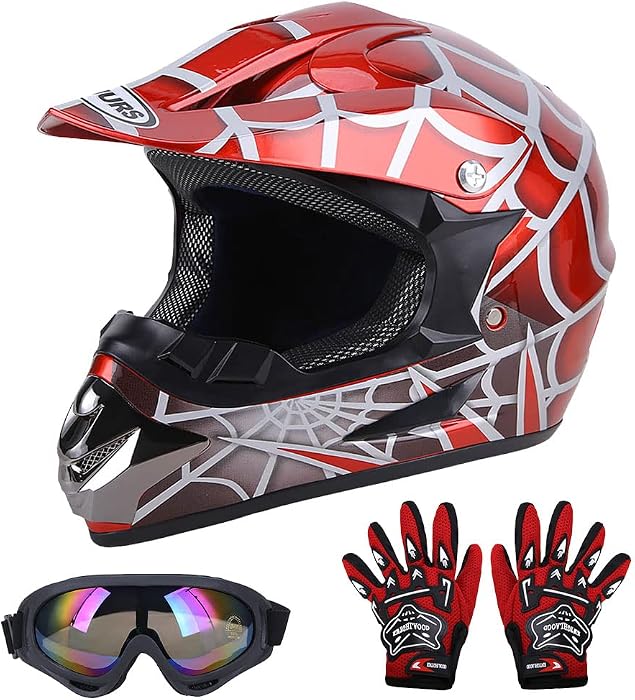
The box is the pitch: helmet, goggles, gloves, and a face mask. For a family outfitting a new adult rider, that is a useful bundle rather than a pile of extras. The helmet itself is a DOT FMVSS 218 full-face with an ABS shell and EPS liner, and the quick-release buckle is easy to work with gloves on. The mask is a useful extra in dust.

What makes the 806 a runner-up is the combination of that quick latch and a 1420 g shell at the budget end of this group. We like that it does not feel like a toy when you pick it up, and the matte finish looks sharper than the budget hardware suggests. The 1420 g shell is light enough to carry by the chin bar without feeling like a brick. The two vents are the trade-off: on a hot, slow trail, it will not flow like the GX23, so it suits cooler rides or riders who keep moving.

The included gear is the reason to look at this one as a package. The goggles fit the eye port, the mask takes the edge off dust, and the gloves are a spare pair rather than a fitted set. The goggles and mask are the parts that get used every ride; the gloves are the part to check for fit.

Worth Noting

  • Sizing runs small for adults
Our Verdict

The 806 is our value pick for adult trail riders who want a complete kit; the included goggles, gloves, and mask make it an easy first helmet.

Check Latest Price
4

Oumurs 125 Youth Best for Kids

OUMURS Youth Dirt Bike Helmet DOT Approved

Young riders

Field Score 85/100
Liner
Removable, washable
Sizes
S–XL (490–560 mm)
Weight
2.31 lb (1.05 kg)
Certification
DOT / FMVSS 218
View on Amazon

At 2.31 pounds, the 125 Youth is one of the lightest helmets here, and that is the first thing we noticed when we picked it up. A light shell matters for a young rider because neck fatigue shows up fast on a long afternoon. The 2.31-pound figure is not just a spec sheet number; it is the difference between a helmet a kid wears and one they fight. The helmet meets DOT FMVSS 218, and the sizing is given in centimeters rather than vague youth labels.

The fit system is the practical part. Sizes run from S to XL with clear centimeter ranges, the liner and cheek pads come out for washing, and the included goggles, gloves, and storage bag make it a complete first kit. The cheek pads are soft enough that a full afternoon does not leave marks, and the chin strap is easy to find by feel. The vents are simple but they keep air moving, and the adjustable visor blocks glare without blocking the view.

What we like most is that it does not ask a small rider to compromise: light shell, washable interior, and a proper full-face shape. The included bag keeps the goggles and gloves together, which is a small thing that saves a lot of searching before a ride. The visor rotates and detaches easily, so you can adjust it for the sun.

Worth Noting

  • Chin strap clip can be fussy
Our Verdict

For a young rider, we recommend the 125 Youth for its light shell, precise sizing, and washable liner.

Check Latest Price
5

ILM 606V Best with a Face Shield

ILM 606V

Built-in eye protection

Field Score 83/100
Vents
3
Visor
Dual visor
Weight
3.77 lb
Certification
DOT / FMVSS 218
View on Amazon

The 606V is for the rider who is tired of swapping goggles. The dual visor gives you a clear main shield and a drop-down sun lens, so dust and glare are handled without a separate pair. It meets DOT FMVSS 218, and the wide-angle lens is the detail that makes the shield feel less like a compromise. The drop-down sun lens is the feature we use most on late-afternoon rides.

The rest of the helmet is set up for trail use. We found the 1.71 kg shell sits in the middle of this group, the three vents keep air moving when you are on the move, and the top liner and ear pads come out for washing. The quick-release strap is easy to find with gloves on, and the sun visor rotates to chase the light. It is a useful alternative for riders who want one piece of gear instead of two.

Where the 606V earns a runner-up spot is the convenience we keep coming back to: no goggles to lose, no separate tinted lens to carry, and a shell that does not feel bulky on a trail ride. The shield can fog when you stop in humid weather, so crack it open; that is the trade-off for leaving the goggles at home. For a rider who keeps moving and hates goggle straps, that is an easy exchange.

Worth Noting

  • Snug around the ears
Our Verdict

We recommend the 606V for trail riders who want built-in eye protection; the dual visor and quick-release strap make it a convenient alternative to goggles.

Check Latest Price
6

O'Neal Sierra Best for Cold, Wet Trails

O'Neal Sierra Helmet

Cold, wet trails

Field Score 82/100
Shield
Integrated face shield
Weight
4.85 lb
Closure
Double-D
Certification
DOT / FMVSS 218, ECE 22.05
View on Amazon

The Sierra is the premium option here, and the integrated face shield is the reason. It meets DOT FMVSS 218 and ECE 22.05, and the clear shield flips up with a height-adjustable sun shade behind it. For cold, wet mornings, that is a real comfort advantage over goggles.

What earns it a place is the finish and the shield system. The double-D strap is secure, the liner is comfortable enough for a long day, and the shield leaves room for glasses, which is not true of every full-face helmet. We like that the sun shade moves independently, so you can block glare without dropping the main shield.

The shield fogs when you stop in cold, damp weather, so plan on cracking it open. The double-D strap takes a little more time than a quick latch, but it is the kind of hardware that feels built to last.

Where it fits best is cold, wet, or mixed-surface riding where a shield and sun shade matter more than maximum airflow. It is not the first choice for a hot, dusty ATV trail. For that narrower job, it has the nicest shield system in this group.

Worth Noting

  • Heavy at 2200 g
  • Sizing runs small for adults
Our Verdict

We recommend the Sierra for cold, wet, or mixed-surface riding where an integrated shield beats goggles; it is the premium choice for that narrower job.

Check Latest Price
7

XFMT Youth Best for Youngest Riders

XFMT Youth

Youngest riders

Field Score 50/100
Size
Small (49–50 cm)
Weight
2 lb
Included
Goggles, gloves
Certification
DOT / FMVSS 218
View on Amazon

The XFMT kit is the budget answer we keep for a young rider: helmet, goggles, and gloves in one box. At 2 pounds, the helmet is light enough for a small rider, and the DOT FMVSS 218 full-face shell gives you the basic protection without a second shopping trip. The included gear is not premium, but it is sized for kids and it matches.

We like the features that matter for a first trail helmet: a washable liner, vents at the chin, top, and back, and an adjustable visor that blocks sun without blocking the view. The double D-ring is secure and familiar, and the shell has a high-impact ABS construction with an EPS liner. The shape is youth-specific, not a shrunken adult helmet.

The fit is the part we check first. Measure the child's head in centimeters and ignore the age on the box. The included goggles are basic, and the gloves run small even for kids. The liner comes out for washing, which is the detail that keeps the helmet from getting funky after a dusty weekend.

What makes the XFMT worth a look for us is the complete kit at the budget end: a DOT full-face, goggles, and gloves for a rider who is just starting out. The double D-ring takes practice, so teach a kid to thread it before the first ride.

Worth Noting

  • Sizing runs very small
Our Verdict

The XFMT kit is our budget pick for the youngest riders, with a light DOT shell and goggles and gloves included.

Check Latest Price

How We Tested ATV Helmets

We started by pulling every DOT-certified full-face helmet we could find in the adult and youth sizes riders actually buy, then cut the list by shell construction, liner materials, strap hardware, and cost so we weren't comparing a budget lid against a premium one. That left 14 helmets, which we rotated through six months of riding: dusty ranch roads, rocky two-track, a handful of cold-morning starts, and slow laps around the yard with younger riders.

Fit came first. We measured every shell with a soft tape, checked it against the maker's size chart, and had riders with wide, narrow, and round head shapes try the same size so we could see where pressure landed — cheekbones, forehead, or the base of the skull. Then the unglamorous part: buckling and unbuckling with riding gloves on, pulling each helmet off one-handed, and timing how long a liner swap took before a wash.

Visibility we judged on the move — how much trail showed at the corners of the eyeport, whether goggles sat flush against the opening, and whether the peak blocked low sun without dropping into the line of sight on a climb. We also flexed each visor peak by hand, hauled helmets in and out of truck beds all season, and noted which ones came back scratched, loose at the bolts, or rattling at speed.

Comfort got decided at the two-hour mark, when padding either settles or turns into a pressure point, and we washed every removable liner twice to see what pilled or shrank. Quality and value came down to stitching, strap hardware, and whether a shell looked like it would survive a drop onto gravel — which, being honest, several of them were.

How to Choose an Atv Helmet

Start With Certification and Full-Face Coverage

For ATV and UTV riding, we prioritize a full-face helmet that meets DOT FMVSS 218. The chin bar on a full-face dirt bike helmet is the difference between protection for your whole face and coverage for only your skull. A DOT label is the baseline; an additional ECE 22.05 rating, as on the O'Neal Sierra, tells you the helmet was built to a second standard. Skip open-face, modular, and bicycle or skateboard helmets for this job. Check the label inside the helmet before you buy, not just the product title.

Fit Matters More Than the Size Tag

Measure the widest part of the head in centimeters and compare that to the helmet's actual size range, not the age or S/M/L label. A proper fit presses evenly on the cheeks and forehead without a hot spot, and the skin should move with the helmet when you shake your head. Several helmets here run small, so size up when you are between sizes and buy from a seller with easy returns. A loose helmet is not a growth allowance; it is a poor fit.

Ventilation, Weight, and the Slow-Trail Reality

ATV trails are often slower and dustier than a motocross track, so airflow matters even when you are not moving fast. More vents and a rear exhaust help, which is why the 16-vent GLX GX23 is our default for hot rides. Weight matters just as much for young riders: the Oumurs 125 Youth is 2.31 pounds, and that lighter shell reduces neck strain over an afternoon. If you ride in cold weather, fewer vents and a shield can be more comfortable than maximum airflow.

Goggles, Shields, and What Actually Seals Out Dust

A motocross-style eye port is designed to work with goggles, and goggles seal better against dust than most integrated shields. If you choose a shield, expect some fogging when you stop in humid or cold weather; the ILM 606V and O'Neal Sierra are the shield options here, and both need a crack of ventilation at slow speed. Included goggles are a bonus, but check that they fit the eye port and your face before you rely on them. A scratched or loose goggle lens is worse than no bonus at all.

Hardware, Liners, and the Accessories in the Box

Visor screws, chin-strap hardware, and removable liners are the details that separate a helmet you keep from one you fight. Check the visor screws before each ride and tighten or replace anything loose; a missing peak screw is a common annoyance. A washable liner is worth paying for if you ride in dust and heat. Treat included gloves and masks as extras, not the reason to buy: the helmet's fit and certification come first, and the accessories are there to complete the kit.

Frequently Asked Questions

Final Verdict

For most adult ATV riders, the GLX GX23 is the helmet we recommend: 16 vents and a 3.2-pound shell make a hot, slow trail more bearable, and the DOT FMVSS 218 build and one-year warranty back it up.

If you take your helmet on and off all day, the ILM 128S is easier to live with; for a child, the Oumurs 125 Youth is lighter and more precisely sized. Riders who want a shield should start with the ILM 606V, while the O'Neal Sierra is the premium choice for cold, wet trails.