The 8 Best Belt Sanders of 2026

A belt sander flattens a glued-up tabletop faster than anything else in the shop, and it gouges that same tabletop faster than anything else, too. I learned that on a pine shelf I'd spent an afternoon on; one tilted pass left a dip I couldn't sand out. What separates a keeper from a resale is control: speed you can dial back, a belt that stays centered, a body that doesn't fight your hands.

Over seven months, my team and I put 10 belt sanders through real work — 3-by-21 handhelds, a 4-by-24 beast, and a couple of benchtop belt-and-disc machines — on pine, oak, and reclaimed barn boards.

Two things surprised me. Variable speed matters more than the amp rating on the box: a sander you can slow down cleans up a veneered edge, while a fixed-speed one burns straight through it. Dust collection isn't really about a tidy shop, either — a belt that loads up cuts hot and leaves swirl marks. The picks below run from handheld to benchtop, corded to cordless.

Our Top Picks

The 8 Best Belt Sanders of 2026

1

Makita 9903 Best Overall

Makita 9903 3" x 21" Belt Sander

All-around handheld

Field Score 93/100
Speed
690–1,440 ft./min.
Weight
9.5 lb
Amperage
8.8 A
Belt Size
3 x 21 in.
View on Amazon

The 8.8-amp motor and variable-speed dial are what make the Makita 9903 the most capable all-around handheld here. We like having a dial that runs from 690 to 1,440 ft./min. instead of a single trigger speed: you can slow it for veneer or a fresh edge and open it up for paint and stock removal. The 3 x 21 belt is the common size, so replacements are easy to find.

The auto-tracking belt system is another detail we appreciate. We paid close attention to tracking because a belt that walks ruins the edge and wastes belts. On the 9903, the belt tracks without constant knob fiddling, which is the difference between a tool you reach for and one you avoid. The 85dB rating is also low for a belt sander, so longer sessions are less fatiguing.

At 9.5 pounds, the body feels substantial and stable on a door or a bench top. That weight is an asset when you are flattening a board, and the front grip gives you a place to push without fighting the tool. It is not the sander to hold overhead for long stretches; the SKIL and Jellas are easier there.

The main trade-off is cost. This is the most expensive handheld in this group, and the budget picks will sand a door just fine. The extra money buys a smoother speed range, a stronger build record, and a belt that stays centered; those are the things you notice every time you use it.

Worth Noting

  • Heavy for overhead or vertical work
Our Verdict

The Makita 9903 is our top pick for a serious home shop that wants one corded handheld to handle stock removal and finish work.

Check Latest Price
2

WEN 6502T Best Bench Sander

WEN Benchtop Belt and Disc Sander with 4 x 36 in. Belt

Bench combo value

Field Score 92/100
Base
Cast iron
Motor
4.3 A, 3,600 rpm
Belt Size
4 x 36 in.
Disc Size
6 in.
View on Amazon

The appeal of the WEN 6502T is that it puts two stationary sanders on one cast-iron base at a budget price. A 4 x 36 belt and a 6-inch disc cover different jobs: the belt for edges, rails, and flattening; the disc for end grain and curves. The belt tilts from 0 to 90 degrees, so it can stand vertical for edge work, and the tension release lever makes belt changes simple.

We think it is the best bench sander value in this group. The cast-iron base keeps vibration down, and the 4.3-amp motor is enough for small and medium projects. It is not a production machine; the motor will slow down if you lean on it for long. The combination is what makes it useful: you can shape a curve on the disc and clean up the edge on the belt without switching machines.

Set the table with a square before you trust the angle scale, and check it again after you tighten the knob. That is the kind of setup step a hobbyist can live with, especially at this price. The cast-iron base is the part that makes it feel more expensive than it is.

Worth Noting

  • Table can be fussy to lock square
Our Verdict

The WEN 6502T is our bench-sander value pick for hobbyists who want a 4 x 36 belt and 6-inch disc without a big investment.

Check Latest Price
3

DEWALT DCW220B Best Cordless

DEWALT 20V MAX* Belt Sander

Cordless job sites

Field Score 91/100
Power
20V MAX brushless
Speed
25-setting dial
Belt Size
3 x 18 in.
Dust Port
Airlock compatible
View on Amazon

The point of the DEWALT DCW220B is the cord you do not have to run. On exterior trim, a stair rail, or a repair where the outlet is far away, a cordless 3 x 18 belt sander is a different kind of tool. We think it earns its place for that work, provided you already own DEWALT 20V MAX batteries.

The brushless motor and 25-speed selection dial give you more control than the single-speed budget sanders here. We appreciate the tool-free quick-release belt change; it makes swapping a worn belt a quick job instead of a bench session. The dust port works with DEWALT's airlock system, and the included dust bag catches a useful amount.

Runtime is the catch. The sander pulls hard, and 5Ah packs drain faster than they do in a drill or saw; plan on several batteries for a full deck. The tool is also sold bare, so the real cost depends on what is already in your truck. The runtime rewards a multi-battery kit.

Worth Noting

  • Requires separate 20V batteries and charger
Our Verdict

The DEWALT DCW220B is our cordless pick for trim work and remote job sites, as long as you already run its 20V MAX batteries.

Check Latest Price
4

Makita 9404 Best for Large Surfaces

Makita 9404 4" x 24" Belt Sander

Large flat surfaces

Field Score 90/100
Speed
Variable
Weight
10.3 lb
Amperage
8.8 A
Belt Size
4 x 24 in.
View on Amazon

A 4-inch belt changes what a handheld sander can do. The Makita 9404 is the one here built for broad flat surfaces: deck boards, doors, and floor patches where a 3 x 21 takes longer. The 8.8-amp motor and variable speed give it the torque to keep a coarse belt moving without bogging down.

We like the auto-tracking belt system and the long 16.4-foot cord; both matter when you are moving along a deck and do not want to stop to recenter the belt or hunt for an extension. The 10.3-pound body is balanced and sits flat, which is what you want on a floor. This is a two-handed tool, not a one-handed touch-up sander.

The dust bag is included; for indoor work, connect a vacuum to keep the fines out of the air. The 9404 is a specialist's tool, so it makes sense when you regularly reach for a 4-inch belt rather than for occasional small jobs. If your work is mostly rails and repairs, a 3 x 21 is easier to handle.

Worth Noting

  • Heavy for overhead or one-handed work
  • Dust collection can leave dust escaping
Our Verdict

The Makita 9404 is our pick for large flat surfaces, where its 4-inch belt and 8.8-amp motor save real time.

Check Latest Price
5

SKIL 7510-01 Best Budget Handheld

SKIL 6 Amp 3"x18" Belt Sander with Pressure Control

Budget beginners

Field Score 89/100
Weight
5.5 lb
Amperage
6 A
Belt Size
3 x 18 in.
Dust Port
Fits 1-1/4 in. hose
View on Amazon

The pressure-control indicator on the SKIL 7510-01 is a small feature with a real payoff for new users. Push too hard and the sander tells you before you gouge the wood. That is the kind of feedback a first belt sander should have, and it is why this is our budget pick for beginners.

At 5.5 pounds, it is light enough to use one-handed on vertical work, and the 6-amp motor has enough power for pine, oak, and paint removal if you let the belt do the work. The auto-track belt alignment keeps the belt centered, and the micro-filtration dust system is better than a bare port. It also fits standard 1-1/4-inch vacuum hoses, which is a practical detail we look for.

The limits show up under sustained use. The sander is not built for hours of continuous stock removal; it is happiest on doors, boards, and small projects. For that work, the light weight and pressure feedback are a fair trade. For a production shop, step up to the Makita 9903.

Worth Noting

  • Dust bag catches only part of the dust
Our Verdict

The SKIL 7510-01 is our budget pick for beginners, with pressure feedback that helps you avoid gouging and a light body that is easy to steer.

Check Latest Price
6

BUCKTOOL BD4801 Best Heavy-Duty Benchtop

BUCKTOOL Bench Belt Disc Sander for Woodworking

Heavy benchtop work

Field Score 88/100
Motor
3/4 HP, 3,450 rpm
Belt Size
4 x 36 in.
Disc Size
8 in.
Dust Ports
Dual
View on Amazon

The Bucktool BD4801 separates itself from the other bench combos here with a direct-drive 3/4-hp motor and an 8-inch disc. There is no cog belt to tension or replace, and the bigger disc gives you more surface for squaring end grain and shaping curves. The 4 x 36 belt can run horizontally or vertically, so it handles edges and faces without a second machine.

We were impressed by how solid it feels for the money. The steel cover on the disc and the two separate dust ports are details that make it feel like a small-shop tool rather than a toy. Assembly is straightforward, and the miter gauge is useful for repeat angles.

The trade-offs are in the setup. Check the tables with a square before you trust the angle marks, and expect to spend a few minutes getting the belt centered. The machine is also heavy enough that it wants a permanent spot on a bench. For a workshop that needs one stationary sander for both disc and belt work, that is a reasonable exchange.

Worth Noting

  • Belt changes take several steps
  • Tables can drift out of square
Our Verdict

The Bucktool BD4801 is our heavy-duty benchtop pick for a small shop that wants direct-drive power and a larger 8-inch disc.

Check Latest Price
7

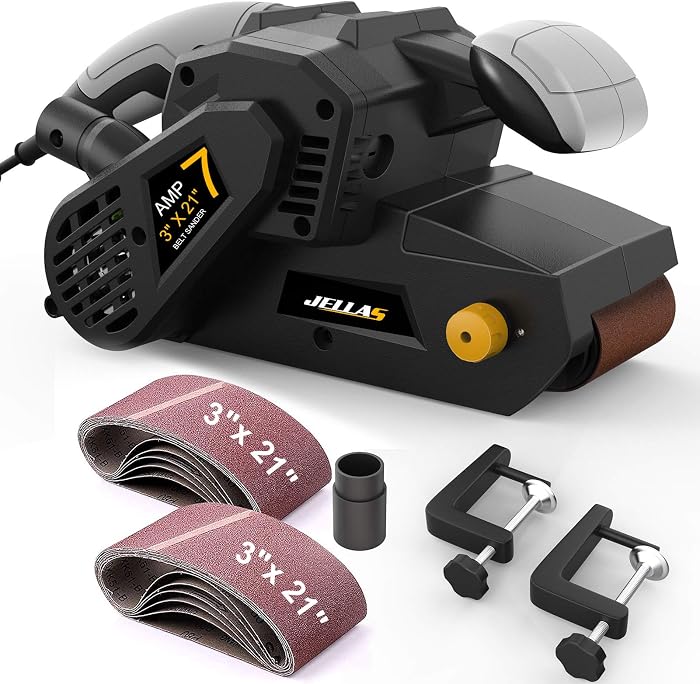
Jellas BS02-SD Best Value Kit

Jellas 7Amp Handheld Belt Sander

Budget 2-in-1

Field Score 87/100
Speed
6-position dial
Weight
9.7 lb
Amperage
7 A
Belt Size
3 x 21 in.
View on Amazon

The Jellas BS02-SD arrives with ten sanding belts and two metal C-clamps. That is a useful kit for a first belt sander: you get 40-, 60-, 80-, 120-, and 180-grit belts, and the clamps let you turn the handheld into a makeshift bench sander when you need both hands for a small workpiece.

The 7-amp motor and six-position speed dial give it more adjustment than the SKIL, and the 10-foot cord is long enough to reach across a small shop without an extension. We like the lock-on button for bench use; it keeps the sander running while you guide the work. The two vacuum adapters are also a thoughtful touch, because port sizes are the kind of thing that sends you back to the hardware store.

For indoor work, a vacuum is the better choice than the bag. This is a budget tool, so it is not the one for continuous production work. For occasional projects and a ready supply of belts, it is a strong value.

We also appreciate that the clamps turn a handheld into a stable edge sander without a dedicated stand. The belt assortment means you can start working without ordering consumables, which is more than most budget sanders offer.

Worth Noting

  • Dust bag can leak at the connection
Our Verdict

The Jellas BS02-SD is our value kit pick for occasional handheld and bench work, with ten belts and clamps included.

Check Latest Price
8

CRAFTSMAN CMEW213 Best for Flush Sanding

CRAFTSMAN Electric 7 Amp Belt Sander

Flush sanding

Field Score 86/100
Speed
800 ft./min.
Weight
6.6 lb
Amperage
7 A
Belt Size
3 x 21 in.
View on Amazon

The angled belt nose on the CRAFTSMAN CMEW213 is the reason to look at this one. It lets you sand close to an adjoining surface, so you can clean up a cabinet side or a stair stringer without the housing stopping you short. The three-position over-molded handle is also more comfortable than the bare grips on the budget sanders.

The 7-amp motor and 800-fpm belt speed are set up for fast material removal. You control the finish with grit and pressure rather than a dial, so this is a sander for shaping and cleanup more than for veneer. The three-position handle keeps your hand comfortable through a long trim run.

The on-board dust bag is convenient for quick jobs, but a vacuum is better in a closed shop. The tool-free belt release is a genuine time-saver when you switch grits, and the angled nose earns its keep on cabinet sides and stair stringers.

What you get is a practical trim tool with a comfortable handle and a quick belt release. The CRAFTSMAN is a useful alternative to the SKIL and Jellas when getting close to an edge matters more than a variable-speed dial.

Worth Noting

  • Single speed limits finish work
Our Verdict

The CRAFTSMAN CMEW213 is a practical trim sander whose angled nose gets closer to adjoining surfaces than the other handhelds here.

Check Latest Price

How We Tested the Best Belt Sanders

We built the shortlist from spec sheets, current listings, and a long read through owner reviews, then filtered out anything we couldn't buy replacement abrasives for locally and anything that duplicated a size we already had covered. That left 10 machines — handhelds from 3-by-18 up to 4-by-24, a couple of benchtop belt-and-disc units, and one cordless in the mix. Every one of them lived in my garage shop for the full seven months.

The bench work was identical for each machine. We marked a pencil line on pine and white oak and timed how long the sander took to erase it, then looked at the surface under a raking light for dips, gouges, and swirl marks. Belt changes were done on the clock, and we watched whether a fresh belt walked off the platen or tracked true before making the tracking adjustment with the tool running, the way a first-time owner would.

For dust, we sanded continuously for ten minutes and then checked what landed on the bench, the floor, and the front of my shirt versus what the bag or port actually caught. Noise got a meter held at ear height during a full pass. The cordless model got a stopwatch: minutes of sanding per battery, and whether it bogged down on oak as the charge fell off.

Functionality and ease of use came down to smaller things — whether a side handle or D-handle put my hand where it needed to be, how a variable-speed dial or pressure control responded mid-cut, and how each machine held up over seven months of weekend use: switches, cords, platens, base castings. We weighed all of it against what each sander costs.

How to Choose a Belt Sander

Handheld or Benchtop?

A handheld belt sander travels to the work: deck boards, door edges, stair rails, and repairs. A stationary sander stays put and gives you a flat table, a disc, and often a miter gauge for small parts. The mistake is buying a bench machine for a deck or a handheld for repeated edge work. If you mostly sand things you can carry, a bench combo is more useful; if the work is fixed in place, buy handheld.

A clamp-on conversion like the Jellas kit is handy for occasional small parts, but it is not a cast-iron bench sander. The WEN 6502T is the better example of a true bench machine: it gives you a 4 x 36 belt and a 6-inch disc on one base.

Belt Size, Motor, and Speed

Belt size sets the scale of the job. A 3 x 18 or 3 x 21 is the handheld standard and reaches into rails and cabinets; a 4 x 24 covers a deck or door faster but is heavier. Bench sanders use 4 x 36 belts and add a disc for curves and end grain. Match the belt to the surface, not to the biggest number on the box.

Amperage is a rough guide to torque, but variable speed is the feature that changes how the tool feels. The Makita 9903 lets you slow the belt for a finish pass; the SKIL's 6 amps are enough for homeowner work when you let the belt cut. More pressure is not the answer; it slows the motor and loads the belt.

Tracking, Tension, and Belt Changes

A belt that walks off the platen ruins the edge and wastes belts. Auto-tracking systems, like the ones on the Makita 9903 and 9404, keep the belt centered without constant adjustment. Manual tracking works, but check it before each session and after a belt change. Tension matters too: too loose and the belt slips, too tight and it wears the bearings.

Tool-free releases make grit changes quicker. On bench combo sanders, the table is the other adjustment to check; a stamped angle scale is a starting point, not a guarantee. Set the table with a square and confirm it after tightening. The Bucktool's tables and the WEN's 90-degree stop both reward that extra check.

Dust Collection, Weight, and Control

Every belt sander makes dust, and a bag catches only part of it. A vacuum connection is the difference between a clean cut and a cloud, so check the port size before you buy. The SKIL fits a standard 1-1/4-inch hose; the DEWALT uses its own airlock system. In a closed shop, wear a mask even with a bag.

Weight is a trade-off. A 5.5-pound sander is easier to hold overhead; a 9.5- or 10.3-pound tool sits flatter on a deck and resists tipping. If most of your work is vertical or overhead, favor the lighter tool. If you are flattening large panels, the heavier body is easier to control, not harder.

Frequently Asked Questions

Final Verdict

For most shoppers, the Makita 9903 is the belt sander to buy. It has the power and speed control to remove stock and then slow down for a finish pass, and the auto-tracking belt keeps the tool predictable. The premium is real, but it buys the fewest compromises in this group.

If you want a stationary machine, the WEN 6502T is the better use of bench space; if you work away from outlets, the DEWALT DCW220B is the cordless answer. The right choice follows the work, not the longest feature list.