The Best Bluetooth Hearing Protection of 2026

Loud chores and loud hobbies have the same problem: you want to protect your ears, but you don't want to disappear into silence. Bluetooth hearing protectors put noise reduction and wireless audio in the same pair of earmuffs, so you can listen to a podcast while you mow or take a call without lifting a cup off your ear. The price spread is wide, and not every pair gets the balance right. Some cut the racket but sound thin; others pair easily and then clamp your head like a vise.

I've spent eight months with 12 pairs, wearing them through mowing, table-saw work, and driveway snowblowing. The differences that mattered were practical: voices staying clear under engine noise, buttons working with gloves on, and a battery that lasted a full weekend rather than dying mid-project. Comfort and fit decided more than I expected—if the cups pinch your temples or trap heat, you'll invent reasons to leave them on the shelf. The picks below are the ones that made protection feel easy.

Our Top Picks

The Best Bluetooth Hearing Protection of 2026

1

Kalence EP015 Best Overall

Kalence EP015 – Bluetooth 6.0 Hearing Protection with 120H Working Time

Lawn and shop

Field Score 91/100
Weight
11.3 oz
Bluetooth
6.0
Battery Life
120 hours
Noise Reduction
26 dB NRR
View on Amazon

A 120-hour battery rating is the kind of number we usually discount, but on the Kalence EP015 it matches the rhythm of yard work: a couple of hours on the mower, a few days on the shelf, then another session without hunting for a cable. The 1200mAh cell charges in about two hours, and the 26 dB NRR is enough for mowers, trimmers, and most shop tools. The 30 dB SNR is the maker's single-number rating, not a second layer of protection, so the seal still does the real work.

What we like most is the control layout. The buttons are deliberately large, so you can pause a podcast or take a call without pulling off a glove, and the Bluetooth connection has been stable enough for music and speech. We think this is the best default here for lawn and shop work because it balances protection, battery, and glove-friendly controls without a premium price. It is not a hunting muff: there is no speech amplification or gunshot-specific suppression, so do not expect range commands to come through like they do on the Peltor or Walker's.

The padding is soft and the headband adjusts widely, but the shape favors average-to-large heads. For a full day of mowing, we prefer it to the firmer PROHEAR 037. It is a leave-by-the-mower pair, not a pack-for-a-hunt pair.

Worth Noting

  • Bulkier than in-ear protection
Our Verdict

The EP015 is our default for lawn and shop work: long battery, strong noise reduction, and glove-friendly controls.

Check Latest Price
2

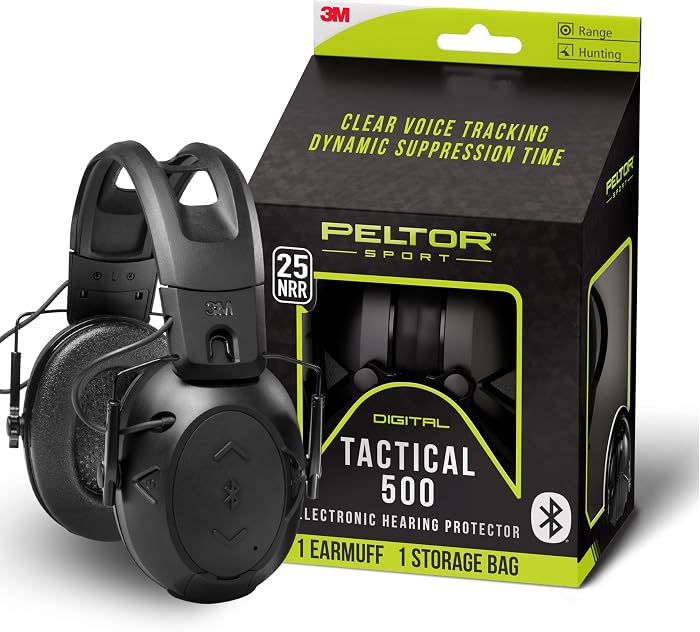
Peltor Tactical 500 Best for Shooting

Peltor Sport Tactical 500 Bluetooth Hearing Protection Ear Muffs

Shooting and hunting

Field Score 90/100
Weight
13 oz
Battery
3 AAA batteries
Bluetooth
Yes
Noise Reduction
25 dB NRR
View on Amazon

The Tactical 500 is the pair we point at first when the noise is gunfire rather than a lawn mower. Its dynamic suppression measures the energy in a shot and adapts the compression time, while the recessed microphones and Clear Voice Tracking are tuned to keep voices intelligible through the wind and background roar. That combination is why it earns the shooting slot here, even though it sits at the premium end of this group.

The Bluetooth side is competent rather than audiophile. Music and calls come through clearly enough, and the connection has been stable, but the sound is tuned for speech and safety, not for rich bass. We do not choose this pair for critical listening; we choose it because the hearing-protection processing is the best in this set for a range session.

The fit is the first thing to check. The headband adjusts, but the cups sit close, and larger heads or thick glasses can feel the clamp after an hour. Check the seal around the arms of your glasses before you commit; a broken seal costs more protection than any Bluetooth feature adds.

The three AAA batteries are a quiet advantage on a cold morning: no charging cable, no built-in cell to age out, and a fresh set before a hunt. That is the kind of detail that matters when the truck is loaded and the range is an hour away.

Worth Noting

  • Durability at the hinge and wire
Our Verdict

For gunfire and range commands, the Tactical 500 earns our shooting pick with dynamic suppression and clearer speech.

Check Latest Price
3

PROHEAR 037 Best Budget

PROHEAR 037 Bluetooth 6.0 Hearing Protection Headphones with Rechargeable

Budget mowing

Field Score 89/100
Weight
11.5 oz
Charging
Rechargeable
Battery Life
120 hours
Noise Reduction
30 dB NRR
View on Amazon

The PROHEAR 037 is the pair we hand to someone who wants Bluetooth protection without paying premium money. It carries a 30 dB NRR, a rechargeable battery rated for 120 hours, and a set of controls that are easy to find with a glove on. On paper, that is a lot of hearing protection for a budget pair, and the Bluetooth connection has been quick to pair in the settings this pair is built for.

The controls are the pleasant part. The buttons are separated enough to work by feel, and the headband adjustment is easy to set with the muffs on. The 30 dB NRR is the number that matters for mowing and shop tools, and the pads are soft enough for a normal afternoon. The clamp is firm, though, and larger heads and thick glasses can feel it after a couple of hours.

The included 3.5mm cable is a useful backup when the charge runs down. That cable is more than many Bluetooth muffs give you, and it means a dead charge does not end the session. The long playtime is the reason this pair stays on the budget shortlist.

Worth Noting

  • Charging port can fail
  • Audio can sound thin at high volume
Our Verdict

We put the PROHEAR 037 at the top of the budget list for its 30 dB NRR and 120-hour battery, provided the firm clamp fits.

Check Latest Price
4

Walker's XCEL Best for Hunting

Walker’s XCEL Digital Electronic Hearing Protection Earmuffs with Bluetooth

Hunting and range

Field Score 88/100
Weight
16 oz
Bluetooth
Yes
Microphones
Omni-directional
Noise Reduction
26 dB NRR
View on Amazon

Walker's builds the XCEL around hearing what is around you. The omni-directional microphones and voice clarity are there to pull in conversation and game movement, while sound-activated compression and dynamic suppression clip gunfire to a safer level. For a hunter who wants to hear the woods without giving up Bluetooth, that is the right brief.

The audio is serviceable for podcasts and calls, not for critical listening. The microphones do their job, but the sound is tuned for speech, and music can feel thin. Calls come through better than music, which is the right priority for a hunting pair. The Bluetooth pairs and plays, and the controls are easy to reach.

We still rate the XCEL highly for hunting because the amplification and suppression are the point, and the pads are comfortable enough for a long sit. The fit runs tight for larger heads, so try the adjustment before a cold morning in a blind. For still hunting, hearing a twig snap is worth more than a few extra decibels of passive foam.

Worth Noting

  • Bluetooth range is short
  • Electronic hiss can be audible
Our Verdict

Hunters who need to hear the woods get our nod with the XCEL, which amplifies voices and clips gunshots.

Check Latest Price
5

PROHEAR 033 Best with Radio

PROHEAR 033 Upgraded Bluetooth 5.4 Hearing Protection Headphones with FM/AM

Jobsite radio

Field Score 87/100
Radio
AM/FM
Weight
13.1 oz
Battery Life
48 hours
Noise Reduction
25 dB NRR
View on Amazon

A long mowing session is exactly where the PROHEAR 033 makes sense. Instead of using your phone for everything, it has an AM/FM radio built in, so you can leave the phone in the house and still have something to listen to. The 25 dB NRR is enough for a mower and most shop tools, and the Bluetooth connection handles calls and streaming when you want them.

We like the radio more than we expected. It is not a high-end tuner, and reception depends on where you are, but it is a useful backup when you do not want to burn phone battery. The controls are reachable, and the sound is good for speech and radio; music can sound compressed. For a job where you are on a mower for hours, that trade-off is easy to take.

The headband runs short for larger heads, and the cups can ride up on the ears; try the adjustment before you commit. The pads are comfortable for long wear, and the 48-hour battery is a long leash. The radio antenna is the quiet bonus: no phone, no data, no charging another device.

Worth Noting

  • Battery can stop accepting a charge
Our Verdict

The 033's built-in radio is why we like it for long mowing sessions; the protection is solid and the phone stays in the house.

Check Latest Price
6

3M WorkTunes Connect Best Simple Pair

3M WorkTunes Connect Wireless Hearing Protector with Bluetooth

Simple shop use

Field Score 86/100
Weight
14.7 oz
Bluetooth
Yes
Dimensions
4.1 x 7.25 x 7.8 inches
Noise Reduction
26 dB NRR
View on Amazon

The WorkTunes Connect feels deliberately plain next to the feature-heavy muffs here. There is no radio, no sound-mode switch, and no app; it is a 26 dB NRR Bluetooth pair of earmuffs with a simple control layout. For some shoppers, that is the whole appeal.

The battery life is the standout. The charge holds through several mowing sessions and weeks of intermittent use, and the Bluetooth pairs without drama. The 26 dB NRR is solid for a mower, trimmer, or router. The controls are simple enough to learn without the manual, and that matters when you are switching tasks all afternoon.

The volume ceiling is the catch. Even at full output, quiet podcasts can get lost under a riding mower or a leaf blower, and there is no getting around that if your job is loud. We still like the WorkTunes for a simple, comfortable pair that does not ask you to manage a radio or a dozen modes. The lack of extra features is the reason the controls are easy to learn.

Worth Noting

  • Fit runs tight for some head sizes
Our Verdict

For a plain, comfortable Bluetooth muff, we suggest the WorkTunes Connect, as long as your job is not too loud for its volume ceiling.

Check Latest Price
7

GLORYFIRE Bluetooth Earplugs Best for Range and Hunting

GLORYFIRE Bluetooth Shooting Ear Protection & Clear Sound

Range and hunting

Field Score 85/100
Modes
3 sound modes
Weight
0.3 oz
Response Time
0.5 ms
Noise Reduction
26 dB NRR
View on Amazon

Muffs are the easy choice until a rifle stock, a hat brim, or a helmet gets in the way. The GLORYFIRE earplugs take the in-ear route, with a 26 dB NRR, three sound modes, and a 0.5 ms suppression response for gunfire. That is a useful shape for range sessions and hunting where full-size cups are bulky.

The sound modes are the reason to consider them. Outdoor mode keeps more ambient awareness, indoor mode balances things, and silent mode gives you straight Bluetooth audio. The 85 dB volume limit is a sensible guardrail for a device that sits inside your ear, and the Bluetooth 5.0 connection handles music and calls.

The fit is where in-ear protection lives or dies. The plugs are light at 0.3 ounces, but they can feel tight, and the seal varies with ear shape. If the tips do not seal, you lose both protection and bass, so try the different tips before a range day. A good seal is worth more than any mode switch.

We think the GLORYFIRE is worth a look for a hunter or range shooter who wants Bluetooth without earmuff bulk, as long as you test the seal early. For all-day mowing, the work muffs are more comfortable and easier to take on and off. The in-ear shape is a specialist tool, not an all-day yard-work muff.

Worth Noting

  • Static or buzz can appear
Our Verdict

We see the GLORYFIRE as a useful in-ear range option for hat or helmet days, provided you test the seal and electronics early.

Check Latest Price
8

ZOHAN EM037

ZOHAN EM037 6.0 Bluetooth Hearing Protection 25dB NRR Noise Reduction

Backup mowing pair

Field Score 84/100
Weight
1.1 lb
Bluetooth
6.0
Battery Life
120 hours
Noise Reduction
25 dB NRR
View on Amazon

The ZOHAN EM037 is the closest thing here to a spare pair you can leave in the shed. It has a 25 dB NRR, a 120-hour battery rating, and Bluetooth 6.0, and it costs about the same as the budget PROHEAR. The difference is in the fit and the finish.

The headband runs snug, and the cups sit close, so larger heads and thick glasses can feel the clamp after an hour. The pads are soft enough for a mowing session, but this is not the pair for a long day in a blind. The controls are simple and the Bluetooth pairs quickly, which is what you want in a second pair.

The 120-hour rating is best-case. At high volume over a mower, the sound can get overwhelmed, and the bass disappears. The 25 dB NRR is a step below the 26 dB Kalence and the 30 dB PROHEAR 037, so the seal matters more. For light yard work, it is enough; for a shop with a router and a dust collector running, it is not the first choice.

We see the ZOHAN as a backup or a second pair for the truck, not the first pair for a shooter. If you need one pair for the range, the Peltor or Walker's is the better call; if you want a cheap pair for the mower, this one earns a look. The charging port is the one part to treat gently; keep the cable aligned and the muffs dry.

Worth Noting

  • Heavy at 1.1 pounds
Our Verdict

The ZOHAN works as our budget backup for light yard work, though the snug fit and 1.1-pound build are real trade-offs.

Check Latest Price

How We Tested Bluetooth Hearing Protection

We started by researching the Bluetooth hearing protection on the market and narrowing the field to models with published noise reduction ratings, wireless audio, and controls that could be used without taking the earmuffs off. We skipped novelty pairs that treated hearing protection as an afterthought, then bought 12 pairs at retail and wore them for eight months. Testing happened where these products actually live: mowing a lawn, running a table saw and router in a shop, clearing a snowy driveway, and working through a few hours of yard cleanup.

For noise reduction, I stood beside a running mower and a table saw and noted whether the motor dropped to a dull hum or still cut through. For Bluetooth, we paired each pair to two phones and a tablet, walked to the far end of the yard to check for dropouts, and took calls with the phone in a pocket. We played the same podcast and a few bass-heavy tracks, noting whether voices stayed clear under load and whether we had to max the volume. Battery life was logged from a full charge or fresh batteries through real work sessions.

Comfort and fit got the longest trials: two-hour stretches with safety glasses and a hat, checking clamp force, heat around the ears, and whether the headband left a hot spot. We worked the buttons with work gloves on and noted whether we could answer a call without removing the earmuffs. Durability was judged by daily handling—dropping each pair from waist height onto a concrete floor, wiping off sweat, and checking hinges, pads, and headband seams. We also compared what each pair included against what it cost, because value here is not just the sticker; it's whether the battery, controls, and build hold up after the novelty wears off.

How to Choose Bluetooth Hearing Protection

Match the Form to the Job

Over-ear earmuffs are the easiest to take on and off, and they tend to be more forgiving of ear shape, which is why they dominate mowing and shop work. In-ear plugs sit under a hat, helmet, or rifle stock and can be more comfortable in heat, but the seal is everything: if the tip does not sit deep enough, you lose both protection and bass. We reach for muffs for a mower and plugs for a day in a layout blind or under a helmet.

Read the Rating, Then Add the Features

A 25 to 30 dB NRR or SNR is the useful range for mowers, trimmers, and most shop tools, but the number is a lab figure and a poor seal will cost you real attenuation. NRR and SNR are not interchangeable, so compare like with like. For shooting, the rating is only half the job; you also want dynamic suppression for gunfire and amplification for voices. A high NRR with no speech circuit will protect your ears but leave you unable to hear range commands.

Put the Controls Where Gloves Can Find Them

Bluetooth is easy to list and harder to live with. Look for physical buttons large enough to work with gloves, a power switch you can find without looking, and a mic that lets you take a call without shouting. Battery life matters, but so does the charging port: a long playtime claim is little help if the port fails after a season. If your phone stays in a truck or pack, check the claimed Bluetooth range too; some shooting muffs drop out at short distances.

Fit and Sound Are Linked

Clamping force is the quiet dealbreaker. A firm headband can seal well for a 30-minute mow and become unbearable after two hours, especially over glasses. Adjust the band, try the muffs with the glasses you actually wear, and check that the pads sit flat around the arms. Audio quality matters less than intelligibility: you want speech and podcasts clear enough at a volume that still lets you hear a warning.

Frequently Asked Questions

Final Verdict

We recommend the Kalence EP015 for most buyers because it gets the daily work right: 26 dB NRR, a 120-hour battery, and controls that work with gloves, without a premium price. If your noise is gunfire and range commands, the Peltor Tactical 500 is the better tool; its dynamic suppression and voice clarity are worth the step up. Budget shoppers who want a work muff can save with the PROHEAR 037, provided the firm clamp fits.