The 8 Best Bow Rakes of 2026

A bow rake has one job nothing else does well: pull clods, compost, and gravel toward you without folding in half. But stiffness and weight travel together. The stiffest heads will break up a compacted bed and then wreck your shoulders by the third wheelbarrow; go too light and the tines spring off every root and rock. We spent six months with 12 bow rakes, from spring bed prep through fall leaf cleanup, and the ones worth keeping got the same few things right.

Tine count, it turns out, is mostly marketing: 14 stout tines will outwork 25 thin ones in soil, and an extra-wide head just snags more when you're gathering leaves. What actually changed how a rake felt in my hands was an adjustable handle — several of these telescope, so one tool works standing in a raised bed and bent over a gravel drive — plus handle material, since fiberglass shrugs off weather while steel is stronger and heavier at the end of a long reach. Assembly counts too, because a rake that goes together without tools is one you'll break down and store instead of leaving to rust against the fence.

The picks below are the ones that earned a spot in the garage.

Our Top Picks

The 8 Best Bow Rakes of 2026

1

Bully Tools 92309 Bow Rake Best Overall

Bully Tools Bow Rake 16" Tines

Heavy soil, gravel

Field Score 91/100
Handle
58-inch fiberglass
Weight
3.5 lb
Head Width
16 inches
Head Material
10-gauge steel
View on Amazon

The first thing we check on any rake is the joint where the head meets the handle, because that is where these tools give out. The Bully 92309 doesn't have one: the 16-inch head is welded steel, pinned and riveted straight into a one-piece fiberglass shaft. Nothing unscrews, nothing needs a half-turn halfway down a row.

That construction is why it is our top pick. The head is true 10-gauge American steel with ribbed teeth and reinforced ridges, and at 3.5 pounds the tool does a good part of the pulling for you. We noticed it most dragging gravel and breaking crusted soil, where a light rake skates along the surface instead of digging in. The fiberglass is coated against splintering and the rubber grip stays put with gloves on.

The handle runs 58 inches on this version, comfortable for most people but shorter than the 63- and 68-inch rakes here; Bully also offers a 66-inch handle if you are tall or want to stand more upright. The socket where the fiberglass takes the head is the one place to watch, since that is where years of hard pulling show up first. A hitch that develops there is worth fixing before a stubborn root makes it worse.

What you give up is adjustability. There is no collapsing this one into a truck box, no shortening it for a kid, and no second set of tines to flip over for leveling. If it has to break down small or be shared with a much shorter user, the joyhalo below is the better answer.

Worth Noting

  • Fixed 58-inch handle, no adjustable sections
Our Verdict

We recommend the Bully 92309 to anyone with real dirt, gravel, or mulch to move: welded 10-gauge steel on a one-piece fiberglass handle, with no joints to retighten.

Check Latest Price
2

BlumeTrec BOR-001 Bow Rake Best Dual-Sided

BlumeTrec BOR-001 Bow Rake – Bow Rake

Loosening and leveling

Field Score 90/100
Tines
17
Handle
68-inch stainless steel
Head Width
17 inches
Head Material
Manganese steel
View on Amazon

Flip the BlumeTrec's head over and you get a second rake: one side carries long tines for breaking soil, pulling thatch, and gathering leaves, while the other has a short set for spreading and leveling. That is the difference between this and the single-headed picks here, and for a spring bed-prep session it is the one we reach for first.

The head is 17 inches wide with 17 tines that run about 4 inches deep, forged from heat-treated manganese steel chosen for hardness and wear resistance. The stainless handle measures 68 inches overall, long enough to work standing up rather than hunched, and the whole thing breaks down for storage with the hardware in the box.

The handle is the part to watch. It screws together in sections, and screw-together poles are the first thing to loosen on a rake like this. Snug them before a long session and again after you have been pulling hard on roots, and the head holds up to the kind of work that folds lighter rakes.

Worth Noting

  • Threaded sections work loose with use
Our Verdict

Buy the BlumeTrec if you want one tool for loosening and leveling: a dual-sided manganese steel head on a 68-inch handle, as long as you keep the threaded sections snug.

Check Latest Price
3

YIAD DRAGON HORSE 26019 Bow Rake Best for Wide Coverage

YIAD DRAGON HORSE 26019 Bow Rake – Metal Bow Leaf Rake with 25 Steel Teeth & 68" Stainless Steel Handle

Big areas, thatch

Field Score 89/100
Teeth
25
Head Width
20 inches
Tine Gauge
1.2mm
Handle Length
40, 54, or 68 inches
View on Amazon

Twenty inches of head and 25 steel teeth make the YIAD the widest sweep in this group, and it is the rake we reach for when the job is area rather than depth: a lawn under leaves, a yard of pine straw, the gravel apron at the end of a drive. It covers more ground per pass than the 14- and 17-tine rakes here, and the teeth sit close enough together to catch what the wider-spaced ones drop.

The handle is the other reason it earns a place: stainless steel in three settings of 40, 54, and 68 inches, held by threaded joints you tighten by hand. That range makes it the easiest rake here to share between a tall user and a shorter one, and at full length you are working standing up. Setup is tool free and takes about a minute.

The teeth are 1.2mm, thin enough that this is a gathering and dethatching tool more than a digging one. Prying rocks out of a bed or breaking new ground is a job for the Bully's heavier head; ask the YIAD to do it and you will spend the afternoon straightening teeth. Match it to maintenance work and it earns its keep season after season.

Worth Noting

  • Thin 1.2mm teeth are not made for prying
Our Verdict

Our pick for big-area cleanup: the YIAD's 20-inch, 25-tooth head covers more ground per pass than anything else here, with three handle heights to share.

Check Latest Price
4

joyhalo JH-leafrake Bow Rake Best for Tight Spaces

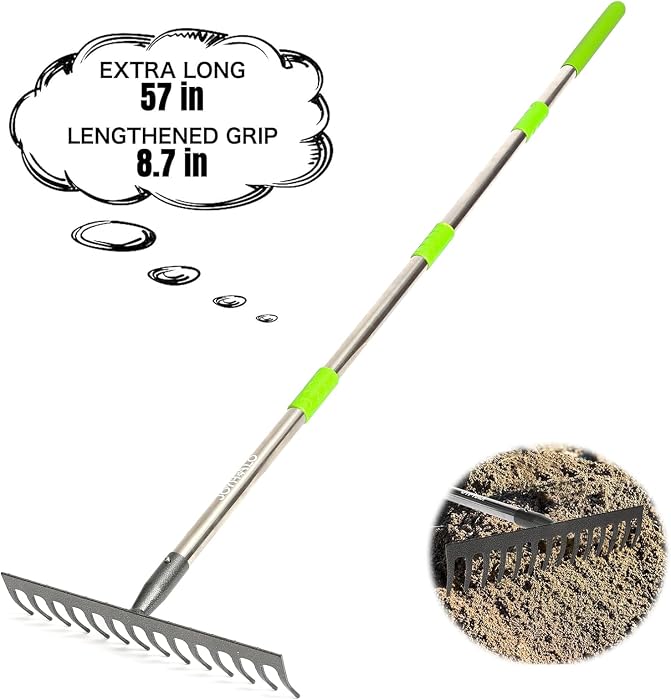
joyhalo JH-leafrake Bow Rake – 14 Tines Adjustable 30.5-57 Inch Bow Rake

Tight beds, travel

Field Score 88/100
Tines
14
Head Width
13.7 inches
Handle Length
30.5 to 57 inches
Handle Material
Aluminum
View on Amazon

A 20-inch head is useless in the two-foot gap between boxwoods. The joyhalo's head is 13.7 inches with 14 tines only 2.5 inches long, and the shaft collapses from 57 inches to 30.5, so you can work under shrubs, between perennials, and into the corners of a raised bed without dragging a full-size rake through the plants and snapping stems.

It is a second rake rather than an only rake, and we are at peace with that. The aluminum handle keeps it light enough to steer one-handed, which is exactly what tight work wants, but it flexes when you lean on it: right for leaves, pine needles, and light thatch, wrong for gravel or breaking clods. The 8.7-inch rubber grip is long enough that your hand does not slide up into the shaft.

Where it surprised us was storage. Broken down it fits behind a truck seat or in a gear bag, and the adjustable length means a shorter user can set it where it is comfortable instead of fighting a 68-inch pole. For a rental property, a camper, or a yard with more shrubs than lawn, that is the whole argument.

Worth Noting

  • Aluminum handle flexes under hard pulling
  • 57-inch maximum reach is short for tall users
Our Verdict

We keep the joyhalo for tight work: a 13.7-inch head and a handle that collapses to 30.5 inches reach places a full-size bow rake cannot.

Check Latest Price
5

YEELOR YLUS1147 Garden Rake Best Budget

YEELOR YLUS1147 Garden Rake – Garden Rake

Light cleanup

Field Score 87/100
Tines
16
Handle
Adjustable stainless steel
Weight
1.1 kg (2.4 lb)
Head Width
15.85 inches
View on Amazon

The YEELOR's handle tops out at 53 inches, the shortest of our picks, and that is worth knowing before anything else because it decides who the rake suits.

What you get in exchange is the lightest tool in the group. The head is just under 16 inches wide with 16 tines, fastened to the shaft with screws rather than a pin, and the stainless sections thread together by hand so the whole thing breaks down small and goes back together without tools. At a little over two pounds it is easy to carry around the yard for an hour, and the adjustable sections let you run it short for close work or for a smaller user.

Where the YEELOR stops is hard ground. A light rake skates over compacted soil and gravel instead of biting in, and this one is built for leaves, mulch, and light thatch. Buy it as a second rake, a starter rake, or the tool for a yard that never gets that serious. At this price, that is an easy call to make.

Worth Noting

  • 53-inch handle is the shortest here
Our Verdict

This is the rake we hand a beginner or a smaller user: light, adjustable, the least expensive here, and honest about being built for cleanup rather than digging.

Check Latest Price
6

Nohovu NH_06 Garden Rake Best Arrives Assembled

Nohovu NH_06 Garden Rake – Garden Rake for Gardening

Ready to use

Field Score 86/100
Tines
14
Handle
58-inch fiberglass
Head Width
14 inches
Head Material
High carbon steel
View on Amazon

No bag of bolts, no four threaded sections, no instruction sheet: the Nohovu arrives as one assembled tool. After a morning of snugging screw-together handles on half the rakes in this group, that alone reads as a feature rather than a convenience.

It is not a stripped-down version of the idea, either. The head is high carbon steel, welded and coated against rust, with 14 tines on a 14.2-inch frame. That is narrower than the 17- and 20-inch heads here, so it takes more passes but gives you better control in a crowded bed. The fiberglass handle is thick, integrated into the head rather than bolted onto it, and 58 inches long, and the whole rake weighs 3.2 pounds, close to the Bully in heft with a smaller head behind it.

You pay for the convenience. This one runs well above the stainless sectionals, and for that money you get fewer inches of head than the BlumeTrec offers. What you do not get is a joint that loosens, and for a tool that will lean by the shed door for a decade that is the trade we take.

Worth Noting

  • 14-inch head is the narrowest here
  • Costs more than the sectional rakes
Our Verdict

You are paying for a rake that arrives assembled and stays that way, which we think is worth it if you are done tightening handles and a 14-inch head suits your beds.

Check Latest Price
7

Lilyvane 17-Tine Bow Rake

Lilyvane 17-Tine Bow Rake – Garden Rake

Extra reach

Field Score 85/100
Tines
17
Coating
Rust-resistant
Head Width
17 inches
Handle Length
63 inches, four sections
View on Amazon

If you are tall and you want a long rake without paying much, the Lilyvane's 63-inch handle is aimed at you. It is four steel sections that screw together, topped with a 17-inch head carrying 17 curved teeth, and it gets you standing more upright than the 53- and 58-inch picks here.

The head is dual-sided, with long curved teeth on one edge for tearing at weeds and thatch and a shorter set on the other for spreading, and the whole tool is coated to resist rust. The teeth are sharp enough to catch on roots rather than skid over them, and the light build makes it easy to swing for an hour.

Assembly takes minutes with no tools, and the sections come apart small enough to ride in a trunk or stand in the corner of a shed. They can also work loose as you use it, so check each joint at the start of the day, especially the one directly under the head.

Where the Lilyvane lands is mid-pack. It does what the BlumeTrec does with less reach and a plainer steel head, and for a little more money the BlumeTrec is the stronger version of the same idea. Unless the 63-inch length specifically fits you, that is the one to take.

Worth Noting

  • Four screw sections need re-tightening
Our Verdict

A solid 63-inch rake for the money, and the right buy if reach matters more than a heat-treated head, just plan on snugging four handle sections.

Check Latest Price
8

Walensee BR-001 Bow Rake Best for Dual-Sided Spreading

Walensee Heavy Duty Dual-Sided Bow Rake

Dual-sided spreading

Field Score 84/100
Tines
17
Handle
63-inch stainless steel
Head Width
17 inches
Head Material
Heat-treated manganese steel
View on Amazon

Turn the Walensee's head over and a flat back edge drags a smooth layer of topsoil or mulch across a bed instead of scratching furrows in it. That is the same trick the BlumeTrec performs with its short-tine side, done here with a straight edge.

The working side is a 17-inch head with 17 tines in heat-treated manganese steel, triple-welded and fixed with double-locking screws, on a stainless pole that reaches 63 inches. It is stiff enough to drag gravel and clumped soil, and the length is right for working upright rather than stooped.

The connections are where this rake asks for attention. Several threaded sections plus locking screws give you plenty of places to lose tightness, and that is the part that shows in long sessions. Snug everything at the start and check again if the head begins to twist. Assembly is quick and the sections store easily.

Of the dual-sided rakes here, this is the one we rank second. It does the same double duty as the BlumeTrec with a shorter handle and a busier connection, but it costs less, and for a homeowner spreading a few yards of mulch a season that math works.

Worth Noting

  • Threaded sections and locking screws work loose
Our Verdict

The flat back edge is genuinely useful for spreading, but the sectional handle keeps this one behind our dual-sided favorite, so buy it when the price matters more than the joints.

Check Latest Price

How We Chose and Tested the Best Bow Rakes

We started with roughly 40 bow rakes sold at hardware stores and online, then cut anything with a plastic collar where the handle meets the head, a head narrower than 14 inches, or a shaft under 55 inches. That left 12, spanning fiberglass, stainless, and painted steel handles, fixed and telescoping shafts, and both single- and dual-sided heads.

Testing ran six months and followed the work rather than a lab bench. In spring we broke up winter-compacted beds, leveled a dumped load of topsoil, and dragged gravel back onto a rutted driveway; in fall we pulled wet leaves off the lawn, turned a mulch pile, and raked thatch out of a fescue lawn.

Assembly came first: I timed how long each rake took to put together with no tools, then checked whether the joints wobbled afterward. Each one got weighed on a luggage scale and measured at its shortest and longest settings. For stiffness, I pressed the tines into packed clay and stepped on the back of the head; for handle durability, I twisted the collar mid-stroke and left two rakes out in the rain for a week. I also dragged each rake across gravel and through a tarp of wet leaves, watching for bent tines, spinning ferrules, and heads that skipped instead of biting, and noted whether the head tipped sideways when I set it down on uneven ground. At the end I set every price against what the rake was actually built from — the best values were rarely the cheapest ones.

How to Choose a Bow Rake

The Joint That Decides How Long It Lasts

A bow rake takes its worst stress at the head-to-handle connection, because every pull on a root or a clump of gravel lands there. One-piece rakes, where the head is welded and pinned or riveted to a solid fiberglass shaft, have nothing to re-tighten, and those are the ones we rate highest for heavy, repetitive work.

Sectional rakes screw together in three or four pieces. They pack down small, adjust for height, and cost less, but the joints work loose and want a firm twist before each session. If the rake leans against the shed all season and gets pulled hard, buy one piece. If it rides in a truck bed or gets shared by several people, a sectional is worth the upkeep.

Handle Length Is About Posture, Not Reach

Handles in this group run from 53 to 68 inches, and the difference shows up in your back. A rake that comes to roughly your shoulder when you stand it on end lets you pull without stooping; anything shorter and you fold over the work.

Taller users should be looking at the 63- and 68-inch rakes, and an adjustable handle that reaches 68 inches covers a household where two very different people share the tool. If tight beds or shorter users are the priority, 53 to 57 inches works well, just don't hand that rake to someone six inches taller and expect a comfortable afternoon.

Head Width and Tine Count Set the Job

A 14-inch head with 14 tines works between plants and in raised beds. A 20-inch head with 25 teeth covers a lawn quickly and gathers fine debris. The trade is depth: closely spaced, thin teeth rake leaves and thatch beautifully but flex if you pry with them, while fewer, heavier tines on a narrower head are what break clods and drag stone. That rigid, downward-curving tine is also what makes a bow rake work as a rock rake on a gravel drive.

Choose the wide, fine-toothed head for fall cleanup and the heavier, narrower head for soil and gravel, or buy two and stop compromising. A rake that is wrong for the material is the reason most people think they need a different tool.

Weight Decides Who Does the Work

The rakes here run from about 2.4 to 3.5 pounds, and the difference is less about comfort than about who supplies the force. A heavier head drops into gravel and crusted soil and drags material back on its own; a light one skates over the surface until you lean on it, which tires you in a different way.

If your ground is hard or gravelly, choose the heavier tool. If the rake is for leaves, mulch, and a couple of beds, lighter is easier on the shoulders and easier to carry around the yard.

What a Dual-Sided Head Actually Adds

Several rakes here flip over to a second set of short tines or a flat back edge, which is genuinely useful for spreading topsoil and leveling mulch after you have loosened it. We like a dual-sided head for bed prep because it keeps a second tool out of the shed.

What it does not replace is a garden fork or a mattock. The short side spreads material; it does not break new ground. If leveling and spreading are part of your routine, pay for the second side. If you only ever pull leaves, it is weight you don't need.

Frequently Asked Questions

Final Verdict

Our pick for most people is the Bully Tools 92309: welded 10-gauge steel pinned into a one-piece fiberglass handle, with no threaded joint to work loose and enough head weight to drag gravel and break crusted soil.

If leveling and spreading mulch take up more of your year than digging does, the dual-sided BlumeTrec does both jobs on a longer handle. If the rake has to live in a truck bed or a corner of a small shed, the joyhalo collapses to 30.5 inches and still reaches into places a full-size head cannot.