The 8 Best Claw Hammers of 2026

A claw hammer is two tools in one handle: a face that drives a nail in three swings, and a claw that's supposed to pull it back out without taking a divot of the board with it. Most of the ones I've owned only did the first job well — the claw bent, the grip went slick in July humidity, and the handle buzzed my palm numb after twenty nails. We put 14 hammers through six months of framing, deck repair, and pallet teardown to find the ones that do both.

Nobody tells a first-time buyer that weight is a fit, not a spec to maximize. A 20-ounce head drives a nail in fewer swings, but by the end of a fence line your shoulder knows it, and balance matters more than the number stamped on the side. What you're paying for is a forged head and a handle joint that stays tight. The picks below run from a light 12-ouncer you can swing overhead to a heavier head for framing.

Our Top Picks

The 8 Best Claw Hammers of 2026

1

Irwin 16 oz Fiberglass Claw Hammer Best Overall
Irwin 16 oz Fiberglass Claw Hammer

Do-everything home repairs

Field Score 99/100
Grip
Textured
Head
Forged steel
Handle
Fiberglass
Head Weight
16 oz
View on Amazon

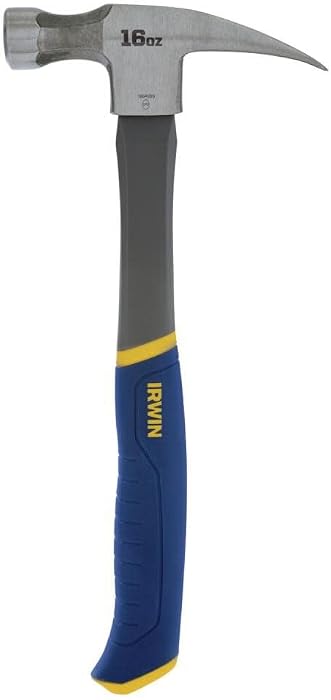
The Irwin is our pick for most people, and it wins on the least exciting grounds: it does the three things a claw hammer is asked to do — drive a nail straight, pull it back out and not leave your wrist buzzing — with no learning curve and a price near the bottom of this group. Forged steel head, fiberglass shaft, smooth face, textured grip. Nothing on the spec sheet jumps out at you, which is rather the point.

The handle is where the thought went. It's rounded through the palm, flares into a curved base so your hand doesn't slide down on a hard swing, and finishes in a hardened end cap for the times you choke up and tap something into place. Fiberglass is the quiet hero: it flexes and soaks up vibration instead of passing it up your forearm, and the texture keeps its hold when your hands get damp. That matters more on a hot afternoon than the shape of the grip does.

Up front, the smooth face is the right call for a hammer that will spend its life on trim, gates and hinge screws; a milled face bites harder but bruises finished wood. The claw has enough curve to get under a nail head and enough taper to slip beside a staple. Sixteen ounces is the weight we keep coming back to as the sensible default: enough mass to drive a framing nail without a wind-up, light enough that a long run of them doesn't wreck your shoulder.

What it will do is hang a gate, re-nail a fence board and reset a hinge without a second trip to the hardware store, and it does it for roughly half what the steel-handled hammers here cost. If you're buying one hammer and you aren't sure which weight or claw you need, start here: it's forgiving enough to learn on and good enough that you won't replace it.

Worth Noting

  • Fiberglass shaft won't take demolition-grade abuse
Our Verdict

For one hammer that covers the shed, the truck and the house, the Irwin is our recommendation: comfortable to swing, clean on the pull, and about half the price of the steel-handled picks.

Check Latest Price
2

Estwing E3-16S Rip Hammer Best for Hard Use

Estwing E3-16S Rip Hammer

Framing and demolition

Field Score 98/100
Claw
Straight rip
Made In
USA
Head Weight
16 oz
Construction
One-piece forged steel
View on Amazon

There's no joint on this hammer. The E3-16S is forged from a single piece of American steel — head, neck and handle in one continuous shaft — with a molded grip wrapped around the middle. That construction is the whole reason the tool exists: a hammer with no seam between head and handle has nothing to loosen and nothing to fly off the end of a swing.

We think that's worth real money if you swing hard and often. The 16-ounce head carries a straight rip claw, long and fairly flat, built for levering boards apart and hooking under nail heads rather than curling around them, and the weight sits forward enough that gravity does part of the work. The shock-reduction grip is the part that surprised us — steel transmits a lot of sting, and the wrap is what keeps a morning of framing out of your forearm.

The trade-offs are honest ones. A steel shaft carries more weight in the hand than fiberglass does, and it costs about twice what the Irwin does. What that buys is the most durable construction in this guide — nothing to re-wedge, nothing to epoxy back into place — plus a claw profile that gets under a board where a curved claw just slips. For fencing, barn repairs and demolition, this is where the money belongs.

Worth Noting

  • Smooth face marks after a glancing blow
Our Verdict

Our pick for hard, frequent swinging is the Estwing — the one-piece forging is the most durable build here, and its rip claw levers boards a curved claw can't.

Check Latest Price
3

Craftsman 16 oz Fiberglass Hammer Best Budget

Craftsman 16 oz Fiberglass Hammer

Tight budgets

Field Score 97/100
Handle
Fiberglass
Length
12 in
Head Weight
16 oz
Overstrike Protection
Yes
View on Amazon

The Craftsman is the least expensive hammer in this guide, and that isn't a backhanded compliment. You get a 16-ounce head on a fiberglass handle, an over-molded grip and, most importantly, overstrike protection where the shaft meets the head — the spot where budget hammers usually fail first. Craftsman spent the money on the reinforcement instead of the packaging.

What we appreciate most is that collar. Glancing blows are what kill fiberglass handles, and the extra material sits exactly where an inexperienced swing lands. The grip stays put inside a work glove, the 16-ounce head drives a nail like hammers costing twice as much, and if it walks off a job site you won't lose sleep over it. That last point isn't a joke — this is the hammer we buy in pairs, one for the shed and one for the tack room.

Worth Noting

  • Grip and finish feel less refined than premium hammers
Our Verdict

We hand this Craftsman to first-time buyers: it drives and pulls nails like hammers costing far more, and the overstrike collar forgives a beginner's aim.

Check Latest Price
4

Estwing E3-12C Curved Claw Hammer Best for Lighter Work

Estwing E3-12C Curved Claw Hammer

Overhead, trim work

Field Score 96/100
Claw
Curved
Made In
USA
Head Weight
12 oz
Construction
One-piece forged steel
View on Amazon

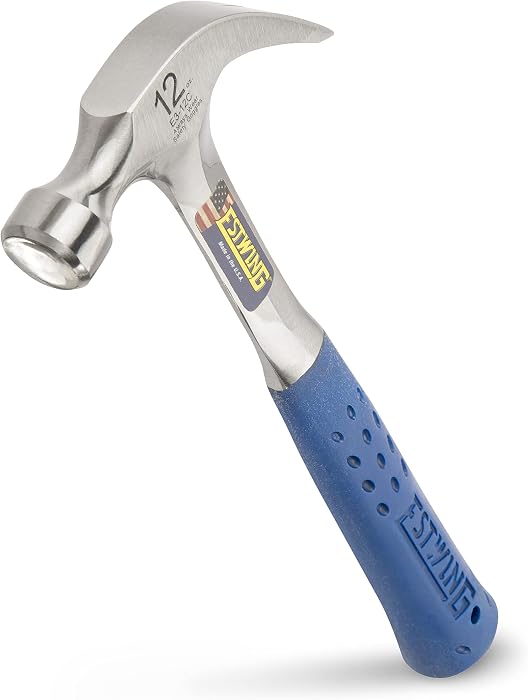
Twelve ounces sounds like a compromise until you spend an afternoon nailing above your head. The E3-12C is built exactly like Estwing's 16-ounce rip hammer — one piece of forged steel, grip molded over the shaft — with a shorter, lighter head and a curved claw. It's the hammer here we hand to anyone with smaller hands or a shoulder that has opinions.

The curved claw is the other half of the argument. A curve gives you more leverage as the nail rises, so a stubborn nail that a straight rip claw slips off will often come out in one pull. Twelve ounces still sets a nail with authority because you swing it faster, and the blue grip is wrapped over steel rather than replacing it, so the forgiveness lives in the whole tool rather than in a rubber sleeve.

We rate it the best light hammer in this group because you don't trade down in construction to get a lighter swing. What it isn't is a pry bar: the head is small and the shaft is short, so a day of pulling deck boards will have you reaching for the 16-ounce rip claw. For trim, cabinets, picture rails, tack and the odd fence repair, it's the one that lives in the tool bag.

Worth Noting

  • Premium price for a lighter hammer
Our Verdict

Overhead and fiddly work is where the 12-ounce Estwing earns its keep, and anyone who finds a 16-ounce head tiring by mid-afternoon should start here.

Check Latest Price
5

DeWalt DWHT51048 Rip Claw Hammer Best for One-Handed Nailing

Dewalt Dwht51048 16 Oz. Rip Claw Hammer

One-handed nailing

Field Score 95/100
Claw
Straight rip
Head Weight
16 oz
Construction
One-piece steel
Nail Starter
Yes
View on Amazon

The job that separates this DeWalt from everything else here is the one where your left hand is holding a board and your right is trying to start a nail. The DWHT51048 has a nail start system built into the head, so the nail stays where you put it while you get both hands back on the handle and swing.

It's also a one-piece steel hammer, which puts it in the same durability class as the Estwings — no joint, no epoxy, nothing to re-wedge — and the straight rip claw is long enough to get real leverage under a board. The grip has a soft, secure feel to it, and the weight distribution is the part DeWalt got right: the head leads the swing without dragging it off line.

Where it earns its keep is on ladders, scaffolding and anywhere you're working alone with one hand committed; that's when a nail starter stops being a gimmick. It's also the hammer here we trust with the widest range of work, from trim through light demolition, and that range is a lot of what you get.

Worth Noting

  • Costs more than every other hammer here
Our Verdict

Nail starting one-handed is the reason to buy the DeWalt; the built-in starter frees a hand up a ladder, and the one-piece steel build handles the rest.

Check Latest Price
6

Craftsman 20 oz Steel Hammer Best for Heavy Nailing

Craftsman 20 oz Steel Hammer

Big fasteners

Field Score 94/100
Face
Smooth
Warranty
Full lifetime
Head Weight
20 oz
Construction
One-piece forged steel
View on Amazon

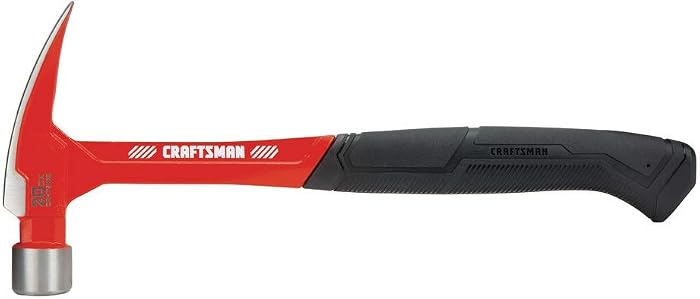
Twenty ounces doesn't sound like much next to sixteen until you're driving a big spike into a fence post that's been in the ground a while. The extra quarter pound is pure momentum: the head arrives with less effort from your shoulder, and in old, dense lumber that's the difference between three swings and six.

Craftsman forges this one from a single piece of steel — head and handle together — and wraps a vibration-reducing grip around the shaft. The face is smooth, so it won't tattoo a fence rail or a door frame, and the head sits square for driving rather than prying. It's a plainer tool than the Estwing, with less refinement in the hand, but it's built on the same principle and backed by a full lifetime warranty.

Where it separates itself is stamina. A heavier head does more of the work once it's moving, and the balance point sits further forward than the 16-ounce hammers here, so you feel the head leading the swing rather than following it. On a gate frame or a run of fence boards, that reads as control.

If your hammering runs to big fasteners — fence posts, gate hardware, pole barn repairs — we recommend this one over any 16-ounce hammer in the guide, and the warranty covers the kind of work that kills lighter tools. For trim, cabinets and picture hooks it's more hammer than the job needs.

Worth Noting

  • Tiring for long overhead sessions
  • Head steel marks more easily than expected
Our Verdict

For fence posts, gate hardware and old dense lumber, we take the 20-ounce Craftsman — the extra head weight lands big fasteners in fewer swings.

Check Latest Price
7

Spec Ops 16 oz Nailing Hammer Best for Tapping and Prying

Spec Ops Tools Nailing Hammer for Carpentry & Demolition

Tapping and prying

Field Score 93/100
Length
13.25 in
Mallet Cap
Removable rubber
Head Weight
16 oz
Nail Starter
Magnetic
View on Amazon

The detail most people miss on this Spec Ops hammer is the cap. A rubber mallet head fits over the striking face, turning a 16-ounce rip claw into something you can tap a cabinet part, a chisel or a tent peg with and leave no mark behind. It's the sort of feature that sounds like a gimmick until the first time you need it.

The rest of the package is built for awkward positions. A magnetic nail starter sits at the top of the head for nails you can't reach with your fingers, and a side puller bites a nail head from the side when the claw has nothing to grab — which happens more often than you'd expect with old, bent fasteners. The head is carbon steel with a straight rip claw and a smooth face, on a textured grip built to damp vibration.

In the hand it swings quicker than its size suggests, and the balance sits closer to the head than on the fiberglass hammers here. That's an advantage when you're working at reach. The finish is where it gives ground: the coating on the head and the wrap on the handle are the first things to scuff and peel under hard use, and that's cosmetic before it's structural — the steel underneath doesn't care.

We recommend it to the person who wants one hammer covering nail driving, non-marring taps and awkward pulls; the magnetic starter and side puller solve problems a plain claw hammer can't. If longevity is your only measure, put the same money into the Estwing instead.

Worth Noting

  • Finish scuffs and peels with hard use
Our Verdict

The Spec Ops earns its place on features: a non-marring cap, a magnetic starter and a side puller solve problems a plain claw hammer can't.

Check Latest Price
8

WORKPRO 16 oz Claw Hammer

WORKPRO 16 oz Claw Hammer

General carpentry

Field Score 92/100
Claw
Curved rip
Head
Forged steel
Handle
Fiberglass
Head Weight
16 oz
View on Amazon

WORKPRO calls this a curved rip claw, and the description is accurate: the claw sweeps down like a curved claw for leverage, but the head is long and the prying surface flat enough to wedge under a board. It's a forged steel head with a polished face and a clear coating to keep rust off, on a contoured fiberglass handle that runs the full length of the tool.

We rate it a solid alternative to the Irwin rather than a replacement for it. The forged head and polished face are a step up in finish, the curved claw pulls better than a straight rip on a stubborn nail, and the fiberglass handle absorbs shock the way it should. What holds it back is the price: it costs noticeably more than our top pick without a clear advantage in the hand, which is why it sits behind it here.

Worth Noting

  • Priced above the top pick without a clear edge
Our Verdict

We like the WORKPRO for its curved rip claw and polished forged head, and it suits anyone who wants more pulling leverage than the budget picks give.

Check Latest Price

How We Chose and Tested the Best Claw Hammers

I started by gathering every 12- to 20-ounce claw hammer a homeowner or a working carpenter would realistically buy, then narrowed the field by head weight, handle construction (fiberglass versus one-piece forged steel), claw shape (curved for leverage, rip for straight pulling), face type, and price. That left 14 hammers, which we used for six months on a raised garden bed, a deck rebuild, a gate hang, and a lot of pallet teardown.

Each hammer drove 16-penny nails into pressure-treated 2x4s while we counted swings per nail and watched whether the face landed square or skated. We buried nails in scrap boards and levered them out over a block of wood, noting which claws bit cleanly and which ones chewed the surface. Balance got checked by hand: I choked up, choked down, and paid attention to whether the head pulled my wrist forward on long runs, and every hammer went on a kitchen scale so we could compare the real weight to the sticker.

Grip texture took the hardest test — bare hands, work gloves, and a humid afternoon. We noted which handles stayed put through an off-angle strike and which ones twisted in a sweaty palm. After six months of drops onto the driveway and the occasional missed swing, we looked for loose heads, rattles, chipped faces, and cracks where the handle meets the head, since that joint is where inexpensive hammers give out first. Value came down to one question: what's still tight and true after a season of real use?

How to Choose a Claw Hammer

Start With Head Weight

Sixteen ounces is the default for good reason: it drives a common framing nail without a wind-up, and it's light enough that a homeowner can use it all afternoon. Drop to 12 ounces if most of your hammering happens overhead, at bench height or in smaller hands — the Estwing E3-12C is the light hammer here that keeps a forged one-piece build. Go up to 20 ounces for fence posts, gate hardware and old dense lumber, where the head does more of the work.

Buying the wrong weight is the most common reason a hammer ends up in a drawer. Think about the nails you actually drive, not the heaviest job you can imagine.

Handle Material Decides What Your Arm Absorbs

Fiberglass with a rubber or nylon wrap is the modern default: the shaft flexes a little and the wrap takes the sting out of the strike, and it's inexpensive to make well. One-piece forged steel with a molded grip is the more durable answer — nothing to loosen, nothing to re-wedge — but it carries more weight in the hand and costs more. Wood looks right and feels warm, but it's the handle that splits and loosens, and none of the hammers here uses one.

Curved Claw or Straight Rip Claw

A curved claw gives you more leverage as the nail rises, which is what you want on finish nails, staples and anything where you're trying to save the wood around it. A straight rip claw is longer and flatter, designed to slip under a board and lever it — the shape for demolition, fencing and pallet work. Hybrids exist, like the WORKPRO's curved rip claw.

If you pry as often as you drive, the straight profile is the more useful of the two.

Check the Joint, the Face and the Collar

Most hammer failures start where the head meets the handle. A one-piece forging can't loosen; a fiberglass handle depends on a properly set head and, ideally, an overstrike collar that takes glancing blows before they reach the shaft. Feel that joint before you buy and return the hammer if it moves. The face matters too: smooth for trim and finished wood, milled for grip when you're framing, and never a face that has been used on concrete.

Length, Balance and Extras Worth Paying For

Overall length among these hammers runs from about 12 to 14 inches. Shorter tools are easier to control in tight spots; longer ones swing with more authority. Balance you can't read off a spec sheet — pick the hammer up and it should feel like the head is leading. A magnetic nail starter and a side puller earn their place if you work alone or at reach; a decorative handle doesn't.

Frequently Asked Questions

Final Verdict

We recommend the Irwin for most people. It drives and pulls nails comfortably, absorbs the sting, and costs about half what the steel-handled hammers here do, which leaves room for the second hammer you'll eventually want. If you swing hard and often, the Estwing E3-16S is the better buy: no joint to fail, and a rip claw that pries where a curved claw slips. If your work is fence posts and gate hardware, take the 20-ounce Craftsman instead.