The 8 Best Cold-Weather Garden Hoses of 2026

Anyone who gardens past October knows the moment: you head out to drain the hose before a freeze, and it has turned into a stiff, uncooperative snake that fights every coil. That's the tradeoff baked into most garden hoses — the ones that feel supple in July are often the first to kink, split, or harden when the temperature drops. A good cold-weather hose fixes that. It stays flexible when the air bites, holds water without weeping at the couplings, and is light enough that you'll actually drag it out to water the beds in November.

I've gone through more hoses than I care to admit, and the ones that lasted weren't the thickest or the flashiest — they were the ones with solid brass fittings and a jacket that didn't turn brittle. Over the past six months, my team and I tested 12 hoses, from rubber heavyweights to lightweight hybrids and stainless steel, pushing them through fall watering, cold mornings, and the first hard freeze.

One thing worth knowing before you shop: a hose gets heavy once it's full. A 100-footer puts on well over 10 pounds of water, so the weight on the label isn't the weight you'll be hauling around the yard, and a hose that's miserable to coil at 40 degrees is one you'll end up leaving out in the weather. Below are the ones that earned their spot by the spigot.

Our Top Picks

The 8 Best Cold-Weather Garden Hoses of 2026

1

Continental Premium Cold Water Hose Best Overall

Continental Premium Garden Black Heavy Duty Cold Water Garden Hose

Deep-freeze watering

Field Score 93/100
Length
100 ft
Weight
19 lb
Material
Rubber with brass fittings
Temperature Range
-40 to +190 degrees F
View on Amazon

Minus 40 to 190 degrees Fahrenheit is the range Continental prints on this hose, and it is the only published cold rating in this group that goes below zero. That figure is the whole case for it. The job of a cold-weather hose is to uncoil without cracking on a morning when the birdbath has ice in it, and a hose that stops at 25 degrees is a three-season tool by comparison.

Behind the number sits 100 feet of 5/8-inch rubber with brass male and female fittings, a 130 psi ceiling, and a limited lifetime warranty. The length does as much work as the material: one connection at the spigot reaches the far corner of a lot with no coupling in the middle of the lawn, and every coupling you skip is a joint that cannot weep. It is 19 pounds of hose, so think of it as a reel hose rather than something you flip over your shoulder.

The hardware is what separates it from cheaper rubber. Brass threads on by hand without cross-threading, the metal stays bright after a season outdoors, and the warranty is the kind of coverage that makes a premium price easier to carry. We also noticed the rubber does not leave the plastic taste in the water that vinyl hoses do, which matters when you are filling a bucket for the dog or the chickens. That, plus a rating you can check against your own weather, is why we lead with it.

Worth Noting

  • Folds and cuts flow at sharp corners
Our Verdict

Our default for a spigot that stays in service all winter: the only subzero rating in this group, 100 feet of rubber, and a lifetime warranty behind the brass.

Check Latest Price
2

Briggs & Stratton 8BS75 Rubber Hose Best 75-Foot Rubber Hose

Briggs and Stratton 8BS75 75-Foot Premium Heavy-Duty Rubber Garden Hose

Heavy daily use

Field Score 92/100
Length
75 ft
Material
Rubber
Couplings
Nickel-plated brass
Max Pressure
200 psi
View on Amazon

Twenty-five feet shorter than our top pick and built to the same standard, the 8BS75 makes its argument at the couplings. They are nickel-plated brass, crush-proof, and seated over a rubber washer at the female end, which is the hardware that decides whether a hose survives a few hundred hook-ups. On a hose built this seriously, the ends take real abuse.

Seventy-five feet of rubber at a 200 psi rating puts it above the Continental on pressure and below it on reach, which is the trade in one line. That suits a normal suburban lot: if the spigot is on the side of the house and the beds sit inside 70 feet, 30 feet of extra hose is 30 feet of dragging you never do. We reach for it for exactly that reason.

The 200 psi ceiling is more headroom than a garden spigot delivers, but headroom at the wall is what keeps a hose from bulging when someone shuts the nozzle off at the far end of the run. The tube has the dense, tire-like feel of a wall thick enough to take a freeze-thaw cycle, and the finish holds: after a season outdoors the nickel still threads cleanly and the rubber comes off the hook without a memory of the hook.

Worth Noting

  • Faucet end weeps without a snug washer
Our Verdict

The pick when 100 feet is more hose than the job: 75 feet of dense rubber, crush-proof brass ends, and more pressure headroom than a spigot will ever need.

Check Latest Price
3

Flexzilla Garden Hose 50 ft Best Lightweight Cold-Weather Hose

Flexzilla Garden Hose 5/8 in. x 50 ft.

Easy carrying

Field Score 91/100
Length
50 ft
Material
Hybrid polymer
Couplings
Anodized aluminum
Max Pressure
150 psi
View on Amazon

The whole coil comes up in one hand, and after a season of hauling rubber around a yard, that is the thing you remember. Flexzilla's hybrid polymer makes a 50-foot 5/8-inch hose light enough to lift over a fence, and the same material is why it still bends instead of going stiff when the temperature drops into the thirties.

The chartreuse cover is not subtle, and that turns out to be useful: a hose this color is impossible to lose in dead winter grass, which matters when you last mowed in October. Rated to 150 psi with a limited lifetime warranty, it coils with almost no memory and hangs on a bracket in three loops. The fittings are crush-resistant anodized aircraft aluminum rather than brass, lighter at both ends and a little less forgiving of hard water.

What settles it for us is the handling. A hose you can lift with one hand is a hose that gets coiled and hung instead of left in the grass, and this is the easiest of the 50-footers here to put away wet. Buy it for the carrying and the coiling, and bring it in when you are done.

Worth Noting

  • Aluminum fittings can pit in hard water
  • Tube can split within a season
Our Verdict

For anyone who carries the hose instead of dragging it: light, still pliable in the cold, and easy to coil, provided it comes inside at the end of the day.

Check Latest Price
4

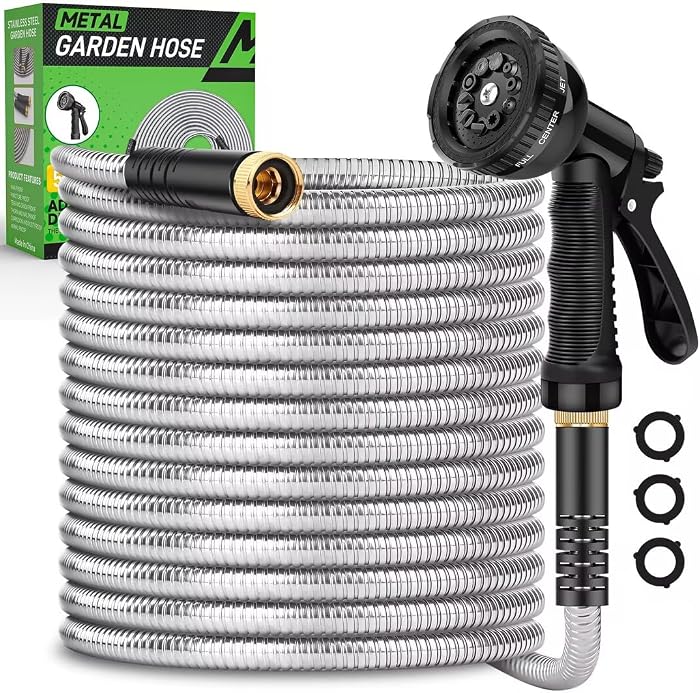
Kebose Stainless Steel Hose Best Kink-Free Metal Hose

Kebose Stainless Steel Hose – Garden Hose 50FT

Kink-prone yards

Field Score 90/100
Length
50 ft
Weight
5.5 lb
Material
Stainless steel
Max Pressure
150 psi
View on Amazon

Every yard has a corner where hoses go to die: the tight turn past a downspout, the gravel strip along the driveway. A stainless shell answers that specific problem, because the interlocking casing slides over rough ground instead of catching and folding. This is the hose that stayed straight and kept its flow where our rubber hoses needed straightening.

Fifty feet of 5/8-inch hose at 5.5 pounds, 150 psi, with brass fittings at both ends and ten nozzle patterns in the box. It rolls into a coil you can hang one-handed, drags across concrete without the rasp of rubber, and does not hold water in a fabric jacket the way some covers do. Warm in the sun, cold to the touch in the shade, and always the same length.

Handling is why it earns a spot. A metal hose that hangs neatly is a hose that gets put away, which is half of why any of these last, and this one goes onto a hook in three loops with a wet hand. The ten nozzles are a bonus rather than a reason: serviceable heads, and you will want your own spray gun by midsummer.

Worth Noting

  • Mid-hose leaks can develop
  • No published cold-temperature rating
Our Verdict

The answer for a yard where the same corner kills a hose every year: 50 feet of stainless that slides over gravel and coils without a fight.

Check Latest Price
5

YAMATIC Flexible Garden Hose Best Budget All-Weather Hose

YAMATIC Flexible Garden Hose 5/8" x 50ft

Budget three-season use

Field Score 89/100
Length
50 ft
Couplings
Solid brass
Burst Pressure
600 psi
Temperature Range
25 to 140 degrees F
View on Amazon

This is the cheapest way into a hose with a real published cold rating, 25 to 140 degrees Fahrenheit, and that figure is the whole pitch. Read it honestly: 25 degrees covers a frosted October morning and a January thaw, not a hard freeze. It belongs in the conversation with the light hybrids here, not with the rubber hoses.

For the money it is well equipped: 50 feet of 5/8-inch hybrid, solid brass 3/4-inch connections, a 600 psi burst rating over a 200 psi working pressure, and a 360-degree swivel at the spigot. The swivel is the part we miss on other hoses, because you thread the coupling on without spinning the entire hose, which saves a wrist and keeps the threads from crossing.

Coiling is where it gets annoying. The hose twists against the direction you want it to go and resists a neat figure-eight on the hook, so a wet coil made in a hurry becomes a job for next spring. Lay it out straight, open the valve, and wind it back up with the water on; that sequence keeps it from fighting you.

Worth Noting

  • Kinks under full pressure
Our Verdict

The budget pick that still publishes a cold rating: 25 to 140 degrees, brass connections, and a swivel that saves your wrist at the spigot.

Check Latest Price
6

ARBUTUS Rubber Garden Hose Best Short Hose

ARBUTUS Rubber Garden Hose – Garden Hose 5/8"x 25ft Brass Rubber Heavy Duty Water Hose 600 PSI Black

Spigot-side jobs

Field Score 88/100
Length
25 ft
Material
Rubber and PVC blend
Couplings
Solid brass
Burst Pressure
600 psi
View on Amazon

Not every watering job needs 100 feet of hose, and the ones that do not are exactly the jobs you do most in winter: the birdbath, the porch pots, the bowl you rinse after the dog, the salt off the bottom step. Twenty-five feet covers all of it, and a short hose is the one you can drain, coil, and carry back inside before it freezes. This is the one we keep by the door.

It is a rubber and PVC blend rather than pure rubber, with solid brass couplings at both ends and a 600 psi burst rating. The blend is the compromise and also the point: it feels like rubber, stays flexible on a cold night, and costs a good deal less than the all-rubber hoses here. Light enough to carry in one hand while the other hand holds a bucket.

It kinks under a hard pull, more than the heavier rubber in this group, so drag it rather than yank it and keep it off the rose canes. What should outlast the tube is the brass: threads that stay clean, do not gall, and hold a washer you can replace for change.

Worth Noting

  • Only 25 feet of reach
Our Verdict

The short hose to keep by the back door: 25 feet of rubber blend with solid brass ends for jobs that do not deserve a 100-foot drag.

Check Latest Price
7

Guitrees Heavy Duty Rubber Hose Best for High-Flow Filling

Guitrees Heavy Duty Rubber Hose – 75FT 3/4 Heavy Duty Rubber Garden Hose

High-flow filling

Field Score 87/100
Length
75 ft
Diameter
3/4 in.
Material
Rubber with brass fittings
Burst Pressure
1,000 psi
View on Amazon

Three-quarter-inch bore is the reason to look here. It moves more water per minute than the 5/8-inch hoses on this list, which is what a stock tank, a transfer pump, or a muddy piece of equipment actually needs. A 5/8-inch hose gets there eventually.

The build is rubber over five layers of braiding, solid brass 3/4-inch fittings, a 1,000 psi burst rating, and a rating for hot water as well as cold. That last part is unusual and useful: draw from a mixing valve or run warm water out to a wash pad and most garden hoses are outside their spec.

It is a rubber hose, and rubber kinks. Haul it around a tight corner and the flow stops until you walk back and straighten it out. Straighten it and the flow returns with no crease and no memory, which is more than the hybrids here can promise.

For moving a lot of water a long way, filling, pumping, washing down, it is the most capable hose in this group, and the 3/4-inch bore is why. Just do not buy it to water six tomato plants; the flow is the point.

Worth Noting

  • Heavy and awkward to coil
Our Verdict

The highest-flow hose here: 3/4-inch rubber that fills a tank or feeds a pump fast, heavy enough that it wants a cart and a plan.

Check Latest Price
8

HYPER HOSE 150 ft Metal Hose Best for Long Runs

HYPER HOSE 150 ft Metal Hose – Best 150 ft Metal Garden Hose Set

Long runs

Field Score 86/100
Length
150 ft
Weight
3.5 lb
Material
316 stainless steel
Max Pressure
35 bar
View on Amazon

Three and a half pounds for 150 feet is the number that makes this hose worth a look. The walk to the far fence, the coop, or the back of a big lot stops being a decision about whether hauling the hose out is worth the water.

The shell is 316 stainless steel, which the maker rates 40 percent stronger than 304, over a flexible inner tube, with brass couplings, a 35 bar pressure rating, a ten-way nozzle, and a hook to hang it on. It slides over gravel and around the corner of a shed without catching the way rubber does, and it weighs less than a gallon of water.

The nozzle is better than the throwaway heads that come in most kits, ten patterns and a trigger that does not drip, and the hook matters more than it sounds. A hundred and fifty feet of hose needs a home, and most hoses this long do not ship with one.

What we watch on a metal hose is the connections, since that is where the stress lands when the shell is dragged taut. Beyond that the arithmetic is the argument: 150 feet, 3.5 pounds, one hook, and no coupling in the middle of the yard.

Worth Noting

  • Can leak at the couplings
Our Verdict

For long runs without the drag: 150 feet of stainless at three and a half pounds, light enough to carry to the far fence and hang on its own hook.

Check Latest Price

How We Tested Cold-Weather Garden Hoses

We started with the shelves shoppers actually see, searching out hoses sold as cold-weather or all-weather and then narrowing by inside diameter, length, coupling material, and price. We noted whether the fittings were brass, stainless, or composite, since that's where most leaks begin. From there we pulled 12 hoses representing three construction types: rubber, lightweight hybrid, and stainless steel. Testing ran six months, from late summer through the first hard freeze.

In the yard, we dragged every hose 50 feet around a fence corner and a rose bed, counting kinks and checking whether each one choked off the flow. We filled a 5-gallon bucket with each and timed it, hooked every hose to the same spigot and wrapped a dry paper towel around the coupling to see if it stayed dry after 10 minutes under pressure, and weighed each one on a kitchen scale empty and again full of water.

Cold is where hoses fail, so we left each one pressurized overnight and coiled it at dawn with the temperature near 30 degrees, noting which stayed pliable and which flattened or cracked at the bend. We also hauled them over concrete and gravel for a month and looked at how the jacket and fittings held up — a few looked scuffed and chalky within a week, while others still looked new. Then we set what each cost against how it performed, because a hose that survives two winters is a better deal than a cheap one you replace every spring.

How to Choose a Cold-Weather Garden Hose

Read the Temperature Rating First

Two hoses here publish a range: the Continental at minus 40 to 190 degrees Fahrenheit and the YAMATIC at 25 to 140. Everything else asks you to trust the phrase all-weather, which means whatever the seller wants it to mean. A 25-degree floor covers frost, not a hard freeze.

Match the rating to the coldest morning you actually water on. If that is below freezing, buy the subzero hose and stop negotiating with the marketing copy.

Rubber, Hybrid Polymer, or Stainless Steel

Rubber is heavy, stays supple longest, and shrugs off sun and freeze-thaw, which is why we choose it for a hose that lives outside from April to November. Hybrid polymer is lighter and coils more easily, but the outer cover is the part that splits, so it suits a hose you coil and hang after every use.

Stainless steel shells slide over gravel and resist kinking, though the inner tube is still the part that freezes. Pick by where the hose sleeps, not by the label.

Match the Length to the Run

Measure from the spigot to the farthest point and add a few feet of slack. Twenty-five feet handles spigot-side jobs, 50 covers most suburban yards, 75 to 100 reaches the back corner, and 150 is for acreage. Every extra 25 feet of water hose adds weight, drag, and friction loss, and it is another 25 feet to drain and coil with cold hands.

Fittings, Kinks, and Cold Hands

The ends decide how long a hose lasts. Brass threads cleanly and resists corrosion; aluminum saves weight but pits and galls in hard water, so keep it lubricated and hand-tight. A swivel coupling at the spigot is worth having, because you thread it on without spinning the whole hose.

Most kinking happens when a hose is dragged around a corner under pressure. Unroll the full length before you open the valve, then wind it back up with the water still on so it lays flat.

Frequently Asked Questions

Final Verdict

If we are buying one hose for a spigot that stays in service through the winter, it is the Continental. The published minus 40 rating is the only one here that covers a real freeze, the 100 feet of rubber reaches most of a lot without a coupling in the middle, and the brass ends and lifetime warranty make the premium easier to carry.

If your beds sit inside 70 feet, the Briggs & Stratton does the same work with better pressure headroom and less hose to drag.