The 4 Best Cordless Finish Nailers of 2026

I left the compressor in the truck once, figuring I'd be back for it by lunch, and finished a room of baseboard with a battery and a belt hook instead. I haven't willingly dragged a hose across a finished floor since. A cordless finish nailer puts a 16-gauge nail where you aimed it — no tank, no regulator, no hose catching on every doorframe.

The catch is that you're buying into a battery platform, and the tool has to reset itself between shots, which is where a cheap one gives itself away. We've had six of these in our hands for nine months, and what separated them was duller than a spec sheet: a gun that jammed twice in a box of nails, one that got heavy at the top of a ladder, another that quit mid-casing.

First-time buyers also stall on the magazine. Angled 16-gauge guns nose into inside corners; straight ones sight down a long run of baseboard more naturally. Neither is wrong — the one that fits your hands and the batteries you already own wins.

Our Top Picks

The 4 Best Cordless Finish Nailers of 2026

1

DEWALT DCN660B 16GA Angled Finish Nailer Best Overall

DEWALT DCN660B 16GA Angled Finish Nailer

Crown and corners

Field Score 91/100
Nail Gauge
16 gauge, angled
Jam Release
Tool-free
Power Source
DEWALT 20V MAX battery (tool only)
Trigger Modes
Sequential or contact actuation
View on Amazon

The reason anyone shops for one of these is the hose you stop dragging and the compressor you stop starting in the next room. Cordless finish nailers have been good enough to make that trade for years, and the angled 16-gauge DEWALT is the one in this group that makes the fewest excuses for being untethered.

What we noticed first was how little interrupts a run. Depth is a thumbwheel at the nose, the trigger flips between sequential and contact actuation without a tool, and the jam release opens with a latch instead of a hex key. Those are the three places trim work actually stops, and on this gun none of them sends you back to the truck.

It will jam eventually, as any of these can, and the latch is what keeps that to a minute rather than an afternoon. Driving is not the worry: 16-gauge nails set flush and countersink where you dial the depth, and the setting holds through a run of casing instead of drifting shot to shot. The brushless motor is the version of this gun to buy if you care about runtime, and it runs on the same packs as your drill and circular saw.

Where it earns its place for us is the shape. The angled magazine puts the body off to the side of the fastener, so you can toe a nail into the joint where two pieces of crown meet, the one that otherwise gets hand-nailed and filled. On baseboard and casing the straight-magazine DEWALT below is the steadier tool; put crown in the plan and this is the one that finishes the job.

Worth Noting

  • Bare tool
Our Verdict

If you already own 20V MAX packs, this is the trim nailer to buy: angled for corners, with tool-free depth, trigger, and jam release that keep a run moving.

Check Latest Price
2

Paslode 902400 16GA Angled Finish Nailer Best for Overhead Work

Paslode 902400 16GA Angled Finish Nailer

Overhead trim work

Field Score 90/100
Weight
4.5 lb
Warranty
1 year
Nail Gauge
16 gauge, angled
Power Source
7V Li-ion battery plus fuel cell
View on Amazon

At 4.5 pounds, this is the only nailer in the group you can hold out at arm's length above your head without counting the nails until you can put it down. Run crown across a room and that difference stops being a spec sheet number and starts being the reason the ceiling gets finished today instead of next weekend.

The low weight comes from a different power scheme. A small 7V lithium-ion pack runs the electronics while a gas cartridge supplies the punch, and Paslode rates the combination at up to 12,000 nails per charge. It drives like a pneumatic, flush in hardwood and flush in composite, and the no-mar tip keeps the nose from printing a ring into finished trim.

The trade is the cartridge. Fuel cells are a consumable you buy by the box, and unlike a battery they do not come back on a charger — when one runs dry mid-run, the gun simply stops until you feed it another. Keep a spare in the case and the whole question mostly disappears; forget one and you are making a trip.

The warranty runs a single year, which is worth weighing against what this gun costs relative to the battery-only options here. What you get for it is the tool that goes up the ladder instead of the one that stays on the floor, and if crown and tall casing are your regular work, that is the whole argument.

Worth Noting

  • Fuel cells are a recurring purchase
  • One-year warranty
Our Verdict

Buy it when your trim work happens overhead: at 4.5 pounds it is the lightest gun here, and the fuel cells are what that lightness costs you.

Check Latest Price
3

CRAFTSMAN V20 CMCN616C1 16GA Finish Nailer Kit Best Complete Kit

CRAFTSMAN V20 CMCN616C1 16GA Finish Nailer Kit

First nailer setup

Field Score 89/100
Weight
9.1 lb
Nail Gauge
16 gauge, straight
Nail Length
Up to 2-1/2 inches
Kit Contents
Battery, charger, and 200 finish nails
View on Amazon

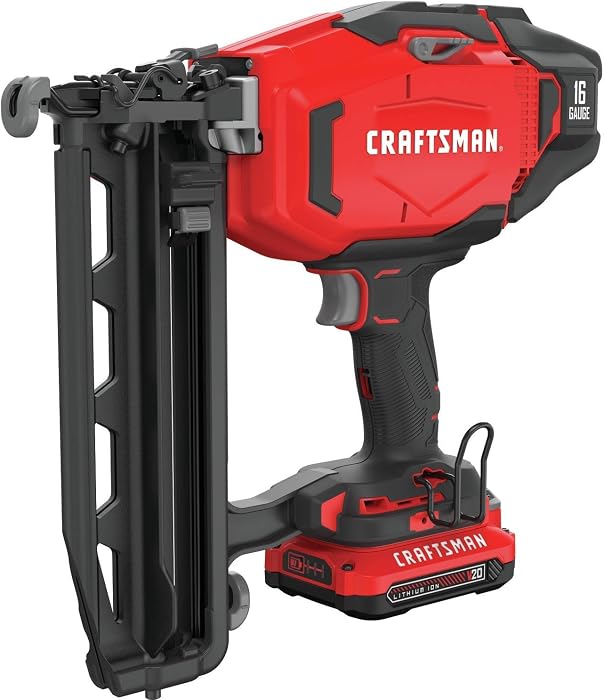
Open the box and you have everything you need to start: the gun, a 20V battery, a charger, and 200 finish nails in two lengths. In a group where two of the four picks are bare tools, that is not a small distinction. It is the difference between a purchase and a project.

That makes it the right first finish nailer for someone starting from nothing. The DEWALT guns are the better tools in the abstract, but they assume a battery platform you may not own, and the packs are not free. This is the only one here that does not send you shopping for a battery before you can fire a nail.

The rest of the package is more capable than the price suggests. Depth adjusts without a tool, the jam and stall settings release without one either, and Craftsman claims consistent firing power across climate conditions and materials. It drives the 2-inch and 2-1/2-inch 16-gauge nails in the box, which covers baseboard and most casing you will hang.

Set the depth on a scrap of the same trim before you commit to a run. The wheel moves easily in both directions, and it is just as easy to overshoot and leave a head proud as it is to bury one.

Worth Noting

  • Heaviest of the four at 9.1 pounds
Our Verdict

The one to buy when you own no batteries yet: gun, battery, charger, and nails in a single box, with the weight as the trade you make.

Check Latest Price
4

DEWALT DCN662B 16GA Straight Finish Nailer Best Straight-Magazine Pick

DEWALT DCN662B 16GA Straight Finish Nailer

Trim and casing

Field Score 88/100
Weight
6 lb
Dimensions
11.9 x 3.7 x 12.3 inches
Nail Gauge
16 gauge, straight
Power Source
DEWALT 20V MAX battery (tool only)
View on Amazon

Straight magazines get walked past on the way to the angled guns, and for trim that runs along a wall rather than into a corner, that is a mistake. This is the DEWALT for baseboard, casing, and cabinet fillers, and the narrower micro nose gives you a cleaner line of sight down the fastener than the bulkier angled bodies do.

At 6 pounds it is the lighter of the two DEWALTs here, and that shows up in the places you would expect: one hand on the gun, one holding the trim in place, no wrestling to keep the nose on your mark. The trigger switches between sequential and contact actuation without a tool, and depth adjusts the same way.

What settled it for us is how little goes wrong with it. Nothing here reads like a compromised version of the top pick: same brushless motor, same 20V MAX packs, same tool-free adjustments. Where it differs is the line it draws — a straight body tracks a long horizontal run without wandering off the face, and that steadiness is worth more than corner access on a job that has no crown in it.

Six pounds and a slim nose also make it the easier of the two DEWALTs to steer in tight spots like a closet return or the underside of a shelf. If your work is trim that runs along a wall, this is the one to put in the bag.

Worth Noting

  • Bare tool
Our Verdict

For straight runs of baseboard and casing, this six-pound DEWALT places nails as precisely as anything here, provided your 20V MAX packs are already on the shelf.

Check Latest Price

How We Tested the Cordless Finish Nailers

This started as a spec-sheet exercise. We sorted the 16-gauge cordless field by magazine angle, bare tool versus kit, published weight, and price, then narrowed it to six units that covered the spread, including tools built for people who already own the batteries and kits for anyone starting from zero. Then we put them to work for nine months on a hallway of baseboard, a set of door casings, two cabinet installs, and a lot of crown molding held overhead at the top of a ladder.

Real trim set the schedule. Each nailer ran pine, poplar, oak, and MDF, since the gun that sets a nail cleanly in soft pine can balk at white oak. We counted shots per charge and ran every battery down to cutoff rather than topping it up, because a nailer that dies eight feet up a ladder is the whole argument against going cordless.

Jams got logged, not forgiven: how many per box of nails, how long each took to clear, and whether the tool came back to life without a screwdriver. Every gun was weighed loaded with a full magazine on a kitchen scale, then carried overhead through a complete crown run, which is where a pound stops being a number. We checked for dimples in prefinished trim, let each one ride loose in a truck bed for a week, and knocked them off a sawhorse onto concrete to see what rattled loose.

How to Choose a Cordless Finish Nailer

Angled or Straight Magazine, 15 or 16 Gauge

The magazine angle decides which joints you can reach. An angled gun holds the fasteners at an angle to the nose, so the body sits off to the side of the nail line and you can toe a nail into an inside corner where crown or casing turns. A straight magazine keeps the whole gun in line with the fastener: stable along a long run, but it cannot lay into that same corner.

Gauge is the other half of the choice. Sixteen-gauge fasteners handle interior trim, casing, and baseboard; fifteen-gauge nails are thicker and suit heavier moldings and exterior work. If one nail gun has to cover everything from baseboard to crown, buy the angled 16-gauge.

A Bare Tool or a Complete Kit

Both DEWALT models here are bare tools, the Paslode arrives with its own 7V pack, and the Craftsman is the only one that ships with a battery, a charger, and a supply of nails. If a 20V MAX drill and charger already live in your shop, a bare tool is plainly the smarter buy. If the shelf is empty, price the packs and charger before you commit, because they can erase the savings.

Running cost is the second half of that math. Fuel-cell guns like the Paslode buy their punch with cartridges you replace by the box, while battery-only guns draw on packs you may already own and never charge you per nail.

Weight Is the Spec You Feel at Hour Three

Listed weights in this group run from 4.5 pounds to 9.1 pounds, and the difference only matters in one direction: up. A heavier gun is perfectly pleasant on baseboard at waist height and a genuine burden on crown above your shoulders, where you are holding the tool out at arm's length rather than resting it against a wall.

Balance counts for almost as much as the number. A gun that hangs nose-heavy fights you on a ladder; one that sits back over your palm lets you steer the nose with your fingertips.

Jams, Depth, and Tool-Free Everything

Driving power is rarely the problem with these tools; recovery time is. A tool-free depth wheel means you can chase a change in trim thickness without hunting for a hex key, and a tool-free jam release turns a stopped run into a minute of work instead of a walk back to the truck.

The trigger setting matters just as much. Sequential actuation fires one nail per pull and is what you want for precise trim work and for anything overhead on a ladder; contact actuation fires on nose contact for speed on long runs of sheathing or fencing. Every gun here offers both, so choose on how fast each one recovers.

Frequently Asked Questions

Final Verdict

If a DEWALT 20V MAX battery is already on your bench, the angled DCN660B is the finish nailer to buy: it reaches the corners the straight guns cannot, and its tool-free depth, trigger, and jam release keep a trim run from stalling.

The exceptions are worth knowing. When the work is crown above your shoulders, the 4.5-pound Paslode is the gun that gets you to the end of the ceiling. When you own no battery platform at all, the Craftsman kit is the only one here that lets you start nailing without another purchase.