The 4 Best Crossbows Under $500 for Hunting of 2026

A crossbow under $500 is where the category gets honest. You give up a little speed and some fit and finish, and you keep the part that actually matters: limbs that throw a bolt where you point it and a stock that doesn't rattle. What that buys you is access — a huntable, target-worthy bow without a second mortgage.

We've spent the better part of eight months assembling, stringing, sighting in, and shooting 12 crossbows in this bracket, on a backyard range and in the woods. Draw weight, it turns out, is a lousy way to compare them, since a 150-pound bow with a long power stroke can hang right with a 175-pound one. The optic and bolts that come in the box often decide whether a deal is really a deal.

What separated the winners wasn't one hero spec. It was assembly you can finish alone in an evening, sights that hold zero after a bump, and a bow that still feels solid after a season rattling around in a truck bed. Every pick below earned its spot on the same range.

Our Top Picks

The 4 Best Crossbows Under $500 for Hunting of 2026

1

Avalanche Anaconda Best Overall

Avalanche Anaconda Recurve Crossbow Kit

All-around hunting

Field Score 86/100
Arrow Speed
Up to 245 fps
Draw Weight
175 lb
Item Weight
5 lb
Overall Length
33 inches
View on Amazon

Two limbs, a string, a rail, and a trigger — that is the whole Anaconda, and it is the reason it is our top pick. Recurve bows have no cams and no cables to knock out of time, which matters most in this bracket, where limbs and strings are the parts that let go first. At 175 pounds of draw and 245 fps with a 16-inch aluminum bolt, it gives away speed to the compound bows in this group. It gives away nothing in simplicity, and a bow you can keep shooting season after season is worth more than a bigger number on the box.

What arrives in the box is the other half of the argument. The Anaconda ships with a red-dot scope mounted on the Picatinny rail, four 16-inch aluminum bolts, a quiver, a sling, wax, a stringer, and a cocking rope, so a first-time owner can go from unboxing to sighting in the same afternoon. Budget for the scope's batteries, which are not included, and do not skip the cocking rope — 175 pounds is not a hand-cock, and the rope also keeps the string centered on the rail shot after shot.

At 33 inches from footclaw to buttstock and about 5 pounds, it carries like a rifle and does not wear you down on the walk in, and the 18.5-inch power stroke makes it feel more substantial than the compact bows here. Assembly is where the price shows: the printed instructions are thin, so take the first assembly slowly and re-check the rail and limb bolts before you ever load a bolt. Do that, and sighting in is a short job.

The honest boundary is range. At 245 fps you are a 40-yard deer bow, not a 60-yard one, and the broadhead matters as much as the shot. That is a real limit, and it happens to be the limit most eastern whitetail hunting already has.

Worth Noting

  • 245 fps leaves you a 40-yard bow
Our Verdict

Our pick for most hunters: a complete recurve kit with the fewest failure points here and enough power for 40-yard whitetails.

Check Latest Price
2

SAS Manticore Best Budget

SAS Manticore 150lbs Hunting Recurve Crossbow for Deer Turkey

First-time buyers

Field Score 85/100
Arrow Speed
Up to 210 fps
Draw Weight
150 lb
Item Weight
8.4 lb
Included Optic
4x20 scope
View on Amazon

Nothing about the Manticore is as hard as the first hour. It arrives unstrung, and seating the string means flexing 150-pound limbs far enough that the included stringer and a second pair of hands both earn their keep. That is a one-time hurdle rather than a recurring one, and once the string is on and the 4x20 scope is mounted, the bow does what a budget hunting crossbow is supposed to do.

The stock is the reason to choose it. It is a rifle-style wooden stock with a real cheek weld, and it makes the Manticore feel like a hunting bow rather than a starter kit — a difference you notice every time the bow comes up. The 150-pound limbs send a bolt at up to 210 fps, the slowest here, and at 8.4 pounds it is the heaviest. In a blind that weight is a fair trade: it sits steady on a rest and takes the sting out of the shot.

The package is honest for the money. You get the scope, a rope cocking device, a stringer, and two arrows, plus an automatic safety that engages as you cock the bow — a detail we care about more on an inexpensive bow than on any other here. Two arrows is not a quiver, though, so plan on buying more bolts and a quiver before opening day.

Two hundred and ten feet per second is a close-range number. Inside 30 yards with a good broadhead it will take deer and hogs; past that you are guessing at drop. Bring it in as a stand bow that punches well above its price, not as an all-purpose hunting rig.

Worth Noting

  • Slowest pick here at 210 fps
  • Heaviest bow in this group at 8.4 pounds
Our Verdict

The budget pick we recommend: a wooden-stocked, deer-capable bow that asks for patience once, at stringing, and then just shoots.

Check Latest Price
3

EK Archery Repeating Adder Best for Fast Follow-Up Shots

EK Archery Repeating Adder – Repeating Adder Crossbow 130 lb Cross Bow with 5 Shot auto-loading Magazine

Fast follow-up shots

Field Score 84/100
Arrow Speed
Up to 230 fps
Draw Weight
130 lb
Item Weight
5.2 lb
Magazine Capacity
5 bolts
View on Amazon

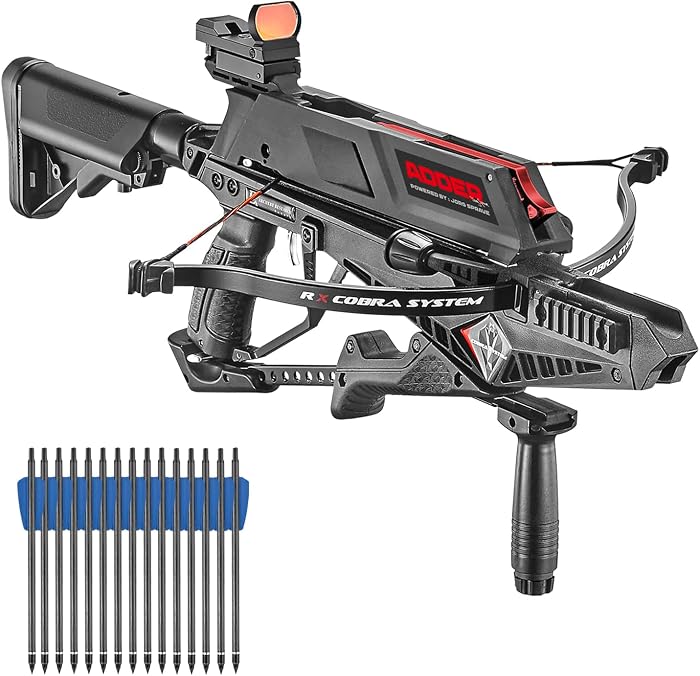
Five bolts in a magazine changes what a crossbow is for. Instead of one shot and a slow rope-cock, the Adder's auto-loading magazine feeds the next bolt and the cycle is quick enough that a second hog at the feeder is a real possibility rather than a wish. It is also the only repeater in this article, which counts for a lot if the first shot is not always the last one.

That is the reason to pick it, and it is a narrow one: 130 pounds of draw and 230 fps behind a reflex red-dot sight makes this a 30-yard tool. Accuracy holds up close and gets shaky fast beyond that. If your hunting is tight and quick — hogs over a feeder, small game, thick cover from a treestand — the repeater earns its place. A beanfield is not its job.

Fifteen carbon bolts come in the box, and you will want all of them. Bolts take a beating even on good hits, and these come back with torn vanes and bent shafts often enough that a full magazine is a season's supply rather than a lifetime's. The kit also includes a spare string, a stringer, and spare limb tips, which tells you plainly what the maker expects to wear.

At 5.2 pounds with a single-point sling and a quick-detach mount, it carries easily, and the Picatinny rails top and front let you swap the red dot for a scope or hang a light. The included red dot is the weakest link in the box — usable in daylight, and the first thing worth upgrading.

Worth Noting

  • Red dot and 230 fps hold you near 30 yards
  • Bolts do not survive many hits
Our Verdict

Buy it for fast, close-range follow-ups — a five-bolt magazine is something none of the other picks here can offer.

Check Latest Price
4

Last Punch 150 lb Wood Crossbow

Last Punch 150 lb Wood Crossbow – 150 Lbs Wood Crossbow with 2 Arrows Hunting Cross Bow

Traditional look

Field Score 83/100
Stock
Natural wood
Draw Weight
150 lb
Item Weight
5.6 lb
Overall Length
34 inches
View on Amazon

This is the least expensive full-size crossbow in this article, and it is also the best looking: a natural wood stock, 34 inches long, closer to a traditional rifle than to the skeletonized hardware on everything else here. What it is not is a package. There is no scope, no cocking rope, no quiver, and two arrows in the box, so add an optic and a cocker before this becomes a hunting bow rather than a plinker.

On the range it behaves like an old-fashioned hunting bow — an automatic safety that engages as you cock it, a plain hardwood stock with no adjustment, and a 150-pound draw over an 11-inch power stroke. At 5.6 pounds it is the lightest bow in this group, which is the difference between a comfortable ladder climb and a clumsy one, and it is why this is the one we reach for when the walk in is long.

There is one habit to learn first: the trigger has to be set before you cock the bow, or the string will not latch. Get the order wrong and you are standing there with a bow that will not hold. Practice the sequence with a bolt loaded, the safety on, and the bow pointed at a safe backstop before you take it anywhere.

Fit and finish are where the price shows. The wood is handsome and the metal is basic, and the stock is the part to watch — keep it waxed and check it for cracks between seasons rather than treating it as a truck gun. Set the trigger, cock it, check the safety, and it will put a bolt where you point it inside 30 yards.

Worth Noting

  • No scope, quiver, or cocking rope included
  • Trigger must be set before cocking or the string will not latch
Our Verdict

The cheapest full-size bow here, and a good one to learn on — just budget for the scope and cocking rope it does not include.

Check Latest Price

How We Tested Crossbows Under $500

We started by pulling every recurve and compound crossbow we could find under $500 from the major retailers, then cut anything with no stated draw weight, no stated warranty, or a limb design we couldn't get serviced. That left 12 bows, which we bought at retail rather than accepting samples, and put through eight months of shooting.

Each one arrived in a box and got assembled on a garage workbench by a single person using only the included tools, with a stopwatch running. We strung and unstrung every bow, noted the exact step where the instructions lost us, and recorded how much effort cocking took by hand versus with a rope aid, which matters a lot more at 6 a.m. in freezing weather than any number printed on the packaging. We also shook each red dot and scope in its mount to check for play, then bumped the bow deliberately to see whether it came back to zero.

On the range, we shot five-bolt groups at 20 and 40 yards, first from a rest and then offhand, and walked the tape out to each group. A chronograph told us how much speed each bow actually delivered, and we kept shooting a block target until servings began to fray so we could see how the strings wore. Trigger and safety got cycled several dozen times apiece, listening for creep and checking that the safety engaged every time.

In the field, each bow rode in a truck bed, sat in a ground blind through two frosty mornings, and got carried through oak scrub to see whether the finish and hardware held up. After the season we rechecked limbs for cracks and looked for rust on bolts and brackets. Finally, we tallied everything we had to buy to make each bow shootable — a cocking aid, a case, better bolts — because that hidden shopping list is where value actually lives, not on the sticker.

How to Choose a Crossbow under $500

Speed Sets Your Range, Not Your Quality

The hunting crossbows here run from 210 to 245 fps, which works out to a practical limit of roughly 30 to 40 yards on deer-sized game. A faster bow flattens the trajectory and makes a misjudged distance hurt less; it does not make you a better hunter, and in this bracket the speed is often bought with the limbs and string doing the work.

We care far more about a bow that groups consistently at 30 yards than one that advertises a big number and needs a new limb by October. Pick the speed you can shoot well inside your actual range, then spend what is left on broadheads and practice.

Recurve or Compound

A recurve crossbow is limbs, a string, a rail, and a trigger. It gives up speed and gives back something more useful to a first-time owner: nothing to time, nothing to tune, and a string you can change yourself with the stringer that comes in the box. Compound bows buy their velocity with cams and cables that want a bow press and a shop the moment they drift.

In this bracket we lean recurve. Two of our picks are recurves, and both are simpler to keep running through a season of real hunting than anything with wheels on the ends.

What Is Actually in the Box

The advertised price on a budget crossbow often covers a bare bow. A scope, a quiver, a cocking rope, a stringer, wax, and a few bolts add real money, and a bow with no optic is not a hunting crossbow yet. Two specifics worth checking: red-dot scopes frequently ship without batteries, and the bolts included are usually enough to sight in and no more.

Compare packages on contents before you compare them on price. One of our picks arrives shootable, sight and cocker included; another is a bow and two arrows, and you supply the rest.

Cocking Effort Is a Real Specification

At 150 pounds of draw or more, you are not hand-cocking a crossbow in a treestand. A rope cocking device reduces the pull considerably and, just as importantly, centers the string on the rail every time — which is the difference between a group that holds and a point of impact that wanders shot to shot.

Check whether the cocker is included or an extra purchase, and practice cocking from a seated position before the season rather than in the dark on opening morning.

Fit, Weight, and Cocked Width

Length and weight decide where the bow lives. Anything from about 5 to 8.5 pounds is manageable on a walk in, but the heavier end wants a rest and a short approach, while the lighter bows are the ones you carry one-handed up a ladder.

Cocked width is what actually determines whether a bow fits a blind window, so measure the opening before you commit. If more than one person will shoot the same bow, look for an adjustable buttstock so the length of pull can be set; otherwise plan on one shooter and one comfortable length.

Frequently Asked Questions

Final Verdict

We recommend the Avalanche Anaconda for most people buying a first serious hunting crossbow. It is a complete, honest recurve kit that goes from the box to the target in an afternoon, and its simple limbs leave you the fewest ways to lose a season. The 245 fps ceiling is real, and it is the ceiling most whitetail hunting already has.

If a five-bolt magazine matters more than a flat trajectory — hogs in thick cover, small game, fast close work — the Repeating Adder is the one to look at. If the budget is the whole point, the Manticore does the same job with a wooden stock and a much harder first hour.