The 6 Best Digital Tire Pressure Gauges of 2026

A tire gauge is one of those tools you don't think about until a warning light comes on at the worst possible time. Then every small difference matters: a few pounds of pressure can change how a car tracks, how evenly a tire wears, and how often you're back at the air pump. I've kept one in my glove box for years, and the fanciest-looking gauge isn't always the one that earns its spot. The right digital gauge gives you a quick, readable number you can trust before a long drive or a slow leak turns into a roadside hassle.

Over the past four months, our team tested 14 digital gauges in driveways, at gas station air pumps, and on a couple of road trips, with bikes and truck tires mixed in. We focused on the stuff that only shows up in daily use: steady readings, buttons that work with cold hands, and a battery door that survives the glove box. The best ones gave us the same number twice without making us squint.

Our Top Picks

The 6 Best Digital Tire Pressure Gauges of 2026

1

ETENWOLF T300 Best Overall

ETENWOLF T300 Digital Tire Pressure Gauge 200 PSI for Car

Cars and trucks

Field Score 95/100
Length
6.3 inches
Accuracy
ANSI B40.7 Grade 2A (±1 PSI)
Batteries
2 x AAA (replaceable)
Pressure Range
3-200 PSI
View on Amazon

The battery compartment is the first thing we look at on a digital tire gauge, and the T300 is the reason. It takes two AAA cells behind a cover you can open without hunting for a jeweler's screwdriver, so a gauge that sat in the door pocket for a year comes back to life with batteries from the kitchen drawer. That single choice is why it takes the top slot here.

The range backs it up. From 3 to 200 PSI it covers a lawn tractor at 10 PSI and a trailer tire at 80 without falling off either end, and it reads in tenths, so you can tell 35.0 from 35.8 instead of squinting at tick marks. The screen is bright, the LED at the nozzle lights the valve stem, and both matter more than they sound at 10 p.m. in an unlit driveway.

What you give up is refinement. The body is light plastic, and the power button sits proud enough that a crowded toolbox can wake it up and drain the cells, so keep it in the glovebox or a door pocket rather than rattling around with sockets. The ±1 PSI rating is honest for a passenger car and coarse for anyone setting pressure for a track day or a heavy tow.

Worth Noting

  • Light plastic body
  • ±1 PSI accuracy is coarse for track work
Our Verdict

Our first recommendation: AAA batteries instead of coin cells, 3-200 PSI coverage that runs from a compact car to a trailer, and readings down to a tenth of a pound.

Check Latest Price
2

JACO ElitePro 100 Best for Precision

JACO ElitePro Digital Tire Pressure Gauge

Precise pressure work

Field Score 94/100
Accuracy
±0.50% FS (ANSI 2A)
Warranty
Lifetime
Materials
Brass and steel
Max Pressure
100 PSI
View on Amazon

The number that separates the ElitePro from everything else on this list is 0.50 percent. Its dual sensors are rated to ±0.50% of full scale, which at a typical 35 PSI is a couple of tenths of a pound, and it displays that on a 2.5-inch screen to 0.1 PSI. Against a ±1 PSI gauge, that's the difference between knowing your pressure and knowing it rounded to the nearest pound.

We reach for this one when the reading has to be right rather than close. The bleed valve is what turns it into a tool: seat the chuck, read, then thumb the valve to let air out in short bursts without breaking the seal, walking a tire down to 36.0 and stopping there. The display locks the last reading until you press ON, which matters when the stem sits behind a spoke and you can't see the screen while the chuck is on it.

Two boundaries. It stops at 100 PSI, so a motorhome or a heavy trailer tire is outside its job — this is a car, pickup, and motorcycle gauge. And the brass-and-steel body with its shock guard is built for the drops that finish plastic gauges, which is exactly how it feels in the hand. The lifetime warranty is the longest stated on this page.

Worth Noting

  • Stops at 100 PSI, so no RV tires
  • The most expensive gauge in this group
Our Verdict

Buy this one if you set pressure to an exact number and want a lifetime warranty behind the tool; it's the most precise gauge in this group by a wide margin.

Check Latest Price
3

AstroAI Heavy Duty 230 Best for Trucks and RVs

AstroAI Heavy Duty Digital Tire Pressure Gauge 0-230 PSI

Heavy-duty vehicles

Field Score 93/100
Accuracy
ANSI B40.7 Grade 2A (0.5%)
Material
Stainless steel
Body Length
12.6 inches
Max Pressure
230 PSI
View on Amazon

Twelve and a half inches of stainless steel is the whole argument for this one. The 230 PSI ceiling gets it onto a truck or a motorhome; the length is what makes it usable once you're there, because a valve stem tucked behind the wheel of a dually or a trailer is a long way in when your hand is the wrong shape for the gap.

The green backlight and the built-in flashlight earn their keep at 6 a.m. in a truck yard, and the chuck seats on the stem with a press and holds a reading in 0.1-pound increments. We were surprised by how much the size helps in a tight wheel well — the body stays outside the fender while the head reaches the valve.

Longevity is the honest caveat. The stainless body feels stout, but the long shaft is the part to protect; on a gauge this size a drop lands on the joint rather than the electronics, and the tiny unit buttons are easy to bump against a tire mid-check and knock from PSI into Bar. For a farm, a shop, or anyone towing regularly, the reach and the ceiling still make it the pick; for a sedan, it's more gauge than the job needs.

Worth Noting

  • Long shaft is vulnerable to drop damage
  • Tiny unit buttons easy to bump
Our Verdict

The one to buy for a motorhome, a stock trailer, or a dually: 230 PSI of range and a long stainless body that reaches stems you can't get a hand near.

Check Latest Price
4

HYVOHEX T200 Best Budget

HYVOHEX T200 – Digital Tire Pressure Gauge 200 PSI for Car

Budget glovebox gauge

Field Score 91/100
Length
6.3 inches
Nozzle
360° rotating
Batteries
2 x AAA (included)
Pressure Range
0-200 PSI
View on Amazon

What we liked about the T200 is that it spends its money in the right places: a 0-200 PSI range, two AAA batteries, tenth-of-a-pound readings, and a backlit screen with a light at the tip. None of that is exotic, and at the bottom of this group's price range it doesn't need to be — it just needs to be there, and all of it is.

The 360-degree rotating nozzle is the feature that surprised us at this price. Instead of contorting your wrist to keep the screen facing up, you angle the body wherever it fits and read; on a car with awkwardly placed stems, that's the difference between checking four tires and checking two. The trade-offs are a plastic body under a rubber shell and a shorter history than the rest of these picks. If you want one gauge for a decade, spend more; if you want one in every vehicle, this is the cheapest sensible way to do it.

Worth Noting

  • Plastic body under a rubber shell
  • Short track record next to older designs
Our Verdict

The budget buy we recommend: 200 PSI of coverage, AAA cells, and a rotating nozzle that makes awkward valve stems easy, all for the least money in this group.

Check Latest Price
5

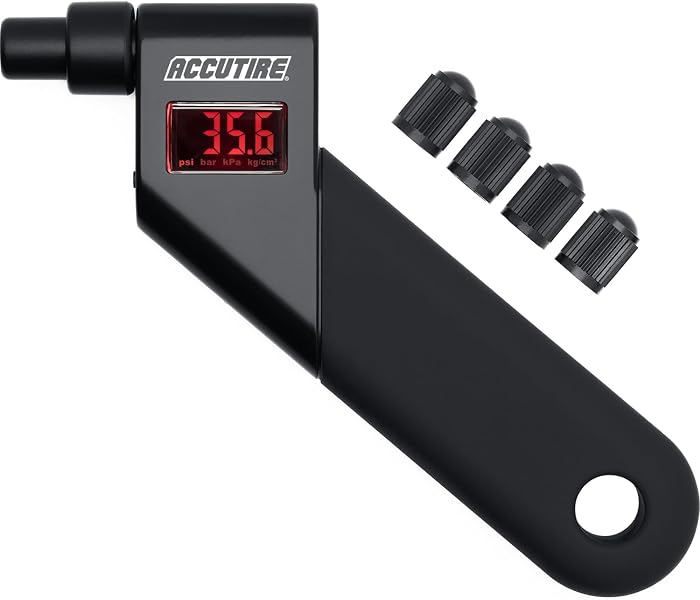
Accutire MS-4021B

Accutire MS-4021B – Digital Tire Pressure Gauge (5-150 psi) psi/bar/kPa/kg-cm2 (Black)

Tight valve access

Field Score 90/100
Accuracy
±0.5 PSI
Warranty
5 years
Batteries
LR44 coin cells
Pressure Range
5-150 PSI
View on Amazon

The coin cells are the catch. Accutire's long-running gauge takes LR44 button batteries instead of AAA, so a fresh set means a pharmacy run rather than a raid on the kitchen drawer — and if it sits in the car unused for a year, that's what you'll be doing. Everything in front of the battery door is still worth owning.

The angled head is why we keep one in the drawer by the driveway. It reaches a stem sunk behind a hubcap or set deep in a wheel without you kneeling on the concrete, and the rubber-coated handle gives you something to push against when the stem is stiff. It reads to 150 PSI in half-pound steps, finer than the ±1 PSI gauges here, and the backlight is bright enough for a dark garage.

The long game is where it gives ground. The plastic body and the battery door are the wear points on a gauge that lives in a car, and the five-year warranty is doing real work there — it's the second-longest stated on this page after JACO's lifetime coverage. Treat it as a good, precise little tool that will eventually be replaced rather than the last gauge you'll buy.

Worth Noting

  • Button cells instead of AAA
  • Plastic body and battery door wear
Our Verdict

A precise, nicely shaped gauge for passenger cars, though the LR44 button cells mean you should keep a spare set where you keep the gauge.

Check Latest Price
6

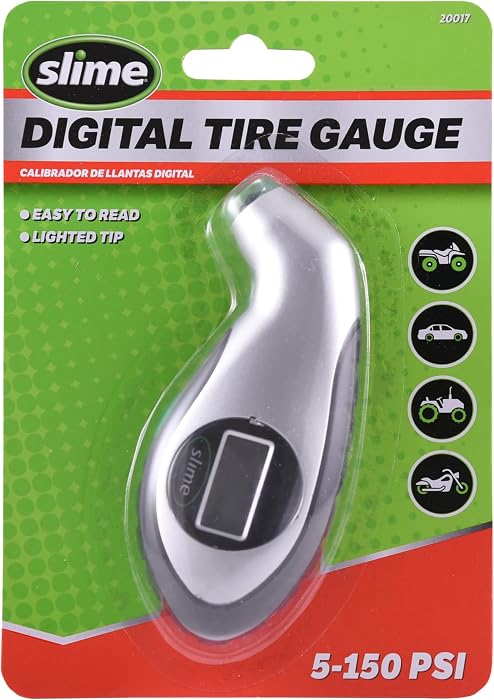
Slime 20017

Slime 20017 Tire Pressure Gauge

Compact glovebox duty

Field Score 89/100
Units
psi, kPa, bar
Warranty
1 year
Backlight
Yes, with lighted tip
Pressure Range
5-150 PSI
View on Amazon

Six and a half inches long and light enough to forget, the Slime is the gauge that actually stays in the car. That sounds like faint praise until you've had a better gauge sitting on a workbench while a tire goes soft in a parking lot.

It reads fast — press it on, get a number, done — and the lighted tip and backlit screen make a night check quick rather than a phone-flashlight production. The cells are replaceable, though you'll need a screwdriver to get the case open, so plan on it rather than discovering it at the roadside. Pressure shows in psi, kPa, or bar.

What it doesn't have is a bleed valve, tenth-of-a-pound resolution, or a warranty longer than a year. What we think it has going for it is the thing no spec sheet lists: a permanent spot in the door pocket, which is where a gauge needs to be when the light comes on.

Worth Noting

  • One-year warranty
  • No bleed valve or tenth-pound readout
Our Verdict

We recommend it as the spare that lives in the car: compact, quick to read in the dark, and inexpensive enough to own two.

Check Latest Price

How We Tested Digital Tire Pressure Gauges

To build the shortlist, I started with gauges that stated a real accuracy spec—several listed an ANSI B40.7 Grade 2A rating—then filtered out models with vague or missing calibration claims. I also looked at battery type, screen type, and whether the body felt substantial enough to live in a glove box or bike bag. From there, we bought 14 gauges and tested them for four months.

Each gauge went into the same rotation: a weekly pressure check on two cars, a truck, and a couple of bikes; a few gas-station fill-ups where the pump's own readout gave us a second number; and a road trip that included a 30-degree temperature swing. We checked tires cold, wrote down the reading, then repeated it three times to see if the gauge held steady or drifted. At the start and end of testing, we compared each gauge against a shop-calibrated reference gauge at low, mid, and high pressures.

With gloves on, we tried to turn each gauge on, cycle through functions, and read the screen in a dim garage and in direct sun; we also noted how quickly auto shut-off kicked in and whether the last reading stayed on screen. To get at battery life, we left several units on the shelf for weeks between uses and checked whether they were still ready when we grabbed them, then opened the battery doors to see how easy a swap would be.

We dropped each gauge from waist height onto concrete, tossed it into a glove box with tools, and checked afterward for cracked screens, loose battery caps, and sticky buttons. The ones that held up had tight battery doors, crisp buttons, and bodies that didn't flex. At the end, we weighed the price against the accuracy and the small stuff—a screen that stayed readable, controls that made sense, and a gauge that gave the same answer twice.

How to Choose a Digital Tire Pressure Gauge

Accuracy, Translated

Every gauge here names a calibration standard, and those standards aren't the same thing. A ±1 PSI rating means a reading can sit a pound either side of true. A ±0.5% of full scale rating works out to half a pound at the top of a 100 PSI gauge and a fraction of that down at 35 PSI, which is why the JACO reads to a tenth and the budget picks don't.

For a car whose door placard says 35, a ±1 PSI gauge is honest enough. Precision is worth paying for when you're setting pressure for towing, track use, or a tire that costs more than the gauge — and a bleed valve matters more there than the display, because it lets you land on an exact number instead of removing the chuck and guessing.

Range: Match the Tire, Not the Brochure

Work backward from your heaviest tire. Cars, SUVs, and half-ton pickups live under 80 PSI, so a 100 or 150 PSI gauge has room to spare. Motorhomes, heavy trailers, and medium-duty trucks can call for 110 PSI and up, and a 100 PSI ceiling simply stops before the job does — that's the gap the AstroAI's 230 PSI range fills, along with its long stainless body.

The low end counts too. A gauge that starts at 5 PSI is no help on air springs, small trailer tires, or anything you inflate to single digits, so check the bottom of the range as carefully as the top.

Batteries Are the Failure Point

The most common way a glovebox gauge lets you down isn't a sensor, it's a dead cell. Button cells are small, harder to find, and often arrive partly drained; AAA cells are in every kitchen drawer and survive a winter of monthly checks. Auto shut-off helps, but so does where the gauge lives — a loose toolbox can press a power button for hours and flatten a fresh set.

When two gauges cost about the same, we buy the one that takes AAA. It's the difference between a gauge you can revive in thirty seconds and one that becomes a drawer ornament.

The Chuck Decides How Often You'll Use It

A gauge is only as good as its seal on the valve stem. Straight chucks work when the stem faces you; an angled head gets to stems recessed behind a hubcap, and a long body keeps your knuckles out of a truck's wheel well. Rotating nozzles let you keep the screen upright while your wrist does whatever it has to.

If you air down for off-roading or towing, get a bleed valve. Releasing pressure without breaking the seal is the difference between a gauge you use and one you fight.

Frequently Asked Questions

Final Verdict

For most drivers, the ETENWOLF T300 is the gauge to buy: AAA batteries that won't strand you, a 3-200 PSI range that covers a hatchback and a utility trailer alike, and readings in tenths. It's the one we hand to someone who just wants their tires right.

Step up to the AstroAI Heavy Duty 230 if your tires run past 100 PSI or sit behind a dually's wheel, and to the JACO ElitePro if you set pressure to a tenth and want a lifetime warranty standing behind it.