The 6 Best Down Jackets of 2026

A down jacket is a bet you make every winter: you pay for warmth you can fold into a backpack and hope the feathers stay inside the seams. The good ones make that bet feel safe — warm at 25 degrees, light enough to forget, cut so you don't look like a sleeping bag with a zipper. The difference between a good one and a leaky one hides in small places: a zipper that snags at your chin, a hood that slides over your eyes, a pocket too shallow for a phone.

I've owned a couple of cheap puffers that shed feathers onto every black sweater I own, so I came into this with a grudge. My team and I wore 12 jackets over the past six months — thin packable layers alongside long, hooded parkas — through cold morning commutes, weekend hikes, and wet, heavy snow.

One thing worth knowing before you shop: down doesn't warm you on its own. Loft traps your body heat, which is why fit matters as much as fill, and a jacket that's too snug flattens the baffles and leaves cold spots across the shoulders. The picks below are the ones we reached for without thinking, which is the highest compliment outerwear gets.

Our Top Picks

The 6 Best Down Jackets of 2026

1

Orolay Thickened Down Jacket Best Overall

Orolay Women's Thickened Down Jacket

Deep winter everyday

Field Score 93/100
Fit
Women's
Hood
Lined, fixed
Design
Thickened parka
View on Amazon

Plenty of down jackets make you choose between warm and comfortable: thick enough for a hard freeze, or light enough that you don't feel like you're wearing a mattress to the store. The Orolay is the one here that refuses the choice. The down is packed thick through the chest and shoulders, the collar stands up on its own, and the coat has the settled heft of something built for February. Pull it on over a sweater on a genuinely cold morning and the weather stops being the thing you're thinking about.

It's the details that keep it in rotation. There are enough zippered pockets to separate gloves, keys, and a phone instead of balling them together, and the hood is lined in something soft that doesn't rasp against your ears when you turn your head. The side zippers are the feature we didn't expect to lean on: crack them open and the coat relaxes over a heavy sweater, or over your lap when you sit down. Sizing is the one thing to get right. This coat is cut close through the shoulders and the tag size doesn't match what most people wear over a sweater, so measure your chest and check the chart against a coat you already layer under.

One quirk we noticed in daily use rather than in the fitting room: the hand pockets sit high on the front, up near the waist. That's fine with gloves on and slightly awkward when you're reaching down for keys or a leash without looking. It's a small thing next to a coat that gets the main job right. It's also the priciest coat on this page, which is the honest trade: you're paying for the fill and the finishing, and both show.

Worth Noting

  • Fixed hood can't be removed
  • Zippers can stick when you're rushed
Our Verdict

The warmest coat in this group and the one we reach for first: thick down, a soft lined hood, and pockets that hold everything. Order by measurement, not the tag.

Check Latest Price
2

Eddie Bauer CirrusLite Down Jacket Best Lightweight Layer

Eddie Bauer Men's CirrusLite Down Jacket

Layering under a shell

Field Score 92/100
Fit
Men's
Design
Lightweight
Insulation
Down
View on Amazon

The listing weighs the CirrusLite at 7.83 ounces, and that number explains everything else about it. It packs into a corner of a daypack, slides under a shell without bunching at the shoulders, and adds warmth without adding bulk where your pack straps sit. For a cold morning at the trailhead, a September hunt, or a ball game that runs three hours past sunset, it's the piece you want in the bag whether or not you end up wearing it.

We treat it as a midlayer, and that's where it earns its keep: over a wool shirt and under a canvas jacket it turns a raw morning into a comfortable one without turning you into the Michelin man. Worn alone it handles a dry, cold day in town, and it looks better than the money suggests, with a clean cut and a collar that sits flat under a hood. Down this light has a way of feeling like nothing in the hand, which is exactly the point: you notice it when you take it off, not while you have it on. Pack it in October and it will earn more days than the parka hanging by the door.

Worth Noting

  • Down works out through the seams onto your clothes
  • Shell is thin enough to tear on brush
Our Verdict

We keep this one in a pack rather than on a hook: real down under eight ounces, cheap enough to leave in the truck, and warm under a shell.

Check Latest Price
3

Calvin Klein Packable Down Jacket Best Packable

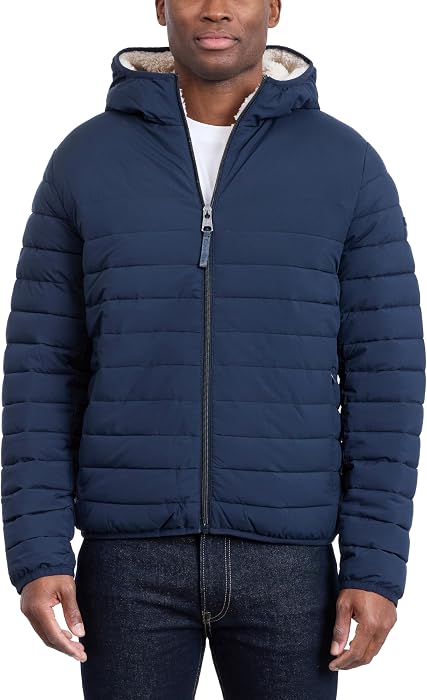
Calvin Klein Men's Lightweight Packable Down Jacket With Sherpa Lining

Travel and packing

Field Score 91/100
Fit
Men's
Design
Packable
Lining
Sherpa
View on Amazon

A packable down puffer usually has one flaw you notice immediately: the shell feels like a trash bag against bare arms. The Calvin Klein fixes it with sherpa lining through the body, and the result is a jacket you can wear over a T-shirt in a cold truck and still fold into a carry-on. The down is real, the shell is light, and it squashes down to about the size of a folded sweater.

Where it's earned its place is on trips where the weather is a guess. It's warm enough over a sweater for a genuinely cold morning and light enough to leave in the truck all afternoon, and the sherpa means this is the one jacket here you don't have to think about what's underneath. It is not a parka and doesn't pretend to be: this is the layer for a cold airport, a dawn walk, and a football sideline, not a January sit in a stand.

The lining does have a cost. It's exactly what the zipper grabs when you pull it up fast, and the teeth will catch the fleece at the throat if you're not paying attention. Zip it with your other hand holding the lining clear and it stops happening; yank it and you'll spend a minute picking fibers out of the slider. The elastic cuffs are the other detail we appreciate, since they seal the wrist without a strap to fiddle with on a cold morning.

Worth Noting

  • Packs bigger than a bare down layer
Our Verdict

Our travel jacket: packable real down with a sherpa lining that doesn't feel like a plastic bag on bare arms, warm for a cold morning and easy to forget.

Check Latest Price
4

GOLDLADIES Long Hooded Down Jacket Best Value

GOLDLADIES Women's Waterproof Long Hooded Down Jacket

Wet, windy cold

Field Score 90/100
Fit
Women's
Hood
Adjustable
Shell
Waterproof
Length
Long
View on Amazon

The GOLDLADIES is the coat you want when the forecast reads 34 and raining sideways. The shell is a proper waterproof layer rather than a water-repellent finish, the down underneath is thick, and the hem drops to the knee, which is the difference between a cold walk and a miserable one when the wind is coming across a field.

Two details make that length livable. The hood adjusts down over a hat and the faux-fur trim zips off, so you can tone the coat down for a weekday and dress it up for town. And the two-way zipper is the practical hero: open it from the bottom and you can climb into a truck, take a set of stairs, or sit down without the hem bunching up around your hips.

For the money, this is the coat we point people to when they want coverage rather than a label. It's warm in a way that shows up in real weather, the pockets are deep enough for gloves and a phone, and the inside is lined so the shell doesn't sit cold against your arms. The sizing is the part to slow down for: the coat is cut close through the shoulders and the tag size doesn't reliably match what you wear over a sweater, so order by your bust measurement with a layer on.

Worth Noting

  • Too bulky to pack for travel
Our Verdict

The coat we point people to for wet cold: knee-length, waterproof, hooded, and cheaper than anything else on this page.

Check Latest Price
5

Pefflarge Plus Size Parka Best Plus Size

Pefflarge Plus Size Parka – Women's Plus Size Winter Parka Jacket Down Coats

Plus-size winter wear

Field Score 89/100
Fit
Women's
Hood
Detachable
Shell
Waterproof
Sizing
Plus size
View on Amazon

Most of the coats on this page stop at a size that leaves a lot of shoppers out, and the ones that don't often feel like an afterthought. The Pefflarge doesn't. It's cut as a parka first, long enough to cover the seat and reach mid-thigh, with a shell the listing calls waterproof and a hood that comes off completely when you want a plainer silhouette.

The hardware is what sold us. There's a metal two-way zipper that opens from the bottom, the thing that makes a long coat wearable in a truck, plus knit cuffs inside the sleeve that seal the wrist and pockets deep enough to swallow gloves, a phone, and a set of keys without any of it migrating into the lining. The faux-fur trim around the hood zips off separately from the hood itself.

What we think: this is a proper cold-weather coat rather than a sized-up fashion parka. The shell blocks wind, the cuffs keep the draft off your wrists, and the length covers the places that get cold first. Order by measurement and plan on going up a size, since the coat is cut close through the chest and the letters don't line up with what you layer underneath.

Worth Noting

  • Hood runs large and is hard to cinch snug
Our Verdict

A real winter parka cut for a fuller frame, with knit cuffs, deep pockets, and a hood that detaches. The one we hand plus-size shoppers first.

Check Latest Price
6

PUFFIT Long Puffer Jacket Best for Standing Around Outdoors

PUFFIT Long Puffer Jacket for Women Thickened Winter Down Coat with Pockets

Standing around outdoors

Field Score 88/100
Fit
Women's
Shell
Water repellent
Length
Long
View on Amazon

Some winter coats are cut for moving and some for standing around. The PUFFIT is squarely in the second camp, with long baffles, a soft shell, and a hem that lands somewhere between the knee and the shin depending on your height, which is worth checking against the size chart before you commit.

The details are what make it a coat rather than a long bag. There's a knit inner cuff at the wrist that closes the gap where cold air gets in first, and the pockets are fleece-lined, so you aren't fighting to get your hands into them on a hard morning. The fleece runs through the body as well, which is why the coat feels warm the second you put it on rather than ten minutes later.

Living with that length takes a little practice. You learn to open the coat before you climb into the truck, and you learn to take it off to drive rather than fighting the hem across the seat. On foot it's pure gain: the wind doesn't find a gap at the waist, and there's enough coat below the hip that a cold bleacher seat stops mattering.

What we come back to is how much coat this is for the money. Nothing here is softer against the neck, the cuffs do more work than a drawcord ever does, and on a dry 15-degree evening it does everything a parka does. It's a town-and-farm coat, and it's honest about that.

Worth Noting

  • Water-repellent shell, not waterproof
  • Runs small through the chest and shoulders
Our Verdict

We like it best when you're standing still: a long, soft, fleece-lined puffer for sidelines, dog walks, and chores in dry cold.

Check Latest Price

How We Tested 12 Down Jackets Through a Full Winter

Before anyone put a jacket on, we read through listings and customer reviews and built a shortlist of 12, filtering by fill type, shell fabric, size range (plus and tall included), hood design, and whether the jacket packed into its own pocket. We bought every one at full price and wore them for six months, from the first hard frost through a slushy March.

Most of the testing happened where jackets actually live: the 20-minute walk to the train at 7 a.m., the dog walk after dinner, weekend hikes, and one memorably wet sleet storm. We wore each jacket over both a T-shirt and a heavy sweater to see how much room the shoulders really had, and noted where the hem landed — hip, thigh, or knee — since that changes how cold your legs feel a mile in.

Then the smaller, meaner tests. We zipped and unzipped every front zipper 20 times wearing gloves, watching for snags at the chin guard and teeth that skipped. We counted how many pockets we could actually reach with gloves on and whether a phone stayed put when we bent over. Each packable jacket went into its own pocket or stuff sack, then into a daypack next to a water bottle, to see what room was left.

Feather containment got its own week: black sweater underneath, normal wear, then a count of quills on our sleeves and car seats. We also ran a sleeve under the faucet for a full minute to see whether water beaded or soaked in, and checked the seams afterward. Warmth was judged on the same 28-degree morning loop, layered identically, paying attention to where the cold got in first — shoulders, wrists, or the gap at the hem.

How to Choose a Down Jacket

Measure first, then pick a size

The most common way a down jacket disappoints is at the shoulders. Sizing in this category isn't standardized, and the same letter can mean a trim cut in one coat and a layering shell in another. Several coats here run small enough that their own buyers treat the tag as a starting point rather than an answer.

Measure your chest or bust over the sweater you'll actually wear underneath and compare that number to the size chart. A down jacket that's too tight loses the air gap that makes it warm in the first place, so if you're between sizes and plan to layer, take the larger one.

Length buys warmth and costs mobility

A hem that covers the seat and reaches mid-thigh keeps wind off the places that make you miserable, and a knee-length coat turns a hard walk across a field into a non-event. The trade is movement: long coats fight you getting into a truck, going up stairs, and swinging a leg over a horse.

That's why a two-way zipper matters more on a long coat than a short one. Open it from the bottom and the hem stops bunching around your hips when you sit. If your winter involves a lot of vehicle time, a long coat with a two-way zip is the practical combination; if you're mostly on foot, the length is free warmth.

Hoods, cuffs, and zippers are where coats fail

Look at three small things before you look at fill weight. A hood that cinches and can be removed handles both a hard wind and a warm truck cab. Knit or elastic inner cuffs close the wrist gap, which is where cold air gets in first on a walking coat.

The zipper is the part that actually breaks, and it's the part you can't repair with a needle. Two-way metal zips hold up better than light coil zips on a long coat, and a zipper with a storm flap behind it keeps wind off the teeth. On a coat with fleece or sherpa lining, expect the lining to be what the slider grabs.

Down or synthetic, and when it matters

Down is warmer per ounce than any synthetic fill and packs smaller, which is why every coat on this page uses it. The catch is water: soaked down clumps, stops lofting, and a wet jacket is worse than no jacket in a wind. Dry cold is down's home turf; sleet and slush are not.

For wet winters, either buy a down coat with a waterproof shell or wear a lightweight down layer under a rain shell you already own. That second approach is the most flexible thing in this article: a sub-eight-ounce puffer does more work across a season than any single parka, because you can carry it on the days you'd never carry a coat.

Frequently Asked Questions

Final Verdict

If you want one coat that handles a real winter, the Orolay is the one we point to. It's the warmest here, the pockets and hood make it easy to live in, and the only work is ordering by your measurements instead of the tag.

If wet cold is your problem rather than dry cold, take the GOLDLADIES instead: it's longer, its shell is waterproof, and it costs less. And if what you need is a layer rather than a coat, the Eddie Bauer is the one that disappears into a pack and earns its keep all season.