The 5 Best Dressage Stirrups of 2026

Dressage asks you to ride long, keep your weight in your heel, and stay quiet in the saddle — which means a plain iron can quietly undo an hour of good work. The wrong pair pinches across the ball of your foot, slides around under a wet boot, and swings back at an angle that's hard to catch. A good pair fixes all three: it spreads your weight across a wider tread, holds your foot when the leather gets wet, and finds your boot again after you lose it.

Over the past eight months, my team and I have ridden in 10 pairs — composite, stainless, hinged, and safety-release designs — through schooling sessions, long trail rides, and more than a few muddy mornings. One thing surprised me: the grippiest tread isn't automatically the best, because a tread your boot can't leave is a genuine problem when you come off. The picks below are the pairs that kept our feet quiet without holding on too hard.

Our Top Picks

The 5 Best Dressage Stirrups of 2026

1

Compositi Reflex 3D Best Overall

Compositi Reflex 3D – Reflex 3D Wide Track Stirrups

Everyday dressage

Field Score 90/100
Size
4.75 inch
Tread
3D swivel, wide non-slip
Weight
1.1 lb
Material
High-tech polymer
View on Amazon

A dressage ride lives or dies by what's under the ball of your foot, and the Reflex 3D puts more there than most of the stirrups in this group. The tread is wide and sits on a slight angle, and it swivels a little as the horse moves instead of staying rigid — the kind of detail you stop noticing right up until you ride in something narrower.

That swivel is what convinced us. A tread with give spreads pressure across the foot rather than driving it into one hot spot, and it gives you the security of a wide platform without a deep cup that grabs a boot in a fall. Compositi lists quick foot release as part of the design, and that pairing is why this is the one we point riders toward for four or five schooling days a week.

Comfort is the other half of the case. Sitting trot and long walk work ask your ankle to hold an angle for a long time, and the 3D tread lets it drift back toward neutral instead of bracing. The listed weight is 1.1 pounds — enough to swing back to your toe when you lose one in a lengthening, not so much that it feels like a pendulum.

Two costs to know about. It runs more than the other composite pick here, and the frame is polymer, so you won't get the chrome flash of a traditional fillis. Neither bothered us once we were riding; both matter if you're dressing a show saddle to a look.

Worth Noting

  • Costs more than the other composite pick
  • Polymer frame, not a classic metal look
Our Verdict

We recommend it as the everyday dressage stirrup: a wide, grippy tread that pivots underfoot keeps your leg quiet without trapping your boot, and the polymer shrugs off cold and damp.

Check Latest Price
2

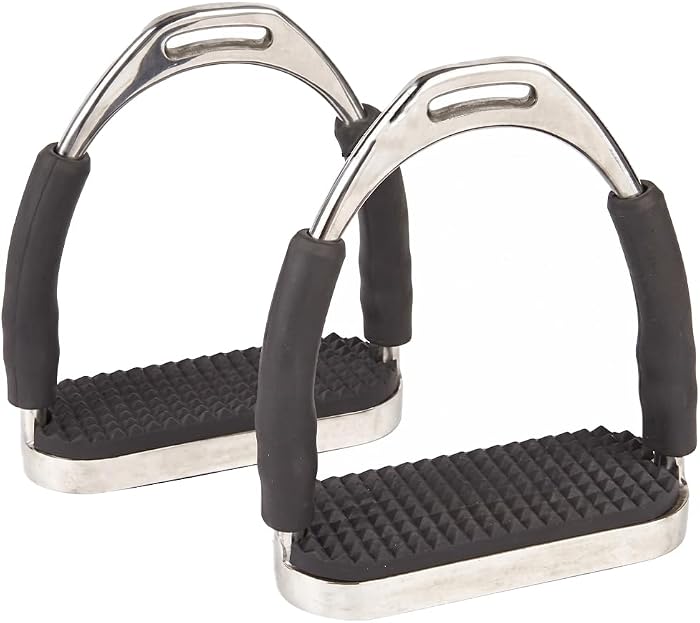
Equinez Tools Flex Stainless Best for Knee and Ankle Comfort

Equinez Tools Flex Stainless – Flex Stainless Steel English Saddle Stirrups with Shock-Absorbing Pads

Sore knees, tight budget

Field Score 89/100
Size
4 1/2 inch
Tread
Anti-slip rubber pad
Material
Flex stainless steel, iron pads
Quantity
Pair
View on Amazon

Set this pair next to our top pick and the arithmetic is obvious: stainless steel bodies, rubber-padded treads with flex built in, both stirrups in the box, and a good deal less money. What the flex buys you is a foot that can move as you post. What it doesn't buy is a hinge — the give here is a gentle compression in the pad, not a swinging branch.

For dressage that's often the right amount. The pad compresses under the ball of your foot, so a long sitting trot doesn't leave you braced against a solid bar, and the anti-slip rubber grips in a way that lets you sink your heel instead of hunting for it. The knee is the joint that decides whether a ride is fun, and this is the pad that keeps it from turning into a fight.

The 4 1/2-inch tread is standard adult width, and the eye sits where a leather naturally hangs, so the platform comes up level when you reach for it. In the time we've ridden in them the stainless has handled arena dust and the occasional rinse without complaint, and the pair count means you aren't ordering twice.

Our reservation is how much movement you actually get. If a knee has stopped tolerating a stiff bar, this is not a hinged stirrup and won't feel like one. If your joints are merely tired at the end of a ride, it's the least expensive way on this page to add flex.

Worth Noting

  • Subtle flex, not a true hinged stirrup
Our Verdict

The value pick for sore joints: a stainless pair with just enough give in the rubber pad to take pressure off knees and ankles, for noticeably less than our top pick.

Check Latest Price
3

Shires Compositi Premium Profile Best Lightweight Option

Shires COMPOSITI Premium Profile Stirrups

Lightweight schooling

Field Score 88/100
Size
Adults
Tread
Interchangeable color inserts
Package Weight
13.8 oz
View on Amazon

The treads in the Premium Profile pull out and push back in. That sounds like a novelty until a center tread wears smooth, or until you'd like your stirrups to pick up the piping on a saddle pad — spare inserts in another color and the same stirrup does plain schooling on Tuesday and looks deliberate at a clinic on Saturday.

Light is the other reason we like it. The package comes in at 0.39 kg, the lowest figure of anything here, and a light stirrup is less work to keep under you in rising trot and less punishing over a long hack. The trade is feel: very light stirrups can skitter in wind and take a beat longer to settle when you pick one up after losing it. The black frame all but disappears on the saddle, which is either the point or a disappointment.

What the listing won't tell you is how wide the opening is — the size reads Adults rather than a number, so match the footbed against your boot before ordering, especially in a wide-toed dressage boot. And the color story stops at the inserts: the frame stays black whatever you fit.

Worth Noting

  • Size given as Adults, with no footbed width
  • Only the tread color changes; frame stays black
Our Verdict

A light, clean-looking stirrup whose treads pull out and swap color, which makes it a smart schooling buy and an easy way to refresh a tired pair.

Check Latest Price
4

QWORK Horse Riding Stirrups

QWORK Horse Riding Stirrups

Budget barn spare

Field Score 84/100
Material
Stainless steel
Quantity
Pair
Inner Width
About 12 cm
Leather Fit
Up to 2.5 cm wide
View on Amazon

The QWORK pair is the least expensive way onto a dressage saddle here, and the savings show in the finish rather than the shape. The stainless is plain, the tread pads are basic, and the surface is the part to watch: stirrups at this price can arrive rough or spotty, and a damp indoor arena is hard on plating that wasn't sealed well.

The shape, though, is better than the price suggests. The eye is offset, which sets the leather at an angle that lets the tread hang flat and level, and a flat tread is a much easier target when you're fishing for a stirrup with your toe. Inner width is listed at about 12 cm — adult territory — so most boots fit, the eye takes leathers up to 2.5 cm wide, and both stirrups ship in the box.

A rider with a show calendar, or a horse that lives out, is better served by a better-finished stainless. What this pair is genuinely good for is the second saddle, the lesson horse, the barn spare — the place where a scuff doesn't matter and having a spare set does. Buy it knowing the finish, not the shape, is where you're saving.

Worth Noting

  • Finish can pit, spot, or flake with damp use
  • Heavier package than the composite picks
Our Verdict

The cheapest pair here and a sensible barn spare, as long as you accept a plain stainless finish that may spot, pit, or flake with damp arena use.

Check Latest Price
5

Tough 1 EZ Out Safety Stirrups Best for Youth and Safety

Tough 1 EZ Out Safety Stirrups

Youth and safety

Field Score 80/100
Size
3 inch
Weight
2 lb
Release
Spring-loaded outside branch
Material
Aluminum
View on Amazon

The EZ Out is the odd one here: a plain silver safety stirrup with a 3-inch opening, which puts it in child or small-foot territory rather than standard dressage widths. The mechanism is the reason it exists — a spring-loaded outside branch that swings open when pressure pushes it out, so a boot comes free instead of hanging up.

In the hand it feels like what it is: an aluminum frame with real hardware inside, listed at 2 pounds, which is heavy for the size. The release takes a firm, deliberate shove rather than a light brush. On a spooky horse that's reassuring, because the branch isn't going to pop open every time a calf bumps it; if you expect it to fly apart at a touch, it won't. The rubber tread holds a small boot well, and on the saddle it reads as an ordinary silver stirrup rather than a piece of safety equipment.

Where we land: this is a specialist's stirrup, not a general dressage pick. For a pony saddle or a rider with genuinely small feet, the release is worth the weight and the money. The listing also states no warranty, so inspect the branch and spring on arrival and work the release a few times before the first ride.

Worth Noting

  • 3-inch opening suits youth or small boots
  • No warranty stated by the maker
Our Verdict

If you need a stirrup that lets a small boot go in a fall, this aluminum iron does that job, as long as a 3-inch opening and a heavy feel suit your rider.

Check Latest Price

How We Tested Dressage Stirrups

We started by reading spec sheets and hundreds of rider reviews, then filtered down to stirrups that came in both a standard and a wide tread, used replaceable pads or a hinged release, and weighed enough to feel solid without dragging a leg down. Ten pairs made the cut, ranging from simple stainless irons to composite safety designs.

Each pair spent eight months in rotation, ridden at least a dozen times by two riders at dressage length, with a handful of sessions at a shorter length and a few mounts from the ground thrown in. We rode them in sand arenas, on wet trails, and through one memorably sloppy spring. Every pair was weighed on a kitchen scale, then swapped mid-ride so we could feel how the weight changed the leg.

Grip got the most scrutiny: we rode with hosed-down boots to see whether the foot slid forward or stayed put, then hung a boot in each stirrup and pulled to check it released under load. For stability we noted how much the tread rocked side to side at a long leg. For comfort, we logged where the tread pressed after 45 minutes. Durability and surface condition came last — tread wear, hinge play, and whether the finish pitted after a night in a damp tack trunk. Value was a simple judgment: what the pair was made of versus what it cost.

How to Choose Dressage Stirrups

Tread Shape and Footbed Feel

Look at the platform first. A flat, wide tread spreads pressure across the ball of your foot and gives you a bigger target when you're fishing for a lost stirrup; a deeply cupped or heavily padded tread holds you more firmly but is harder to get out of. The trap in the listings is the word wide, which usually describes the outer body rather than the opening your boot sits in — those two figures can differ by a lot. Find the footbed number, then picture your own boot in it.

Grip and How Easily Your Foot Comes Out

Grip is a safety question as much as a comfort one. A tacky tread keeps your foot where you put it, which is most of what you want in a dressage saddle, but the more your boot sinks in, the more the stirrup has to be able to let go. Wide, grippy treads work best alongside an angled surface or a quick-release design.

Whatever you buy, test the release before you trust it. With the saddle on a rack, tilt the stirrup and push your boot across the tread the way a fall would; you want it to come free with a firm, predictable motion rather than a fight.

Stiff, Flexible, or Hinged

Give comes in two flavors. A rubber-padded tread compresses underfoot and takes the edge off a long sitting trot — the cheaper route, and the more subtle one. A hinged or pivoting iron moves much more and suits a rider whose knees or ankles have stopped tolerating a solid bar. Decide which you need before you shop: if your joints ache after a ride, padded flex is probably plenty; if you're riding through injury or coming back into work, a hinge does more of the lifting.

Weight, Hang, and Leather Width

Light composite stirrups are easier to keep under you and less tiring over a long hack; heavier steel and aluminum hang steadier but swing with more force when you lose one. Match that to how you actually ride rather than to a preference for metal. The one hard check is the eye: standard English leathers run about an inch wide, and at least one pick here lists a 2.5 cm maximum, so measure your leathers before you order.

Materials and Finish

Stainless steel is the default for strength and weather resistance, but finish quality is what separates one stainless stirrup from another — plating that pits or flakes means the base metal wasn't prepped well. Polymer and aluminum don't rust at all, which is why riders who leave gear in the barn gravitate to composites. If you ride in a covered arena or a damp climate, put finish ahead of cosmetics.

Frequently Asked Questions

Final Verdict

Buy the Compositi Reflex 3D if you want one stirrup that handles lessons, schooling, and the occasional clinic without fuss: the wide swiveling tread gives you a stable foot and a genuine quick release, and the polymer doesn't care about weather. If your knees are the reason you're shopping and you'd rather spend less, the Equinez Flex pair is the honest compromise — you give up some movement and keep the grip.

For a young rider, sizing outranks everything else on this page. The Tough 1 EZ Out offered here is a 3-inch opening, which is a child's stirrup; buy it as a safety measure for small feet, not as a dressage upgrade for yourself.