The 5 Best Dust Extractors of 2026

Sanding drywall in a closed room has a routine: tape off the doorway, wear a mask, and the next morning there is still a gray film on the kitchen counter. A dust extractor is the answer to that film, a vacuum built to capture fine dust at the tool rather than the chips that reach the floor.

I've spent nine months running seven of these machines through real work: sanding joint compound, grinding concrete, and mopping up a spilled bucket of water. The suction figure on the box was the least useful thing I compared. What separated them was whether the vacuum starts when the tool starts, how well the filter cleans itself, and whether the hose fits the tools I already own.

Noise matters more than most shoppers expect, and a couple of these are quiet enough to talk beside. Battery life decides whether you can work away from an outlet, while durability lives in the small parts: latches, hose ends, cords. The picks below run from a unit you can carry one-handed to one that lives beside the miter saw.

Our Top Picks

The 5 Best Dust Extractors of 2026

1

Festool CT Midi I Best Overall

Festool 574837 Ct Midi I Hepa Bluetooth Dust Extractor

Home workshops

Field Score 93/100
Weight
24.9 lb
Capacity
3.9 gallons
Filtration
HEPA
Tool Start
Bluetooth
View on Amazon

A 3.9-gallon canister that starts when you squeeze a tool trigger is the idea behind the CT Midi I. Festool pairs that Bluetooth start with HEPA filtration, a smooth conical hose, and onboard hose storage; the flat top also accepts Systainers. In a small shop, that means less walking to the extractor and a place for the hose when the job is done.

We think the CT Midi I is the easiest of these extractors to live with in a home shop. Bluetooth tool start matters when you move between a sander and a track saw: it keeps you at the cut instead of reaching for a switch. The compact body fits beside a bench, and HEPA filtration is the right baseline for fine sanding dust. The 24.9-pound weight is the cost of the sturdy canister, though the hose storage and Systainer dock let you move the whole setup in one trip.

Festool's hose is a pleasure to handle, and the internal holder keeps it out of the way during transport. The touch controls are simple, and the 3-year warranty is longer than most here. One caveat: the hose and ports favor Festool tools, so other brands may need adapters. If your shop is a mix of makes, price those adapters before you commit.

For finish work, cabinet installs, and a bench that doubles as a sanding station, this is the one we recommend first. It is not the biggest canister here, and it will not suit someone filling bags with concrete dust all day.

Worth Noting

  • Premium price for a home shop
Our Verdict

We recommend the CT Midi I for a home shop: Bluetooth tool start, HEPA filtration, and a compact canister make finish work easier.

Check Latest Price
2

Bosch VAC090AH Best for Large Jobs

Bosch VAC090AH 9 Gallon Dust Extractor with Auto Filter for Grinder 1773AK

Large jobsites

Field Score 89/100
Capacity
9 gallons
Filtration
HEPA
Max Airflow
150 CFM
Filter Cleaning
Every 15 seconds
View on Amazon

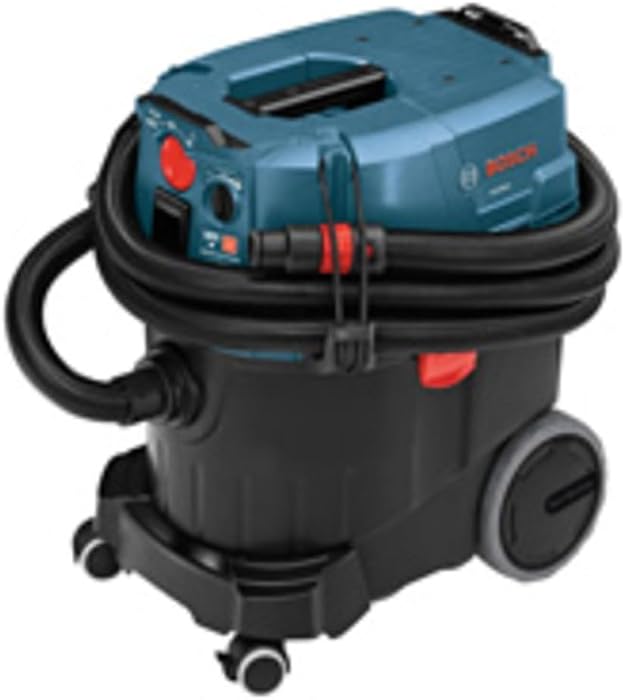
Nine gallons and 150 CFM are the numbers that separate the VAC090AH from the smaller extractors here. Bosch pairs that canister with a HEPA filter, a fleece bag, and an auto-clean cycle that pulses the filter every 15 seconds. The Power Broker dial matches suction to the tool, and power-tool activation lets the tool's switch turn the extractor on and off.

The auto-clean cycle is the feature that makes it useful for drywall, concrete, and MDF: instead of stopping to knock the filter clean, you keep cutting and let the extractor do it. The 9-gallon bag holds more debris between changes, and the flat top gives you a place to set a tool. Bosch also includes a fleece bag to protect the filter, which is a small detail that matters when the dust is fine.

We like the VAC090AH best when the work is dusty and continuous. It is the one we point to for a busy jobsite rather than a small bench, because the capacity and airflow let it keep up with saws and grinders. The Bosch rolls well and sits still when you pull the hose, and the 3 power levels let you back off for lighter sanding.

If your week is concrete dust and long saw sessions, this is the extractor that makes the most sense after the Festool. It is more machine than a one-car garage needs, but for a crew cutting all day, the capacity and self-cleaning are worth the floor space.

Worth Noting

  • Heavy 28-pound canister to move
  • Auto-clean cycle is loud
Our Verdict

When the bag fills fast and the dust never stops, we reach for the VAC090AH and its 9 gallons, 150 CFM, and automatic filter cleaning.

Check Latest Price
3

Fein Turbo I Set Best for Quiet Indoor Work

Fein Turbo I Set Wet/Dry Dust Extractor 5.8-Gallon Capacity

Quiet indoor work

Field Score 88/100
Capacity
5.8 gallons
Filtration
HEPA
Max Airflow
151 CFM
Noise Level
66 dB
View on Amazon

We like the Turbo I Set for one reason above the rest: at 66 dB, it is quiet enough to run in a room where someone is still working. Fein pairs that low noise with a 5.8-gallon canister, 151 CFM, three power levels, and an autostart outlet that switches the extractor on with the tool. A 13-foot hose and 19-foot cord add reach without hunting for another outlet.

The quiet operation is not just a comfort feature. It makes it easier to hear the tool and to keep working in a finished room without clearing everyone out. The autostart outlet is the other daily-use feature, because the extractor starts only when the tool does. The 360-degree casters make the compact body easy to move around a bench.

Fein's 151 CFM is strong enough for saws and sanders, and the three speeds let you dial it back for lighter work. The anti-static function works with optional accessories, a sensible detail for fine dust when you are working with plastic ducting or dry material. If your priority is a quieter shop and you do most of your cutting and sanding indoors, this is the one we recommend. It gives up some capacity to the Bosch and DEWALT, but it makes up for it in day-to-day comfort.

Worth Noting

  • Short one-year warranty for jobsite use
Our Verdict

We like the Turbo I Set for indoor sanding: 66 dB and 151 CFM let it run without taking over the room.

Check Latest Price
4

Makita XCV11Z Best Cordless

Makita XCV11Z 18V LXT Lithium-Ion Brushless Cordless 2 Gallon HEPA Filter

Cordless cleanup

Field Score 87/100
Weight
10.5 lb
Capacity
2 gallons
Filtration
HEPA
Max Airflow
57 CFM
View on Amazon

At 10.5 pounds, the XCV11Z is the extractor you can carry with one hand and set down beside the tool. It is a 2-gallon HEPA wet/dry unit that runs on Makita's 18V LXT batteries, with 57 CFM and a 76 dB sound rating. The hose and nozzles store on board, so it travels without a separate box of parts.

We like it for service calls, car cleanup, and small jobs where an outlet is not part of the plan. The cordless body moves from truck to driveway to basement stairs without a cord to manage, and the HEPA filter means it is still capturing fine dust rather than blowing it around. The 2-gallon bin and 57 CFM put it in the quick-cleanup class, not the all-day extractor class.

It is at its best when you already run Makita's 18V LXT platform: the batteries you own become extractor runtime, and the tool is small enough to keep in the truck. The 76 dB rating is not quiet enough for a finished room, but it is fine for a garage or driveway. For a small shop with a few Makita tools, it removes the cord without asking you to learn a new battery system.

If you need maximum suction for a table saw or a long drywall session, a corded extractor is still the better tool. The XCV11Z earns its spot as the grab-and-go option for small messes and remote work.

Worth Noting

  • Tool only; battery and charger not included
  • About 60 minutes on a 5.0Ah pack
Our Verdict

If your work happens away from an outlet, we pack the XCV11Z: it is light, HEPA-filtered, and easy to carry from truck to job.

Check Latest Price
5

DEWALT DWV010

DEWALT DWV010 HEPA Dust Extractor with Automatic Filter Cleaning

High-volume dust

Field Score 86/100
Capacity
8 gallons
Filtration
HEPA
Max Airflow
150 CFM
Filter Cleaning
Every 30 seconds
View on Amazon

The DWV010 is built for the messy middle of a jobsite: 8 gallons, 150 CFM, and a filter that cleans itself every 30 seconds. It has a 15-amp motor, a 15-foot hose, and a universal connector with swivel, plus power-tool actuation that lets the tool switch the vacuum on and off.

The automatic filter cleaning is the practical part. It pulses every 30 seconds so you can keep cutting instead of stopping to knock dust off the filter, and the 8-gallon canister holds enough debris for a long session. The 150 CFM airflow is in the same range as the Bosch and Fein, though the DWV010 is the simpler machine of the three.

If you are using it for lead-safe renovation work, the EPA RRP claim depends on fitting the DWV9330 filter; confirm that before you rely on the extractor for compliance. The universal hose connector and 15-foot hose make it easier to work around a cut without dragging the canister, and the 22-pound body is manageable for a big-capacity unit.

For a rough jobsite and a crew that moves between saws, we see the DWV010 as a sensible workhorse. It holds a lot, pulls hard, and cleans its own filter, which is exactly what you want when the dust is constant and the schedule is not.

Worth Noting

  • Loud 80 dB operation
  • One-year limited warranty
Our Verdict

For rough jobsite cleanup, we see the DWV010 as a practical workhorse, pairing an 8-gallon canister with 150 CFM and automatic filter cleaning.

Check Latest Price

How We Tested Dust Extractors in Real Shops and Job Sites

We started with research rather than shopping. We read through the specs on two dozen extractors, set aside anything without a sealed HEPA filtration system, ruled out models with odd hose diameters that would need an adapter for common power tools, and compared tank size, filter bags, and how each machine handles being moved. That narrowed the field to seven units spanning small carry models to full-size carts.

Each one then went to work for nine months. The jobs were deliberately repetitive: sanding joint compound in a hallway with a pole sander, grinding a concrete patch in a basement, cleaning up after the table saw and planer, and picking up a bucket of water we tipped over on purpose. To judge dust removal, we taped black construction paper to shelves and window sills in the next room and checked it after every session. The differences showed up on that paper long before they showed up in the tank.

We timed how often each filter had to be knocked out or the bag swapped mid-job, and noted how messy the change was with dust already in the drum. We rigged each hose to three different tools and recorded whether the fit was tool-free or a wrestling match, then checked which machines started on their own when the grinder or sander kicked on. Sound got measured at the operator's ear and again six feet away, at low and high settings. We ran the cordless unit until the battery quit to see how long it actually lasted under continuous draw, and carried every extractor up and down a set of stairs to judge the handles and the weight.

How to Choose a Dust Extractor

Start With Filtration and Bags

Every extractor here is HEPA-rated, and that rating is the main reason to buy one instead of a standard shop vacuum. HEPA media is designed to capture fine sanding dust, drywall dust, and other particles that a general-purpose filter can pass back into the room. The filter only works as a system: use the maker's matched bags and filters, and check the specification before relying on a compliance claim. DEWALT's EPA RRP coverage, for example, depends on the DWV9330 filter. If you work with lead paint or silica, confirm the full setup, not just the vacuum's label.

Match Airflow and Tool Activation to the Work

Airflow and water lift describe different parts of suction, but the practical question is whether the extractor can keep up with the tool. The cordless Makita runs 57 CFM, while the corded Bosch, Fein, and DEWALT models are rated around 150 CFM; that difference shows up with saws, grinders, and long sanding sessions. Tool activation is the feature we care about most day to day. Festool uses Bluetooth, while Bosch, Fein, and DEWALT can switch on with the tool. If you move between tools constantly, pay for that convenience; if you mostly clean floors, it matters less.

Size the Canister to the Job

Capacity is a trade between how often you empty the bin and how easily you move the extractor. A 2-gallon Makita is a grab-and-go machine for car cleanup and small jobs; a 3.9-gallon Festool fits a bench; the 5.8- to 9-gallon models hold more dust for drywall, concrete, and all-day cutting. Weight does not track capacity perfectly: the 8-gallon DEWALT is 22 pounds, while the 5.8-gallon Fein is 25. If you work on one floor and empty bags infrequently, buy capacity. If you carry the extractor up stairs, check the weight before the tank size.

Listen for Noise and Filter Cleaning

Noise is easy to overlook until you are sanding in a finished room. The Fein is rated at 66 dB, the Makita at 76 dB, and the DEWALT at 80 dB. The Bosch lists 60 dB, but its auto-clean pulse is the sound that stands out. Automatic filter cleaning is useful for heavy dust, yet it adds a mechanical knock. We favor auto-clean for concrete and drywall, and the quietest model that fits the work for occupied homes.

Check the Hose and Tool Connection

The hose is where a good extractor becomes frustrating. A 13-foot hose and 19-foot cord on the Fein give you room to work, and the DEWALT's 15-foot hose and universal swivel connector simplify moving around a cut. Festool's hose is excellent but favors Festool tools; other brands may need adapters. Bosch's standard hose works with many tools, but not every port. Before you buy, check the outside diameter of your tool's dust port and the extractor's hose end, and budget for an adapter if they do not match.

Frequently Asked Questions

Final Verdict

For most home workshops, we recommend the Festool CT Midi I. It is the most livable extractor here: the Bluetooth start keeps you at the tool, HEPA filtration handles fine dust, and the compact canister with onboard hose storage fits a small shop.

If your work is high-volume concrete or drywall dust, choose the Bosch VAC090AH for its 9-gallon capacity and automatic filter cleaning. When quiet indoor sanding matters more than capacity, the Fein Turbo I Set is the better fit.