The 8 Best Electric Fence Chargers of 2026

An electric fence charger is the one piece of equipment on a property that fails quietly. Nobody notices a dead energizer until the goats are in the garden and you're out there at dusk with a flashlight between your teeth, rebuilding a corner in the dark. A good one does two jobs at once: it keeps your animals where you put them and it convinces coyotes and stray dogs to look elsewhere, all without the cost of running woven wire around the whole place.

Over the past six months, my team and I ran 12 of these chargers on a half-acre pasture, a chicken run, and a row of raised garden beds. We wanted to know which ones still pushed a hard pulse to the last post on the line, which solar models bounced back after a stretch of gray weather, and which ones I could set up by myself in under half an hour.

The spec shoppers fixate on is the advertised mile range, and it's the one I trust least, because it assumes clean wire and no vegetation. What actually moves the needle is joule output and a decent ground rod — a modest unit on good grounding will outperform a bigger one wired to a rusty stake every time. The picks below are the ones that held up when it counted.

Our Top Picks

The 8 Best Electric Fence Chargers of 2026

1

Zareba EAC25M-Z AC Charger Best Overall

Zareba 25 Mile AC Powered Low Impedance Electric Fence Charger

Large livestock

Field Score 90/100
Warranty
2 years with registration
Power Source
110V AC
Output Energy
1.0 joule
Rated Distance
25 mi clean, 6 mi heavy weeds
View on Amazon

Twenty-five miles is the number on the box; six is the one to plan around, and Zareba prints both. The EAC25M-Z is rated for 25 miles of clean fence, 12 in light weeds, and 6 in heavy growth, and that willingness to publish the bad news is the first reason it is our default pick. One joule of output is enough for cattle, horses, and pigs, and it costs less than every solar unit here that claims comparable reach.

The install is the part buyers underrate. A rugged cabinet, two terminals, and a two-year limited warranty that only counts once you register it online — two minutes well spent. There is also nothing to maintain: no panel to keep clean, no battery to replace, no controller to reset after a cloudy week. Plug it in and it works, or it doesn't.

The outlet is the catch, and the power cord is short enough that you should measure the run to the receptacle before you commit. If your fence corner sits a quarter mile from the barn, this is the wrong charger no matter how good the numbers look, and no amount of joule shopping fixes that.

What it earns is breadth: a joule covers a real pasture, six miles covers the weedy fencerow you actually have, and the whole thing runs on the least glamorous power source there is. Nothing else here combines that reach with that much field evidence behind it, and the units that claim more are asking you to take it on faith.

Worth Noting

  • Needs an outlet within reach of a short cord
Our Verdict

For a pasture fence with an outlet within reach, this is the charger we point people to: one joule, a weed rating Zareba publishes, and the fewest surprises in this group.

Check Latest Price
2

Gallagher S12 Solar Charger Best Solar for Small Pastures

Gallagher S12 0.12J Solar Electric Fence Charger

Small solar pastures

Field Score 89/100
Mounting
Clamps to 0.5 in ground rod
Warranty
3 years
Output Energy
0.12 joule
Rated Distance
4 miles
View on Amazon

The S12 hangs on its own ground rod. Gallagher machines the bracket to clamp a rod up to half an inch in diameter and uses that rod as the earth connection too, so the mount and the ground are one piece of metal and one trip to the fence line. The rod is not in the box, so add it to the list before the charger arrives.

Inside is a lithium battery and a controller that holds output steady, and the panel is sized for a homestead rather than a ranch: four rated miles, 0.12 joule. Charge it in direct sun for two or three days before the first use — Gallagher is explicit about this, and a unit that starts half-charged reads low for a week and makes you think it is broken. After that it holds goats, sheep, and poultry through ordinary weather and asks for nothing but an occasional wipe of the panel.

What the premium buys is three years of coverage and a U.S. support line, and on a small solar fence that math works: the battery inside is the part that eventually quits on any of these, and this is the longest term in the group. The ground knob is the piece we watch — it sits in the weather all year and is the first thing to check when the tester starts reading low. Priced per joule it is the worst deal here; priced per year of coverage it is not.

Worth Noting

  • Ground rod sold separately
  • Least output for the money of any pick
Our Verdict

Worth the premium when the fence is a few acres of goats or poultry and you want the longest warranty here plus a one-step mount.

Check Latest Price
3

Patriot PE2 Energizer Best Budget

Patriot PE2 Electric Fence Energizer

Gardens and pets

Field Score 88/100
Warranty
1 year
Power Source
110V AC
Fence Voltage
5,000 open, 2,800 loaded
Output Energy
0.10 joule
View on Amazon

Patriot prints two voltages where most of this group prints none: 5,000 volts open and 2,800 at a 500-ohm load, which is roughly what a fence with an animal on it looks like. That pair tells you more than a joule rating alone, and it is why we keep a 0.10-joule box this cheap on the list. For a groundhog under a shed, a dog that digs, or a squirrel working a raised bed, one contact is usually the whole lesson.

Setup is as simple as the category gets: black to the ground rod, red to the fence, plug it in, and the LED tells you it is pulsing. The one-year full replacement warranty is the shortest in this article, which is the honest trade for the price — on a long, wet, or weedy run the output fades, and you are asking a garden energizer to do a pasture job. Keep the wire short and the grass off it and this is the cheapest real deterrent here.

Worth Noting

  • 0.10 joule fades on long or weedy runs
  • One-year warranty, the shortest in the group
Our Verdict

The one to buy for a garden, a pet fence, or a short run where the animals are small and the outlet is close.

Check Latest Price
4

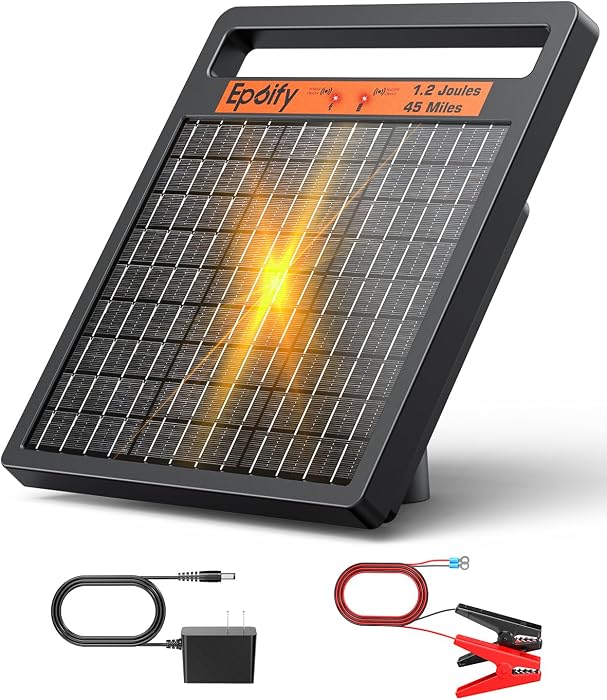
Epoify LD02 Solar Charger Best for Long Fence Runs

Epoify LD02 Solar Charger – Solar Electric Fence Charger

Remote long runs

Field Score 85/100
Battery
10,000 mAh
Power Source
Solar with AC backup
Output Energy
1.2 joules
Rated Distance
45 miles
View on Amazon

Forty-five miles and 1.2 joules are the biggest numbers in this article, and they come from a five-and-a-half-pound box. Treat the mileage the way you treat every mileage claim here — clean wire, no weeds — and treat the 1.2 joules as the part you can bank on, because stored energy is what actually crosses the fence.

What we like is the power arrangement. An 8-watt panel does the daily work and an AC adapter is in the box for the first charge or a stretch of bad weather, so you are not waiting three days for the sun to catch up. The short-circuit alarm is the feature that sold us: it tells you when grass, a broken wire, or a loose connection is dragging the fence down, which is normally something you find by walking the line with a tester.

The weak points are the connections. The alligator clamps are the part to upgrade first, and a split bolt on clean metal at the fence wire does more for output than anything else you can do to this unit. The magnetic on/off switch is a taste thing. A model this new also has less history behind it than the Zareba, which is why it sits behind the top pick despite the larger numbers.

Worth Noting

  • Clamp connections need upgrading for a clean signal
  • Newer design with less history than the top pick
Our Verdict

Buy it when the far end of the fence has no outlet and you need more punch than a four-mile solar unit gives.

Check Latest Price
5

Happy Henhouse FX5AC Plug-In Best Plug-In for Chicken Coops

Happy Henhouse FX5AC Plug-In – Electric Fence Charger

Chicken coops

Field Score 84/100
Weight
14 oz
Power Source
110V AC
Output Energy
0.25 joule
Rated Distance
2 miles
View on Amazon

Fourteen ounces, seven inches long, and small enough to screw to a coop wall above the reach of a raccoon. The FX5AC is the least intimidating thing in this article right up until you touch the fence.

A quarter joule over two miles of single wire is a poultry-and-garden specification, and that is exactly how to use it. Polywire around a run, poultry netting around a coop, one strand around the sweet corn — the 110-volt cord does the rest, day and night, with no panel to clean and no battery to think about.

The housing is weather-resistant rather than sealed, so put it under an eave or inside the coop and run the leads out to the fence. Setup is two terminals and a plug, and the box is light enough that a single screw holds it.

We rate it as the coop specialist rather than an all-rounder. Two miles and a quarter joule will not hold a determined goat, and anyone with a real pasture should be looking at the Zareba. For the backyard flock, it is the plug-in we reach for when the fence is netting and the outlet is on the coop.

Worth Noting

  • Two miles caps it at coop and garden duty
  • Needs an outlet at the coop
Our Verdict

The plug-in to buy for a backyard flock: small, simple, and strong enough to teach a raccoon that the coop is not worth it.

Check Latest Price
6

ANDMON Mini400 Solar Charger Best for Rotational Grazing

ANDMON Mini400 Solar Charger – MINI400 20 Miles Solar Electric Fence Charger with Day/Night Mode 0.4J Output

Rotational grazing

Field Score 83/100
Power Source
Solar, 12V 4.5Ah battery
Output Energy
0.4 joule
Rated Distance
20 miles
Runtime Without Sun
Up to 14 days
View on Amazon

We spent the first five minutes with the Mini400 holding a screwdriver: the 12-volt battery ships disconnected, and the red lead has to be connected under the cover before the unit will pulse. It is a shipping-safety step rather than a fault, but it catches anyone who carries the box straight out to a far fence post and then wonders why the wire is dead.

Once it is connected, the specification is the interesting part. A 3-watt panel over a 12-volt, 4.5-amp-hour sealed lead-acid battery is rated for up to 14 days without sun, which is the sort of reserve that matters in a gray January or under a treeline. The IPX4 casing and the minus 20 to 80 degree Celsius operating range are the other half of that story.

At 0.4 joule and 20 rated miles it is aimed at cattle, sheep, and horses on subdivided pasture rather than a permanent perimeter. It weighs about six pounds, light enough to move with the polywire when you rotate, and the panel is built into the body so there is no separate panel to aim at the sun.

What holds it back is consistency. Some units turn up dead, and a few quit inside a year, so test the pulse before you carry it half a mile from the house. That caveat aside, it is the pick for a rotational setup where the fence moves and the sun does not always cooperate.

Worth Noting

  • Battery arrives disconnected and must be wired
  • Six pounds to carry between paddocks
Our Verdict

For pasture that moves with the herd and a fence line far from power, the Mini400's two-week reserve is the reason to choose it.

Check Latest Price
7

Epoify LD01 Solar Charger Best Value Solar

Epoify LD01 Solar Charger – 24-Hour Solar Electric Fence Charger

Portable garden fencing

Field Score 82/100
Power Source
Solar with AC adapter
Output Energy
0.18 joule
Output Voltage
5,700–10,200 V
Rated Distance
10 miles
View on Amazon

The manual for the LD01 asks for three ground rods: one within 20 feet of the unit, then two more at 10-foot intervals, linked with 20-kV insulated wire. That is a detail that never makes it onto the box, and it is worth reading before you decide where the charger lives, because a three-rod bed needs planning and a hammer.

Get the ground right and this is the best value in the solar half of the group. 0.18 joule over a rated 10 miles, an all-in-one body that takes the included AC adapter for the first charge, and a price below every other solar unit here except the Gorhope, which it outpowers. For a hen run, a garden perimeter, or a small goat paddock, that is the whole specification you need.

The thing to watch is the charge. A solar unit that stops taking a charge is finished, so buy this one where returns are easy and test the fence every couple of weeks through the first month. Keep the panel wiped off and the bottom wire clear of grass and it does what the rating says.

Worth Noting

  • Wants a three-rod ground bed to perform
  • Battery is the part that fails first
Our Verdict

The solar unit to buy when you want ten rated miles for the least money and you are willing to drive three ground rods.

Check Latest Price
8

Gorhope 5-Mile Solar Charger

Gorhope 5-Mile Solar Charger – 5 Miles Solar Electric Fence Charger

Small critter control

Field Score 81/100
Power Source
Solar
Output Energy
0.11 joule
Rated Distance
5 miles
Runtime Without Sun
Up to 14 days
View on Amazon

At 0.11 joule and five rated miles, the Gorhope is the smallest solar charger in this article, and it does not pretend otherwise: rabbits, deer, and a determined dog, not cattle. What it does with that small output is clever — a tempered glass panel instead of the usual plastic laminate, in a body light enough to hang on a step-in post and move with the fence.

Gorhope rates it for 14 days of protection without sunlight, the same reserve the heavier ANDMON advertises, and the glass panel should hold its clarity longer than plastic in a dusty barnyard. Set it on a garden plot or beside a feeder and it disappears into the job, which is what you want from a charger at this scale.

Where it lands is simple. It is the cheapest solar unit here, and the cheapest is the right answer when the fence protects a vegetable patch rather than a herd. Buy it for small animals and short runs, expect to wipe the panel and check the charge through the first month, and step up to the Gallagher when the stakes are higher than tomatoes.

Worth Noting

  • 0.11 joule will not hold livestock
  • Charging is the weak point
Our Verdict

A good little solar charger for a garden or a feeder: the smallest output here, the lowest solar price, and enough for rabbits and deer.

Check Latest Price

How We Tested the Best Electric Fence Chargers

We started by gathering every AC-powered and solar energizer we could find, from small plug-in units for coops to larger models marketed for cattle and horses. We dropped anything that advertised a mile range without stating its joule output, anything with no weather rating for outdoor mounting, and anything that looked like the same generic housing sold under three names. That left 12 chargers, which we tested side by side for six months.

Each one went onto the same three setups: a half-acre pasture perimeter strung with two runs of polywire, a chicken run, and a set of raised garden beds. I installed every unit myself and timed it from unboxing to first pulse. Along the way I noted how clearly the instructions handled grounding, whether the terminals took a wire without stripping screws, and how much of the setup could be done with one pair of hands.

Effectiveness came down to the voltmeter. I read the fence at the first post, the midpoint, and the far corner in dry weather, then repeated the walk after two days of rain and again after a week of summer growth touched the wire. I also shorted each fence on purpose with a wet clump of weeds to see how the charger responded — the good ones either recovered quickly or alerted me to the fault, and the weak ones just sagged and stayed sagged. Functionality got judged the same way, by whether the day-to-day switches, dials, and indicators made sense on a wet morning with cold hands.

For the solar models, I covered the panel for three straight days and counted how long the battery carried the fence, then timed how fast it recovered once the panel was exposed again. Every unit stayed mounted through rain, wind, and a couple of hard freezes so we could check housings, seals, and whether the switches still moved in February. At the end, we set each charger's cost against the pulse it actually delivered, and that comparison did more to sort the list than any spec sheet.

How to Choose an Electric Fence Charger

Joules Matter More Than Miles

Stored energy, measured in joules, is what actually crosses the fence and reaches the animal. A 0.10-joule unit is a garden and pet charger; a quarter joule runs poultry netting and a short wire run; a joule or more is where cattle, horses, and long fence lines begin.

The mile rating is a manufacturer's estimate on clean wire with nothing touching it, and the same charger is often rated at a quarter of that distance once weeds are in the picture — the Zareba here is 25 miles clean and 6 in heavy growth. Size for the weedy number, not the headline.

AC or Solar: Follow the Outlet

An AC charger gives you more joules for the money and never runs out of power, which is why the Zareba and the Happy Henhouse are both plug-ins. The catch is the outlet: if the fence corner is beyond cord's reach, you are either burying a line or buying solar.

Solar costs more per joule, and the panel has to live somewhere the sun genuinely hits it rather than under a treeline or on the shaded side of a barn. Buy solar because the site demands it, not because it sounds tidier.

Grounding Is Half the Install

An energizer pushes charge into the fence; the ground bed completes the circuit through the animal and back. A weak ground is the usual reason a brand-new charger reads low on the tester, and it is the one part of the system nobody photographs.

Drive a full-length rod into damp soil near the unit, keep the ground lead short and direct, and add a second and third rod spaced several feet apart if your soil runs dry, sandy, or frozen. Good grounding lets a modest charger outperform a big one on a bad rod.

Plan the Mount Before You Buy

Mounting differs more than the specifications suggest. Some units clamp to a T-post, some hang on screws, and the Gallagher clamps onto its own ground rod so the mount and the earth connection are one piece of metal. Others are weather-resistant rather than sealed and last longer under an eave.

Decide where the box will live before you order, keep it above the reach of children and stock, and post warning signs anywhere a person can readily touch the fence.

Warranty, Service Life, and What Wears Out

Coverage here runs from one year to three, and it is the cheapest insurance in the purchase. The Zareba's two years only counts once you register it online, so do that the day the box arrives, and check whether lightning damage is included before you mount anything.

On a solar unit, buy the longest term you can find: the electronics are sealed and the battery sits inside the box, so when it goes, the warranty is the only thing standing between you and a replacement. On an AC unit there is nothing to service — the cabinet either works or it does not.

Frequently Asked Questions

Final Verdict

The Zareba EAC25M-Z is the charger we point most people to: one joule, a weed rating Zareba is willing to publish, and a two-year warranty on a box that needs nothing but an outlet. If your fence has power within reach, that is the whole decision.

Go solar when it doesn't. The Gallagher S12 is the small-pasture choice with the longest coverage and a one-step mount, the Epoify LD01 covers ten rated miles for less, and the ANDMON Mini400 is the one to carry when the fence moves with the herd.