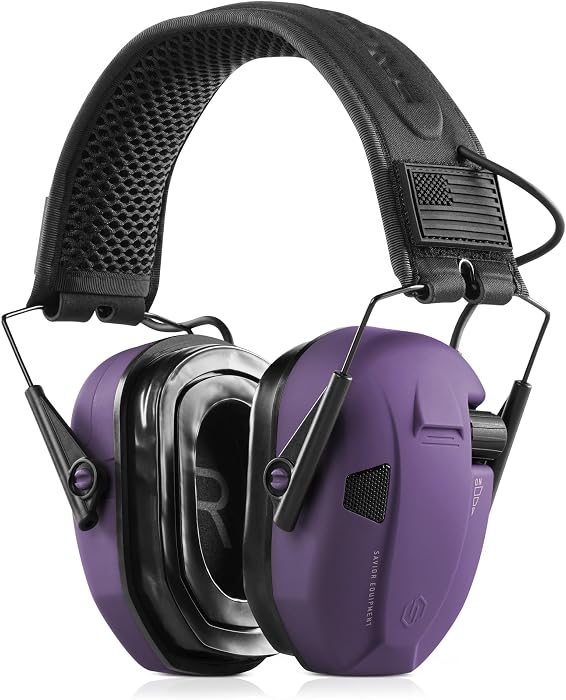
The 8 Best Electronic Shooting Earmuffs of 2026

Electronic earmuffs pull off a small magic trick: microphones pick up the room, a circuit clamps down on anything loud, and quieter sounds come through amplified. My first pair went with me to an indoor range, where I could hear the man two lanes over grumbling about his groups — until he fired, and the shot landed as a muffled thump instead of a crack. Passive muffs and foam plugs just deaden the world. Good electronics keep you inside it, which is exactly what you want when a safety officer is talking.

That filter has to be trustworthy in both directions. My team spent eight months with 12 pairs, listening for whether voices stayed natural or went tinny, whether the cutoff landed smoothly or hit with a jolt, and whether the seal survived a full afternoon. A high noise reduction rating impresses on the box, but a muff that strangles everything makes people slide a cup off to talk, and an earmuff resting on your head protects nothing.

Our Top Picks

The 8 Best Electronic Shooting Earmuffs of 2026

1

Howard Leight Impact Sport Best Overall

Howard Leight by Honeywell R-01526

Mixed shooting days

Field Score 96/100
Battery
2 AAA
Cup Profile
Low-profile
Noise Reduction
22 dB NRR
Amplification Cutoff
82 dB
View on Amazon

The cup shape is the first thing to notice: the Impact Sport sits low enough that a rifle stock has somewhere to go besides the side of the muff. That matters more at the range than a long feature list, because a bad cheek weld turns every shot into a compromise. The rest of the package backs it up with a 22 dB NRR, directional microphones, and a circuit that stops amplifying at 82 dB so speech comes through but gunshots do not.

We recommend it as the default because the amplification is tuned for talking, not for turning the range into a concert. The 82 dB cap is the useful detail: the mics lift voices and range commands, then get out of the way when the shot breaks. It folds into a small package, runs on two AAA batteries, and includes a 3.5 mm cord for wired audio. That cord is a small bonus, but we care more about the fact that the muff still works passively if the batteries die.

The Impact Sport is not the quietest muff here; the 25 dB Peltor Tactical 500 and 26 dB Floriogra pair list more attenuation. We still choose the Howard Leight for mixed pistol and rifle sessions because the slim cups solve a problem the higher-rated muffs do not. For an indoor centerfire line, we add foam plugs and treat the 22 dB rating as one layer of protection, not the whole plan.

Worth Noting

  • Snug fit on larger heads
Our Verdict

Our default for mixed rifle and pistol days: 22 dB NRR, directional mics capped at 82 dB, and slim cups that leave room for a stock.

Check Latest Price
2

Walker's Razor Slim Best Value

Walker's Razor Slim Electronic Muff

Budget range kit

Field Score 95/100
Storage
Folding
Audio Input
3.5 mm
Cup Profile
Slim
Amplification
Active electronic
View on Amazon

The Razor Slim is our budget pick because it gets the basics right without making you feel like you bought a toy. The folding frame is slim enough for a side pocket, the active circuit lifts voices well enough for a normal conversation, and the controls stay simple. It is the pair we hand someone who wants electronic protection without a big outlay.

We like the compact shape for more than storage. The slim cups leave more room around a rifle stock than a full-size muff, and the folding headband means the whole thing disappears into a range bag. The 3.5 mm input is a useful extra if you listen to music between strings; it also lets the muff double as a wired headset. That is more flexibility than we expect at this end of the set.

Indoors, steady background noise is the catch: overhead exhaust fans and ventilation can get amplified along with voices, which makes the Razor Slim less pleasant in a loud bay. We treat it as an outdoor or mixed-use muff and pick a higher-rated pair for indoor centerfire. The folding frame is the part we keep coming back to when packing light.

Worth Noting

  • No published noise reduction rating
Our Verdict

We reach for the Razor Slim when the budget is tight: it folds small, adds a 3.5 mm input, and still lets voices through.

Check Latest Price
3

Peltor Tactical 500 Best with Bluetooth

Peltor Sport Tactical 500 Bluetooth Hearing Protection Ear Muffs

Bluetooth and NRR

Field Score 94/100
Battery
3 AAA
Bluetooth
Yes
Microphones
Recessed
Noise Reduction
25 dB NRR
View on Amazon

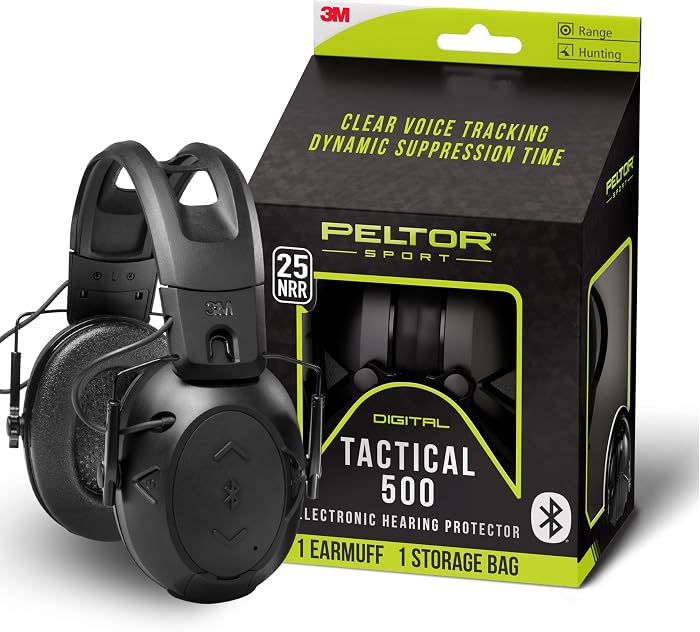
Bluetooth is the headline, but the 25 dB NRR is what makes the Tactical 500 a serious shooting muff rather than a pair of headphones with ear cups. It pairs that rating with recessed microphones, dynamic suppression, and Clear Voice Tracking, a combination aimed at keeping speech intelligible when the line gets busy. The 3 AAA batteries are old-school, but they are easy to replace from a range bag.

We appreciate the Bluetooth implementation because it adds music or a phone call without another cord dangling from the muff. The recessed mics sit away from the wind, and the dynamic suppression adapts to the energy in a shot instead of clipping at one fixed level. On a busy range, that is the difference between hearing the next command and asking someone to repeat it.

We recommend it as a specialist: choose the Tactical 500 when Bluetooth and a high NRR are both on your list. If Bluetooth is a nice-to-have, the extra hardware is another thing to manage, and a simpler muff like the Impact Sport is easier to live with. For a rangemaster who takes calls between relays or a hunter who wants music on the walk in, the combination earns its keep.

Worth Noting

  • Headband pivots can crack
  • Bluetooth audio can sound hollow
Our Verdict

The Tactical 500 is our pick when Bluetooth and strong attenuation both matter, with 25 dB NRR and clear speech on the line.

Check Latest Price
4

Savior Equipment Apollo Best for Comfort

Savior Equipment Apollo Electronic Earmuffs For Shooting w/Gel Ear Pads

Glasses and comfort

Field Score 93/100
Ear Pads
Gel
Noise Control
Active
Noise Reduction
24 dB NRR
View on Amazon

Gel ear pads are usually an upgrade you buy after the fact; on the Apollo they come in the box. That is the detail that makes this muff interesting for anyone who wears shooting glasses, because the soft pad can seal around a temple arm without pressing it into the side of your head. The 24 dB NRR is high for a comfort-first pair, and the active circuit keeps voices audible while knocking down the shot.

We recommend the Apollo when comfort is the deciding factor. The cups have enough interior room for an earbud and still clear the arms of shooting glasses, which is the useful part for anyone who wears both. The padded headband is built for long sessions, and the gel pads feel less like a clamp than a stiff foam cushion. We also like the sturdy exterior; it feels like a muff that can be tossed in a bag without babying it.

The Apollo makes its case on the seal, not on extra features. The Walker's Razor Slim is the one to choose if folding storage matters more than gel cushions; the Apollo is the one for a long class day. The Velcro flag and name patch are small extras; the real luxury is putting the muff on and not thinking about your glasses for the next hour.

Our Verdict

We like the Apollo for glasses wearers and long sessions: gel pads come standard, and the 24 dB NRR is high for a comfort-first muff.

Check Latest Price
5

Peltor RangeGuard Best for Rifles

Peltor Sport RangeGuard Electronic Hearing Protector

Rifle stock clearance

Field Score 92/100
Weight
8.32 oz
Cup Profile
Low-profile
Microphones
Recessed
Noise Reduction
21 dB NRR
View on Amazon

At 8.32 ounces, the RangeGuard is the muff that disappears on your head. The low-profile cups are cut for rifle and shotgun use, and the recessed microphones sit out of the wind. That is a specific set of priorities, and it makes this pair more useful to a hunter than a feature-heavy muff that fights the stock.

The 21 dB NRR is the trade-off. It is enough for outdoor pistol and rimfire work, and the light weight and low cups are built for a long afternoon. For indoor centerfire, we add plugs and treat the muff as a second layer, not the only one. The fit runs true for adults, with a soft foam seal that stays put under a hat.

We recommend the RangeGuard for the rifle-first kit because it solves the problem most muffs create: the cup hits the stock and pushes your cheek off the gun. The recessed mics are a real advantage in wind, and the low weight matters more than a bigger battery compartment or Bluetooth. If you shoot mostly indoors, the 25 dB Tactical 500 is the more protective choice; outdoors, the lighter frame is the one we want.

Worth Noting

  • Battery door is a weak point
Our Verdict

For rifle shooters, we choose the RangeGuard: 8.3 ounces, low-profile cups, and a 21 dB NRR that keeps a cheek weld intact.

Check Latest Price
6

Walker's Razor Rechargeable Best Rechargeable

Walker's Razor Rechargeable

Frequent range trips

Field Score 91/100
Weight
16 oz
Charging
USB-C
Battery Life
Up to 80 hours
Noise Reduction
21 dB NRR
View on Amazon

The rechargeable battery is the reason to look at this Walker's. It uses USB-C charging and is rated for up to 80 hours per charge, which is enough for several range trips between top-ups. If you already carry a battery bank for your phone, the appeal is obvious: no drawer of AAA cells and no last-minute stop at the store.

The rest is familiar Walker's. The frame is slim and folds for storage, the cups use sound-activated compression, and the fit is adjustable for a hat or shooting glasses. The 16-ounce weight is on the heavy side for a slim muff, so the headband adjustment matters. The controls are easy to find by feel.

The 21 dB NRR is at the lower end of this set, so we treat the Razor Rechargeable as an outdoor or mixed-use muff. For indoor centerfire, add plugs or step up to a higher-rated pair. Charging is the other fussy part: some units do not play nice with a generic USB-C cable, so keep the supplied cable with the muff.

We recommend it for frequent range trips where the charging routine is easier than buying batteries. The convenience is the point: one cable, a full charge, and no last-minute stop for AAA cells. If you leave gear in a truck for months at a time, the calculation changes.

Worth Noting

  • Built-in battery cannot be swapped
Our Verdict

We put the Razor Rechargeable on the short list for frequent range trips: USB-C charging, up to 80 hours per charge, and a slim frame.

Check Latest Price
7

PROHEAR 066 Best Budget

PROHEAR Electronic Ear Protection for Shooting with 4X Sound Amplification

Low-cost spare pair

Field Score 90/100
Weight
9.6 oz
Suppression
Under 0.01 sec
Amplification
4x
Noise Reduction
23 dB NRR
View on Amazon

Four times amplification is the headline, but it is not the number that protects you. The PROHEAR 066 carries a 23 dB NRR and a circuit that suppresses gunshots in under 0.01 second, which is the part that keeps a shot from arriving at full volume. Add a 9.6-ounce frame and a folding design, and this is a serious electronic muff at the low end of the set.

The wide cups and padded headband are comfortable over glasses, and the four-times amplification makes range commands easy to hear without shouting. The controls are simple, and the volume is large enough to find by feel. It folds into its own carry bag, which is the detail we appreciate most when the muff has to live in a truck or at the bottom of a range bag.

We recommend the PROHEAR for a new shooter or a spare pair because it keeps the job simple: hear voices, block shots, fold it up, repeat. The 23 dB NRR is mid-pack, so an indoor centerfire line still calls for plugs. We do not miss Bluetooth here; the money goes into protection and light weight instead. The 4x number is marketing, but the low weight and clear speech are not.

Our Verdict

Our budget pick is the PROHEAR 066: a 9.6-ounce muff with 23 dB NRR, 4x amplification, and a folding frame.

Check Latest Price
8

Floriogra 2 Pack

Floriogra 2 Pack Electronic Ear Protection for Shooting with 5X Sound

Shared range bag

Field Score 87/100
Age Range
5+ years
Pack Count
2
Amplification
5x
Noise Reduction
26 dB NRR
View on Amazon

A two-pack changes the math for a household or a regular shooting partner. The Floriogra set gives you two electronic muffs, each rated 26 dB NRR with 5x amplification and compliance with ANSI S3.19 and CE EN 352-1. If you need two sets, that is a more useful package than one premium muff.

The muffs fold, come boxed as a pair, and have a ranger-green finish that looks less like borrowed safety gear than the usual black plastic. The cups fit snugly enough for active movement, and the sound magnification makes range commands easy to follow when the circuit is working properly. For a shared range bag, the color and folding frame are practical details, not just cosmetics.

The electronics are the variable. Static and cutouts show up in use, and the sound can drop in and out instead of holding a steady level. The snug fit that helps during active movement can turn into pressure over a long indoor session, though the 26 dB rating still depends on a clean seal. For a quick outdoor session, that hold is an advantage; for an all-day indoor class, a gel-padded muff is gentler.

We recommend the Floriogra when two complete sets matter more than one flawless set. What earns it a place is the packaging: two folding muffs, a box that makes a practical gift, and a spare set ready when a friend joins the line. The durability record is too uneven for hard weekly use, so we keep it as a shared or backup pair. The 5x amplification is not what protects you; the 26 dB seal is.

Worth Noting

  • Durability is inconsistent
Our Verdict

For two shooters or a spare set, we pick the Floriogra two-pack: 26 dB NRR, 5x amplification, and two folding muffs in one box.

Check Latest Price

How We Tested Electronic Shooting Earmuffs

We began by collecting every electronic muff we could find that published a noise reduction rating and used a genuine amplifier circuit rather than straight passive foam, then filtered by price, battery type, and whether pads and headbands could be replaced. That narrowed the field to 12 pairs, which we ran for eight months — long enough that every set went through at least one battery change.

The bulk of that time was spent where these actually live: two-hour sessions in an indoor bay, a string of mornings on an outdoor range, an afternoon mowing and blowing leaves, and a few hunting trips. We wore each pair in three-hour stretches and noted where the headband pressed at the temples, how the cups felt over the ears with safety glasses on, and whether we could adjust the fit one-handed while wearing gloves.

For sound, a colleague stood 25 feet away and spoke at normal volume while we cycled the amplification from minimum to maximum, then we fired .22, 9mm, and 12-gauge next to each muff. We logged whether voices came back instantly after a shot or lagged a beat, whether the report sounded dulled or sharp, and whether cranking the volume introduced hiss or static. Each pair also went head-to-head against plain foam plugs and passive muffs on the same firing line.

Battery life came from a written log of hours per set, plus a check of whether the muffs shut themselves off when set down. Durability meant tossing them into a range bag, dropping them from bench height onto concrete, and folding and unfolding the headband a few dozen times. Fit and hearing protection got judged together at the end of each session, by whether the seal still felt snug after hours of wear and whether we had wanted to take them off.

How to Choose Electronic Shooting Earmuffs

Start With Fit and Seal

An electronic muff protects only as well as its cushion seals. Shooting glasses, a cap brim, or a thick temple arm can break that seal, and no NRR rating survives a gap. Put the muff on with the eyewear you actually shoot in, adjust each side evenly, and check that the cushion sits around the ear rather than on it. Gel pads, like those on the Savior Equipment Apollo, are more forgiving around glasses than stiff foam. If the headband leaves red pressure points after a few minutes, the fit is wrong, not something to break in.

Match NRR to the Line

The NRR is passive attenuation; the electronics only restore quiet sounds. Our picks run from 21 to 26 dB, and that spread matters. A 21 dB muff like the Peltor RangeGuard is a good outdoor rifle or rimfire choice, where you want a light, low-profile cup. For indoor centerfire, start at 25 dB or higher, or use foam plugs under the muff. Do not judge protection by the amplification number; a 4x or 5x microphone does not make a 21 dB muff quieter.

Look at Cup Shape and Stock Clearance

A full-size cup can push a rifle stock away from your cheek, which changes your sight picture and makes the muff feel like an obstacle. Low-profile cups with cutouts, like the RangeGuard and Impact Sport, leave a pocket for the stock. If you mostly shoot handguns or shotguns, a roomier cup can be more comfortable and seal better. We put stock clearance ahead of extra features for hunters who carry a rifle all day.

Decide on Power and Controls

AAA batteries are easy to replace at the range, while a rechargeable muff saves the battery drawer and adds charging chores. The Walker's Razor Rechargeable is rated for up to 80 hours and uses USB-C, while the Peltor Tactical 500 runs on three AAA cells. Bluetooth is worth having only if you listen between strings or take calls; it adds another circuit to manage. Whichever you choose, learn the volume dial by feel and carry spare batteries or a charging cable in your range bag.

Frequently Asked Questions

Final Verdict

For most shooters, the Howard Leight Impact Sport is the pair we recommend: the 22 dB NRR, 82 dB amplification cap, and slim cups handle a mixed day of rifles and handguns without getting in the way. If Bluetooth and a higher NRR are both on your list, the Peltor Tactical 500 is the step up. If budget is the deciding factor, the Walker's Razor Slim gives you a folding electronic muff and a 3.5 mm input at the low end of this set.