The 8 Best Fillet Knives of 2026

A whole fish looks less intimidating once you're holding a blade that follows the rib bones instead of fighting them. That's the job of a fillet knife: thin, flexible, riding the spine, bending where you ask it to, leaving the meat in one piece. Choose badly and you'll saw through pin bones and quit halfway.

I've broken down fish on a cooler lid at a windy boat ramp and on a cramped apartment counter, and a bad fillet knife reveals itself in about ten seconds. Over six months, my team and I worked through 12 of them — flexible and stiff, manual and electric — filleting whole fish until we knew exactly where each edge gave up.

Shoppers overrate blade length and steel bragging rights. An 8-inch blade handles most fish, and the handle matters as much as the alloy — a slippery grip on a wet fish is how knives end up on the floor. A sheath is the accessory nobody thinks about until a bare blade is rolling around in a tackle box. Some of the picks below are built for the dock, some for the kitchen counter.

Our Top Picks

The 8 Best Fillet Knives of 2026

1

Victorinox Fibrox 8-Inch Fillet Best Overall

Victorinox Fibrox 8-Inch Fillet Knife

All-around fish cleaning

Field Score 97/100
Handle
Thermoplastic rubber
Weight
3.2 oz
Blade Type
Flexible straight edge
Blade Length
8 inches
View on Amazon

Eight inches of blade, 3.2 ounces of knife. The Fibrox is stamped rather than forged, and that is exactly why it works on fish: the steel is thin enough to bend along the spine and slide over the rib bones instead of levering against them, and there is so little weight in the handle that your wrist isn't the thing that gives out on a long session.

This is the one we reach for first, and the reason is boring in the best way. It arrives sharp, it tracks a straight line from the gills to the tail, and it comes back to a working edge after a few passes on a fine stone — the blade is thin behind the edge, so there is less steel to remove. We also stopped noticing the Fibrox handle, which is the compliment: textured, unbothered by slime, and happy to be rinsed under the faucet.

The boundary here is length. Eight inches is the right blade for walleye, salmon, and slot-size stripers, and it is more knife than a crappie needs; if your fish are mostly perch and stocked trout, the 6-inch blades on this list will feel handier in the water. For a dedicated fish knife that lives in the boat box, that is the only real question left.

Worth Noting

  • No sheath included
Our Verdict

We recommend the Fibrox to anyone who wants a single fillet knife for walleye, salmon, and everything between — light, flexible, and quick to sharpen.

Check Latest Price
2

HOSHANHO 7-Inch Fillet Best Japanese-Steel Blade

HOSHANHO Fillet Knife 7 Inch

Fish and poultry

Field Score 96/100
Steel
10Cr15CoMoV high carbon
Handle
Pakkawood
Blade Length
7 inches
Construction
Forged
View on Amazon

Where the Victorinox is a working knife you keep in a bucket, the HOSHANHO is the one that ends up on the counter. The 7-inch blade is forged from 10Cr15CoMoV high-carbon steel, the pakkawood handle has real figure in it, and the edge out of the box is the finest in this group — closer to a good kitchen knife than to the stamped blades we usually carry to the water.

It also does the work. The blade is thin enough to run along a salmon's spine and firm enough that it doesn't wander, and the balance sits where the handle meets the steel, so the knife feels lighter in hand than it has any right to. We found the 7-inch length a good compromise for someone who breaks down a whole fish at the sink and then reaches for the same knife to spatchcock a chicken.

Two buying notes. High-carbon steel is not stainless in the careless sense — rinse it, dry it, and put it away dry or you will find spots along the flat. And when it arrives, run a thumb over the joint where the handle meets the tang; that is the spot to inspect on any knife at this price, and the one place a small gap can show up.

Worth Noting

  • Costs more than any other manual knife here
Our Verdict

Buy the HOSHANHO if you want one handsome, very sharp knife for the fillet board and the kitchen board; it asks for more money and more care than the stamped blades.

Check Latest Price
3

Morakniv Fishing Comfort Best for the Tackle Box

Morakniv Fishing Comfort Fillet Knife with Sandvik Stainless Steel Blade

Backpack and boat

Field Score 95/100
Steel
Sandvik 12C27 stainless
Weight
3.5 ounces with sheath
Blade Length
6.1 inches
Blade Thickness
0.07 inches
View on Amazon

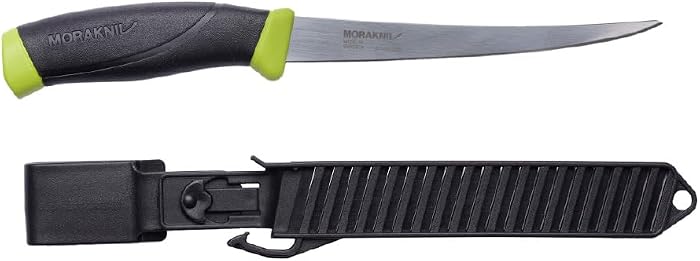
The sheath is why this one comes fishing. It's a hard polymer shell with a detachable belt clip and a belt loop, the knife clicks into it and stays put, and the whole package — knife and sheath together — weighs 3.5 ounces. That's the difference between a fillet knife that goes in the pack and one that stays in the truck.

The blade is 6.1 inches of Sandvik 12C27 stainless, ground to 0.07 inch, with just enough flex to skin a trout and not so much that it feels like a whip. The polymer handle has a finger guard and doesn't hold on to fish smell, which matters more than it sounds when the knife spends a week in a bag between trips. It arrives sharp and keeps a working edge through a mess of panfish.

We treat it as the tackle-box knife rather than the only knife, because 6.1 inches is right for trout, perch, and crappie and short on a salmon. The stainless is corrosion resistant, not corrosion proof — dry it before it goes back in the sheath, especially after saltwater, and it will outlast the trip and the next one.

Worth Noting

  • Bulky hard-plastic sheath for a light knife
Our Verdict

For a knife that lives in a backpack or a tackle box, we take the Morakniv: light, sheathed, and sharp enough for a limit of trout or panfish.

Check Latest Price
4

Bubba 7-Inch Tapered Flex Best Grip for Wet Hands

Bubba 7 Inch Tapered Flex Fillet Fishing Knife

Wet, slippery hands

Field Score 94/100
Steel
8Cr13MoV stainless
Weight
9.6 oz
Blade Length
7 inches
Overall Length
13 inches
View on Amazon

Pick this one up by the handle and you understand what Bubba is selling: a fat, textured grip with a trigger-shaped swell and a guard between your fingers and the blade. It is the most secure handle in this group when your hands are covered in slime, and the 7-inch tapered-flex blade is thin enough to work around the ribs of a walleye without tearing the fillet.

The trade-off is weight, and we noticed it before anything else. At 9.6 ounces and 13 inches overall this is a substantial knife, closer to a hunting knife in the hand than the 3-ounce blades here, and over a long session at the table you feel it in your forearm. For a bank angler cleaning a dozen fish, or anyone fishing in cold weather who wants a handle they can grip with stiff fingers, that is a trade worth making.

Worth Noting

  • Heavy at 9.6 ounces for a fillet knife
Our Verdict

We hand the Bubba to anyone whose hands are wet and cold when they fillet — the grip is the most secure here, and the tapered blade does precise work around bones.

Check Latest Price
5

KastKing Speed Demon Pro 9-Inch Best for Big Fish

KastKing Speed Demon Pro Fillet Knife with Protective Sheath

Big fish, saltwater

Field Score 93/100
Steel
G4116 German stainless
Weight
5.99 oz
Blade Length
9 inches
Overall Length
14.8 inches
View on Amazon

Nine inches is a decision, not a specification. A blade this long makes one continuous draw from the gills to the tail on a salmon or a striper instead of three short strokes, and once you have cleaned a big fish that way it is hard to go back to a 6-inch knife.

The Speed Demon Pro backs the length with G4116 German stainless and a super-polymer grip that stays put when it's wet — the best wet-hand grip among the long blades here, and one you don't need a glove to use. At 5.99 ounces it's light for its size, the sheath snaps the knife in without a rattle, and there's enough belly in the blade to make one clean cut across a thick fillet.

Salt changes the maintenance, not the knife. Rinse it in fresh water at the dock, towel it dry, and leave it out of the sheath overnight; the coating and the steel both last longer for the trouble. It's the routine that decides how a saltwater knife looks after a season, not the price on the tag.

Where it lands for us: if the fish in your cooler have shoulders, this is the pick. It makes long, confident cuts on big fish, it doesn't ask you to baby it, and the money you save is money toward a decent stone.

Worth Noting

  • Stiff tip for fine work around ribs
  • Awkward length in a kayak or small boat
Our Verdict

We recommend the KastKing to anyone chasing salmon, stripers, or saltwater fish — a long German-steel blade with a grip that holds and a sheath that snaps shut.

Check Latest Price
6

Bubba Pro Series Electric Best Electric

Bubba Pro Series Lithium-Ion Electric Fillet Knife with Non-Slip Grip Handle

Cleaning in volume

Field Score 92/100
Power
Brushless motor, lithium-ion
Blade Length
9 inches
Handle Length
8.5 inches
Included Components
Knife, four blades, battery, and case
View on Amazon

An electric fillet knife is a volume tool, and this is the volume tool here. Set up at a cleaning station with a cooler of fish and the difference isn't subtle: the blade does the sawing, you do the steering, and forearm strength stops being the limiting factor somewhere in the first half of the pile.

The kit is complete in a way the manual knives aren't. Four Ti-nitride coated blades, two batteries, an LED indicator on the handle, and a zippered case with slots for the blades and a little room left over for bags and a spare knife. This version gets the brushless motor and the aluminum housing, and that is where the extra money goes.

What it doesn't replace is a thin manual blade. The first cut behind the head and the skinning pass are still cleaner by hand, and the trigger has to be held for as long as the knife is running — there's no stay-on switch, which we noticed on the long fish. The blades come out for cleaning and are hand wash only.

So buy it for the cooler, not for the two fish you keep for dinner. If you clean a limit at a time, or you split a charter with three other people, the second battery and the four blades pay you back inside a season.

Worth Noting

  • Costs more than any manual knife here
  • Heavy, and the blades need hand washing
Our Verdict

We recommend the Pro Series to anyone cleaning fish by the cooler-load — two batteries, four blades, and a motor that doesn't care how many are left.

Check Latest Price
7

Rapala Soft Grip 6-Inch Best Budget

Rapala Soft Grip 6-Inch – Rapala4 Soft Grip Fillet / Single Stage Sharpener / Sheath

First fillet knife

Field Score 91/100
Handle
Textured soft grip
Blade Length
6 inches
Included Components
Knife, sharpener, and sheath
View on Amazon

Open the package and you have a complete kit: a 6-inch flexible stainless blade, a textured soft-grip handle, a black belt sheath, and a single-stage sharpener. For someone cleaning their first fish, that is the whole shopping list in one box, and nothing in it is an afterthought.

The blade is the right length for panfish, perch, and stocked trout — short enough to control inside a small fish, flexible enough to skin a fillet in one pass — and it comes sharp. The soft grip stays grippy when it's wet, the sheath keeps the blade covered in the bottom of a bag, and the whole thing is light enough to forget about until you need it.

The caveat is the sharpener. A pull-through removes a lot of steel in a hurry, so treat it as a field tool for a blade that is already dull and keep a fine stone or a ceramic hone for regular touch-ups. That's a small ask at this price, and it's why this stays our first recommendation for a beginner or a spare for the boat.

Worth Noting

  • Included pull-through sharpener is coarse
Our Verdict

We hand the Soft Grip to first-timers: knife, sheath, and sharpener in one buy, with a flexible 6-inch blade sized for the panfish most people actually catch.

Check Latest Price
8

Mercer Culinary Millennia 8.5-Inch

Mercer Culinary M23860 Millennia Black Handle

Stationary cleaning table

Field Score 90/100
Steel
High-carbon Japanese steel
Handle
Santoprene
Weight
4.6 oz
Blade Length
8.5 inches
View on Amazon

This is the cheapest knife on the list, and it's built like the knives that turn up in commercial kitchens: one-piece stamped high-carbon Japanese steel, a molded Santoprene handle, no decoration anywhere. Nothing about it is precious, which is exactly the point for a knife that lives beside a hose and a cutting board.

The 8.5-inch narrow blade is second in length only to the KastKing here, and the narrow profile is what makes it work — it slides along the spine with less drag than a wider blade, and at 4.6 ounces it doesn't wear you down. It takes an edge quickly and, like most thin stamped blades, gives it back just as quickly if you use it on bones or a cutting board.

We keep coming back to it for stationary work: a fixed table, a hose, and a pile of fish. The handle is comfortable over a long session and the textured finger points do their job with wet hands, and the price makes a second one an easy call rather than a decision.

Worth Noting

  • No sheath or blade cover
Our Verdict

Buy the Mercer if the knife stays at your cleaning table: a long, narrow blade that slides along the spine, sharp and easy to touch up, for the least money here.

Check Latest Price

How We Chose and Tested 12 Fillet Knives

We shortlisted from kitchen supply catalogs, fishing forums, and the specs that actually separate one fillet knife from another: blade length, steel, flex pattern, handle texture, and whether a sheath came in the box. Anything with a smooth, untextured handle got cut early — wet hands and fish slime are the whole operating environment.

That left 12 knives, which we used for six months. They lived on the kitchen counter for whole fish from the fishmonger, went into coolers for weekend trips, and got pulled out on a cooler lid at the dock at dusk. The first pass was out-of-box sharpness: we sliced printer paper, then skinned a fillet in one pull and noted whether the blade caught or glided.

Then we tracked edge retention, counting fish between honings and noting when a blade started tearing instead of slicing. Flex got tested by running each blade along the spine and ribs from gill to tail, feeling how much pressure it took to follow the bones without cutting through them. With wet, slimy hands we checked whether the handle rolled, whether the thumb rest lined up, and whether our forearms ached after ten fish.

Sheaths got their own scrutiny: we shook each one upside down to see if the blade shifted, then checked whether water drained out or sat against the steel. Last, we weighed price against what came in the box — a sheath, a sharpener, a case — since a knife that needs replacing in a season is no bargain.

How to Choose a Fillet Knife

Match the Blade to the Fish, Not to the Picture

If most of what you clean fits in a skillet, a 6-inch blade is the right tool. It's nimble inside a small fish and short enough that you can feel where the tip is. Step up to 7 or 8 inches for walleye, bass, and salmon, and go to 9 inches only if big fish and saltwater are normal for you.

The trap is buying the longest filet knife on the shelf because it looks more capable. A 9-inch blade on a perch is all tip and no control, and you end up working with the back half of the knife.

Flex Should Follow the Spine, Not Flop

A fillet knife works because the blade bends. It rides the curve of the backbone and slides over the ribs instead of cutting into them. Thin stamped stainless flexes most; forged high-carbon blades run stiffer and behave more like a boning knife.

When a knife arrives, flex the tip against your thumb. It should bend noticeably and spring straight. If it stays bent, send it back before you use it.

Wet Hands Pick the Handle

Fish slime is slicker than water, and a smooth handle that feels lovely in the store becomes a problem at the table. Textured rubber or polymer with a guard or a trigger swell is what we look for on a boat knife, and a rinse beats a wipe — wiping just spreads the slime around.

Wood and pakkawood are fine when the knife lives at a sink where you can wash and dry your hands between fish. On a wet boat, they're the last thing we reach for.

Steel, Salt, and the Care Trade-Off

Stamped stainless is forgiving: rinse it, dry it, and it shrugs off a season of use. High-carbon steels like the Japanese 10Cr15CoMoV take a finer edge and hold it, but they spot if they go away wet.

Saltwater is the real test for either. A fresh-water rinse at the dock and a few minutes out of the sheath to air dry do more for the edge than any sharpening gadget, and a knife should never sit wet in its sheath.

Manual or Electric

Electric fillet knives are for volume: a cleaning station, a cooler of fish, a charter, or one big annual trip where speed matters and your forearm is the limiting factor. They are heavier, they cost many times what a manual knife does, and their blades still come out and get washed by hand.

Keep a thin manual blade alongside one anyway. The first cut behind the head and the skinning pass are cleaner by hand, and an electric knife with a 9-inch reciprocating blade has no feel for either.

Frequently Asked Questions

Final Verdict

If you buy one fillet knife, make it the Victorinox Fibrox 8-inch. It's the lightest and most flexible blade here, it comes back to a working edge in a minute, and it handles everything from walleye to salmon without asking you to learn a new knife.

Two situations change the answer. If your fish run small, the Morakniv's 6.1-inch blade and belt-clip sheath are handier for trout and panfish, and the Rapala does the same job with a sharpener in the box. If you clean fish by the cooler-load, the Bubba Pro Series electric pays you back in saved time. Buy the Victorinox first, and add the second knife when your own fishing tells you to.