The 8 Best Fire Starters of 2026

There's a particular kind of defeat in a cold fire pit: kindling stacked, match flares, paper burns off, nothing catches. A good fire starter deletes that moment — one match, a steady flame, on to the part of the evening you actually wanted. The trouble is that good varies wildly. Some cubes burn hot for three minutes and quit before the splits take; others smolder long enough to light damp wood but leave a chemical smell in the den.

Over four months, my team and I lit fires with 15 different starters — pressed cubes, fatwood sticks, quick-light logs — in the fireplace, the backyard pit, the charcoal grill, and on a camping trip that rained sideways. We timed burn, counted pieces per fire, and noted what people complain about later: indoor scent and the flare when a starter goes up faster than it should.

Format matters more than most shoppers expect — a big box of cubes is cheap insurance for a winter of fireplaces, while fatwood sticks are what I reach for when the wood is wet. Below are the ones we'd buy again.

Our Top Picks

The 8 Best Fire Starters of 2026

1

Rutland Fire Starter Squares Best Overall

Rutland Fire Starter for Campfires

Everyday fire starting

Field Score 97/100
Form
Cube
Count
144
Burn Time
10 minutes each
Pack Weight
4.6 lb
View on Amazon

The scored grid across each Rutland square is the detail that makes this box easier to live with than loose fire-starting cubes. We snap one square in half for a small fire pit, use two under a charcoal chimney, and let the listed 10-minute burn do the work of catching the fuel. That range is why the 144-pack is our top pick: it handles a fireplace, a grill, and a campfire without making you keep three different starters on hand.

What settled it for us was how little attention the fire needed after lighting. The cubes catch quickly, throw a steady flame rather than a flash, and leave no chemical smell in the room or on the food. We also appreciate that they break apart, so you can match the dose to the fire instead of tossing a whole block into a small grill. Against the fatwood picks here, Rutland is the cleaner, more compact choice for indoor use.

For a deep bed of split logs, plan on two or three squares; for a single chimney of charcoal, two is usually enough. The box is compact for a 144-count pack, so it stores on a shelf without becoming a fixture. We keep it beside the wood stove and a handful in the camping tote.

Worth Noting

  • Scored edges can crumble when snapped
Our Verdict

For a household that lights a fireplace, grill, or fire pit, the Rutland squares are the fire starter to buy first: they burn long enough for charcoal or logs and work in every setting we tried.

Check Latest Price
2

Billy Buckskin 10 lb Fatwood Best Natural Fatwood

Billy Buckskin 10lb Fatwood Fire Starter Sticks

Natural fire starting

Field Score 96/100
Form
Stick
Weather
Lights when wet
Material
Fatwood, pine, resin
Box Weight
10 lb
View on Amazon

Ten pounds of fatwood is a serious stash, and that scale is the first reason the Billy Buckskin box earns a spot. For a household that heats with wood or lights a fireplace several times a week, this is the natural-fatwood pick we reach for: two or three resin-rich sticks under split logs replace a pile of newspaper, and the box keeps going through a long run of fires.

What makes it more than a bulk buy is the weather resistance. Fatwood resin lights when the wood around it is damp, which matters on a cold morning when the kindling is not as dry as you thought. We also like that the sticks are long enough to tuck between logs and can be split down for a small fire. The pieces vary in thickness, so sort through the box for a fat one when you need an easy light.

Storage is the practical catch. A 10-pound box needs a dry spot off the floor, and the sticks are bulky enough that they take up more room than a bag of cubes. We keep ours in a garage bin and refill a small bucket for the house, which keeps the bulk out of the living room. The pine scent is pronounced, especially when the box is open; for a grill or pizza oven, choose an odorless cube instead.

Worth Noting

  • Strong pine scent in storage
Our Verdict

For anyone who heats with wood, this 10-pound fatwood box is the natural starter we point to, especially for damp weather.

Check Latest Price
3

Duraflame Fire Starters 24-Pack Best for Fireplaces

Duraflame Fire Starter for Indoor and Outdoor Use

Fireplaces and stoves

Field Score 95/100
Form
Stick
Count
24
Weather
Water-resistant
Material
Wax and renewable biomass
View on Amazon

Compared with the Rutland squares we recommend for most people, Duraflame's 24-pack is the more forgiving option: one block throws a bigger flame and holds it long enough to catch damp wood, so you can spend less time tending the early fire. The blocks are wax and renewable biomass, and they are water-resistant enough for a damp fire pit or a campfire after rain.

We used these in a fireplace and a fire pit, and the shape is simple: place a block under the logs, light the edge, and give it air. Because the block is larger than a cube, it takes up more room in a small grill, but it also needs less arranging. The flame is steady and low-drama, which is what we want when the wood is not perfectly seasoned.

This is a convenience pick rather than a value pick. For a weekend cabin, a fireplace you use a few times a week, or a damp-weather camp box, the bigger flame and simple lighting are worth the space they take. For daily wood-stove duty, the fatwood or square packs here stretch further.

Worth Noting

  • Costs more per fire than square packs
Our Verdict

We choose Duraflame's 24-pack for a fireplace or wood stove when we want one big, forgiving flame and don't mind paying more per fire.

Check Latest Price
4

Realcook Natural Fire Starters Best Budget

Realcook Natural Fire Starters – Natural Fire Starter for Campfires: All Weather Firestarters

Budget fire starting

Field Score 94/100
Form
Tumbleweed
Count
72
Weather
Burns when wet
Burn Time
8 to 10 minutes
View on Amazon

The Realcook box is the value play in this group: 72 tumbleweed-style starters at the budget end of the range, enough that you don't ration them. This is the box we reach for when we want to light a grill or a fire pit without thinking about cost, and it has become our default for casual backyard fires.

The pitch is a clean, odorless burn, and that matters for a grill or a pizza oven. The starters are made from wax, sawdust, and hardwood, and they light with a match and burn for a listed 8 to 10 minutes. We found the flame strong enough to catch lump charcoal in a chimney, with no chemical smell hanging around the cooking grate.

For a dense load of charcoal, use two starters and leave a gap for air; one is enough for a small fire pit or a quick grill. The tumbleweeds are compact enough to tuck under a chimney, and the bag keeps loose fibers contained. It is a simple product, but the simple part is what makes it easy to keep using.

Worth Noting

  • Burn time can vary from piece to piece
Our Verdict

This is the budget box we keep coming back to for grills and fire pits, thanks to odorless starters and a generous count.

Check Latest Price
5

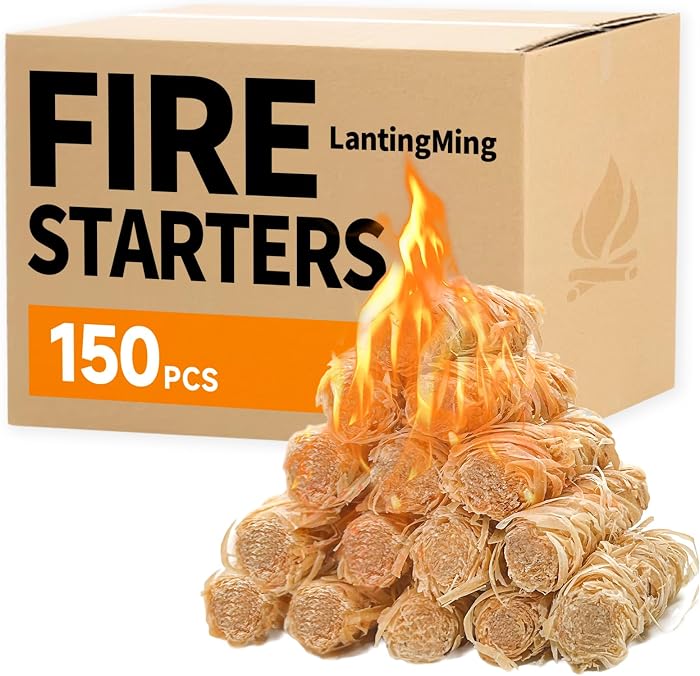
LantingMing Fire Starters 150-Pack Best Waterproof Bulk

LantingMing Fire Starters 150-Pack – 150 PCS Fire Starters for Fireplace Waterproof

Wet-weather camping

Field Score 93/100
Form
Stick
Count
150
Weather
Waterproof
Material
Pine and paraffin
View on Amazon

Waterproof is the claim that separates LantingMing's 150-pack from the paper-and-wax crowd. The starters are pine sticks dipped in paraffin, and they are packed in a zip bag inside the box, so a wet campsite does not turn them into mush before you need them. If you have ever watched a cardboard fire-starter box sag in the rain, that detail is worth something.

We appreciate the combination of a real waterproof coating and a count high enough to keep a camping box stocked for a season. One or two pieces light quickly under kindling or charcoal, and the flame is stable enough for a fire pit on a breezy evening. For a deep charcoal chimney, plan on two or three and give them room to breathe.

The sticks are small, so this is a pack for starting fires, not for building them. Pair them with dry kindling and small splits, and keep the bag sealed between trips. For a wet-weather kit or a boat, the waterproofing earns its place; for a fireplace you light every night, a bigger cube or fatwood stick is less fuss.

Worth Noting

  • Burns shorter than 10-minute cubes
Our Verdict

The waterproof, high-count LantingMing pack is what we trust for wet campsites and backup kits, though it burns shorter than the cubes.

Check Latest Price
6

WABUPD Fire Starters 110-Pack Best Compact Pack

WABUPD Fire Starters 110-Pack – 110 PCS Fire Starter

Camping and emergencies

Field Score 92/100
Form
Cube or stick
Count
110
Weather
Wind- and moisture-resistant
Pack Weight
2.3 lb
View on Amazon

At 2.3 pounds for 110 starters, the WABUPD pack is the one that disappears into a camp bin instead of taking over a shelf. The pieces are compact cubes and sticks, and the box is small enough to keep in a truck console, a backpack, or an emergency kit without a second thought.

The starters are treated to resist wind and moisture, and they light with a quick, large flame. We used them for a small fire pit and a charcoal grill, and the flame caught dry kindling without a lot of coaxing. The pieces are small, though, so a deep bed of logs or a full chimney takes three or four rather than one.

That size is the trade-off. If you are lighting a fire every night in a wood stove, a bigger cube or a fatwood stick is less fiddly. But for a camp box, a bug-out bag, or a grill at a tailgate, the small dose is an advantage: you can carry more fire-starting capacity in less space and use only what the fire needs.

We reach for this pack when space matters and the fire is modest. It is not the box we keep by the hearth, but it is the one we tuck into the truck for weekends, and that is a specific job worth having covered.

Worth Noting

  • Small pieces need several for a full fire pit
Our Verdict

We reach for this compact pack when space matters; it slips into a camp bin and lights reliably, but the pieces are small.

Check Latest Price
7

Pure Garden Fatwood Sticks Best for High-Volume Wood Burning

Pure Garden 25lb Fire Starter Sticks

High-volume wood burning

Field Score 91/100
Form
Stick
Material
Natural pine
Box Weight
25 lb
Box Dimensions
17.5 x 10.5 x 8.75 inches
View on Amazon

Twenty-five pounds is not a starter stash; it is a heating-season supply. The Pure Garden box is built for someone who burns wood often enough that a handful of cubes would be gone by midwinter, and the long shelf life means the extra volume does not go to waste. The box itself is sizable, about 17.5 by 10.5 by 8.75 inches, so give it a dry corner.

The sticks are natural pine, and two or three under a load of splits get a fire going without paper. The pieces are long enough to tuck between logs and can be split for a small fire. There is no chemical smell, just a piney woodshop scent that fades once the fire is drawing.

We like this bulk fatwood for a cabin, a workshop stove, or a household that goes through kindling every week. The 25-pound box is too much for a casual fire pit and too bulky for a camping bin. Buy it for volume and for a dry storage spot, not for a small patio.

Worth Noting

  • Uneven resin means some sticks resist lighting
Our Verdict

This bulk fatwood is our choice for a cabin or wood stove that goes through kindling weekly, not for occasional fire pits.

Check Latest Price
8

WH Natural Fire Starters 370-Pack Best for Frequent Fire Starting

WH 370 pcs Natural Fire Starters for Indoor Fireplace

Frequent fire starting

Field Score 90/100
Form
Wood wool
Count
370
Weather
Water-resistant
Box Weight
10 lb
View on Amazon

The 370 count sounds enormous until you see how small each wood-wool starter is. This is a box of tight little tumbleweeds, not a set of chunky blocks, and that changes how you use it: one or two pieces are for kindling and small loads, while a full fire pit or a deep charcoal bed takes a small handful.

What we appreciate is how fast they catch and how hot they burn. The wood wool is treated to resist water, and the starters light with a match even when the weather is less than perfect. They produce very little smoke, which makes them a good fit for a wood stove or an indoor fireplace where you don't want a lot of paper smoke in the room.

The 10-pound box is a high-volume buy. It takes up real shelf space, and the individual pieces are small enough to scatter if you are careless with the bag. Keep them in a bin with a lid and scoop out what you need rather than tearing the box open on the hearth.

We recommend this 370-piece box for a high-volume wood stove or fireplace. The count is the point: you can use two or three pieces without feeling like you are burning through a precious supply, and the low-smoke burn keeps the room comfortable.

Worth Noting

  • Tiny pieces need several for larger fires
Our Verdict

We recommend this 370-piece box for a high-volume wood stove or fireplace, where the hot, low-smoke flame earns the space.

Check Latest Price

How We Tested Fire Starters in Fireplaces, Fire Pits, and Wet Weather

We started by pulling the fire starters people actually buy in volume — pressed wood cubes, fatwood sticks, quick-light logs, and large bulk boxes — then filtered by what each package claims: natural or odorless, all-weather, indoor-rated. Cost per fire mattered more than sticker price, so we counted the pieces in every box and estimated how many a normal load of wood would take.

Fifteen starters got a fire lit over four months. In the fireplace, we built the same small load of splits each time and timed from strike to a flame that would hold without help, then watched what happened after: whether the starter died before the splits caught or kept burning and left a greasy smear on the grate. In the backyard pit and the charcoal chimney we counted pieces per fire, since a box that needs three per fire is a worse deal than one that needs half of one.

Two tests were less comfortable. We soaked a sample of each all-weather starter in a bucket overnight and tried to light it the next morning under wet kindling, and we burned each one in a closed-up room to judge scent — pressed sawdust reads like a lumber yard, while some chemical binders read like a garage. We also watched flare height when a starter first met the flame, because a foot-tall flash is a genuine problem next to a sleeve or a grill lid.

How to Choose Fire Starters

Match the Form to the Fire

Cubes and squares are the most flexible for indoor fireplaces, charcoal chimneys, and grills because you can break them to size. Fatwood sticks suit wood stoves and fireplaces where you want a natural, resin-rich starter that can be tucked between logs. Tumbleweeds and wood wool light fast and work well for grills and campfires, but they often burn hotter and shorter. Start by naming your most common fire, then choose the form that makes that fire easiest.

Look for Burn Time, Not Just Flame

A big flame is impressive, but the useful number is how long the starter keeps burning under the fuel. A 10-minute cube gives a charcoal chimney or a damp log time to catch; a 3- to 5-minute starter may need kindling or a second piece. We prioritize sustained burn over a quick flare for anything beyond a small fire pit. If you light charcoal often, choose a starter rated around 8 to 10 minutes. For a quick grill, a shorter tumbleweed is fine.

Plan for Weather and Storage

Waterproof and water-resistant labels are worth having for a camping kit, but they do not make a soaked box reliable. Wax-coated cubes and paraffin-dipped sticks shed light moisture; fatwood's resin lights when the wood around it is damp. The bigger issue is storage. A bulk box left in a humid garage can soften or absorb moisture, so keep it in a sealed bin or the original bag. For a truck or backpack, a compact 2- to 3-pound pack makes more sense than a 25-pound box.

Decide How Much Odor and Smoke You Can Live With

Indoor fireplaces and cooking appliances make odor a real buying criterion. Wax-and-sawdust cubes marketed as odorless are the safer choice for a grill, pizza oven, or living room. Fatwood has a strong pine-resin smell that some people love and others do not want in a garage or kitchen. Smoke matters too: a low-smoke starter is easier to live with in a wood stove. If you cook over the fire, choose a starter labeled for cooking and let it burn down before food goes on.

Bulk or Compact?

Buy bulk when you light fires at home several times a week and have a dry place to store it. A 10- or 25-pound box lowers the cost per fire and saves repeat orders, but it is a commitment in space. Buy compact when the starter lives in a camper, truck, or emergency bag; a 70- to 150-piece pack is easier to carry and still covers a season of weekend trips. The middle ground is a 110- to 150-piece box that fits on a shelf and does not dominate a camping bin.

Frequently Asked Questions

Final Verdict

Rutland's 144-pack is the fire starter we recommend first. The scored cubes break down to the size of the fire, burn long enough for charcoal or split logs, and stay clean enough for indoor use, which is why they cover more situations than any other pick here. If you heat with wood and want a natural fatwood stash, Billy Buckskin is the alternative we name; if you want the lowest cost per fire in a compact box, Realcook is the one. Start with Rutland unless your storage or scent preferences point elsewhere.