The 8 Best Foam Sleeping Pads of 2026

Foam sleeping pads are the least glamorous thing in the gear closet and the only one that can't fail on you at 2 a.m. There's no valve to blow into and no baffle to puncture — you unroll it and it's ready. The catch is that foam comes in two very different personalities: a thin closed-cell accordion that weighs almost nothing, and a memory foam slab that sleeps like a guest bed but eats half the trunk. Which one you want depends on whether you're carrying it or driving it.

We spent six months sleeping on 12 of them — ultralight folding mats, closed-cell roll-ups, and three-inch memory foam mattresses — on tent floors, on a cot, and on my own guest room floor when family visited. One thing surprised me: thickness is a terrible way to judge these. A soft three-inch pad bottoms out under your hip, while a dense inch and a half can feel genuinely plush. The picks below are the ones that held their loft and still rolled up tight.

Our Top Picks

The 8 Best Foam Sleeping Pads of 2026

1

Therm-a-Rest Z Lite Sol Best Overall

Therm-a-Rest Z Lite Sol Camping and Backpacking Sleeping Pad

Backpacking trips

Field Score 94/100
Weight
14 oz
R-value
2.0
Dimensions
72"L x 20"W x 0.75"Th
Packed Size
20" x 5" x 5.5"
View on Amazon

Closed-cell foam is the reason the Therm-a-Rest Z Lite Sol is our default: no valve, no pump, no slow leak in the night. At 14 ounces and 72 by 20 inches, it folds accordion-style into a package about the size of a small pillow, and the R-2.0 reflective surface adds more warmth than a bare foam mat. We keep it in the truck and in the pack because it is the pad we trust not to strand us.

The 0.75-inch thickness is the trade for that low weight. It is a firm surface, not a mattress, and the 20-inch width leaves little room for a wide sleeper. That is the bargain: you carry less and give up plushness. If you need sink-in comfort, this is the wrong category of pad.

What we like beyond sleeping is the fold. Half-folded, it works as a seat or a kneeling pad, and it adds a protective layer under an inflatable when the ground is sharp. That versatility is why it stays in the truck even when another pad gets the sleeping spot.

The folded bundle is long and not especially compact for tight packs, so we treat it as a strap-on-the-outside pad. For three-season backpacking, the combination of low weight, R-2.0 warmth, and closed-cell durability is still the one we choose first.

Worth Noting

  • Thin, narrow surface won't suit side sleepers
  • Folded bundle is long for tight packs
Our Verdict

Buy the Therm-a-Rest Z Lite Sol if you want a dependable, lightweight foam pad for three-season backpacking and tent camping; it is our default for good reason.

Check Latest Price
2

NEMO Switchback Best Closed-Cell Comfort

NEMO Equipment Switchback Foam Sleeping Pad

Backpacking comfort

Field Score 93/100
Weight
14.8 oz
R-value
2
Surface
Hexagonal nesting pattern
Foam Type
Closed-cell
View on Amazon

The NEMO Switchback is what we point to when someone likes the Z Lite Sol's packability but wants a little more give. Its hexagonal nodes are taller and nest together, so the surface has more room to flex under a hip or shoulder. The dual-density foam and metallized film add an R-2.0 layer of warmth, and it still weighs about as little as a closed-cell pad should.

We noticed the difference most in how it spreads pressure. It is still a thin pad, but the nodes create small pockets of give that a flat closed-cell mat does not. That makes it a better choice for backpackers who sleep on their side and refuse to carry an inflatable. It is not a mattress, and the comfort crowd will still want 3 inches of memory foam.

The trade is bulk and cost. It packs into a block, not a tiny stuff sack, and it costs about the same as the Z Lite Sol. We still prefer it for the hiker who wants a little comfort without giving up the no-leak construction.

Worth Noting

  • Still firm compared with memory foam
  • Folded block can crowd small packs
Our Verdict

Choose the NEMO Switchback if you want a closed-cell pad with more give than the Z Lite Sol; it is our pick for backpackers who can still handle a thin surface.

Check Latest Price
3

Teton Outfitter XL Best for Cots and Car Camping

Teton Outfitter XL Sleeping Pad for Cot

Cot camping

Field Score 92/100
Foam
Open-cell foam
Shell
300D polyester canvas
Weight
6 lb
Dimensions
80"L x 30"W x 2"Th
View on Amazon

The Teton Outfitter XL is the foam pad that feels most like a bed in this group, and that is the reason we recommend it for cot camping. The 80-by-30-inch surface covers an oversized cot, and the 2-inch open-cell foam has enough give that you are not sleeping on a board. The canvas shell is the other useful part: it slips off for washing, which matters on a pad that will spend years in tents and truck beds.

This is not a packable pad. At 6 pounds, it belongs in a vehicle, a wall tent, or a base camp, not on a long hike. The open-cell foam also is not water resistant, so a wet tent floor needs a barrier underneath. Those are real limits, but they are the price of the bed-like feel.

We like it best on a cot, where the 80-inch length and 30-inch width use the cot frame instead of fighting it. On the ground it works, but the canvas shell and six-pound weight make more sense when you are setting up a base rather than moving every day.

Worth Noting

  • Six pounds is vehicle-only
  • Open-cell foam is not water resistant
Our Verdict

We recommend the Teton Outfitter XL for cot and vehicle camping because it is the most bed-like foam pad here; backpackers should keep looking.

Check Latest Price
4

CYMULA Memory Foam Best Memory Foam for Car Camping

CYMULA Memory Foam – Memory Foam Camping Mattress Pad

Car camping comfort

Field Score 91/100
Cover
Waterproof non-slip bottom
Weight
7.5 lb
Dimensions
72"L x 24"W x 3"Th
Certification
OEKO-TEX
View on Amazon

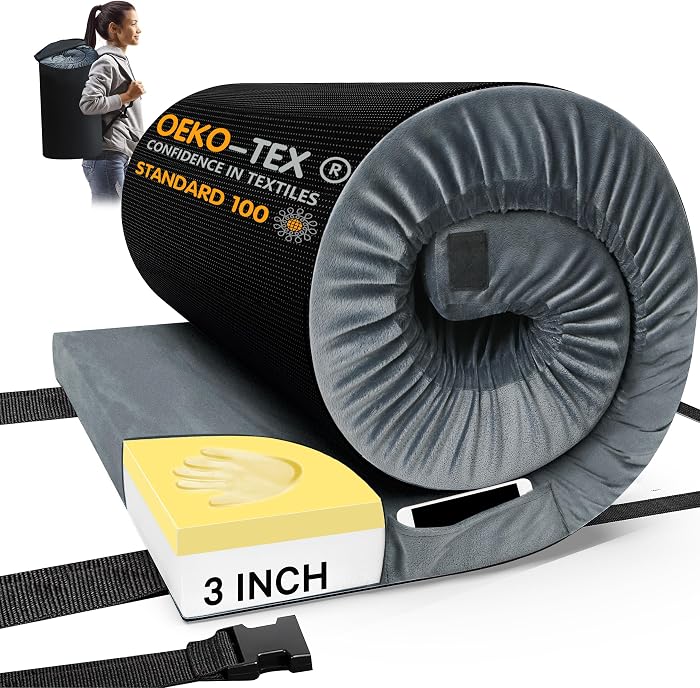
A 3-inch memory-foam camping mattress is the closest thing here to sleeping on a real mattress, and the CYMULA is the version we recommend first. The 72-by-24-inch surface fits a standard cot or a tent floor, the waterproof non-slip bottom keeps it from skating, and the included straps make the roll manageable. The OEKO-TEX certification is a detail we appreciate for a pad that may double as a guest bed.

What sold us is the balance: it is soft enough to take the edge off roots and rocks without turning into a marshmallow. The 7.5-pound weight is the catch; this is a car-camping pad, not a backpacking one. Rolling it takes a few passes, but the long straps are easy to reach and buckle.

The 24-inch width is the other thing to check. It is fine for a solo sleeper who stays fairly still, but a broad-shouldered or restless sleeper will want the 30-inch Kingfun. For everyone else, this is the memory-foam pad that makes the most sense.

Worth Noting

  • 7.5 pounds is too heavy to carry far
  • 24-inch width is snug for restless sleepers
Our Verdict

We recommend the CYMULA for car camping and guest-room overflow: it brings real mattress comfort without an air pump, as long as you are not carrying it far.

Check Latest Price
5

Homemate Memory Foam Best Budget Memory Foam

HomeMate Memory Foam Camping Mattress Pad: Portable Car Sleeping Pad

Budget car camping

Field Score 90/100
Cover
Removable washable
Bottom
Waterproof non-slip
Weight
7.8 lb
Dimensions
72"L x 24"W x 3"Th
View on Amazon

The Homemate is the lower-priced way into the same 3-inch memory-foam idea as the CYMULA. You get a 72-by-24-inch pad, a removable washable cover, and a waterproof non-slip bottom, all in a package that rolls up with straps. It is a car-camping and guest-room pad, not a backpacking one.

The foam is a memory-foam top over a denser support layer, so it has a little more structure than a pure soft topper. The 7.8-pound weight is the obvious cost; this is another pad that stays near the vehicle. The cover zips off, which is the detail that makes it useful for sleepovers and temporary beds.

Where it gives ground to the CYMULA is refinement: the surface is not quite as plush, and the 24-inch width has the same narrow feel. But if the goal is a comfortable temporary bed at the lowest price here, this is the one we point to.

Worth Noting

  • 7.8 pounds limits it to car camping
  • 24-inch width is narrow for some
Our Verdict

We recommend the Homemate for budget-minded car campers and guest beds; it delivers 3-inch memory-foam comfort without pretending to be a backpacking pad.

Check Latest Price
6

REDCAMP Closed-Cell Best Budget Backpacking Pad

REDCAMP Foldable Foam Camping Pads for Sleeping

Budget backpacking

Field Score 89/100
Weight
1.1 lb
R-value
2.1
Foam Type
Closed-cell
Dimensions
72"L x 22"W x 0.75"Th
View on Amazon

The REDCAMP is the budget backpacking pad in this group: 1.1 pounds, a 72-by-22-inch surface, and an R-2.1 rating. It folds into a triple-panel bundle, so it can ride outside a pack without much fuss. For the weight and warmth, it is a sensible place to start.

The foam is 0.75 inch thick, and that tells you most of what you need to know. It keeps you off cold, rough ground and reflects some heat, but it does not cushion like a 3-inch memory-foam pad. If you sleep on your side or need pressure relief, this is not the pad; the CYMULA is the comfort alternative.

We also treat the edges as the wear point. The foam and reflective layer are not fragile in normal use, but rough ground and abrasion can shorten its life, so a ground sheet is worth the small extra weight. At the budget end, it is a fair trade: light, warm enough for three seasons, and not plush.

Worth Noting

  • Little cushioning for side sleepers
  • Edges can wear on rough ground
Our Verdict

We recommend the REDCAMP when weight and warmth matter more than cushion; it is the budget backpacking pad here, but side sleepers should spend more.

Check Latest Price
7

Kingfun Memory Foam Best for Wide Sleepers

Kingfun Memory Foam – 3 Inch CertiPUR-US Memory Foam Camping Mattress Pad

Wide sleepers

Field Score 88/100
Cover
Waterproof removable
Layers
Two-layer memory foam
Dimensions
75"L x 30"W x 3"Th
View on Amazon

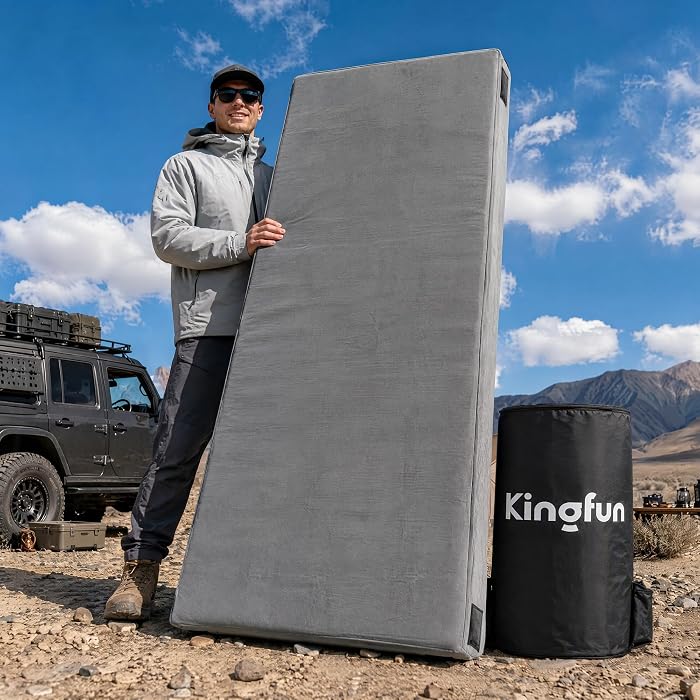
The Kingfun is the memory-foam pad we point to when 72 by 24 inches feels cramped. Its 75-by-30-inch surface gives taller and broader sleepers more room, and the 3-inch, two-layer foam has a gel-infused memory top over a firmer support base. In a tent or on a cot, that extra width is immediately noticeable.

The details are practical: a waterproof cover, an anti-slip bottom, and eight Velcro connectors that let two pads sit side by side without gaping. We like the connectors because they turn a pair of singles into a more usable double for a couple or a family.

The weak points are the straps, buckles, and storage bag. The foam is not the issue; the hardware is. Treat the buckles gently and keep a spare strap in the truck. The pad also needs a few days to fully expand after unpacking, so open it well before your trip.

We still recommend it for the sleeper who needs the width and does not want to move up to a twin-size pad. It is a car-camping comfort piece, not a packable one, and the hardware is the compromise.

Worth Noting

  • Straps, buckles, and bag are weak points
Our Verdict

We recommend the Kingfun for taller or broader sleepers who want a 30-inch-wide memory-foam surface; treat the straps and bag as the weak points.

Check Latest Price
8

Aehma Foil Mat

Aehma Foil Mat – Foam Sleeping Mat

Ultralight warmth

Field Score 87/100
Weight
5.65 oz
Material
Aluminum foil and EPE foam
Dimensions
78.7"L x 59"W x 0.07"Th
Water Resistance
Waterproof
View on Amazon

The Aehma is not a stand-alone sleeping pad. At 0.07 inch thick, it is a reflective sheet with a thin foam core, and it offers almost no cushioning. Its job is to add warmth and a barrier under a sleeping bag, an air mattress, or a cot, not to replace the pad itself.

That job is useful. The 5.65-ounce mat unfolds to 78.7 by 59 inches, wide enough to cover a large sleeping area, and the aluminum foil surface reflects heat back toward you. It folds into a small pack and takes up almost no room in a vehicle or emergency kit.

The limits are the same as the appeal: it is thin, and the foil edges are the first thing to suffer on rough ground. We treat it as a supplement for cold floors and as a protective layer under an air mattress. It is not the pad we hand someone who wants a comfortable night on its own.

Where it earns a place is as cheap insurance. It is the least expensive pad here, and it solves a specific problem—cold or abrasive ground under another pad—without adding meaningful weight. Buy it for that, not as your only sleeping surface.

Worth Noting

  • Provides no meaningful cushioning
  • Foil edges can tear with rough use
Our Verdict

We recommend the Aehma as an ultralight warmth layer for an air mattress, cot, or emergency kit, not as the pad you sleep on by itself.

Check Latest Price

How We Tested a Dozen Foam Sleeping Pads

We started by pulling more than 40 pads and comparing what the listings claimed — foam type, thickness, packed size, weight, R-value, and how each one was held rolled. Then we read reviews for the complaints that repeat: pads that flatten by the second season, seams that split, straps that give out. Twelve made the cut, chosen to cover the range of the category rather than the same pad a dozen times over: featherweight accordion folds, closed-cell roll-ups with a reflective layer, extra-thick cot pads, and memory foam mattresses that come with a travel bag.

Each pad got at least three overnights across six months — a cold backyard night in March, a three-night car camping trip, a week of regular sleep on a guest room floor, and a long weekend where the pad lived on a cot. Before bed we laid on each one to check the footprint against its listed size and pressed a fist into the foam to see how fast it pushed back. In the morning we wrote down whether we'd woken up with a numb hip or shoulder, which is the honest measure of cushioning and sleep quality.

Rollability got its own round: three roll-ups per pad, noting whether the straps held tight enough to carry by hand or lash to a pack, and weighing the packed bundle against a duffel on the way out the door. The backpacking models went to the trailhead on our backs; the thicker ones got hauled in and out of a trunk. For durability we left one pad compressed for a full week to see how much loft returned, dragged boots across the surface, and ran a hose over anything claiming waterproof. By the end, it was clear which of the cheaper pads were real value and which were a bargain only on paper.

How to Choose a Foam Sleeping Pad

Start With How You'll Carry It

Closed-cell foam is the backpacker's material: it cannot spring a leak, it folds into a compact bundle, and it is firm enough to double as a seat. The trade is cushioning. A 0.75-inch pad such as the Z Lite Sol or REDCAMP keeps you off cold ground, but it will not feel like a mattress. Memory foam is the car-camper's material. A 3-inch camping mattress like the CYMULA or Homemate is far more comfortable on a tent floor or cot, but it weighs 7 to 8 pounds and rolls into a bulky bundle. If the pad has to go in a pack, choose closed-cell; if the vehicle carries the load, choose memory foam.

Match the Size to Your Body and Your Cot

A 20-inch-wide closed-cell pad is light and packable, but it leaves little room for a broad sleeper; the 22-inch REDCAMP and 24-inch memory-foam pads are easier to live with. Length matters too: 72 inches suits many adults, but a taller sleeper should look at the 75-inch Kingfun or the 80-inch Teton. For cot use, measure the cot deck before ordering. The Teton's 80-by-30-inch shape is built for an oversized cot; a 72-by-24-inch pad fits a standard cot but will look small on an XL frame.

Use R-Value for Cold Ground

R-value measures resistance to heat flow, not a temperature rating. The closed-cell pads here sit around R-2: the Z Lite Sol is 2.0, the NEMO Switchback is 2, and the REDCAMP is 2.1. That is a reasonable three-season baseline, especially with a sleeping bag and a tent floor underneath you. The memory-foam pads do not publish an R-value, so do not assume their thickness makes them warmer. For cold ground, put a closed-cell or reflective layer under the memory foam; the Aehma foil mat is made for that kind of supplement.

Plan for Packing, Expansion, and Cleaning

Closed-cell pads wipe clean and do not absorb much water; memory foam needs more care. A removable, washable cover makes a big difference for a pad that doubles as a guest bed, and a waterproof bottom helps on damp ground. Memory foam also needs time: the Kingfun asks for 72 hours to fully expand, so unroll it well before the trip. Store memory foam loosely rather than compressed, and keep the straps and bag in good repair; on the Kingfun, the hardware is the part to watch.

Frequently Asked Questions

Final Verdict

Buy the Therm-a-Rest Z Lite Sol if you want one foam pad that can go in a pack, shrug off rough ground, and add R-2.0 warmth on a three-season night. Its 14-ounce weight and closed-cell construction are why it stays our default. If your camping is vehicle-based, the CYMULA memory-foam pad is the better comfort choice; for an oversized cot, go with the Teton Outfitter XL.