The 5 Best Framing Hammers of 2026

You don't notice a bad framing hammer on the first nail. You notice it around nail two hundred, when the shock has run up your forearm for the tenth time and your grip has gone soft. A framing hammer is the tool you swing more than any other on a build, and the difference between two that look nearly identical often comes down to a few ounces, a face that's milled instead of smooth, and a handle that swallows vibration instead of passing it along.

Weight is the first tradeoff. A 28-ounce head sets a 16-penny nail in fewer swings, but you feel those extra ounces by midafternoon, and a heavy hammer that's poorly balanced is worse than a light one that isn't. Then there's everything the head does besides strike: a milled face grips the nail so it doesn't skate, a magnetic starter holds the nail upright so your off hand stays clear, and the claw has to pull as well as it drives.

My team has spent the last six months swinging 12 of them on decks, in garages, and along a fence line that needed rebuilding, and the pattern held every time — the hammers that won us over did it in hour two, not on the first swing. What follows is what I'd hand to a friend without a warning.

Our Top Picks

The 5 Best Framing Hammers of 2026

1

Estwing E3-20S Best Overall

ESTWING Framing Hammer

All-around framing

Field Score 96/100
Face
Smooth
Grip
Shock reduction
Head Weight
20 oz
Item Weight
1.3 lb
View on Amazon

One piece of steel runs from the striking face to the butt of the handle on the E3-20S, and that single fact is most of why we recommend it first. There is no wedge to work loose, no epoxy joint to fail, and nothing to reseat after an afternoon of prying sheathing off a wall. The straight claw is the other half of that story: slide it under a nail head, lean back, and the nail comes out instead of fighting you.

Twenty ounces sits at the light end of this group, and we felt the difference in both directions. Nailing off a wall takes a few more swings than it does with the 28-ounce hammers here, but the balance is the best of these five — the head goes where you point it and the handle does not fight your hand — so the swings you take land square. For a remodeler, someone building a shop, or anyone who frames a few days a month rather than every day, that is the right trade.

The molded shock-reduction grip is doing real work on a steel handle: the sting stays in the tool rather than traveling up your forearm, which is what we noticed most while nailing overhead. It is forged and assembled in Rockford, Illinois, too, and that carries weight with the buyers this category attracts.

Worth Noting

  • Smooth face can skate on a slick nail head
Our Verdict

We tell most people to start here: the E3-20S is balanced, forged from a single piece of steel, and priced in the middle of this group, which makes it the safest framing hammer to buy first.

Check Latest Price
2

DeWalt DWHT51453 Best for Heavy Framing

DeWalt DWHT51453 – 28OZ 1PC STEEL HAMMER

Heavy framing

Field Score 95/100
Grip
Ergonomic
Dimensions
16"L x 5.9"W x 1.7"Th
Head Weight
28 oz
Item Weight
1.8 lb
View on Amazon

The DWHT51453 makes one trade up front: the biggest head in this group. What 28 ounces buys is fewer swings. On long nails the head does the work and your shoulder just steers, and by mid-afternoon on a tear-out that is the difference between a tired arm and a useless one.

The balance is what sold us. The handle is shaped plastic over a steel core with a swell where your palm sits, and sixteen inches overall gives you room to swing without feeling like you picked up a sledge. It is the hammer we reach for when the work is big — joists, plates, teardowns — and the magnet in the head holds a nail well enough to start it one-handed where you cannot get two hands to the spot.

It is also a lot of hammer to carry on a belt all day. If your work is trim, punch lists, or overhead nailing in a crawlspace, the Estwing above is the easier tool to live with; the mass that makes this one drive is the same mass you feel walking a site.

Worth Noting

  • Heaviest of these to carry on a belt
  • Highest price tier in this group
Our Verdict

If your days are spent driving framing nails or tearing out walls, the DWHT51453's 28-ounce head does more of the work than your arm does.

Check Latest Price
3

Spec Ops SPEC-M28CF-S Best Feature Set

Spec Ops Tools Rip Claw Framing Hammer

Framing with extras

Field Score 94/100
Face
Milled
Head Weight
28 oz
Item Weight
2.27 lb
Nail Starter
Magnetic
View on Amazon

A magnetic nail starter, a side nail puller, a removable mallet cap, and a milled face: the Spec Ops hammer carries more features than anything else here, and its 28-ounce head has the mass to back them up.

The one that changed our minds is the side puller. A straight rip claw is fine on a nail you can get behind; the side puller gives you a second bite at a nail buried in a corner or a tight stud bay where the claw has no room to work. The magnetic starter got used more than we expected on fascia and layout, where one hand is holding a board and the other needs the nail to stay put.

The mallet cap is the odd one out. It presses over the head so you can seat a stake or tap a cabinet home without marring it, and it does that well — but it comes off, and a cap loose in a toolbag is a cap you will be replacing. That is the price of the Swiss-army approach: the more a hammer does, the more there is to keep track of.

Worth Noting

  • Claw edge is the wear point under daily use
Our Verdict

We reach for the Spec Ops when a job needs a nail starter, a pry point, and a mallet in one tool, and the milled face seals it.

Check Latest Price
4

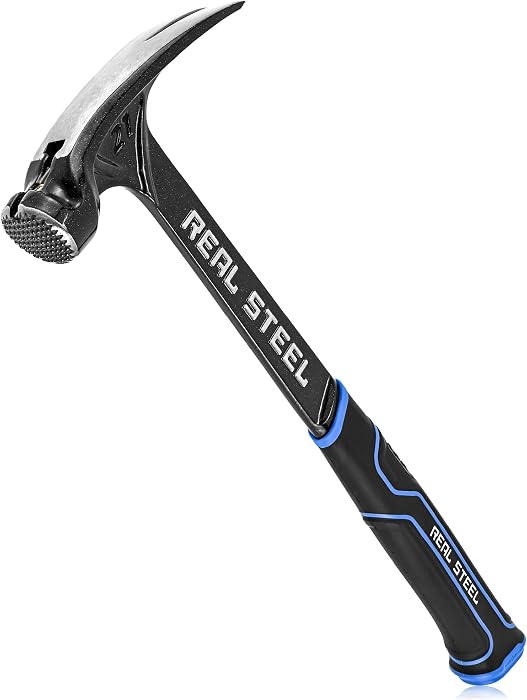
Real Steel 0517 Best Budget

Real Steel Framing Hammer 21 Oz One Piece Forged Milled Face with Rip Claw 0517

Budget framing

Field Score 93/100
Face
Milled
Grip
Textured rubber
Head Weight
21 oz
Item Weight
2.1 lb
View on Amazon

The Real Steel is the least expensive hammer here, and nothing about it reads cheap. Head and handle are forged from one piece of high-carbon steel, the face is milled, and there is a magnetic nail starter in the head — much the same short list the hammers costing more here carry.

What you give up is refinement, not function. The grip is a textured rubber sleeve rather than a molded handle, and 21 ounces of head sit on a tool listed at 2.1 pounds, so it rides heavier on a belt than the Estwing does. For a second hammer that lives in the truck, or a first framing hammer bought on a budget, we think that is a trade worth making.

The milled face is the reason to choose it over the smooth-face Estwing when you are driving nails into framing lumber all afternoon: the crosshatch grabs the head and keeps a slightly off-center hit from skating. On anything you plan to stain or leave exposed, it will leave its mark, so keep it out of the finish work.

Worth Noting

  • Rides heavy on a belt for its head weight
Our Verdict

Buy it if the budget decides: the Real Steel is the least expensive hammer here and still forges its head and handle from a single piece of steel.

Check Latest Price
5

Estwing E6-24TM Hammertooth Best for Straightening Studs

Estwing E6-24TM Hammertooth

Straightening studs

Field Score 92/100
Face
Milled
Grip
Shock reduction
Head Weight
24 oz
Item Weight
1.5 lb
View on Amazon

Bowed studs are why this hammer exists. A crowned or twisted 2x4 is a fight with a straight claw — you pull, you pry, and you end up shimming. The fin behind the Hammertooth's face catches the side of a stud and levers it straight, and the same tooth twists a cupped board back into line.

In practice that is one less tool on the belt, and we found the rest of the hammer holds up its end: one piece of forged steel, a molded shock-reduction grip, a milled face for structural nailing, and the blue finish Estwing puts on everything. At 24 ounces it is heavier than the 20-ounce Estwing here without being a burden to swing.

It is a specialist's tool. If you frame walls, true openings, or clean up other people's rough carpentry, the tooth earns its keep the first time a wall goes together flat and square. If your framing is really remodeling and repair, you are paying for a feature you will rarely reach for.

Worth Noting

  • No nail starter in the head
  • Near the top of this group on price
Our Verdict

Spend the extra if you true walls all day: the Hammertooth grabs a bowed stud and levers it straight, which no plain rip claw here can do.

Check Latest Price

How We Tested Framing Hammers (and What Showed Up in Hour Two)

We started by pulling every framing hammer we could find with a forged one-piece steel build, a rip claw, and a grip meant to cut vibration, then sorted them by weight class so we had a real mix of 20-, 21-, 24-, and 28-ounce heads rather than five versions of the same swing. We cut anything with a handle we could flex by hand or a face that had been painted over at the factory. That left 12 hammers, and we bought each one at retail so nothing arrived pre-selected by a brand.

Testing ran six months, mostly across a deck rebuild, a garage framing job, and a run of pressure-treated fence posts, with a few weeks of smaller work mixed in — prying pallet nails, tapping joints apart, straightening boards that had cupped. Every hammer got the same tasks: driving 16-penny common and galvanized nails into spruce and treated lumber, starting nails one-handed, and pulling them back out with the claw.

Weight and balance got graded before we ever swung. We choked up and then held the end of the handle, feeling where the head sat and whether the hammer wanted to rotate in the hand at the top of the swing. Over the six months we checked the head-to-handle joint for wiggle, ran a thumb across the face looking for chips and mushrooming at the edges, and inspected the grip for seams lifting where the palm sits. To judge the magnetic starter and general accuracy, we set a nail with one hand, brought the hammer up, and counted how often the head slid off before it bit.

Ergonomics only got an honest answer after two hours of continuous swinging, when we could say whether the palm was hot, the forearm tired, or the wrist sore the next morning. Value came last, and it had little to do with the sticker — we weighed what each hammer cost against how it held up, since a cheap one that chips its face in a season turns out to be the expensive one.

How to Choose a Framing Hammer

Start with head weight, then stop staring at it

Anything from about 20 to 24 ounces covers general framing, remodeling, and the occasional demolition afternoon, and it is where most of this group sits. The 28-ounce hammers here exist for volume: a heavier head drives a big nail in fewer strokes, so your arm does less per nail but carries more between them.

A few days a month of swinging favors the lighter head, because control and fatigue matter more than raw drive. Nailing off walls all week, or tearing out, favors the heavier one. Choose the weight for the work you do most, not the work you imagine doing.

Smooth or milled, and the mark it leaves

A milled face carries a crosshatch that grips a nail head, so an off-center swing still drives instead of skating — which is why most production framing hammers have one. The cost is a waffle mark in the wood that no sanding hides, and that is the trap: a milled face on anything you plan to stain or leave exposed is the wrong tool, however good it feels in the store.

A smooth face leaves the surface clean and suits a hammer that does double duty around the house, but it asks for a squarer hit on a slick, galvanized nail. Match the face to the surface you are nailing, not the other way around.

One-piece forged steel, and what it does not fix

The joint between head and handle is where hammers fail: a wood or composite handle can loosen, and a steel head can walk off a worn eye. Every hammer here is forged from a single piece of steel, which removes that failure point entirely.

What forging does not remove is shock. Steel carries vibration up into your hand, so the grip is doing real work, and it matters more on a 28-ounce head than a 20. All five picks have a molded or rubber over-mold; on a heavy head, that is the difference between a tool you can swing all day and one you put down.

Extras: which ones earn their keep

Nail starters, side pullers, mallet caps, and straightening teeth all solve real problems. A magnet holds a nail where you cannot get a second hand; a side puller reaches nails a rip claw has no room to work; a tooth levers a bowed stud straight. Each one also adds a little weight and something to lose track of.

We judge an extra by how often the situation it fixes comes up in our own week. A magnetic starter comes up several times a day on layout work. A mallet cap comes up rarely. Buy the extras that match your week, not the longest feature list.

Frequently Asked Questions

Final Verdict

The Estwing E3-20S is the framing hammer we recommend to most people. It is the easiest of these to stay accurate with for the longest part of a day, it is forged from one piece of steel, and it sits in the middle of this group on price. That combination is hard to argue with.

Two requirements change the answer. If your work is joists, plates, and teardowns rather than remodeling, the DeWalt's 28-ounce head takes more of the load off your arm. If you true walls for a living, the Estwing Hammertooth's tooth replaces a second tool. On a tight budget, the Real Steel does the same job with more heft on your belt.