The 8 Best Garden Hose Splitters of 2026

Every yard seems to have exactly one spigot in exactly the wrong place, and by midsummer it has to feed two things at once: the soaker hose in the vegetable bed and the spray nozzle you use for everything else. Screwing one hose off and the other on gets old fast. A splitter fixes that — one faucet in, two or four independently valved outlets out, so both hoses stay connected and you open only what you need.

My first was a plastic Y that split at the collar before Labor Day, which taught me that body material and handle length decide almost everything here. A handle that's too short is useless once your hands are wet or you're wearing gloves, and a flat washer is the difference between a dry joint and a puddle at your feet. We've had 14 splitters screwed onto outdoor spigots for five months now, and the differences are not subtle.

The picks below run from simple brass two-ways to four-outlet manifolds, sorted by what each one does best. One thing no splitter can do is add pressure — the good ones simply don't take any away.

Our Top Picks

The 8 Best Garden Hose Splitters of 2026

1

RAINPOINT 2-Way Hose Splitter Best Overall

RAINPOINT 2 Way Garden Hose Splitter

Everyday spigot duty

Field Score 96/100
Body
Metal with TPR rubber grip
Valve Bore
0.42 in ball valve
Configuration
2-way, individually valved
Handle Length
1.9 in
View on Amazon

The RAINPOINT is the most expensive splitter in this roundup, and it is still the one we put first. Pick it up and the reason is obvious: a metal body wrapped in a rubber grip, a little under a pound, with an inlet nut that spins on by hand and seats without a wrench.

The handle is what earns it the top spot. At 1.9 inches it is the longest in this group, with an arc that gives your fingers something to pull against, so shutting a line off one-handed in wet gloves is doable rather than fiddly. Inside, the stainless ball valve is full-port, and we ran a sprinkler and a hand wand at the same time without the sprinkler losing its throw.

The price is the honest trade-off, and it is not a small one next to the brass two-ways below. What it buys is the part that fails on cheap splitters: the threads. These are machined cleanly, the anti-twist nut holds where you set it, and a quarter turn past hand-tight has been enough to keep the inlet dry through a summer of hooking and unhooking hoses.

If your splitter sits on a spigot you touch twice a week, save the money and take one of the brass picks below. This one belongs on the faucet the whole household uses, or on a spigot where someone with stiff hands needs to shut the water off without a fight.

Worth Noting

  • Priciest splitter here by a wide margin
Our Verdict

Buy this one if you are tired of replacing a splitter every spring — the metal body, full-port valve and long handles are the most convincing combination here.

Check Latest Price
2

Morvat Brass 2-Way Splitter Best Value

Morvat Brass 2-Way Splitter – Brass Heavy-Duty Garden Hose Water Splitter

Value brass setup

Field Score 95/100
Thread
3/4 in GHT
Included
3 washers and thread tape
Material
Brass
Configuration
2-way Y
View on Amazon

The Morvat box comes with three spare washers and a roll of thread tape, which sounds like filler until a connection starts weeping on a Sunday afternoon. It also carries a one-year manufacturer warranty, something most of the brass here leaves you without.

As a plain two-way splitter it is well thought out. The body is fully brass at about eight ounces, with a 360-degree swivel on the inlet and broad valve wings that push easily with a thumb instead of biting into your fingers the way thin stamped levers do. Of the inexpensive brass units here, this is the best-finished body.

Expect the valves to arrive stiff. Work them open and closed a handful of times, or put a drop of oil on the stems, and they settle down within a week of watering. After that it is the low-drama choice: screw it on, keep a washer in the drawer, and it does its job without asking anything of you.

Worth Noting

  • Inlet thread can split under a hard hose pull
Our Verdict

Our value pick: full brass, spare washers and tape in the box, and a one-year warranty for roughly half what the top pick costs.

Check Latest Price
3

SNUTUYA Stainless 2-Way Splitter Best for Low Pressure

SNUTUYA Stainless 2-Way Splitter – 304 Stainless Steel Garden Hose Splitter 2 Way Heavy Duty

Long sprinkler runs

Field Score 94/100
Thread
3/4 in GHT
Material
304 stainless steel
Valve Bore
0.59 in
Configuration
2-way Y
View on Amazon

A splitter can quietly rob your water supply: the ball inside is smaller than the hose, and the sprinkler that used to reach the fence starts dribbling halfway across the lawn. The SNUTUYA's valve is 0.59 inches across, the widest bore in this group, and that is the reason we hand it to anyone whose complaint is pressure.

The rest of the build backs it up. The body and the long handle are 304 stainless, the 3/4-inch GHT threads are cut cleanly with no burrs to chew a washer, and the swivel nut turns freely enough to seat by hand and then hold. The long lever is the other thing we noticed: it is easy to find and turn without looking, which matters when you are crouched behind a shrub.

What you pay for the bore is mass. At roughly a pound and a half this is the heaviest splitter here, and a short spigot with two full hoses hanging off it will feel the leverage. Take the strain off the threads with a quick-connect, or put it on a solid wall-mounted faucet and forget the difference.

Worth Noting

  • Heavy enough to strain a short spigot
Our Verdict

If a splitter has ever flattened your sprinkler's reach, this full-port stainless one barely narrows the flow, and it has the cleanest threads here.

Check Latest Price
4

Biswing 2-Pack 2-Way Splitter Best Two-Pack

Biswing 2 Pack Garden Hose Splitter 2 Way

Two spigots

Field Score 93/100
Thread
3/4 in GHT
Included
4 spare O-rings
Material
Brass
Configuration
2-way, 2-pack
View on Amazon

Two brass splitters arrive in one box here, which is the whole pitch: the front spigot and the back spigot sorted in a single order, plus four spare O-rings for the connections that always end up seeping.

The bodies are brass with a ball valve in each arm and standard 3/4-inch GHT fittings, so they go onto the same spigots everything else does. The knobs are the weak point: small, and stiff enough that you pinch them between two fingers rather than push them with a thumb, which is worth knowing before you mount one behind a rose bush.

As a value buy we think it is the sensible one for a yard with more than one faucet. You get two brass splitters for less than a premium single costs, and a spare on the shelf if one ever gives up. The four extra O-rings matter more than they sound, too, because the washer is the first thing to fail on any splitter, and having replacements in a drawer spares you the hardware store run.

Worth Noting

  • Small knobs are stiff to turn
Our Verdict

Two decent brass splitters for the price of one premium pick — the smart buy when you have a front and a back spigot to feed.

Check Latest Price
5

Twinkle Star 4-Way Brass Splitter Best 4-Way

Twinkle Star 4 Way Heavy Duty Brass Garden Hose Splitter

Drip systems

Field Score 92/100
Weight
1.1 lb
Material
Metal, brass finish
Thread Size
0.75 in
Configuration
4-way, individually valved
View on Amazon

Four outlets on one faucet solves a scheduling problem more than a pressure problem. The Twinkle Star is the four-way we recommend, and the honest version of the pitch is that it lets you leave several lines connected and switch between them without hauling anything.

The body is brass with a ball valve in each of the four arms, individually controlled, on standard 3/4-inch connections. At 1.1 pounds it hangs solidly without feeling like it is pulling the spigot out of the siding, and the hex flats on the inlet give you something to hold while you tighten it.

We recommend it for a drip or soaker setup that gets set up once: three lines to the beds and a hose for the watering can, where four separately valved outlets genuinely earn their space. What it is not good for is running four sprinklers at once. The ports through the body are narrow, and by the time water reaches the fourth outlet there is not much throw left.

The handles are small and wet hands fumble them, so set the valves with the water off and leave the ones you never use shut. Do that and the compromises stop mattering; it turns one faucet into a small manifold for less than the top pick costs.

Worth Noting

  • Small handles are fiddly when wet
Our Verdict

Buy it when four lines need to share one faucet and you want to shut each one off at the tap instead of dragging hoses around the yard.

Check Latest Price
6

BILAL Brass 2-Way Splitter Best Budget

BILAL Brass 2-Way Splitter – Garden Hose Splitter 2 Way Heavy Duty

Tight budgets

Field Score 91/100
Weight
3.2 oz
Material
Brass
Configuration
2-way Y
Valve Handles
Extended levers
View on Amazon

The BILAL is a small splitter, barely two inches of body and a bit over three ounces in the hand, and on the shelf it looks like the toy of the group. Then you notice the shutoff levers are brass rather than plastic, and the arithmetic changes: this is as cheap as anything here, and there is no plastic in the valve train.

Installation is easier than its size suggests. The octagon body takes a wrench if the spigot threads are chewed up, the inlet swivels a full 360 degrees so you can aim the outlets where you want them, and it uses standard US 3/4-inch threads. The extended levers are the detail we keep coming back to: they are long enough to work with gloves on, which is unusual at this price.

The compromise is flow. The passage through the body is narrower than a 5/8-inch hose, so an impact sprinkler at the end of a long run will lose some reach. For a hand wand, a soaker or a drip line it is more than enough, and at three ounces it puts almost no leverage on the spigot threads when you tug a hose.

Worth Noting

  • Narrow bore limits reach on big sprinklers
Our Verdict

Brass body and brass levers for about as little as anything here — this is the splitter we suggest when a plastic one has just cracked.

Check Latest Price
7

Hourleey Brass 2-Way Splitter Best for Spare and Backup

Hourleey Brass Garden Hose Splitter (2 Way)

Spare and backup

Field Score 90/100
Thread
3/4 in
Included
Tape and 2 spare O-rings
Material
Brass
Configuration
2-way Y
View on Amazon

The roll of thread tape in the Hourleey box turned out to be the useful part. On a spigot with worn threads, a wrap before you screw this on is the difference between a dry connection and a slow drip down the siding, and most splitters at this end of the price range make you supply your own.

The body and the valve handles are solid brass, the ball valves close all the way, and the threads measure 3/4 inch on both the male and female ends, so it fits the same hoses as everything else here. Two spare O-rings ship in the box as well, which tells you the maker knows which part wears out.

Two things to know. The valve stems arrive stiff and stay that way if you park them in one position, so work them open and closed now and then. And the body is compact, which keeps it out of sight behind a shrub but also means it passes less water than the full-port picks; you notice it at the end of a long sprinkler run and not at all on a hand wand.

At the bottom of the price range, we think of it as the spare to keep in the shed: brass enough to outlast the plastic splitters it replaces, small enough to disappear, and inexpensive enough that buying a second for the far spigot is not really a decision.

Worth Noting

  • Passes less water than full-port picks
Our Verdict

One of the cheapest brass two-ways here, with tape and spare washers in the box — we buy this one in pairs and keep one in the shed.

Check Latest Price
8

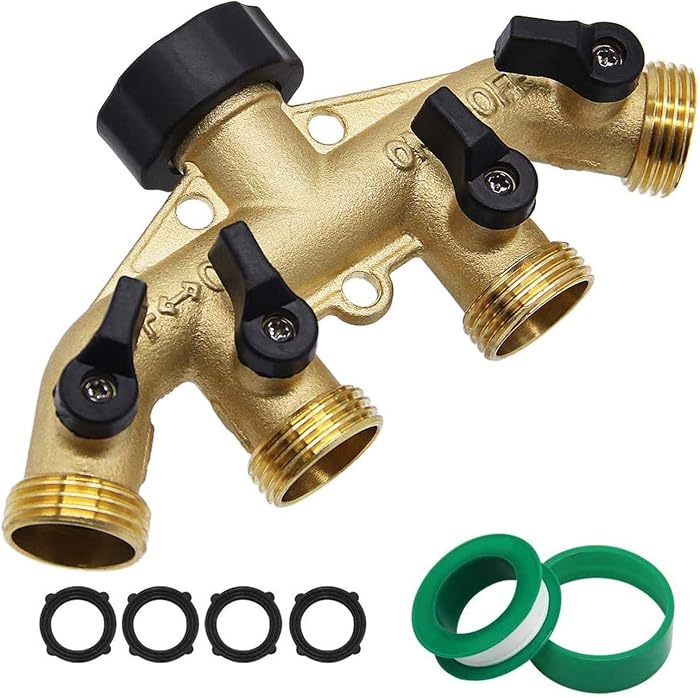
Hourleey Brass 4-Way Splitter

Hourleey Brass Garden Hose Splitter (4 Way)

Budget drip manifold

Field Score 89/100
Thread
3/4 in
Included
8 washers and PTFE tape
Material
Brass
Configuration
4-way, individually valved
View on Amazon

Four zones off one faucet is a drip-system job, and this Hourleey is the budget way in. It is a brass body with four individually valved outlets on 3/4-inch connections, and it ships with eight washers and a roll of PTFE tape, which tells you where the fuss usually is.

The brass is solid and the unit has real weight at about a pound, so it hangs steady with four lines hanging off it. Each outlet shuts off completely, which is the point of the thing: you leave the beds connected and kill the line you are not using without walking back to the tap.

The valves are the compromise. They are small and stiff, hard enough to turn that you will not want to be adjusting them weekly, and with wet hands especially. Set each zone once with the water off and treat them as open or closed rather than as flow controls.

For a timer-fed drip manifold in a vegetable bed, that trade is worth making. It costs less than the four-way we recommend first, and the jobs it does badly are the jobs you would not ask of it anyway.

Worth Noting

  • Valves are small and stiff
  • Inlet swivel needs tape to stay dry
Our Verdict

The budget route to four zones: set the stiff valves once for a drip system and the effort stops mattering.

Check Latest Price

How We Tested Garden Hose Splitters

We started with spec sheets and a few hundred customer reviews, then filtered hard: a metal body (solid brass, stainless steel, or a metal shell), a standard 3/4-inch GHT connection, and a handle long enough to actually grip. Any listing that wouldn't state its body material got cut. That left 14 splitters, two-way and four-way, from bare-bones Ys to kits that ship with spare washers and thread tape.

Each one went onto the same outdoor spigot in late April and stayed there through August. One outlet fed a soaker hose along a vegetable bed, the other a spray nozzle used for watering cans, the car, and a kiddie pool. To check for leaks, we wrapped a dry paper towel around the spigot joint and under each closed valve, ran full flow for 20 minutes, and looked for damp spots; we also timed a five-gallon bucket fill through each splitter against the bare spigot to see how much flow the body cost us.

Valves were opened and closed with wet hands and with garden gloves on, and we noted whether the handle cleared our knuckles, how far it turned from full open to shut, and whether it stiffened after a few weeks in the sun. For fit, we threaded every splitter onto three spigots of different ages — an old galvanized one, a new brass one, and a plastic one — watching for cross-threading and counting the turns until snug. We also tracked corrosion at the threads, cracks in the body, and the slow drip that shows up in week six rather than day one, and we noted which ones were sold as lead-free and what came in the box, since a spare washer is the difference between a five-minute fix and a return.

How to Choose a Garden Hose Splitter

Two outlets or four

Most yards need two. A four-way divides your pressure four ways and hangs four hoses' worth of weight on one spigot, and it earns that only when you run a drip manifold or a set of timed lines you leave connected. What matters either way is that each outlet closes on its own, so a two-way Y splitter with good ball valves beats a four-way with sloppy ones.

Count the lines you actually leave hooked up, then buy one outlet more than that. Anyone who hauls a hose from zone to zone is paying for a fourth outlet they will never open.

The inlet is where leaks start

Nearly every drip we have chased starts at the swivel nut that meets the spigot, not at the valves. Use the rubber washer the splitter ships with, add a wrap of thread tape if the spigot threads are worn, and stop at hand-tight plus a quarter turn. A wrench on a brass nut mostly buys you a distorted fitting that leaks worse.

Before you blame the splitter, swap the washer. It is the part that flattens and fails first, and it costs less than the drive to the hardware store.

Handles and bore, the specs photos hide

Two things decide whether you like a splitter in July. The first is handle length: long levers work with gloves on and are kind to stiff hands, while small knobs demand two fingers and a good pinch. The second is the bore through the valve. A full-port ball valve passes close to the hose's own capacity; a narrow one is fine for a wand or a soaker and frustrating at the end of a long sprinkler run.

Match the bore to the job and pay for the one you need. Pressure complaints almost always trace back to a small port, not to the spigot.

Brass, stainless, and the freeze that kills them

Brass is the default for good reason: it holds threads, resists corrosion, and does not go brittle in the sun. Stainless costs a little more and shrugs off humid, salty air. What actually ends most splitters is ice, because water trapped in the body expands and splits the casting. A splitter left on the spigot through a hard freeze usually comes back weeping in spring.

Drain it and bring it inside, or shut the spigot off and open every valve so the body can empty. That single habit outlasts any difference between the metals.

Frequently Asked Questions

Final Verdict

The RAINPOINT is the splitter we recommend first. It is the most expensive one here, and it is the one where the handles, the threads and the valve all feel considered by someone who has fought a stiff splitter in the rain.

If the budget is tighter, the Morvat gives you full brass, spare washers and a warranty for a lot less. If your sprinklers have been losing reach, the SNUTUYA's full-port valve is the fix. Everything else here is a considered second choice rather than a compromise.