The 5 Best Garden Shovels of 2026

The worst thing a garden shovel can do is stop. Catch a buried root or a rock the wrong way and a weak blade will stall, twist in your hands, or bend at the socket, usually on the afternoon you finally committed to planting. A good one goes where you point it, comes back out with a full load, and feels the same in October as it did in April.

Over eight months we dug with 14 shovels through fall cleanup, snow, and a full spring of planting, and the differences almost never showed up on the shelf. Handle style matters more than people expect: a D-handle gives you something to lever against in a trench, while a straight shaft reaches further and lets you put your legs into the dig. A couple extra pounds is nothing on the first hole and everything on the twentieth, and a length that fits one gardener will wreck another's back. The picks below are the ones that stayed sharp and straight through all of it.

Our Top Picks

The 5 Best Garden Shovels of 2026

1

Root Slayer RS220 Best Overall

Root Slayer RS220 Heavy Duty Garden Shovel

Roots and clay

Field Score 96/100
Handle
Ergonomic grip
Tip Shape
Sharpened inverted V
Blade Material
Powder-coated alloy steel
Overall Length
45 in
View on Amazon

A flat blade that meets a root stops dead. The Root Slayer's sharpened inverted V and serrated shoulders turn that same root into a few short strokes: the point starts the hole, the teeth on either side saw through whatever crosses it, and the powder-coated steel head comes back for more in clay that sends a cheap blade skidding. Of everything here, it's the shovel we reach for first when we don't know what's under the soil.

That changes a planting job more than any figure on the listing. Lifting a shrub whose root ball is wider than the hole you planned, splitting a perennial, digging out a bed threaded with old tree roots — the teeth cut the boundary for you instead of you fighting it with a lopper. The 45-inch shaft is the other half of the design: short enough to steer between plants, long enough to keep some of the bend out of your back.

The serrations are for digging, not for moving dirt. Cut planting holes with them all day; load a wheelbarrow and you'll feel the teeth catch and hold soil where a smooth round-point would let it slide. Heft works the same way — all that steel drives the blade into hard ground with less stomping, and it's the last thing you want at the end of an afternoon in soft raised-bed mix. Keep the point out of gravel, too; sharpened steel dulls faster in a driveway than it ever will in a bed.

Worth Noting

  • Serrations hold soil instead of releasing it
  • Priciest shovel in this set
Our Verdict

With roots and clay underfoot, this is the shovel we reach for first: the serrated V-tip saws where a flat blade bounces, and the steel shaft takes the levering.

Check Latest Price
2

Fiskars 57" Digging Shovel Best Long-Handle Leverage

Fiskars 57" Garden Digging Shovel

Deep holes, rock

Field Score 94/100
Blade
14-gauge hardened steel
Weight
5.94 lb
Warranty
Full lifetime
Overall Length
57.25 in
View on Amazon

Fifty-seven inches of handle and nearly six pounds of steel is the whole argument. This is a long lever with a heavy head on the end of it: the 14-gauge blade is sharpened out of the box, the shoulders are reinforced for your boot, and the mass does a good part of the driving before you push at all.

What convinced us is that there's no joint to fail. Blade and shaft are welded into one continuous piece of steel, where a wood-handled shovel presses its shaft into a socket that can split or snap under a lever's load. It's the pick here we trust with a pry bar's job — working a rock out of a planting hole, trenching through gravel, cutting a new bed edge — and the full lifetime warranty is the maker putting its money behind that claim.

The trade is weight and reach. Six pounds swinging at the end of a long shaft is real work, and the straight handle gives your top hand nothing to brace against the way a D-grip does; over a couple of hours of planting, the lighter picks here are kinder to your shoulders. That flips the moment rock or depth is involved, where the Fiskars does in one pass what a light shovel needs three tries at. Much under six feet tall, though, and the length stops being leverage and starts being a reach.

Worth Noting

  • Nearly six pounds to swing
  • Black steel gets hot in direct sun
Our Verdict

We keep this one for deep holes, trenching, and prying rock: the long steel handle gives leverage nothing else here matches, and the warranty is for life.

Check Latest Price
3

KOLEIYA Round Point Shovel Best for Shorter Gardeners

KOLEIYA Round Point Shovel – Shovel for Digging

Shorter gardeners

Field Score 91/100
Handle
Wood D-grip
Weight
3.3 lb
Blade Material
Alloy steel
Overall Length
41 in
View on Amazon

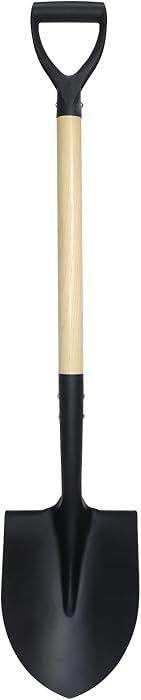
Most full-size shovels are drawn for a six-foot frame, and no amount of technique fixes a handle you have to choke up on. This one runs 41 inches overall with the D-grip set low, so a shorter gardener can pull, lever, and lift with both hands where they naturally sit. In a raised bed, where you're already working above waist height, the same short shaft is the difference between digging and reaching.

The working end holds up its side of the bargain. The alloy steel head arrives with a real edge on it, the wood shaft absorbs the sting of a strike that a steel handle sends straight up your wrists, and 3.3 pounds is light enough to lift a loaded scoop and set it down without bracing your elbow against your hip.

What you give up is depth. Forty-one inches is not much shaft to drive through compacted subsoil, and in heavy clay you'll do more stomping than the Root Slayer ever asks of you. Keep it for beds, borders, transplanting, and lifting — it's a gardener's shovel, not a groundbreaker's. The generous D-grip is the detail that won us over: even with a work glove on, there's room inside it.

Worth Noting

  • Less leverage in deep, compacted ground
Our Verdict

A 41-inch wood-handled digger that puts the grip where shorter gardeners can use it, and we like that it stays light enough to carry a full scoop.

Check Latest Price
4

Ashman Digging Shovel Best for Light Digging

Ashman Heavy-Duty Digging Shovel (1 Pack) 41-Inch with Trenching Blade

Light digging

Field Score 90/100
Weight
2.2 lb
Blade Type
Round point
Blade Material
Hardened alloy steel
Handle Material
Plastic and fiberglass
View on Amazon

At 2.2 pounds this is the lightest shovel here, and the plastic-sheathed shaft is most of the reason. That's a trade you feel at both ends: the weight comes off your arms and shoulders, and it comes out of the blade too, so hard, compacted ground takes more stomping than it would with the Fiskars.

The round-point blade comes sharpened, and it's the most versatile shape in this group — it cuts a trench edge, lifts a transplant, scoops compost, and moves gravel without the Root Slayer's teeth catching on the way out. The D-handle gives you two-handed control for all of it, which counts for more on a light shovel than on a heavy one, where the tool's own mass does some of the steadying.

Where it earns its place is as the second shovel: the one by the raised beds, the one you grab to turn a compost heap or clear out a truck bed, the one a smaller gardener can work one-handed while the other hand holds the plant. The orange finish earns its keep too — of everything here, it's the easiest to spot standing in tall grass.

Worth Noting

  • Plastic-sheathed handle is the light-duty part
  • Short shaft for tall diggers
Our Verdict

We rate it as a light, sharp second shovel for beds, gravel, and compost — not the one to pry a stump out with.

Check Latest Price
5

VNIMTI Round Shovel Best for Car and Camp

VNIMTI Round Shovel – 41 Inch Round Point Shovel for Digging

Car and camp

Field Score 89/100
Handle
Wood D-grip
Weight
3.3 lb
Blade Material
High-carbon steel
Overall Length
41 in
View on Amazon

The least expensive shovel here, and not by enough to be the reason to buy it. What actually sets it apart is the shape of the job it fits: 41 inches overall, 3.3 pounds, a high-carbon steel head quenched for hardness, and a wood D-grip — short enough to stow almost anywhere, light enough to swing one-handed.

We like it best as the shovel that isn't in the garden: the one behind the truck seat, in the camp kit, on the beach trip, in the shed at the far fence. The head takes an edge, cuts small roots, and shrugs off the gravel and rock you meet in a driveway, and the shaft is short enough to go where a 57-inch digger won't and long enough to cut a decent planting hole when that's what the afternoon asks for.

What keeps it out of the top tier is the part no listing can show: how long a wood shaft and a riveted D-grip hold up to regular use. Treat it as a digger and a scooper rather than a pry bar, dry it off before it goes away, and it has an easier life than most shovels get. It also lies flat across a car trunk, which is more than the Fiskars can say.

Worth Noting

  • Durability record is the thinnest here
  • Short shaft limits leverage
Our Verdict

We think of it as the shovel that lives in the truck: 41 inches, wood-handled, and the least expensive pick here.

Check Latest Price

How We Tested 14 Garden Shovels

We started by gathering the digging shovels shoppers actually compare: round-point and trenching blades, D-handles and straight shafts, wooden and steel, in overall lengths from about 41 inches up to nearly 5 feet. We filtered by price and by whether the blade and socket were built as one continuous piece or simply welded together. That left 14 shovels, which we put to work for eight months, from fall cleanup through a full spring of planting.

The testing happened in working gardens, not on a bench. Every shovel turned over clay-heavy raised beds, dug a rocky border where the blade either sliced past stones or stopped cold, split perennials and cut through roots up to two inches across, trenched a 30-foot line for edging, and moved gravel, mulch, and a few loads of snow. At each step we noted how much force it took to drive the blade in, whether it came back out with a full load or dumped it halfway, and whether the shaft flexed or the grip twisted inside a wet glove.

We weighed every shovel on a kitchen scale and logged its overall length and balance point, then passed each one around to gardeners of different heights to see where the grip landed and how far the blade sat from their feet. Durability was less formal: shovels stayed out overnight, got left standing in wet soil, and were checked after each session for bent blades, loose rivets, cracked handles, and rust. By the end of eight months we knew which ones still cut cleanly, which had loosened up, and which still felt worth their price.

How to Choose a Garden Shovel

Match the Blade to the Ground

A round-point blade digs and scoops and is the right default for most gardens. Serrated or V-tipped blades, like the Root Slayer's, trade some scooping speed for the ability to saw through roots, which is what separates a planting hole from a twenty-minute fight in old pasture or heavy clay. Look at the shoulders above the blade too: a wide, reinforced step lets you put your boot into it, and on hard ground that matters more than the steel specification does.

Length Is a Fit Question

Shaft length decides whether you dig with your legs or your back. A long handle, like the Fiskars at 57 inches, gives you a lever and reach for deep holes, and it's the right call if you're tall or working compacted ground. A 41-inch shaft puts the grip inside a shorter gardener's natural stance and keeps you from overreaching in a raised bed.

The trap is that listed length is overall length, blade included, so a 41-inch shovel has a good deal less handle than 41 inches. Check where the grip lands relative to your hip rather than trusting the number.

Weight: Momentum or Fatigue

Weight is the most divisive figure on any shovel listing, and both camps are right. Mass in the head drives a blade into clay and rock with less stomping, which is why the heaviest pick here is also the one we trust on the worst ground. The same mass is a tax when you're lifting a full scoop two hundred times in a raised bed, or when the person swinging it is small. Decide which of those afternoons you have more of before you decide a shovel is too heavy.

The Handle and the Joint Are Where They Fail

Almost every broken shovel gives way in the same two places: the socket where shaft meets blade, and the grip. Welded one-piece steel removes the socket entirely, which is why the all-steel picks here carry the strongest durability reputation in this group. Wood damps shock and stays warm in cold weather but wants dry storage and an occasional rub of oil. Plastic-sheathed handles are light and cheap and the first thing to let go when a light shovel gets used as a pry bar.

Then decide the grip: a D-handle gives your top hand a stop and better control close in, while a straight shaft gives a longer reach and nothing to brace against.

Frequently Asked Questions

Final Verdict

Start with the Root Slayer RS220 unless something specific rules it out. On roots and clay it does work the flat blades here can't, and it's the shovel we reach for first.

If you're tall, digging deep, or prying rock, the Fiskars' extra foot of handle, welded steel, and lifetime warranty make it the better buy. Under about five-foot-six, or gardening in raised beds, the KOLEIYA's shorter shaft is the one that stops hurting your back.