The Best Generator Covers While Running for Rain and Snow of 2026

A generator earns its keep in exactly the weather that's hardest on it — the ice storm, the nor'easter, the three-day blow that takes the grid down with it. Run one uncovered in a downpour and you're risking a soaked control panel and an air intake full of water. Throw a tarp over it instead and you've created a different problem, because a running generator has to breathe.

That's the narrow job a running cover does: shed water, keep the intake and exhaust clear, and let you refuel without tearing the whole thing off. I've spent eight months with a dozen of these, and the same lesson kept coming up — fit beats fabric. A cover a size too big flaps, sags toward the hot side, and never sits right again after a wet night.

Two things first-timers don't know: covers are sized three different ways — overall dimensions, post perimeter, or a wattage range — and "heavy duty" on the label says nothing about whether the seams are sealed. The picks below span open-frame and inverter machines alike.

Our Top Picks

The Best Generator Covers While Running for Rain and Snow of 2026

1

GenTent Universal Open Frame Generator Tent Best Overall

GenTent Universal Open Frame Generator Tent

Open-frame generators

Field Score 93/100
Fits
Open-frame generators, 78-104 in post perimeter
Setup
Clamp mount, no tools
Canopy
NFPA 701 flame-retardant vinyl
Weight
6 lb
View on Amazon

Every cover here is asked to do one slightly nerve-racking job: sit inches from a hot exhaust on a machine that may run for days. The GenTent is the only one that answers for it in writing. The canopy is dual-coated vinyl rated to NFPA 701, and the clamps and hardware are UL V-0 flame-retardant, which no other cover in this group states. That is the main reason it is our default for open-frame generators, and it is not a small thing when the alternative is a treated tarp.

The mount is the other half of the story. Instead of draping over the top, the GenTent clamps onto the generator's posts and pulls a peaked canopy above the machine, so rain and snow run off the sides rather than collecting over the control panel. The stated fit is 78 to 104 inches of post perimeter, which takes in most 7,500- to 9,500-watt open-frame units, and setup runs about 20 minutes with no tools, with a step-by-step video doing most of the teaching.

The exhaust and cooling side is what matters once the machine is running, and the canopy leaves both clear: the water goes around the generator instead of through it. A side door opens wide enough to reach the fuel cap and read the panel without dismantling anything, which sounds minor until you are topping off a hot machine in the dark.

One installation wrinkle is worth knowing before the storm rather than during it. On generators with square frame tubing instead of round, the clamps will not grab as-is and you have to drill to mount them, so sort that out on a dry afternoon. It also costs more than any fabric cover here, and for a machine you are counting on in January, we think the difference buys the thing you actually want from a cover: the confidence to walk away from it.

Worth Noting

  • Square-tube frames need drilling to mount
  • Priciest tent in this group
Our Verdict

We recommend the GenTent as the default for open-frame generators: flame-rated materials, a clamped canopy that sheds water, and a mount that holds in wind.

Check Latest Price
2

GenArmor Generator Tent Best Heavy-Duty

GenArmor Generator Covers While Running

Wind and snow

Field Score 92/100
Fits
4,000-13,000W generators
Frame
Metal frame bolted to tarp
Weight
14 lb
Waterproofing
100% waterproof tarp
View on Amazon

Most covers in this category are fabric and straps, and they behave like it in a storm. The GenArmor is built like a small structure: a metal frame bolted to a heavy tarpaulin so the fabric and the frame act as one rigid piece, with four sides that roll up and fasten when the machine is running. The tarp is specified as waterproof and the whole assembly is designed to hold its shape rather than drape over the generator.

That rigidity is what you are paying for, and it shows up in the two conditions that break softer covers: wind and snow load. A taut, bolted shell does not flap itself apart or collapse under accumulated snow, and the sides roll up and stay up so heat and exhaust have somewhere to go. On a generator that sits out all winter, that is the difference between a cover you replace every spring and one you stop thinking about.

Fit runs from 4,000 to 13,000 watts, which spans a lot of frame shapes, so check your model against the reference images rather than trusting the range alone. Once it is on, refueling and panel checks take seconds because the sides roll clear. Assembly takes one session with the included tools and the photo-heavy instructions, and then it is done for the season.

Worth Noting

  • Heavy at 14 pounds to move and store
Our Verdict

We recommend the GenArmor when wind and snow are the real threat, since the bolted frame and heavy tarp keep their shape where fabric covers give up.

Check Latest Price
3

Jorohiker Generator Cover Best Value

Jorohiker Generator Cover – Generator Covers While Running

Budget open frames

Field Score 91/100
Fits
32 x 24 x 24 in frames
Fabric
Three-layer 600D with PU coating
Closure
Zipper and hook-and-loop
Wattage Range
5,000-10,000W
View on Amazon

Not every generator needs a frame tent, and the Jorohiker is where we start when price is the deciding factor. It is the classic 32 x 24 x 24-inch fabric cover, cut for 5,000- to 10,000-watt frames, and it costs a fraction of what the clamped tents here do. For a machine that runs a few days a year during outages, that math is hard to argue with.

The detailing is better than the price suggests. The shell is three layers with a 600D PU-coated outer, and each of the four sides rolls up and fastens out of the way so exhaust and cooling air stay clear while it runs. The top unclips on its own for refueling, hook-and-loop loops hold the cover to the frame legs, a drawstring snugs the skirt around the bottom, and a flap at the back opens over the exhaust pipe.

What you give up is structure. With nothing rigid inside, the flat top can sag and hold a puddle in a long, heavy rain, so check it after the first storm and tighten the drawstring rather than letting water sit there. Sizing also runs generous, and a compact inverter frame can swim in it, so measure the outside of the frame with the wheel kit on instead of going by wattage. Do that and it does the job of far pricier covers.

Worth Noting

  • Flat top pools water in heavy rain
Our Verdict

We recommend the Jorohiker for budget-minded owners of 5,000- to 10,000-watt open frames who want real venting without tent pricing.

Check Latest Price
4

GUYISS Generator Cover Best Heavy Fabric Cover

GUYISS Generator Cover – Generator Covers While Running

Large open frames

Field Score 88/100
Fits
32 x 24 x 24 in frames
Fabric
900D + 210D Oxford
Weight
2 lb
Wattage Range
5,000-13,000W
View on Amazon

Denier is the number sellers shout and buyers skim, so here is what 900D actually means: a denser, heavier weave in the outer shell than the 600D covers here use, which makes it more resistant to scuffs and tears and gives it a stiffer hand. That matters on a cover that flaps against a hot metal frame through a storm, and it is why this one feels closer to canvas than the cheapest covers in this group.

The layout is built around running the machine rather than storing it. All four sides roll up and fasten, the top opens over the fuel cap, and there is enough clearance to reach the panel and read the gauges without pulling anything off. In rain the shell keeps water out and the double-layer construction backs it up, but the fabric is doing all the work here because there is no frame inside to shed water for you.

What we like is the balance: heavy fabric, a 5,000- to 13,000-watt fit in the same 32 x 24 x 24 box, and water resistance that holds through a soaking rather than a sprinkle. Fit is where it rewards care, since the cover that is snug over an 8,500-watt frame sits loose on a 5,000-watt one, and loose fabric flaps. Measure the outside of the frame with the wheel kit on before you order.

Worth Noting

  • Roll-up flaps take fiddling to secure
  • Stitching is the weak point over time
Our Verdict

We recommend the GUYISS for 5,000- to 13,000-watt frames when you want a heavy fabric shell and true roll-up venting without a tent frame.

Check Latest Price
5

NGB Generator Running Cover Best for Inverter Generators

NGB Generator Runing Cover 24.8L x 20.2Wx 20.8H for Universal Most Inverter

Compact inverter generators

Field Score 87/100
Fits
24.8 x 20.2 x 20.8 in inverters
Fabric
600D + 210D Oxford
Weight
1.9 lb
Closure
Snaps and zipper
View on Amazon

An inverter generator has a different shape problem than an open frame: a box roughly two feet tall with a molded case and a small footprint, and a full-size cover on one of those is a sail with a generator underneath it. The NGB is cut for that machine at 24.8 x 20.2 x 20.8 inches, and its compatibility list reads like the usual compact suspects, including the Predator 5000, Champion 4500, and WEN 3800 and 4750.

It is a 600D shell with a silver-coated 210D lining, and all four sides roll up and fasten so a running inverter gets airflow across the panel while the top stays covered. What we like is the fit discipline: close-cut fabric on a small machine does not flap, and snaps plus a zipper keep it where you put it. The trade is that a flat fabric top has no frame to shed water, so set it taut and knock the puddle off after a long rain. For a compact inverter, that is a fair deal.

Worth Noting

  • One size, cut for compact inverter frames
Our Verdict

We recommend the NGB for owners of compact inverter generators who want a close-fitting vented cover instead of a tarp-sized one.

Check Latest Price
6

Westinghouse WGenTent Best for Westinghouse Open Frames

Westinghouse WGenTent Generator Running Cover for Open Frame Generators

Westinghouse open frames

Field Score 86/100
Fits
Open-frame generators, 80-107 in perimeter
Fabric
Vinyl
Weight
4.4 lb
Covered Models
Westinghouse up to 11500 series
View on Amazon

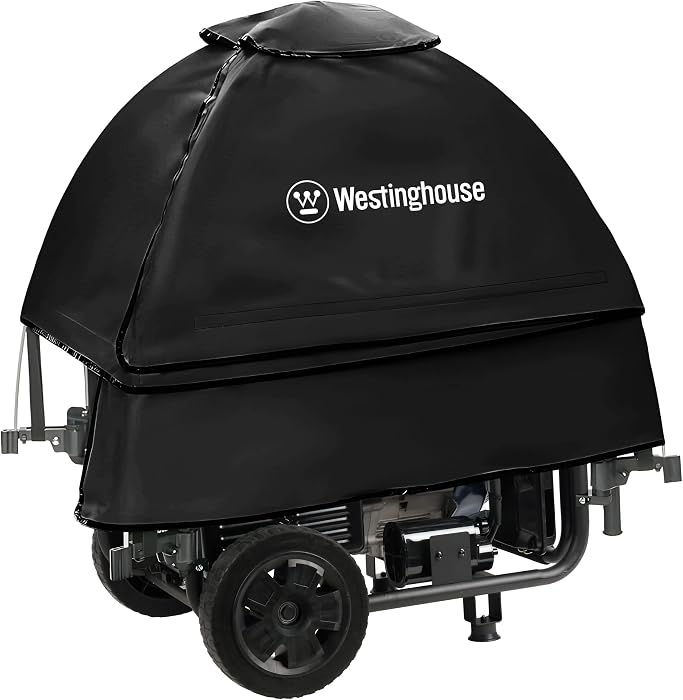
Westinghouse builds this one for its own open-frame line, and the ceiling is stated plainly: up to and including the 11500 series, plus the ecoGen10000. Push past that and the canopy stops short, covering the fuel tank and not much else on a much larger unit. If you own a smaller Westinghouse, that specificity is a feature. If you do not, the universal clamp tents here are the safer buy.

The design is a vinyl canopy stretched over a support frame, open at the top for ventilation and rated by Westinghouse for up to 12 inches of rain and 18 inches of snow a day. It goes on without tools in a few minutes, the whole thing weighs a bit over four pounds, and a flap opens for refueling without dismantling the canopy. You can also reposition the generator without pulling the cover off, which is more useful than it sounds.

Against the frame tents here it is the lighter, quicker option, and on a Westinghouse in the 7,500- to 9,500-watt range it fits as neatly as anything we tried. The weak point is the mounting hardware: the brackets that clamp the support rods to the frame are plastic, and those are the parts that crack. Treat the cover gently when you pull it off in a hurry and it should hold.

Worth Noting

  • Coverage stops at the 11500 series
  • Plastic support brackets can crack
Our Verdict

We recommend the Westinghouse for its own open-frame models up to the 11500 series, where the brand-matched fit and light vinyl canopy make sense.

Check Latest Price
7

BOANEN Generator Cover Best for Wide 10,000W Frames

BOANEN Generator Cover – Generator Cover for 6000-13000W

Wide 10,000W frames

Field Score 85/100
Fits
30 x 30 x 27 in frames
Fabric
900D Oxford, UPF50+
Weight
1.8 lb
Wattage Range
Up to 10,000W
View on Amazon

Most covers here are built around the same 32 x 24 x 24 box, which is fine until your generator is not that shape. The BOANEN measures 30 x 30 x 27 inches, squarer and taller, and it targets the wider frames in the 10,000-watt class, with DuroMax's XP8500 and XP10000E among the models it lists.

The shell is 900D Oxford with a UPF50+ treatment, and the color is woven from original-color yarns rather than dyed on afterward, which is the part that usually fades first on a cover that lives outside. Wind securing is a central buckle, an adjustable drawstring around the bottom, and hook-and-loop at the corners, a belt-and-suspenders approach rather than one strap doing everything.

It opens at both the front and the back, so air moves through while the machine runs and the exhaust has a clear path out. At just under two pounds it folds small enough to keep in the shed beside the generator, and getting it on is a one-person job.

What this one solves is the odd frame: a wider, taller generator that a 32 x 24 cover leaves half-exposed on every side. There is no frame inside, so on an exposed site the drawstring is doing the real work, and cinching it well is the difference between a cover that stays put and one that sails. If your machine measures closer to 30 inches square, this is the fit that avoids the flapping.

Worth Noting

  • No frame, so wind security is all straps
Our Verdict

We recommend the BOANEN for wider, taller frames around the 10,000-watt mark that a standard 32 x 24 cover leaves exposed.

Check Latest Price
8

GEHENG Generator Running Cover Best for Handle-Top Generators

GEHENG Generator Running Cover – Generator Running Cover

Handle-top generators

Field Score 84/100
Fits
Up to 31.5 x 23.6 x 21.3 in
Fabric
Silver-coated Oxford
Weight
16 oz
Wattage Range
Up to 7,000W
View on Amazon

Generators with a handle across the top are awkward to cover: the handle holds fabric up off the machine, and a boxy cover ends up sitting on it like a hat. This GEHENG cover is cut for that shape, up to 31.5 x 23.6 x 21.3 inches for frame-mounted units around 7,000 watts, with Generac's XT8500EFI and GP3600 among the models it names.

It is a silver-coated Oxford shell with sides that roll up and secure, a buckle strap underneath, and a retractable rope around the skirt to pull it tight. At 16 ounces it is the lightest cover here, which makes it easy to throw on and off between storms, and easy for a gust to move if you do not cinch that rope.

It fits the models it names, including Westinghouse's 9500 dual fuel and Generac's RS5500 and XT8000E, and the fit tops out around 7,000 watts. Measure the frame at the widest point with the handle in place rather than trusting the wattage, because the handle is what pushes this one's sizing.

What holds it back is small and obvious once the machine is running: the rolled-up sides have nothing to clip to, so they hang or flap instead of staying put. Everything else about it is sensible for the money. It is light, quick to fit, and genuinely usable in rain, which makes it a reasonable way to keep a handle-top generator's panel dry.

Worth Noting

  • Rolled-up sides have no clips to hold them
  • Fit tops out around 7,000W frames
Our Verdict

We recommend this GEHENG for handle-top Generac and Westinghouse frames around 7,000 watts, where its light shell goes on fast in bad weather.

Check Latest Price

How We Picked and Tested Running Generator Covers

We started with every cover sold specifically for use while the generator runs, then threw out anything without a clear sizing chart. That mattered more than it sounds: some makers size by overall length, width, and height, some by the perimeter of the frame posts, and some just quote a wattage range. We measured our own generators and matched those numbers against each listing before ordering, and we passed on covers that would only fit one exact model.

Twelve covers went out over eight months. A 5,000-watt open-frame unit sat on a concrete pad behind the house through a wet fall and two multi-day outages, while a smaller inverter generator moved between a back deck and the bed of a truck on job weekends. That mix covered the common shapes — tall frames with a vented panel up top, and low boxes you can carry with one hand.

At each setup we timed how long one person needed to get the cover on and tensioned, and we deliberately installed one on a 38-degree morning to see whether cold fabric fought back. We hosed each cover for five minutes, aiming at the top panel and the seams, then checked the generator's shell and the underside of the fabric for damp. With the generator running under load, we watched exhaust clearance and noted any cover that crept toward the hot side or billowed in a gust. We also refueled with the cover in place and counted how many fasteners had to come undone to reach the cap.

Durability got the long view. Covers stayed out in sun and rain for weeks at a stretch and came on and off dozens of times, and we checked stitching, zippers, hook-and-loop tape, and grommets for fraying or pulled threads, along with which straps still held tension after a month outdoors. Value came down to what survived that abuse in each price band — a plain cover that seals well is worth more than a stiff one that fights you every time you add fuel.

How to Choose a Generator Cover You Can Run Under

Size by the Frame, Not the Wattage

A cover fits a box, not a wattage. Sellers quote ranges because they sell to a wide audience, but the number that decides whether a cover works is the outside of your generator's frame, measured with the wheel kit and handle exactly as it sits in the yard. The common fabric cover, 32 x 24 x 24 inches, handles most 5,000- to 10,000-watt open frames; clamp-style generator tents use post perimeter instead, and the ones here span 78 to 107 inches.

A cover that is noticeably too big flaps and pools water above the panel; one that is too small will not clear the fuel cap or the outlets. If your measurements land between two sizes, buy for the frame you measured rather than the wattage on the box.

Venting and Exhaust Clearance Come First

Running covers work in one way: they keep rain and snow off the electrical side while leaving the exhaust outlet and the cooling intake open. Roll-up sides, peaked canopies, and open bottoms all exist for that. A cover that closes the machine in, like a tarp thrown over the top and bungeed down, traps heat and can push carbon monoxide somewhere you never intended.

Nothing about a vented cover makes an indoor or covered run safe. Generators stay outdoors, well away from doors, windows, and vents, with the exhaust pointed off the house. If the plan involves a garage, a porch, or a shed, no cover changes the answer.

Frame Tents vs. Fabric Covers

Two designs, two kinds of owner. A clamped or framed generator tent holds its shape: it sheds snow, refuses to flap, and stays put in wind, and it takes one session with instructions to mount. A fabric cover folds into a bag, goes on in a minute, and depends on straps, drawstrings, and a taut fit to behave itself.

Choose by how the generator lives. If it sits outside all winter and runs for days at a time, the rigid structure is worth the money and the storage space. If it comes out for a few outages a year and lives in the barn otherwise, a fabric cover does the job — plan on checking it for pooled water after the first heavy rain.

Denier, Coatings, and What Actually Ages

Denier describes the weave of the outer shell, and higher is heavier: 600D is the baseline here, while 900D is denser, stiffer, and more resistant to scuffs. What denier does not tell you is how the seams are finished, and seams, zippers, and plastic clips are what fail first on a cover that lives outdoors.

Two habits stretch the life of any of these. Keep summer sun off the cover when the generator is idle, because UV is what embrittles fabric and fades color, and open and close the zippers and roll-up panels gently instead of yanking them. If fire near a hot exhaust worries you, look for an NFPA 701 canopy rating; one cover here carries it.

Frequently Asked Questions

Final Verdict

For most open-frame owners, the GenTent is the one to buy. It is the only cover here with a flame-rated canopy and flame-retardant hardware, its clamp mount stays put in wind instead of draping and hoping, and the peaked design sends water off the sides rather than into a puddle over the control panel. That combination is worth the premium.

If your site gets real wind and snow load and you want a rigid shell, the GenArmor's bolted frame is the sturdier structure. On a budget, the Jorohiker covers a 5,000- to 10,000-watt frame for a fraction of either, provided you tighten it after the first heavy rain. And if you run a compact inverter, skip the big covers entirely — the NGB is cut for that machine and will not sail in a gust.