The 8 Best GPS Dog Collars of 2026

The gate clicks open, the dog bolts, and the next forty minutes vanish into circling the neighborhood and calling a name into the wind. That's usually the moment someone starts shopping for a GPS dog collar — not as a gadget but as insurance against the worst afternoon of the year. What you want from one is simple: to check your phone or a handheld and see where your dog is right now, not where he was an hour ago.

Here's what surprises most first-time buyers: this category holds two very different machines. Phone-app trackers lean on a cellular network and a monthly plan; handheld-and-collar systems talk straight to the collar over radio, which is why they hold up deep in the woods. Both can draw a virtual fence and alert you when it's crossed, and the sticker price is rarely the whole cost — a two-year subscription can rival the hardware itself. Over the past seven months, my team and I have walked, hiked, and occasionally sprinted after 12 of these, and the ones worth keeping share a few habits.

Our Top Picks

The 8 Best GPS Dog Collars of 2026

1

Dogtra Pathfinder 2 Mini Compass Best Overall

Dogtra PATHFINDER2 MINI Compass Live GPS Dog Tracking & Training System

All-around tracking

Field Score 89/100
Range
4 miles
GPS Updates
2 seconds
Dogs Tracked
Up to 21
Water Rating
IPX9K
View on Amazon

The piece we ended up valuing most is not on the collar at all. It is the small handheld in the box, with a 2-inch screen and a built-in compass, that tells you where the dog is without borrowing your phone. That matters more than it sounds. A phone that dies, overheats or loses bars in a river bottom takes the dog's last known position down with it, and the handheld just keeps going.

The numbers hold up their end. Positions refresh every two seconds, the stated range is four miles, and the system carries up to 21 dogs with four shown on screen at once, which is enough for a beagle pack or a string of bird dogs. Offline maps mean the screen still works when there is nothing to download to, and there are no subscription fees at any point. The receiver is rated IPX9K, so pond water and a wet saddlebag are not a problem. Training rides along: nick, constant, tone, vibration and an LED locate light you can flash to pick a dog out of cover at dusk.

Two things to know before you order. The collar is rated for dogs 25 pounds and up, which rules out a terrier and makes a beagle about the smallest sensible fit. And the handheld's antenna is a long whip that swings against your chest as you walk, the one part of the design worth grumbling about. Neither is a dealbreaker, and both stop registering within a few days of carrying it.

Worth Noting

  • Collar rated for dogs 25 lbs and up
  • Shortest range of the handheld systems here
Our Verdict

Our default for country dogs: a handheld with its own screen, four miles of range and no subscription, so it keeps working where your phone does not.

Check Latest Price
2

Garmin Alpha TT 25 Best for Alpha Handheld Owners

Garmin Alpha® TT 25

Garmin handheld owners

Field Score 88/100
Range
Up to 9 miles
GPS Updates
As often as 2.5 seconds
Training Levels
18 plus tone and vibration
View on Amazon

What arrives is a collar, a strap, a charging clip and a set of contact points. No screen, no handheld, no way to see a dog until it pairs with an Alpha unit. That is the whole decision in one sentence, and it is worth being clear about because the box does not say it loudly. If there is already an Alpha 100 or an Alpha 300i riding on your dash, this is the collar to hang on a second dog: slim, orange where you want it visible, and built around a flex band you can replace yourself when a strap finally gives out.

What it does, it does better than anything else in this group. Nine miles with a compatible handheld, updates as often as every 2.5 seconds, and 18 levels of momentary or continuous stimulation plus tone and vibration. That is a training collar and a tracking collar in one housing, which is exactly what you want on a dog that ranges out of sight. Dynamic tracking stretches the battery when the dog is standing still. We think the 2.5-second refresh is the underrated part: on a moving hound, a slow update is a lost dog with a nice map.

The catch is straightforward. You are buying half a system, and until it pairs with an Alpha handheld it does nothing at all, so settle that before you order. Then keep the collar on its charger overnight; dynamic tracking buys you runtime, but only if the day starts with a full battery.

Worth Noting

  • Charging clip is easy to lose
Our Verdict

Buy this only if you already carry an Alpha handheld, and then it is a nine-mile collar with serious training that nothing else here touches on range.

Check Latest Price
3

Garmin Alpha 300i Bundle Best for Remote Hunting

Garmin Alpha 300i Dog Tracking System with Alpha TT25 Dog Collar Bundle

Remote hunting

Field Score 87/100
Range
Up to 9 miles
Satellite
inReach messaging and SOS
Dogs Tracked
Up to 20
View on Amazon

This is the most expensive kit we recommend, and it is the only one that can summon rescue. The Alpha 300i handheld carries inReach satellite technology, which means interactive SOS messages and two-way texting from country with no bars at all. That reads like an odd thing to build into a dog collar until you have spent a cold hour on a ridge at dusk, and then it is the only feature you care about.

The rest of the bundle is the system we already trust: nine miles of range, tracking for up to 20 dogs on compatible collars, a touchscreen you can read in weather, and the TT 25 collar with its 2.5-second updates and 18 training levels. The kit adds the car and wall adapters and a field bag, so the box is usable the day it lands. One honest annoyance: loading topo maps onto the handheld takes patience and, ideally, a desktop rather than a tailgate.

If you hunt remote country with a dog that ranges, this answers both questions from one device, where is the dog and how do I get help. If an Alpha handheld is already in your truck, skip the bundle and buy the collar alone, since you are otherwise paying a second time for the same screen.

Worth Noting

  • Highest price of anything we recommend
Our Verdict

The pick for hunters who go where there is no signal: 20 dogs at nine miles and a satellite messenger for the day it all goes wrong.

Check Latest Price
4

Dogtra Pathfinder 2 Best Long-Range Value

Dogtra Pathfinder 2 GPS Dog Tracker e Collar 9 Mile Long Range LED Light No

Long-range value

Field Score 86/100
Range
9 miles
Corrections
Belt connector or app
Dogs Tracked
Up to 21
Subscription
None required
View on Amazon

If four miles sounds tight, this one more than doubles it and still costs less than our top pick. The trade is the display: the Pathfinder 2 puts the map on your phone and keeps a GPS connector on your belt, so corrections come from a thumb button instead of a touchscreen while a dog is moving.

The app is better than most outdoor software. General, satellite and terrain views, offline maps you download before you lose service, and no subscription or monthly fee for any of it. It handles up to 21 dogs, has an LED locate light for finding a dog in tall grass after dark, and offers nick, constant, tone, vibration and pager modes from either the connector or the phone.

What you give up is independence. The app has to be connected each session to run training, which is a step the handheld systems do not have, and a phone that dies at four in the afternoon ends your hunt. A charging block in the truck covers most of that, and a habit of pairing before you turn the dog loose covers the rest.

We rate it the better buy for someone who already runs a phone on the dash and wants the extra miles without a second screen in the vest. Where the Mini Compass wins is the day the phone stays home.

Worth Noting

  • Live map depends on a charged phone
Our Verdict

Nine miles of range and room for 21 dogs for less than our top pick, as long as you are happy letting your phone be the screen.

Check Latest Price
5

Tractive Smart Dog Tracker Best Budget Tracker

Tractive Smart Dog GPS Tracker

Budget tracking

Field Score 82/100
Battery
Up to 14 days
Dog Size
Over 8 lbs
Waterproof
Fully waterproof
Location Updates
Every 2–3 seconds
View on Amazon

The hardware is inexpensive because the plan is not. Tractive makes its money on the cellular subscription that gives the tracker unlimited range, and that is the honest way to think about the purchase: you are buying a service with a plastic clip attached. Budget for the plan the way you budget for kibble, because a tracker without one reports nothing.

What you get for it is genuinely good. Positions land every two to three seconds, virtual fences fire an escape alert the moment the dog crosses one, and location history draws the route the dog took, which is how you find the loose board in the fence and not just the dog. The unit adds heart and respiratory rate monitoring and barking alerts, it is fully waterproof, and it fits any dog over 8 pounds. Battery is listed at up to 14 days, which assumes you are not watching live tracking all afternoon.

We recommend it without hesitation to the person whose dog keeps slipping a suburban gate, and with a real caveat to the person whose dog runs a 40-acre pasture. Cellular trackers are only as good as the bars, and a dead zone is a dead zone regardless of brand. If your ground is patchy, a radio system is the safer buy.

Worth Noting

  • Requires a paid cellular subscription
  • Live tracking cuts battery well below 14 days
Our Verdict

The cheapest way into live GPS tracking, and the one we recommend to anyone whose dog escapes in town, provided you will pay the monthly plan.

Check Latest Price
6

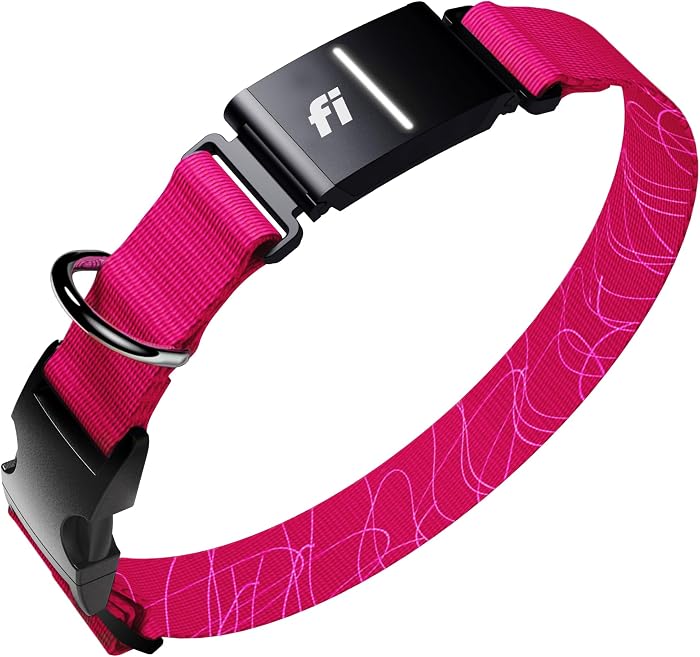
Fi Series 3+ Best Battery Life

Fi Series 3+ Smart GPS Dog Collar & Pet Health Tracker

Long battery life

Field Score 81/100
Sizes
XS to XL
Battery
Up to 3 months
Network
LTE-M cellular
Water Rating
IP68/66K
View on Amazon

Battery is the reason trackers get abandoned. A device that needs a cable every night ends up in a drawer by the second month, and Fi's answer is a collar rated for up to three months on a single charge from its base. That number is the whole argument. The collar goes on the dog and then you stop thinking about it, which is what a safety device should ask of you.

The hardware earns the claim. A stainless steel frame, an IP68/66K rating, a built-in LED for night walks, and sizes from XS to XL in several colors, so it reads as a collar rather than a box strapped to one. In the app you get live location with unlimited range over LTE-M, safe zones and escape alerts, plus activity and behavior tracking for steps, sleeping, scratching, licking and barking. Some of that is novelty. The safe-zone alert is not.

Two things to accept. Fi requires a membership for the cellular service, so the collar is the down payment and the plan is the ongoing cost. And live view is a battery tax: a dog left on continuous tracking will not come near three months, so put it on the charger every Sunday like the rest of your gear and treat the headline as a best case.

Worth Noting

  • Membership required beyond the collar
  • Needs LTE-M coverage to report a location
Our Verdict

We recommend it to anyone who wants a tracker that stays on the dog: a stainless collar, real safe zones, and nothing to remember most weeks.

Check Latest Price
7

Tractive XL Tracker Best for Large Dogs

Tractive XL Smart Dog GPS Tracker

Large dogs

Field Score 80/100
Weight
2.47 oz
Battery
Up to 6 weeks
Dog Size
Over 44 lbs
Location Updates
Every 2–3 seconds
View on Amazon

Dogs over 44 pounds get the XL, and the difference is more than a longer strap. The battery is rated at up to six weeks instead of about two, which for a dog that wears a tracker every day is the difference between a habit and a chore. The unit weighs around 70 grams, present on the collar and not enough to bother a dog with a chest on it.

The app is the same one, and that is the appeal. Live tracking at two- to three-second intervals, the same virtual fences and escape alerts, and the same heart and respiratory rate monitoring, just with a battery that keeps up with a working dog rather than a lap dog.

The caveat is the one that follows every cellular tracker: coverage. In heavy timber and deep draws the position drifts and updates slow down, and no amount of app polish fixes a weak signal. On open ground with solid bars, this is a straightforward upgrade for a big dog. Without them, spend the money on a radio system instead.

Worth Noting

  • Requires a Tractive subscription
Our Verdict

We recommend it for the Labrador-and-up crowd: the same live tracking as the smaller Tractive, a six-week battery and a body that suits a big neck.

Check Latest Price
8

SpotOn Nova

SpotOn Nova – Nova GPS Dog Fence Collar

Shaped containment

Field Score 77/100
Positioning
Dual-band, dual-feed GPS
Fence Shapes
Any shape or size
Subscription
None required
View on Amazon

Most GPS fence collars hand you a circle and call it a boundary, which works right up until the circle crosses the driveway, the barn or the road at the end of it. SpotOn lets you draw instead of dial: unlimited fences of any shape and size, plus keep-out zones and correction-free areas inside the boundary.

It backs the flexibility with dual-band, dual-feed GPS aimed at holding the line where you drew it, tree cover included, which is where single-band containment units get vague and a dog starts catching warnings in the middle of the yard. The app shows collar and boundary together in real time, so a corner that keeps triggering is visible rather than a mystery. SpotOn also includes access to one-on-one trainer support, and for a first fence that is worth more than another settings screen.

You pay for the flexibility. This is the priciest containment option in this group, and the money goes into boundary shapes and keep-out zones rather than into more range. If your property is a plain rectangle and a circle would do, that trade does not favor you.

We point people to it when the land has an awkward shape: a farm with a lane running through it, or a place where the dog has to stay out of the shop but reach the pond. Judged as a fence, it is the most capable thing here, and it does not pretend to be anything else.

Worth Noting

  • Built for containment, not cross-country pursuit
Our Verdict

Draw the boundary instead of dialing a circle: any shape, keep-out zones, no monthly fee, and a fence line that holds up under tree cover.

Check Latest Price

How We Tested GPS Dog Collars

A shortlist in this category starts with one hard question: is it a tracker you run from your phone, or a handheld system that doesn't need cell service at all? We built an initial list of about 30 collars and collar attachments, then filtered by weight (a 30-pound dog shouldn't be hauling a brick), whether the unit slid onto an existing collar or replaced it, how many dogs one system could hold, and what two years of subscription would add to the total. That left 12, which we lived with for seven months.

Most of the testing happened where dogs actually misbehave. We set up virtual fences in a suburban backyard, on a 60-acre rural property, and along a wooded trail, walking the boundary with a dog on a long line to see how far past the line the alert or correction actually fired. To check accuracy, one of us stood with the dog at a marked corner of a field while the other watched the map and counted the paces between the pin and the dog. We also ran dead zones on purpose — a creek bottom, dense tree cover — to see what happened when the connection dropped and how quickly it recovered.

Battery claims got tested the boring way: full charge, ordinary days, and a note on when each one died. Durability meant lake swims, mud, an unseasonal downpour, and a roll in something I'd rather not describe, followed by a close look at the charging port and the collar's seals. For ease of use, we timed setup from box-open to first location fix, then handed the app to a friend who'd never used a tracker to see where she got stuck. Value came down to arithmetic — hardware plus two years of service — measured against how often we actually reached for it.

How to Choose a Gps Dog Collar

Radio Versus Cellular, Decided First

Cellular trackers such as the Tractive and the Fi send a position over the mobile network: unlimited range wherever there are bars, and nothing at all where there are not. Radio systems, which is what the Garmin and Dogtra handhelds are, talk directly between collar and handheld over open ground, up to nine miles, with no plan and no tower in the middle.

On a farm with solid coverage, either family works. In big timber, mountain, or prairie without service, only radio does. Settle this before you compare models, because it eliminates half the field faster than any specification.

What a Range Rating Actually Means

A nine-mile figure is measured over open ground with a clear line between collar and handheld. Put a ridge, a cedar thicket, or a wet creek bottom in the path and the usable distance shrinks well before that. Cellular has the same problem in a different form: the coverage map decides, not the collar.

If your dog routinely works more than a mile out, watch the update rate as closely as the range. A two-second refresh tells you where a moving dog is; a slow one tells you where it was.

The Subscription Is Part of the Price

Radio systems are a one-time purchase. Cellular trackers are not: Tractive and Fi both require a plan to keep the collar reporting, and the hardware is effectively a down payment on that service. Do the arithmetic over three years rather than at checkout, then weigh it against a handheld kit that costs more on day one and nothing afterward.

For a dog that only needs watching during a few weeks of hunting season, that comparison usually favors the radio system. For a dog that gets out of a suburban gate in February, the plan is the cheapest part of the whole arrangement.

Fit the Collar to the Dog

The weight classes are printed plainly and they are not marketing. Tractive's standard unit is for dogs over 8 pounds and the XL for dogs over 44; the Dogtra Mini Compass collar starts at 25 pounds; the Garmin collar uses a user-replaceable flex band sized for large and small breeds. A tracker that rides wrong rubs a raw spot in a week.

Measure the neck, leave room for two fingers underneath, and check the contact area daily on any collar that also delivers stimulation. A dog that is uncomfortable in the hardware will find a way to be rid of it.

Containment and Training Are Separate Purchases

A GPS fence and an e-collar are different features, and buying for one does not get you the other. If the goal is keeping a dog on the property, look at boundary shapes first: a circle drawn from the house is quick to set and easy to regret, because it will happily cross the driveway or the road at the end of it. A polygon fence fixes that, and you pay for the flexibility.

If the goal is stopping a dog mid-run, you want tone and stimulation on the collar that is already tracking it, which is exactly what the Garmin and Dogtra systems provide.

Frequently Asked Questions

Final Verdict

For most people tracking a dog on their own ground, the Dogtra Pathfinder 2 Mini Compass is the one to buy: a handheld that works without a phone or a plan, four miles of range, and updates fast enough to follow a moving dog through cover.

If your country is bigger than four miles, the Garmin Alpha TT 25 collar paired with an Alpha handheld stretches to nine. And if there is no cell service where you hunt, skip the cellular trackers entirely and put the money into a radio system.