The Best Grass Seed for Shade of 2026

The bare dirt under a shade tree is the oldest disappointment in lawn care. The seed sprouts, looks fine for three weeks, then the canopy fills in and you're staring at thin, yellow strands by July. My team and I planted 12 shade blends in our own yards and watched them through a full growing season, from deep all-day shade to a strip that gets three hours of afternoon sun.

Here's what first-time buyers miss: shade mixes are blends — tall fescue for durability, perennial ryegrass for quick cover, Kentucky bluegrass to fill in — and cheap bags lean on the fast filler while skimping on the fescue that actually survives. Coated seed costs more per pound, but it holds moisture around the seed and often carries starter fertilizer and a soil improver, which is one less step on a Saturday.

Nothing here will grow grass in total darkness. What these can do is green up the spots you'd written off, and the picks below are sorted by how little sun they'll take and how far a bag goes.

Our Top Picks

The Best Grass Seed for Shade of 2026

1

Jonathan Green Black Beauty Dense Shade Best Overall

Jonathan Green Black Beauty Dense Shade Grass Seed

Deep shade

Field Score 88/100
Coverage
300 sq ft new lawn; 600 sq ft overseeding
Germination
14 to 21 days
Grass Types
Four cool-season grasses
Shade Tolerance
Dense shade
View on Amazon

Four cool-season grasses share this bag, more than any other shade mix here, and the blend is aimed at ground that gets limited sun rather than at a lawn that's sunny with a shady corner. Tall fescue, Kentucky bluegrass, and perennial rye are all in it, so the grass that happens to like your particular patch of shade has a few candidates to be. Single-species bags don't offer that insurance.

Under the heaviest canopy we planted, this is the seed that held its density and its dark green color while the sun-and-shade mixes thinned out. That's what you're buying: shade performance rather than a bigger bag. It's also the most efficient seed here by weight — one pound covers 300 square feet of new lawn — which matters when you're seeding under three trees and pricing the job by the square foot instead of by the bag.

The price of that performance is patience and a small bag. Germination runs 14 to 21 days, and in cool fall soil expect the long end of it; the rapid-establishment mixes are up in half the time. A pound goes 300 square feet on bare ground or 600 overseeding, so a real side yard takes two or three bags. Mid-August to mid-October is the window printed on the label, and it's good advice — seedlings need mild weather to root before winter.

Water is the thing to plan around. Shaded ground under trees dries faster than the open lawn because the roots above take it first, and a dry August will thin this turf if the sprinkler doesn't keep up. That's a maintenance commitment rather than a flaw in the seed, but it's the difference between the carpet in the photos and bare dirt in September.

Worth Noting

  • Slow 14 to 21 day germination
  • One-pound bag needs repeating on big jobs
Our Verdict

Our pick for a genuinely shady yard: the blend that stayed thickest and darkest under a canopy, with the best coverage per pound here.

Check Latest Price
2

Scotts Turf Builder Dense Shade Mix Best for the Least Light

Scotts Turf Builder Grass Seed Dense Shade Mix

Lowest-light yards

Field Score 87/100
Bag Size
5.6 lb
Coverage
465 sq ft new lawn; 1,400 sq ft overseeding
Minimum Sun
3 hours
Drought Tolerance
Medium
View on Amazon

Three hours of direct sun is the lowest light requirement on any bag in this group, and in a yard with a mature maple that figure settles the argument. This is a shade seed first — it grows in full sun too, but the mix and its Root-Building Nutrition, a fertilizer and soil improver combo, are aimed at ground where light is the limiting factor. If you can't tell how much sun a spot gets, this is the safest bag to put down.

It goes on thick, which is the part the coverage number hides. A 5.6-pound bag seeds 465 square feet of new lawn, or 1,400 square feet overseeding — about 83 square feet per pound, against 300 for the Jonathan Green bag. That heavy rate is why the bag looks generous on the shelf and disappears fast in the yard. Measure the bare area first and buy to that.

Results are uneven. Some sowings knit into a dense lawn, and others come up patchy enough that you're filling bare spots a month later; thin sowing and a dry week are usually where it goes wrong. We sow it at the new-lawn rate even when overseeding, keep the surface damp until the blades show, and use the spring or fall window on the bag, when soil is 60 to 75°F.

Worth Noting

  • Heavy rate; 465 sq ft new lawn per bag
  • Germination comes up uneven
Our Verdict

What we put down when the light is uncertain: three hours of sun tolerance and fertilizer already in the bag, as long as you sow it thick.

Check Latest Price
3

Pennington Smart Seed Dense Shade Best With Fertilizer Built In

Pennington Smart Seed Dense Shade Mix Grass Seeds for Lawn

Thin shady spots

Field Score 86/100
Bag Size
3 lb
Sunlight
2 to 6 hours
Fertilizer
Included
Grass Types
Tall fescue, perennial ryegrass, Kentucky bluegrass
View on Amazon

Coated seed is easier to see against dark soil and easier to spread evenly, and that counts for more in shade than in the open, where you're usually sowing around roots and trunks instead of in tidy rectangles. Pennington's dense shade mix is coated, comes with its own fertilizer blended in, and asks for only two to six hours of sun — the widest shade window here. For patching thin spots under trees, we haven't found a combination that's easier to live with.

The blend is tall fescue, perennial ryegrass, and Kentucky bluegrass, the standard cool-season trio, and it's rated disease and traffic resistant, which helps under trees where air movement is poor and the mower turns. Having the fertilizer in the bag saves a pass with the spreader, though it also means the feed rate is fixed — on rich soil you're adding more than the lawn needs.

Staying power is what keeps it out of the top spot. It comes up well and colors fast, and the shade performance is real, but it can thin out after its first flush, especially when summer arrives and watering gets casual. Under a tree that's the hardest test there is, and the answer we give is a soaker hose or a timer rather than another bag of lawn seed.

Worth Noting

  • Can thin out after its first flush
Our Verdict

Coated seed and built-in fertilizer make this the one we reach for when patching thin spots under trees, down to two hours of sun.

Check Latest Price
4

X-Seed Kentucky 31 Tall Fescue Best for Worn Shady Runs

X-Seed Oregon Grown Kentucky 31 Tall Fescue Grass Seed for Sun and Shade

Worn shady runs

Field Score 85/100
Bag Size
5 lb
Coverage
Up to 1,000 sq ft
Grass Type
Kentucky 31 tall fescue
Seed Coating
Moisture-coated
View on Amazon

Picture the strip along the back fence where the dog runs, half of it under the neighbor's oak, worn to dirt every August. That's the job this bag is for, and it isn't the front lawn. X-Seed's Kentucky 31 is a pasture-type tall fescue with a moisture coating that holds water against the seed, sold for high-traffic turf and patching rather than for a showpiece.

Coarse and tough is the trade you're making. Kentucky 31 blades are wider than the fine-bladed shade mixes, so a lawn of it reads utility rather than manicured — but it takes foot traffic, heat, and drought without much complaint, which is exactly what we ask of a path or a dog run and what the softer shade blends can't give you.

Five pounds covers up to 1,000 square feet, so one bag handles a long run of fence line. The instruction to water two or three times a day until germination isn't a suggestion: coated seed still needs the surface kept damp, and ground under a tree dries unevenly. Give it sun or partial shade and it will hold, but judge it as durable turf rather than as a lawn you'd photograph.

Worth Noting

  • Coarse texture, not a show lawn
  • Needs watering two to three times a day to start
Our Verdict

For shaded ground that gets used, we take this tough coated fescue over the fine-bladed mixes — a dog run or fence line won't wear it out.

Check Latest Price
5

Scotts Turf Builder Sun & Shade Best for Mixed Light Lawns

Scotts Turf Builder Grass Seed Sun & Shade Mix

Mixed light lawns

Field Score 84/100
Bag Size
5.6 lb
Coverage
745 sq ft new lawn; 2,240 sq ft overseeding
Shade Tolerance
Moderate shade
Drought Tolerance
Medium
View on Amazon

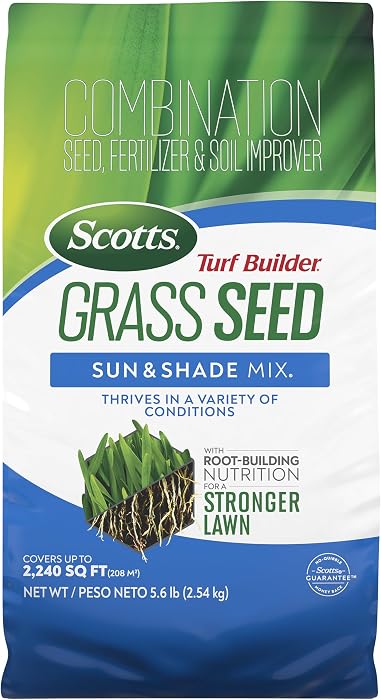
Moderate shade is the phrase to read twice on this bag. Scotts builds this mix for a lawn that's sunny in the middle and thinner along the fence, not for the ground under a dense canopy, and that distinction decides whether you're admiring grass in six weeks or reseeding in October.

On its own terms it's a sensible bag: seed, fertilizer, and soil improver together, medium drought resistance, and the biggest coverage here — 745 square feet of new lawn or 2,240 square feet overseeding from 5.6 pounds. That works out to about 133 square feet per pound, roughly four times what the dense shade mix delivers per pound, so a big sunny lawn costs far less per square foot.

The seed wears a blue coating that shows up against soil, which makes it easy to see where you've been and looks faintly alarming for the first week. Where it stops working is under a real canopy: this mix thins in deep shade, and germination is patchy enough that we sow generously and keep the water on it. It's the bag for the sunny three-quarters of the yard and the dappled edge, not for the circle of dirt under the oak.

Worth Noting

  • Thins out in dense shade
  • Patchy germination
Our Verdict

We keep this one for lawns that are mostly sun with a shaded edge; under a thick canopy it simply thins out.

Check Latest Price

How We Tested Shade Grass Seed

We started with shade-labeled bags from two garden centers and the best-selling blends online, then crossed off anything with no stated sun-hour minimum and anything whose coverage claim worked out to more than a few cents per square foot at the label seeding rate. That left 12 blends, which we sowed over one full growing season — a spring planting and a fall overseeding in the same plots.

The plots were real yards, not trays. I have a north-facing side yard that gets maybe two hours of sun and a bare patch under a mature maple; my team added a deeply shaded bed along a fence and one half-sun control area so we could tell a slow blend from a bad one. Everyone prepped the same way — raked, loosened the top inch, seeded at the label rate — and we staked one-square-foot frames to count actual seedlings at 10 days, 21 days, and again after the canopy leafed out.

We recorded whether sprouts came up evenly or in clumps, then tracked color (deep green versus the washed-out yellow shade grass turns), density, and whether blades thickened or thinned once the tree filled in. Wear got judged by the same mowing height and the same foot traffic, plus a deliberate walk across each plot after rain. For ease of use we noted how each bag poured and spread, whether it clumped in the spreader, and whether it already carried fertilizer and soil improver or meant a second trip to the store. Value came last, figured at cost per 1,000 square feet rather than per bag.

How to Choose Grass Seed for Shade

Match the blend to the hours of sun, not the word shade

Shade on a seed bag is a range, not a promise. The blends here run from two hours of sun to full sun with moderate shade, and those are different products for different spots. Walk the yard at midday and count the hours of direct sun that reach the bare patch. Under about three hours, you're in dense-shade territory and want a bag that says so.

The trap is the phrase sun and shade. It sounds like it covers everything, but it usually describes a bright lawn with some shadow at the edges — put it under a mature canopy and it thins to nothing. If one bag has to serve a whole mixed yard, buy for the shadiest spot, not the sunniest one.

Read the species list, not the picture on the bag

Fine fescues are the grasses that genuinely tolerate low light. Tall fescue and Kentucky bluegrass bring toughness, color, and traffic tolerance, but they want more sun than a fine fescue does. That is why the shade-specific blends combine several species: one carries the shade, the others fill in where light is better.

Kentucky 31 is the one to shop knowingly. It's a coarse pasture-type fescue that survives almost anything and looks like a pasture doing it, which makes it right for a dog run and wrong for a front lawn. Turn the bag over and read the species before you decide.

Do the coverage math before you order

Every bag quotes two rates, one for a new lawn and one for overseeding, and they differ by roughly double. A pound of lawn seed covers 300 square feet of bare ground in the Jonathan Green bag; the Scotts dense shade bag goes on at about 83 square feet per pound. Neither figure is a trick — they are different seeding densities.

Measure the bare area, divide by the new-lawn rate, and buy that many bags. Shade jobs are usually smaller than people think and want a heavier rate than they expect, and running short halfway through is how a renovation becomes a patchy first year.

Plant into warm soil, then keep the surface damp

Soil temperature starts grass seed, not air temperature. The dense shade mixes want soil at 60 to 75°F, which in most of the country means late spring or, better, late summer into early fall; mid-August to mid-October is the window printed on the Jonathan Green bag. Fall gives seedlings mild weather to root before winter closes in.

New seed needs the top of the soil dark and damp for its first two weeks. Once the blades are up, water less often and more deeply, because shallow daily sprinkling encourages shallow roots — the opposite of what grass under a tree needs.

Frequently Asked Questions

Final Verdict

Jonathan Green Black Beauty Dense Shade is the bag we hand someone with a real canopy problem: four cool-season grasses, 300 square feet of new lawn per pound, and the thickest, darkest turf of this group where the light is genuinely poor.

When the spot gets closer to three hours of sun and you're seeding a lot of ground at once, Scotts Turf Builder Dense Shade Mix gets there with the lowest light requirement here — just plan for how thick it goes on.