The 8 Best Grow Bags of 2026

A grow bag does one thing a plastic pot can't: it lets air reach the root zone, so a root branches out instead of circling the wall and strangling itself. That's why tomatoes and peppers planted in fabric tend to take off. What a product photo won't tell you is whether the bag survives a season or six.

I've grown in buckets, nursery pots, and a raised bed I regret building, and I've come around to fabric for almost everything. Over the past seven months, my team and I planted 18 grow bags — 2-gallon herb bags up to 20-gallon monsters — on a windy back patio, at a community plot, and on two balconies. We dragged them across concrete, overwatered them, and hauled them by one handle to see what gave.

Two things I'd tell a first-time buyer: size up if you're growing tomatoes, since a 5-gallon bag dries out by mid-afternoon in July, and check for training holes or rings before you order, because you can't add them to an eight-week-old plant. The picks below are sorted by what each one is actually good at.

Our Top Picks

The 8 Best Grow Bags of 2026

1

AC Infinity Heavy-Duty 500G Fabric Pots Best Overall
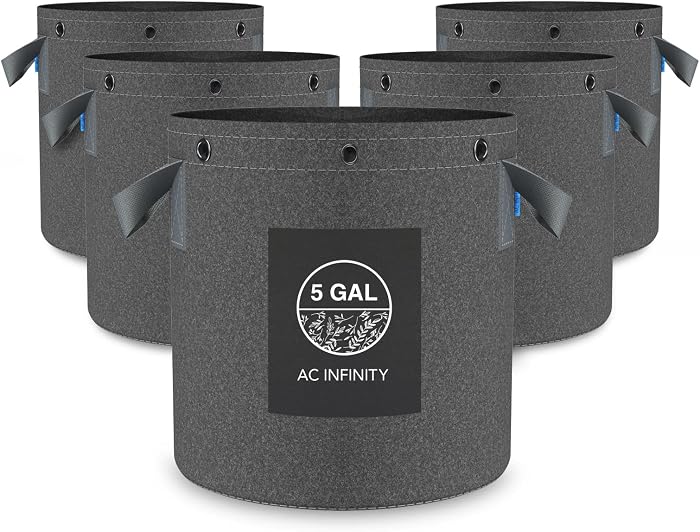
AC Infinity Heavy-Duty 500G Fabric Pots

All-round container growing

Field Score 97/100
Capacity
5.39 gallons
Pack Size
5 bags
Dimensions
11.81 x 11.81 x 11.42 inches
Fabric Weight
1.1 lb
View on Amazon

'Five gallon' on a grow bag is closer to a category than a measurement, and several of the five-gallon bags in this guide fill closer to four. AC Infinity is the one that puts a real number on it — 5.39 gallons, in a pot 11.81 inches across and 11.42 inches tall — and that honesty is most of why it's our top pick. Root volume is the variable you're actually shopping for.

The fabric explains the rest. At 500G it's the heaviest nonwoven in this set, and you notice that before you've planted anything: the walls stand up on their own, so filling a bag is a one-person job instead of a two-person one. The handles are nylon webbing sewn into reinforced stitching rather than strips cut from the bag wall, which is the difference between lifting a wet bag and watching a handle peel out of the seam.

Metal rings around the top edge are the detail we didn't expect to use as much as we did. Thread twine through one and you can pull a tomato branch sideways without punching holes in the fabric or lashing it to a stake. We wanted a second row down the sides for taller plants; the rings only run around the top, which is a small limitation on an otherwise well-considered bag.

It's also the priciest per bag in this guide, roughly three times the cheapest five-gallon option, and it arrives five to a pack. For a patio of peppers or a row of tomatoes, that math works out over two or three seasons. If you're filling thirty containers this spring, buy one of the dozens instead and spend the difference on soil.

Worth Noting

  • Priciest per bag in this set
  • Training rings only around the top edge
Our Verdict

The one we hand people first: a true 5.39 gallons, the heaviest fabric here, and rings that make tying up tomatoes easy — the pick for a full season in containers.

Check Latest Price
2

JERIA 12-Pack 5 Gallon Grow Bags Best Bulk Value

JERIA 12-Pack 5 Gallon Grow Bags – 12-Pack 5 Gallon Grow Bags

Whole-patio planting

Field Score 96/100
Capacity
5 gallons
Pack Size
12 bags plus labels
Dimensions
12 x 12 x 10 inches
Fabric Weight
10.6 oz
View on Amazon

A first garden is a quantity problem before it's a quality problem. You want ten or twelve bags, not five, and the cost stacks up fast. JERIA's twelve-pack is the cheapest route to a full patio in this guide, and it throws in a dozen plant labels — a small thing until six weeks have passed and you can't remember which bag holds the cherry tomatoes.

The bags are honest 300G nonwoven, and durability is where they've held up best. The fabric takes summer sun without going brittle, the handles carry a full bag without the stitching letting go, and moving them around the yard to chase light is the whole reason to grow this way. If you're outfitting a rental patio or a first-season container garden and don't want to agonize over it, this is the pack we point to.

Peppers, herbs, and determinate tomatoes are the right crops here; a beefsteak or a potato crop wants the 10-gallon Lyincat or one of the AC Infinity bags. The labels alone are worth a few dollars of the price if you're growing more than one variety.

Worth Noting

  • Runs small against a true 5 gallons
  • Sold only in packs of 12
Our Verdict

Twelve bags and plant labels at the lowest cost per bag here — the fastest way to plant a whole patio, as long as you're not expecting a full five gallons.

Check Latest Price
3

PHYEX 12-Pack 20 Gallon Grow Bags Best for Big Crops

PHYEX 12-Pack 20 Gallon Grow Bags – 12-Pack 20 Gallon Grow Bags

Big root crops

Field Score 95/100
Capacity
20 gallons
Pack Size
12 bags plus labels
Dimensions
20.5 x 20.5 x 14.5 inches
Fabric Type
300g polyester felt
View on Amazon

The bags are the cheap part. Twelve 20-gallon containers take an enormous amount of potting mix — each one is 20.5 inches across and 14.5 inches tall — and that fill cost is what really decides whether a set this size makes sense. Mix your own or shovel from a compost pile and this is the most soil volume for the money in the guide; buy bagged mix and you'll spend more on the fill than on the bags.

The material is a 300g polyester felt rather than the tighter nonwoven on our top pick, and it drains hard — welcome in a wet spring, less welcome in a dry August, when a bag this size can want water every day. The double-stitched handles are strong, but at 20 gallons the smart move is to position the bag before you fill it, not after.

This is the size people reach for with potatoes, sunflowers, and full-size tomatoes, and a dozen will stand in for a small raised bed if you'd rather not build one. The green stitching on black fabric looks better than it needs to for something parked at the back of a yard.

Worth Noting

  • Big footprint
Our Verdict

For potatoes, sunflowers, and anything that wants a raised bed's worth of root room, this dozen gets you there without building one.

Check Latest Price
4

VIVOSUN 5-Pack 2 Gallon Grow Bags Best for Herbs and Small Spaces

VIVOSUN 5-Pack 2 Gallon Plant Grow Bags Fabric Pots with Handles

Windowsill herbs

Field Score 94/100
Capacity
2 gallons
Pack Size
5 bags
Dimensions
8.7 x 8.7 x 7.9 inches
Fabric Weight
10.6 oz
View on Amazon

Two gallons is 8.7 inches across and 7.9 inches deep, the footprint of a stock pot. That's the right size for basil, cilantro, lettuce, and strawberries on a balcony or a kitchen windowsill, and it's small enough that you can carry a plant indoors when the forecast turns.

The fabric is the same 300G nonwoven VIVOSUN uses on its larger bags, so drainage behaves the same way: water leaves through the walls, not just the bottom, and it is genuinely hard to drown a plant in one. The trade is watering — a two-gallon bag in July heat dries out fast, so plan on checking daily rather than weekly.

Longevity is where these give ground. Durability is the weakest showing of the 300G bags here, and small bags tend to sit on hot paving or a sunny sill, which is hard on nonwoven. Keep them off the hottest concrete and store them empty at the end of the season, and they're still the most useful small bags in this guide.

Worth Noting

  • Two gallons only
Our Verdict

Buy this one for basil and lettuce on a windowsill — small enough to lift one-handed, and it drains like the big bags do.

Check Latest Price
5

Lyincat 12-Pack 10 Gallon Grow Bags Best for Potatoes and Tomatoes

Lyincat 12-Pack 10 Gallon Grow Bags – 12-Pack 10 Gallon Grow Bags Heavy Duty Thickened Nonwoven Fabric Pots

Potatoes and tomatoes

Field Score 93/100
Capacity
10 gallons
Pack Size
12 bags
Dimensions
16 x 16 x 12 inches
Fabric Weight
10.6 oz
View on Amazon

Sixteen inches across and twelve deep is a specific shape: wider than it is tall, which leaves room to hill soil up a potato stem and keeps a tomato plant from going over in wind. Set one next to a five-gallon bag and the extra root room is obvious; set it next to a 20-gallon and you'll notice you can still move it when it's full.

The handles are nylon webbing rather than strips of the bag fabric, sewn down with a box stitch — the detail we care about most on a bag this size. A full 10-gallon bag of wet soil is heavy enough that a failed handle isn't an inconvenience, it's a spilled plant and a snapped stem. These showed no sign of strain.

At 300g the fabric matches most of this guide, the stitching is neat, and the walls hold their shape once filled. Size is the pleasant surprise: the dimensions on the listing are the dimensions you get, which is rarer in this category than it should be.

Worth Noting

  • Sides slump when the bag is empty
Our Verdict

Ten gallons in a wide, shallow shape that suits potatoes and a full-size tomato, from the multi-pack that came closest to its stated size.

Check Latest Price
6

FEED GARDEN 4-Pack 5 Gallon Grow Bags Best Small Pack

FEED GARDEN 4-Pack 5 Gallon Grow Bags – 5 Gallon Grow Bags 4 Pack 300G Thickened Non-Woven Fabric Pots

First-time growers

Field Score 92/100
Capacity
5 gallons
Pack Size
4 bags
Dimensions
12.2 x 12.2 x 10.2 inches
Folded Height
About 1.96 inches
View on Amazon

Empty and folded, the whole four-pack stacks to about two inches, so the off-season version of this purchase lives in a drawer instead of a shed. That's the detail that makes a four-pack sensible for someone who isn't sure they want a fabric garden yet — nothing about it commits you to a corner of the yard.

The bags are 300G nonwoven, 12.2 inches across and 10.2 deep, with handles made from woven webbing and double-stitched in a box-X pattern rather than cut from the bag wall. Fill one and the walls hold; carry one full of wet soil and the handle stays exactly where it was sewn.

Four bags is enough to find out what you like. Lettuce, herbs, strawberries, and peppers all do well at this size, and the pack costs little enough that replacing it in a couple of seasons isn't a real loss. A full-size beefsteak tomato wants more root room, and if you already know you want a dozen bags, buy the dozen and save the per-bag difference.

Worth Noting

  • Fills to about 4 gallons, not 5
Our Verdict

Four bags, a low entry price, and a stack that folds to two inches: the least commitment you can make to fabric growing.

Check Latest Price
7

VIVOSUN 5-Pack 5 Gallon 500G Grow Bags

VIVOSUN 5-Pack 5 Gallon 500G Grow Bags

Budget 500G build

Field Score 91/100
Capacity
5 gallons
Pack Size
5 bags
Dimensions
11.8 x 11.8 x 9.8 inches
Fabric Weight
1.1 lb
View on Amazon

If our top pick is the right design at a price you don't love, this is the near-twin to look at. VIVOSUN builds it from the same 500G nonwoven, with nylon strap handles box-X stitched into the wall and metal rings around the top edge for pulling branches sideways.

The trade is height. This bag is 9.8 inches tall against 11.42 on the AC Infinity, which works out to roughly half a gallon less root room, and the fabric reads a touch less rigid for it. Handles matter most on a bag you lift wet, and these are sewn in solidly, with no give at the seam.

What the money buys is firm, thick fabric that stands open while you fill it, seams that don't pucker, and a bag that keeps its shape when the soil settles rather than slumping into a puddle.

The honest comparison is capacity: 5 gallons listed against 5.39 on our top pick, and an inch and a half less height. For peppers and determinate tomatoes that gap won't decide your season. For squeezing the biggest root ball onto a small patio, it might — and that's what the extra money for the AC Infinity buys.

Worth Noting

  • About half a gallon less room than the top pick
Our Verdict

If you like the sound of our top pick but not the price, this is the same 500G build with about half a gallon less room.

Check Latest Price
8

ADORMA 12-Pack 5 Gallon Grow Bags

ADORMA 12-Pack 5 Gallon Grow Bags – 12 Packs 5 Gallon Grow Bags

Cheapest dozen

Field Score 90/100
Capacity
5 gallons
Pack Size
12 bags
Dimensions
12.2 x 12.2 x 10 inches
Fabric Weight
10.6 oz
View on Amazon

The listing says the handles carry ten times the weight of the bag. We don't read that literally. What matters is the construction under the claim: a separate reinforced strap with X-shaped stitching rather than a flap cut from the bag wall, which is the failure point on cheap fabric pots.

Set these out empty and they hold their shape better than most of the 300G bags here, which makes filling them a one-person job. The material is standard 300g nonwoven, sewn straight, with the kind of doubled seams at the bottom that keep a bag from splitting in year two.

Twelve of them arrive with no labels, no rings, and no extras, which is exactly why the per-bag price lands where it does. Against the JERIA twelve-pack you're trading a set of plant labels for a little less money per bag — a fair trade if you already own a marker and a roll of tape.

Where we land: for a community plot, a row of bags along a driveway, or a school garden where things walk off, this is the dozen to order. They're plain, they're inexpensive, and the seams and handles hold.

Worth Noting

  • Runs small against a true 5 gallons
Our Verdict

The cheapest dozen five-gallon bags here, with stitching that holds and handles that don't peel — a good buy if labels and rings don't matter to you.

Check Latest Price

How We Picked and Tested the Best Grow Bags

We started with about 40 fabric pots and cut the list on the things that hold up over time: fabric weight (the finalists are 300G or 500G nonwoven), how the handles were attached, whether the bag was BPA-free and machine washable, and whether the size range covered what people actually grow — 2-gallon bags for herbs, 5- and 10-gallon for tomatoes, 20-gallon for potatoes. Eighteen made the cut.

Testing ran for seven months, April through October, on a back patio, at a community garden plot, and on two balconies, with a few weeks indoors under lights during a late cold snap. We filled every bag with the same potting mix, planted tomatoes, peppers, lettuce, strawberries, and potatoes, and watered on the same schedule so differences would show. Every other week we lifted each bag by a single handle and dragged it a few feet across concrete, noting whether the stitching held, the handle stretched, or the fabric slumped.

We timed how fast water ran out the bottom and checked whether the sides dried between waterings, since that drainage is the entire point of fabric. At harvest we emptied each bag, hosed them off, machine washed the ones that claimed to be washable, and looked for frayed seams, sun bleaching, and salt crust. On bags with metal rings or training holes, we tied branches down as the plants grew and watched whether the rings pulled loose or the fabric around them stretched.

At the end we compared what each bag gave back: how much soil it held, how it handled a second planting, and whether it folded flat for winter storage.

How to Choose Grow Bags

Size on the Label, Size in the Bag

A true five-gallon fabric pot usually runs about 12 inches across and 10 to 12 inches tall. When a listing shows a diameter well under 12 inches, expect closer to three or four gallons no matter what the title claims. Check the dimensions before the gallon figure; that is where the honest number lives.

Then match the class to the crop: 2 gallons for herbs, lettuce, and strawberries, 5 for peppers and determinate tomatoes, 10 for potatoes and full-size slicing tomatoes, and 20 when you're replacing a raised bed rather than adding to one.

Fabric Weight and Handle Stitching

Most bags here are 300G nonwoven; the AC Infinity and VIVOSUN 500G bags are heavier, and you can feel the difference before you plant. Thicker fabric stands open on its own while you shovel, resists sun damage longer, and doesn't crease where it was folded.

Handles deserve the same scrutiny. We look for a separate webbing strap attached with box-X stitching rather than a strip cut from the bag wall, because that strip is what tears first when a bag is full and wet.

Watering, Drainage, and Where the Water Goes

Fabric breathes in every direction, which is why roots do well in it and why you'll water more than you did in plastic. Small bags dry fastest, and one sitting on hot concrete or against a south wall may need water daily in July.

Plan placement around the runoff too. The first good watering sends a muddy stain across a deck, so set bags on gravel, a pallet, or a patch of lawn you don't mind marking.

Pack Size, Storage, and the Cost Nobody Counts

The bags are the cheap part. Twelve 20-gallon containers need a serious amount of potting mix, and that fill is often the larger expense — price it before you order a dozen.

Count the space you actually have, then decide between a four-pack and a case. Between seasons, empty the bags, let them dry, and fold them flat; a four-pack compresses to a couple of inches and disappears into a drawer.

Frequently Asked Questions

Final Verdict

The AC Infinity five-pack is what we hand most people. It's the one bag here that holds the capacity it prints, the 500G fabric survives more than a single season, and the rings save you from improvising a trellis. If you're planting a whole patio on a budget, the JERIA twelve-pack does it for far less per bag — just plant peppers and determinate tomatoes in it rather than beefsteaks. And on a windowsill, the two-gallon VIVOSUN fits where nothing else here will.