The 6 Best Hiking Gaiters of 2026

Somewhere on a cold February hike, a chunk of snow slides off a snowshoe, drops past the cuff of your boot, and melts against your bare sock. That's usually the moment people start looking for gaiters. A good pair seals the gap between your pant hem and your boot, keeping snow, mud, gravel, and cheatgrass on the outside — which means dry feet, warm ankles, and no more stopping every mile to shake out your socks.

I've worn gaiters for years, and over the past six months my team and I have put 14 pairs through mud season, deep snow, and wet brush. Here's what I'd tell a first-time buyer: everyone fixates on the waterproof fabric, but the attachment system is what decides whether a gaiter actually works — the lace hook, the under-boot strap, and the closure at the calf. A stiff, heavily rated gaiter that sags around your ankle is worse than a lighter one that stays put. We weighted fit heavily too, since most pairs are sized by calf rather than boot, along with snow protection, ease of use, and value. The picks below are the ones that held.

Our Top Picks

The 6 Best Hiking Gaiters of 2026

1

Unigear 1000D Leg Gaiters Best Overall

Unigear 1000D Leg Gaiters

Three-season hiking

Field Score 90/100
Shell
1000D nylon lower, TASLON upper
Closure
Hook-and-loop front, buckle top strap, lace hook
Listed Weight
8.46 oz
Water Protection
Water-resistant coated fabric
View on Amazon

Unigear builds these from two different fabrics, and that split is why they are our top pick. The lower half is 1000D nylon — the heaviest shell in this group — which is exactly where a gaiter meets rock, deadfall, and crusty snow. Above the ankle the material changes to a lighter, breathable TASLON, so the sweat that builds on a climb has somewhere to go. At a listed 8.46 ounces they are the heaviest pair here, and we will take that trade: the weight sits low, and the fabric that touches the trail is the fabric that needs to be tough.

The closure is the part we paid closest attention to, because it is what keeps a gaiter from bunching around your ankle halfway down a descent. A wide hook-and-loop panel runs up the front, a buckle strap cinches the top, and a lace hook anchors the whole thing to the boot. That is three points of adjustment, and on wet, brushy hikes it is the difference between coverage that stays put and coverage you are yanking back into place. Fit is the catch: these run small, so measure your calf over the pants you hike in and go up a size if you land between two.

Care is where these ask for patience. The label rules out machine washing, bleach, the dryer, and an iron, so a muddy day ends with a spot-clean and a hang. That is normal for a coated shell, and it is the only upkeep they need. What we keep coming back to is the balance — a shell that takes a beating at the boot and a leg that does not overheat on the climb, which is more than most gaiters manage.

Worth Noting

  • Glued hook-and-loop tabs can lift with wear
Our Verdict

We recommend these to most hikers: the 1000D lower takes real abuse, the breathable upper keeps calves from cooking, and the three-point closure stays where you set it.

Check Latest Price
2

TRIWONDER 600D Leg Gaiters Best Budget

TRIWONDER 600D Leg Gaiters – Leg Gaiters for Hiking Hunting

Budget day hikes

Field Score 89/100
Shell
600D Oxford
Adjustment
Top drawstring, TPU instep strap, metal lace hooks
Listed Weight
4.59 oz
Waterproof Rating
6000 mm coating
View on Amazon

The TRIWONDER pair costs less than any other here, and the spec list does not read like a compromise. You get a 6000 mm waterproof coating, 600D Oxford on the outside, a 3D cut that follows the ankle and boot, metal lace hooks, and a TPU strap that runs under the boot. Three adjustment points — a drawstring at the calf, the instep strap, the lace hook — is the same count as our top pick. What you give up is fabric weight and some fit tolerance, not the basic architecture.

In wet snow and mud they do what the expensive pairs do, and they fold down small enough to disappear into a daypack, which is why we think they are the best value in this group. The top drawstring is the one fussy detail: tension it hard and the fabric bunches to one side, so you smooth it out with a second pass. It is a ten-second annoyance, not a reason to walk away.

Sizing is the real catch. These run small, and a medium can struggle to close over a calf with hiking pants tucked in. Order a size up and check your calf measurement before you commit — the same advice applies to most leg gaiters, but it matters more here. Do that and you have a pair that handles three-season mud, snow, and weeds, packs into a pocket, and costs little enough that a second pair for the truck makes sense.

Worth Noting

  • Thinner 600D shell than the 900D and 1000D picks
Our Verdict

We recommend these for occasional hikers and anyone outfitting a family: they seal over the boot, pack small, and the thinner shell is the only real compromise.

Check Latest Price
3

Frelaxy Leg Gaiters Best for Hunting and Brush

Frelaxy Leg Gaiters Ultra HIGH-Performance Hunting Gaiters Hiking Gaiters

Hunting and brush

Field Score 88/100
Shell
900D waterproof-coated Oxford
Sizes
Four sizes
Foot Strap
Three-layer rubber with metal buckles
Listed Weight
3.2 oz
View on Amazon

Wet alder, thorny blackberry, crusty spring snow — the Frelaxy pair is built for the hikes where a thin shell gives out. The lower leg is 900D waterproof-coated Oxford, with a wide hook-and-loop panel down the front and elastic sections that let it flex over a calf. Under the boot, a three-layer rubber strap with metal buckles replaces the thin cord you find on cheaper gaiters, and that strap is the piece that usually fails first on any gaiter.

We appreciate that Frelaxy sells these in four sizes instead of one adjustable fit. You pick a size, then trim with drawcords and elastic, which is a better arrangement for a big calf or a tall boot. The closure is not automatic, though: the metal press studs have to line up with the hook-and-loop when you close the front, and on a calf at the top of a size range they can miss. The wide panel is also stiff enough to rub against a pant leg on a long stride — worn over pants rather than under, it does not. Frelaxy's listing promises a free size exchange if you get the fit wrong, which matters on a four-size gaiter.

Four sizes and a 900D shell are why this is the pair we point hunters and brush-pushers toward. It is the most expensive gaiter here by a clear margin, and the money goes where it should: into the fabric that meets the brush and the strap that holds it down. For a late-season hunt or a trail that punishes fabric, that is money well spent.

Worth Noting

  • Most expensive pair in this group
  • Instep straps and drawcords wear before the fabric
Our Verdict

We reach for these when the trail is wet and thorny: the 900D shell and rubber instep strap are the toughest combination here, and four sizes cover a big calf.

Check Latest Price
4

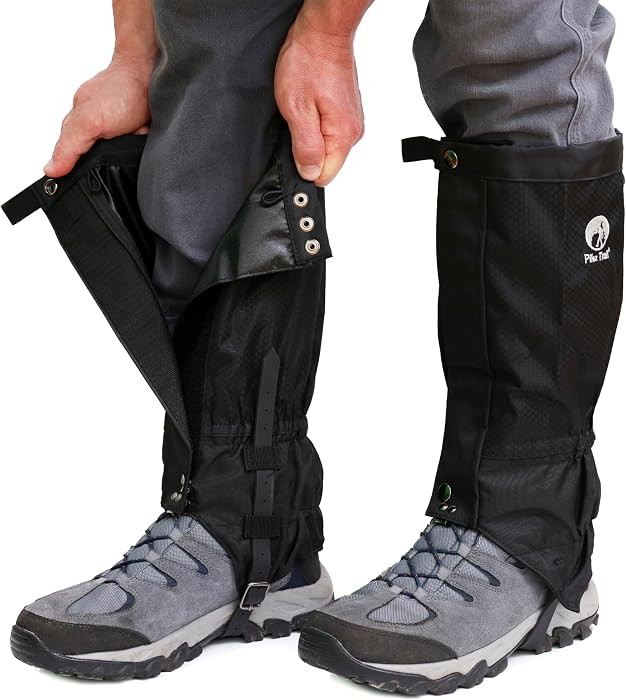
Pike Trail Adjustable Leg Gaiters Best for Ultralight Day Trips

Pike Trail Adjustable Leg Gaiters – Adjustable Leg Gaiters

Ultralight day trips

Field Score 87/100
Shell
Ripstop nylon upper, 900D lower
Sizing
One adjustable size
Closure
Hook-and-loop with metal press studs
Listed Weight
1.6 oz
View on Amazon

At a listed 1.6 ounces, the Pike Trail pair is the lightest gaiter here, and it is the one that disappears into a pack until you need it. The build is a ripstop nylon upper over a reinforced 900D lower — thin where it wraps the calf, tougher where it meets rock and brush — closed with an extra-wide hook-and-loop panel and heavy-duty metal press studs, with an adjustable drawstring at the top and straps you can reposition.

The adjustable fit is why we keep a pair around. There is no size to pick, so one pair covers everyone in the truck and pulls on over bare legs in summer or snow pants in February, which is a real convenience if you are outfitting a family or lending gear to a friend. Packed in its carry bag, it takes up about as much room as a pair of gloves.

One thing to check before you commit to a long trip: the straps that run under the boot are the part that gives out first, so look them over after rocky miles rather than at the trailhead. For day hikes, travel, and cold dry snow — trips where a gaiter is insurance rather than equipment — the light weight is the whole argument, and this is the pair here we are most likely to leave in the bottom of a bag all winter.

Worth Noting

  • Waterproof shell traps sweat on hard climbs
Our Verdict

We keep these for day hikes and travel: at 1.6 ounces they are the lightest here, one size fits everyone, and the under-boot straps are the part to watch.

Check Latest Price
5

Azarxis Hiking Gaiters Best for Simple Wet-Weather Hikes

Azarxis Hiking Gaiters

Simple wet-weather hikes

Field Score 81/100
Size
Small
Shell
600D Oxford
Closure
Hook-and-loop front, drawstring, TPU instep belt
Listed Weight
7.04 oz
View on Amazon

The variant on this listing is the small, and that is the first thing to sort out before you order. These run tight, and a small will not close over a bulky calf with snow pants tucked in. Measure your calf over the layers you hike in, order from that number, and size up if you are anywhere near the top of a range.

What you get is a plain 600D Oxford gaiter: waterproof-coated and tear-resistant, with a drawstring at the top, a TPU belt that runs under the boot, and hook-and-loop down the front. It is the least fussy design in this group, and on wet grass, morning dew, gravel dust, and thorny weeds it does exactly what a gaiter is supposed to do. They go on and off fast and wipe clean with a hand.

The 20-month warranty is the longest stated here, and it is worth something on a piece of gear whose closure takes the abuse. We wish the instep strap felt less like vinyl — the TPU and rubber straps on the pricier picks are more confidence-inspiring — but that is the one place these feel built to a minimum. Otherwise they are well made, they keep snow and dew out, and they go on without a fight.

Worth Noting

  • Instep strap is lighter than the pricier picks
Our Verdict

We recommend these for smaller frames and simple wet-weather hikes: a plain 600D gaiter with the longest warranty here, as long as you order by calf measurement.

Check Latest Price
6

ALTRA Trail Gaiter Best for Trail Running

ALTRA Unisex Trail Gaiter

Trail running

Field Score 80/100
Attachment
Hook-and-loop heel patch plus lace hook
Department
Unisex
Intended Use
Trail running and fast hiking
View on Amazon

This is the odd one out: an ankle-height debris gaiter for trail running shoes, not a calf-high gaiter for snow. It attaches with a hook-and-loop patch at the heel and a hook on the laces, and it stops at the ankle. We think that is a genuinely different product, and worth having for exactly one job — keeping sand, grit, and pebbles out of a low-cut shoe on a long run or a desert hike.

For that job it works, and it is light enough that you forget you are wearing it. Two limits come with it. The adhesive heel patch is only as good as its bond to your shoe, and that is the part that fails — on a shoe without a matching patch, or one where the patch peels, the gaiter flaps loose. And the fabric tears: brush, rock, and repeated river crossings wear through it well before a coated Oxford gaiter would. If you run Altra or another trail shoe with a heel patch and want grit out of your shoes, this is the pick. If you want snow out of your boots, it is not.

Worth Noting

  • Fabric tears before a coated Oxford gaiter would
  • Ankle coverage only; no calf or snow protection
Our Verdict

We recommend these only for trail runners chasing grit and sand out of low-cut shoes; they will not keep snow out of a boot or cover a calf.

Check Latest Price

What Six Months of Mud, Slush, and Snow Taught Us

We started by gathering every hiking gaiter we could find, then filtered out kids' sizing, dedicated mountaineering designs, and anything that didn't state a waterproof construction. We kept a spread from budget pairs to spendier ones so price would be a fair comparison rather than an excuse. That left 14 pairs, worn from late fall into spring.

Testing happened where gaiters actually live: postholing through knee-deep snow, walking a freeze-thaw trail that went from ice to shin-deep mud inside a mile, and pushing through wet, brushy singletrack after a rain. We wore them over trail runners, mid-cut boots, and snow boots, and over both pants and bare ankles.

Water resistance was checked directly — 20 minutes through soaked brush, then a look at the sock and pant leg underneath. For snow protection we deliberately stomped into drifts and noted whether anything crept past the top cuff. To gauge stability we counted how many times each pair needed re-adjusting per mile, and we inspected the under-boot strap after every outing for fraying, stretching, and whether it had slipped off the instep. Velcro closures got worked with cold, muddy fingers to see whether they still grabbed or clogged with grit and pine needles. Fit was judged against each maker's calf chart and by how much the top gaped once cinched, and we timed putting the pair on and peeling it off at a cold trailhead. Durability settled in slowly: seams, fabric, and lace hooks were re-inspected after each hike, then weighed against what the pair cost.

How to Choose Hiking Gaiters

Start With the Closure, Not the Fabric

How a gaiter attaches to your boot decides how well it works. A lace hook clips to your laces and pulls the front down tight; an instep strap runs under the sole and holds the whole gaiter in place. If you hike in boots with deep lugs or wear snowshoes, the under-boot strap matters most — and it is the part that wears out first.

Trail runners are the exception. A low gaiter with a heel patch and a lace hook does the job without a strap grinding under your foot, which is exactly what the Altra is for. Whatever you choose, check that the closure clears the boot you actually wear, not the one on the product page.

Size by Calf, Not by Shoe

Every gaiter here is sized around your calf, and most of them run small. Measure the widest part of your calf over the pants you hike in, then order from that number rather than from your boot size or your usual clothing size. A gaiter that is too small will not let the front closure meet, which is the most common fit failure; one that is too big bunches and slides down on descents.

If you land between sizes, or the chart is vague — true of more than one pair on this page — go up.

Fabric Weight and the Parts That Wear Out

Oxford fabric is graded by denier. The 600D shells here are the lightest, while 900D and 1000D resist thorn, rock, and crusty snow with more authority. Heavier fabric earns its keep on trails that run through blackberry, alder, or talus; for packed trail, mud, and snow, 600D is plenty.

But the shell is rarely what fails. The under-boot strap, the drawcord, and glued hook-and-loop tabs go first, so judge a pair on those parts as closely as on the fabric.

Waterproof, Water-Resistant, and Sweat

A coated shell keeps snow and rain out and your sweat in. That is why the better gaiters here pair a waterproof lower with a breathable upper, or use a lighter fabric that vents. A number like 6000 mm describes the fabric's water resistance, not the seams, and no coating stays waterproof forever once mud and abrasion work on it.

If you hike in cold, dry snow, prioritize the coating; if you climb hard in mild weather, accept slightly damp calves or pick a breathable upper. Hang gaiters to dry rather than machine washing a coated fabric.

Frequently Asked Questions

Final Verdict

For most hikers, the Unigear 1000D is the pair to buy: the heavy shell takes the abuse at the boot, the breathable upper keeps your legs from stewing, and the three-point closure stays where you set it. Measure your calf and size up first — that is the one place these trip people up.

If you hike a handful of times a season and want to spend as little as possible, the TRIWONDER does the same job with a thinner shell. If your season runs through wet alders and blackberry, the Frelaxy's 900D fabric and four-size fit are worth the extra money.