The 5 Best Hiking Watches of 2026

A hiking watch earns its keep in the moments your phone can't help: hands full, gloves on, sun washing out the screen you're squinting at. That's also why the category is a stack of compromises. The brightest displays drain the fastest, solar charging is slow enough that you start noticing where the sun sits, and a case that shrugs off rock scrapes can swallow a small wrist. I've worn one on every long walk for years, and over the past eight months my team has lived with 12 of them.

Readability matters more than any spec: a display you can read at a glance in full sun beats one that's only lovely indoors, and luminosity is a different problem once the trail goes dark under trees — as is finding a flashlight button by feel. Fit and build quality decide whether you forget you're wearing it or start loosening the strap by mile three, and appearance counts for more than I expected, since these end up at the office as often as on a ridge. The picks below kept time, held a charge, and stayed comfortable.

Our Top Picks

The 5 Best Hiking Watches of 2026

1

Garmin Instinct 2X Solar Tactical Best Overall

Garmin Instinct® 2X Solar Tactical

Multi-day backcountry

Field Score 93/100
Case Size
50 mm
Navigation
Multi-band GPS, TracBack routing, ABC sensors
Battery Life
Up to 40 days; solar extends
Water Resistance
100 meters
View on Amazon

Forty days in smartwatch mode is the figure that decided this one for us, and the solar lens is what makes the claim hold up: Garmin rates it for unlimited smartwatch use at three hours of direct sun per day. We charged it before a long weekend and did not think about the battery again for the rest of the trip.

Multi-band frequency support is the specification worth paying for, because it holds more than one satellite signal at a time, which is what keeps a track from wandering under canopy or inside a canyon. Add the ABC sensors and TracBack routing and a wrong turn becomes a line to follow back instead of a guess. We came to trust the compass and the altitude readout more than the map on our phones.

The case is fiber-reinforced polymer built to military standard 810 for thermal, shock, and water resistance, with a 100-meter depth rating behind it, and the whole thing weighs 67 grams. What we did not expect to lean on is the flashlight: variable brightness plus a strobe, bright enough to read a trail marker or fix a buckle in the dark without unpacking a headlamp.

Where the 2X gives ground is on-screen mapping. It routes you back with TracBack and reference points rather than a topographic map you can pan and zoom, so the Amazfit is the pick if you want the map itself. For battery, satellites, and toughness together, this is the watch we hand people first.

Worth Noting

  • Menu system takes patience to learn
  • Large 50 mm case and 67 g weight
Our Verdict

We recommend the Instinct 2X Solar to anyone whose hikes run long, wander off-trail, or finish after dark — multi-band GPS, a real flashlight, and solar charging that keeps it alive for weeks.

Check Latest Price
2

Amazfit T-Rex 3 Best Value and Maps

Amazfit T-Rex 3

Budget navigation

Field Score 92/100
Display
1.5-inch AMOLED, 2,000 nits
Navigation
Dual-band GPS, free offline maps
Battery Life
Up to 27 days; 180 hours in GPS
Water Resistance
100 meters
View on Amazon

Less money than our top pick buys a bigger screen and something the Garmin leaves out: free global maps stored on the watch, with topo and road detail you can pan and zoom while you are standing at a junction deciding which way.

That combination is why we point improvised hikers here. The 1.5-inch AMOLED hits 2,000 nits, so it stays readable in direct sun, and Glove Mode means you are not pulling a mitten off in February to check a bearing. Night mode drops the brightness for a tent at two in the morning without blinding you.

Endurance is the other half: 27 days typical and up to 180 hours in GPS mode from a 700 mAh battery, which covers a long trip away from a wall socket. The 316L stainless steel bezel is rated from -22F to 158F and to 100 meters of water resistance, and the 26 GB of storage holds the downloaded maps.

The caveat worth knowing is accuracy. Wrist heart rate during hard climbs is the number we treat with suspicion, while the GPS track itself has stayed solid; a chest strap settles it if you train by heart rate. Otherwise the T-Rex 3 asks very little of you beyond a cable every few weeks.

Worth Noting

  • Charging cradle arrives without a USB-C cable
  • Bluetooth pairing can drop between watch and phone
Our Verdict

Our pick for hikers who want maps on the wrist and a screen that reads in full sun without paying Garmin money.

Check Latest Price
3

Casio Pro Trek PRG-270-1 Best Without a Charger

Casio Men's Pro Trek PRG-270-1 Tough Solar Triple Sensor Multifunction Digital

No-charge instruments

Field Score 91/100
Power
Tough Solar
Sensors
Compass, barometer, altimeter
Navigation
Sensor readings only, no GPS
View on Amazon

Not every hiker wants a second phone on their wrist. The Pro Trek is built for the other kind: a triple sensor puts compass, barometer, and altimeter on your arm, Tough Solar keeps the cell fed from any light, and nothing about it needs a pairing screen or a charging brick.

The appeal is instruments that need nothing but light and buttons. You get a bearing to follow, a pressure trend that warns you the weather is turning, and an altitude readout, all worked from buttons you can press with gloves on. Digits are big and contrast is high, which is what you want from a watch that gets glanced at while you are moving, and it takes knocks without complaint.

Altitude is the reading to handle carefully. The altimeter works from barometric pressure, so a shifting weather system looks exactly like a climb; calibrate at a known elevation in the morning and read the trend rather than the number. The thermometer has the opposite problem, sitting against a warm wrist and in direct sun, so take it off before trusting it.

That leaves the Pro Trek as the cheapest route to real instruments here: compass, barometer, and altitude that run on light and a button press. If you navigate with a paper map and want numbers to confirm it, this is the watch that never asks for a cable.

Worth Noting

  • No GPS or route tracking
  • Bulky on smaller wrists
Our Verdict

We point hikers to the Pro Trek when they want compass, pressure, and altitude readings with no charger, no app, and no fuss.

Check Latest Price
4

Garmin Instinct 3 AMOLED Best Display

Garmin Instinct® 3 AMOLED

Readability-first hiking

Field Score 90/100
Display
1.2-inch AMOLED, 390 x 390
Navigation
Multi-band GPS with SatIQ, ABC sensors
Battery Life
Up to 18 days
Water Resistance
100 meters
View on Amazon

The 1.2-inch AMOLED is the whole reason to choose this Instinct over its siblings: 390 x 390 at 1,000 nits, with the glass set slightly below the bezel lip so rock and branches find the bezel first. In flat midday light it reads more like a phone screen than a watch face.

We noticed the difference on climbs, when you want pace, elevation, and distance without breaking stride. On a transflective display that is a squint; here it is a glance. Underneath sits the full Garmin toolset: multi-band GPS with SatIQ, which shifts satellite modes to save power, plus the three-axis compass, barometric altimeter, and the built-in flashlight.

Battery lands at 18 days in smartwatch mode, and this one charges from a cable rather than the sun. The 45 mm fiber-reinforced case with its metal-reinforced bezel weighs 52 grams, so it sits lighter on the wrist than the 50 mm Instinct, and it carries a 100-meter depth rating.

The trade is a fair one for day hikes and weekends, when charging every couple of weeks becomes a habit rather than a chore. String together nights out on the trail and the 2X is the better companion.

Worth Noting

  • Priciest of our picks
Our Verdict

Choose the Instinct 3 AMOLED if a bright color screen matters more than maximum battery; it is the easiest of these to read mid-climb.

Check Latest Price
5

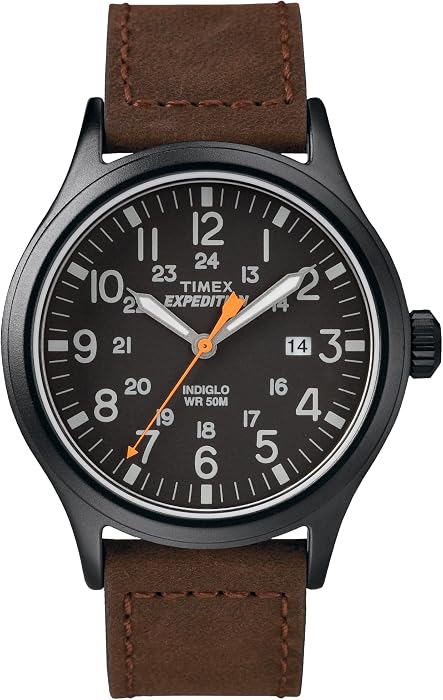
Timex Expedition Scout 40mm Best for Short Day Hikes

Timex Men's Expedition Scout 40mm Watch

Short day hikes

Field Score 88/100
Weight
2.24 oz
Backlight
INDIGLO
Case Size
40 mm
Water Resistance
50 meters
View on Amazon

The Expedition Scout is the watch we take when we do not want to think about a watch: a 40 mm field case, a nylon strap, and a battery you replace rather than charge. It costs the least of anything here, which is most of the appeal on a rocky trail where a scratched crystal is a foregone conclusion.

INDIGLO is the detail that sells it. Press the crown and the whole dial lights evenly instead of just glowing hands, so you can read the time and the date inside a tent without hunting for a headlamp. The Arabic numerals are big and the contrast is high, and at 2.24 ounces on a 40 mm case it disappears on the wrist.

Fifty meters of water resistance is the honest limit: rain, splashes, a stream crossing you did not plan, but not a swim. Quartz movements drift over months, so check it against your phone before a morning when the time actually matters, a shuttle pickup say. As a timekeeper for a day hike, it does the job and asks nothing.

Worth Noting

  • Strap and crown are the weak points
  • No compass, altimeter, or GPS
Our Verdict

We treat the Expedition Scout as a beater field watch: legible day or night, cheap enough to scratch, and happiest on short day hikes.

Check Latest Price

How We Tested Hiking Watches

We started by reading spec sheets and a few hundred owner reviews, then cut anything that couldn't handle a full day outside: no compass or barometer, no water resistance worth trusting, no way to get through a weekend without a cable. We also made sure the shortlist spread across case sizes and price points, since a 50mm tactical case and a 40mm field watch are answering different questions. Twelve watches made the cut, and we wore them for eight months.

Each one got at least a week of daily life — trail runs, a three-day backpacking trip, gym sessions, showers, a cold dawn at a trailhead — and several never came off, including overnight. Timekeeping was checked the boring way: we compared each watch against a reference clock after weeks of wear to catch drift, and on hikes we matched tracked distance and elevation against a loop we know to the tenth of a mile.

Readability got tested at arm's length, which is how you actually check the time: full noon sun, deep shade under trees, and dusk, plus a dark tent to judge luminosity and whether the backlight or glow blew out the digits. Battery life was logged from the moment each watch came out of the box, GPS on and off, and we noted whether a solar model gained anything on a gray day. We knocked wrists against doorframes and rock, dunked them in a creek, and strapped the same watch onto a 6-inch and an 8-inch wrist to see where fit fell apart. Menus were navigated with cold, wet hands, and once with gloves on.

How to Choose a Hiking Watch

Navigation or instruments first

Two kinds of rugged outdoor watch show up in this category. A GPS watch records a track, routes you back, and on some models draws a map on your wrist. A sensor watch gives you a compass bearing, barometric pressure, and altitude without ever talking to a satellite.

For marked trails of a few hours, sensors and a charged phone cover you. If you go off-trail, hike alone, or link days together, multi-band GPS with a routing function is the feature that justifies the money. Settle this before you compare battery figures, because everything else follows from it.

Battery, and how you will top it up

Smartwatch days are the number shoppers compare and the least useful one. GPS hours are what a navigation day actually costs, and a watch rated for three weeks of wear can still be dead by the second evening if you track every mile.

Solar charging is a real bonus and an unreliable one: the unlimited-runtime claims assume hours of direct sun at high intensity, which shade, cloud, and a jacket sleeve all cancel. For more than a weekend out, pick a watch whose plain GPS life covers your longest day with margin.

Screens you can read with cold hands

There are two display philosophies here. Transflective monochrome screens get sharper as the sun gets brighter and sip power. Color AMOLED panels are far easier to read at dusk and inside a tent, and they cost you battery for the privilege.

Think about operation too. Buttons work through gloves and wet hands; touchscreens need a mode built for it, and not every watch has one. A watch that demands a bare finger at a windy junction is one you will stop using.

Fit, weight, and what holds it on

Case size is the specification hikers regret most. A 50 mm case with a 67 g body is a lot of mass to swing on a trekking pole for six hours, and on a smaller wrist the lugs overhang and catch on pack straps. The 45 mm range is the safer default for all-day wear.

Check the strap as carefully as the case. Soft silicone feels good against the skin but stretches and holds sweat; a nylon pass-through strap dries faster and swaps without tools, though it soaks through in a downpour.

The app is part of the purchase

Every watch here except the Casio leans on a phone app for setup, updates, and pulling tracks off the watch. A model with shaky syncing is one you quietly stop bothering with, so weight pairing behavior as heavily as you weight the spec sheet.

If leaving the phone at home is the point, that narrows things quickly: the Casio needs nothing but light and a button press, and the Garmins will log a hike and hand it over whenever the phone comes back into range.

Frequently Asked Questions

Final Verdict

For most hikers the pick is the Garmin Instinct 2X Solar: multi-band GPS, a genuine flashlight, a build that survives being dropped on rock, and a battery that outlasts the trip. If maps on the wrist matter more than runtime, the Amazfit T-Rex 3 does that for less money.

And if you navigate with a paper map and only want the numbers to confirm it, the Casio Pro Trek is the one that never asks for a cable.