The 5 Best Horse Reins of 2026

Reins are the one piece of tack your hands are on every second of a ride, which is exactly why a bad pair is so hard to ignore: slick the moment your palms sweat, stiff enough to leave a crease across your fingers, or thin enough that a hard stop feels personal. I've swapped reins mid-ride more than once, and what separates a pair you forget about from a pair you fight is feel, not tooling. A good set puts a little weight in your hand, stays soft after a rain, and still matches the headstall by August.

Softness and durability pull against each other in this category, and so do thickness and weight — a heavy, wide rein gives you something to feel through winter gloves, but too much bulk turns clumsy fast. Split reins, roping reins, and flat braided cotton all ride differently, so I sorted out which style I actually wanted before judging quality. Over the past six months my team and I have ridden in 12 sets, from arena schooling to long trail miles, and the keepers all shared the same handful of traits. The ones below earned their spot on the bridle hooks.

Our Top Picks

The 5 Best Horse Reins of 2026

1

Weaver Extra Heavy Harness Split Reins Best Overall

Weaver Leather Working Tack Extra Heavy Harness Split Reins

Everyday western riding

Field Score 90/100
Size
1/2" x 8'
Color
Golden chestnut
Material
Harness leather
Item Weight
9.6 oz
View on Amazon

Split reins live or die on how the leather feels in your hand, and this is the pair we reach for first. At a half inch wide there's enough leather to fill a closed fist without feeling like a strap, and the harness leather arrives hand-rubbed and dressed with butter, so it feels broken in on the first ride instead of a month from now. The weighted ends are the detail we appreciated most: drop a rein to neck-rein or to take up two hands, and the tail falls and stays down instead of swinging up toward the horse's ears.

Eight feet is a working length for most western riders, long enough to have a fold to give with and short enough that you aren't gathering slack before every transition. The listed weight is 9.6 ounces, heavy enough to hang steadily off the bit without dragging it down. Golden chestnut is a warm, old-fashioned color that suits roughout and natural-finish saddles.

The bit ends tie on, and the ties at the attachment points are the sturdy part of the build, which is where you want the strength since the bit end takes every pull. Tying on costs you a minute whenever you change bits, and it means learning a knot you trust. What it buys is a connection that doesn't rattle or work loose the way a tired snap can, plus the ability to trim the reins if eight feet runs long on a shorter horse. Hand wash only, so no bucket soaks at the end of a muddy season.

Worth Noting

  • Tying on slows bit changes
  • Hand wash only
Our Verdict

We recommend these to anyone who wants one pair of split reins for everyday western riding: the harness leather is supple from the first ride and the weighted ends stay where you drop them.

Check Latest Price
2

Weaver Stacy Westfall ProTack Split Rein Best for Quick Bit Changes

Weaver Leather Stacy Westfall ProTack Oiled Split Rein

Swapping bits often

Field Score 89/100
Size
1/2" x 8'
Bit Ends
Stainless steel buckles
Material
Hermann Oak harness leather
Item Weight
16 oz
View on Amazon

The most expensive pair in this group spends its money in two places: the leather and the buckles. The leather is Hermann Oak harness leather with a four-step finish, oiled before it ships, so there's no break-in period to plan around. The buckles are stainless steel, and they're the reason to look here at all: you can move the same pair of reins from one bit or headstall to another in seconds, without untying or re-lacing anything.

For anyone riding more than one horse, or switching between a curb and a snaffle, we think that convenience is worth paying for. The buckles are secure enough that we stopped thinking about them after the first few rides, and the half-inch leather has the weighty, buttery feel that makes a split rein pleasant to hold for an hour at a time. Brown is the only finish, and it's a plain working brown that suits a roughout saddle.

If you own one headstall and one bit, though, the buckles are a feature you'd carry and never use, and a plain tie-on pair gets you the same quality of leather for less money. That's the honest boundary on these: they're a working tool for someone with a tack room full of options, not a first pair of reins.

Worth Noting

  • Heaviest leather here at 16 ounces
  • Some pairs arrive stiff and need oiling
Our Verdict

Buy these if you switch bits or headstalls often: the stainless buckles are quick and secure, and the oiled Hermann Oak leather is ready to ride the day it arrives.

Check Latest Price
3

Tough 1 Deluxe Knotted Cord Roping Reins Best for Roping

Tough 1 Deluxe Knotted Cord Roping Reins

Roping and grip

Field Score 88/100
Color
Black/White
Length
8.1 feet
Bit Ends
Scissor snap and Conway buckle
Material
Knotted nylon cord
View on Amazon

Roping reins have one job that matters more than the rest: staying in your hand when something on the other end pulls. The knotted cord on this pair gives your fingers a series of ridges to close against, and we like it best for roping, ranch work, and riders who want grip without a wide leather strap across the palm. The cord is soft enough to hold bare-handed and firm enough that it doesn't collapse when you take up slack.

At 8.1 feet it's a working roper length, long enough to dally or to give a horse its head, and the ends are a scissor snap on one side and a Conway buckle on the other. That's worth reading twice if you're used to clipping both sides on and off, because one end snaps and the other buckles through the bit ring. The nylon cord and 6.4-ounce weight make it a light rein, which is the real trade-off: easy on the hands over a long day, but light cord swings, and a horse that shakes its head can flip a rein over an ear.

What you're buying is a durable, weatherproof rein at a budget price. It doesn't need conditioning, it doesn't care about rain, and the black-and-white cord hides arena dirt better than any leather we tested. It will never feel like oiled leather in your hand, and that's fine, because this is the pair for the horse you rope off and the muddy days, not the one you show in.

Worth Noting

  • Only one snap; other end buckles
Our Verdict

A roper's rein on a budget: the knots give you something to close your fingers against, and the nylon cord shrugs off weather that would ruin a leather pair.

Check Latest Price
4

SHOWMEN CRAFT Braided Cotton Rein Best for Sensitive Hands

SHOWMEN CRAFT Braided Cotton Rein – 8' Braided Cotton Rein for Horse Headstall with Snaps Soft and Durable Reins

Sensitive hands

Field Score 87/100
Color
Black
Length
8 feet
Bit Ends
Snaps on both ends
Material
Braided cotton
View on Amazon

These aren't leather, and nobody should expect them to age like it. The braid is pure cotton, which means it takes on water, holds it, and stays damp well after the rain has stopped. What the cotton buys you is feel: the braided surface is softly cushioned and slightly tacky in the hand, easier to close a sore fist around than stiff nylon or brand-new leather.

For a rider whose hands ache, whether from arthritis, weak grip, or a long day in the saddle, we think that trade is worth making. The eight-foot length gives a normal working amount of slack, and having snaps on both ends means the pair moves between headstalls without untying anything. It's a black braid with plain hardware, so it won't dress up a show saddle, but it looks tidy on a trail rig.

The snaps are what will decide how long these last, so close each one firmly in your hand and retire the pair if a snap starts to open under a pull. In a dry climate the braid will give you several seasons of trail riding, and it doesn't need oiling or conditioning to stay comfortable. Where the humidity never breaks, though, a cord rein is the more practical buy.

Worth Noting

  • Cotton soaks up water and dries slowly
  • Braid and snaps wear faster than leather
Our Verdict

We point riders with arthritic or tired hands here: the braided cotton is soft, grippy, and priced so a second pair can live in the trailer.

Check Latest Price
5

CHALLENGER Latigo Laced Barrel Reins Best for Barrel Racing

CHALLENGER 8' Horse Western Leather Latigo Laced Barrel Contest Reins 66RT10

Barrel racing

Field Score 86/100
Size
8' L x 3/4" W
Style
Western
Material
Full-grain leather
Warranty
1 year manufacturer
View on Amazon

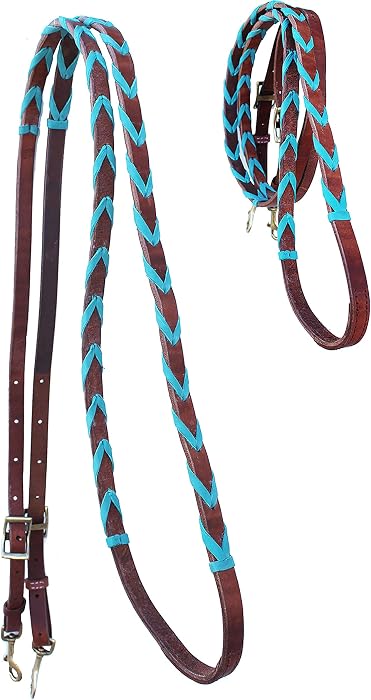
The turquoise latigo lace running the length of these reins is the first thing anyone notices, and on a turquoise-and-black barrel saddle they look like they were made for the rig. Under the lace is full-grain leather with a soft, broken-in feel, cut into a traditional split design and measuring 8 feet long by three-quarters of an inch wide.

Three-quarters of an inch is the widest rein on this page, and we care about that more than the lace. A wide rein fills a large hand and spreads pressure across the fingers, which is comfortable on a horse that leans on the bit. It's also more leather than a small hand wants, and there's more of it to gather when you need to shorten up in a hurry.

We see this as a look-first pick rather than a daily work rein. The leather is the best-supported thing about it, and the split design gives you the same drop-a-rein flexibility as every other leather pair here. The lace is decorative stitching sitting under real load, though, and it's the piece that goes first; when it does, the leather underneath still does the work, but the reins will look ragged. A one-year manufacturer warranty against defects is worth knowing about on a laced rein.

Worth Noting

  • Decorative latigo lace frays first
Our Verdict

Choose these if you want a wide, showy leather rein: the three-quarter-inch body fills a big hand, and the laced trim looks the part on a barrel saddle.

Check Latest Price

How We Tested Horse Reins

We started by gathering 12 sets across the formats riders actually shop for: split reins in harness and oiled leather, knotted cord roping styles, and flat braided cotton with snap ends. Before anything went on a horse, we read the listings for the details that usually get left out — finished width, listed length, and whether the snaps or tie ends come in the box. Anything whose measurements didn't line up with a standard eight-foot split, or that would have needed a tack store run before it could be attached to a bridle, didn't make the cut.

In the barn aisle we measured each rein with calipers at the spot your hand naturally lands, weighed it on a kitchen scale, and looked closely at the finishing: edge paint, lacing, stitching at the bit end, and whether the color in daylight matched the color on the screen. Every box got opened and inventoried, so we knew exactly what shipped and what we'd have to supply ourselves.

Then we rode. Six months of arena schooling, trail miles, and roping practice, in gloves and bare-handed, with two riders of different hand sizes putting each set through the same week of work. We soaked a few and let them dry to see whether they stiffened up, and after every few rides we checked the stitching at the bit end and the handhold for fraying, along with how each rein hung once it had sweat and rain on it. Value got judged at the end of that stretch: a set that still felt good in month five was worth its price, and one that had stretched, faded, or gone slick by then wasn't, no matter what it cost.

How to Choose Horse Reins

Split Reins, Roper Reins, and What Each One Does

Split reins are two separate straps, one to each bit ring, with nothing joining them. You can drop a side and keep the other, neck-rein one-handed, or take up both when you need to. A roper rein is one continuous rein with both ends on the bit: you can't lose a side, which is exactly why ropers and new riders like it, and it's the rein you can dally around a horn.

Choose split reins if you ride one-handed and want a loose rein on the trail; choose a roper if dropping a rein mid-ride worries you more than losing the option to drop one. Our leather picks are all split; the knotted cord pair is the roper of the group.

Length Is Where Most Buys Go Wrong

Eight feet is the working default, and it's the length most of our picks come in. A seven-foot rein is fine on a compact, short-necked horse, but on a long-necked or draft cross it leaves you riding with an arm out in front. If you want a loose rein on the trail or you plan to let your horse graze, go longer rather than shorter.

Check how the rein attaches before you worry about length, because that decides whether you can fix it. Tie-on ends can be trimmed to fit; a snapped or buckled rein is the length it is, so with hardware, length is final.

Width, Weight, and What Your Hands Can Hold

Width decides comfort, and it's the spec buyers underweight. A half-inch leather rein is the all-around standard: enough body to fill a closed fist, not so much that small hands have to work at it. Three-eighths of an inch of rope or cord is slim and quick but can feel like holding a leash, while a three-quarter-inch leather rein fills a big hand and spreads pressure from a horse that pulls.

Weight matters as much as width. Weighted ends keep a dropped split rein hanging down instead of flicking up toward the horse's ears. If your hands are small or sore, go narrower and softer; if they're big, go wider and heavier.

The Bit Ends Do the Real Work

How a rein meets the bit is the part that fails, and it's the part listings gloss over. Scissor snaps and buckles are fast for changing bits and headstalls, but a snap with a tired spring can open under a pull, so close both of them in your hand before every ride. Tie laces are slower, quieter, and stronger, and they let you trim the reins to length.

Read the hardware line rather than the photograph. Plenty of reins ship with one snap and one buckle end instead of two snaps, which changes how you take them on and off.

Frequently Asked Questions

Final Verdict

The Weaver Extra Heavy Harness Split Reins are the pair we point most riders to. The leather is supple from the first ride, the weighted ends stay where you drop them, and the tie ends let you trim them if eight feet runs long on your horse.

Spend more only if you move reins between bits and headstalls often, because the Stacy Westfall pair's stainless buckles are what the extra money buys. And if your hands hurt more than your budget does, the braided cotton SHOWMEN CRAFT pair is the softest thing here.