The 6 Best Horse Stall Guards of 2026

A horse who learns he can lean on the stall guard and pop the snap is a horse who will be loose in the aisle at 2 a.m. I've done that walk with a lead rope and a flashlight. The right guard keeps him safely in without shutting him off from the barn: air still moves, he can hang his head out and watch the aisle, and you can get in with an armful of hay without undoing three fittings first.

Over the past six months, my team and I hung 12 guards on stalls holding everything from a draft cross to a wily pony, and the differences came down to hardware and how the material behaves under a horse's honest weight. Webbing is quiet against a chest; chain and rubber-coated chain survive a chewer but rattle every time the horse shifts. Adjustable straps and replaceable fittings matter more than most shoppers expect, since a snapped snap should cost you a few dollars rather than a whole new guard, and stall widths and horse heights vary more than barns like to admit.

What follows is sorted by the jobs people actually need a guard to do: the leaner, the escape artist, the show barn that wants the aisle to look tidy.

Our Top Picks

The 6 Best Horse Stall Guards of 2026

1

Kensington Deluxe Stall Guard Best Overall

Kensington Stall Guard for Pony Horse Draft

Standard stall doors

Field Score 88/100
Patterns
Multiple plaid colorways
Panel Size
21"W x 34.5"H
Webbing Border
3" nylon, all four sides
Hardware Included
D rings, snaps, screw eyes
View on Amazon

The screw eyes come in the box, and that small piece of hardware is a big part of why this guard sits at the top of our list. Kensington ships the mesh panel, its webbing border, heavy-duty D rings, double-ended snaps, and the eyes that screw into the door frame. One order, one afternoon, done.

What we noticed once it's hanging is how much of the doorway it actually fills. The panel runs 21 inches wide by 34.5 inches long, a mesh center framed in 3-inch nylon webbing on all four sides, so a lean lands on four D-ring tabs instead of pulling on a single strap. For the horse that pushes on everything you hang, that spread is the part we trust.

Depth is what to check before you order. At 34.5 inches this hangs lower than any other panel here, and on a short stall opening the bottom edge crowds the floor or bunches against the door. Measure the opening first; a horse that steps at a low-hanging barrier is better served by one of the shorter guards in this guide.

The plaid has a lot to do with why this one gets picked. It reads as barn decor rather than equipment, the hardware has the same polished look, and there are several colorways to tie into an aisle guard. Check the stitching where the straps meet the D rings when you wash it, since that junction carries the most load.

Worth Noting

  • Priciest guard in this group
Our Verdict

We recommend it for most stalls: the largest panel in this group, plaid to match your aisle, and every piece of mounting hardware, screw eyes included, in the box.

Check Latest Price
2

Majestic Ally Stall Guard Best Value

Majestic Ally 1200D 29"x19" Horse Stall Guard with Replaceable and Adjustable

Budget full-panel barrier

Field Score 87/100
Guard Size
29"L x 19"W
Overall Span
51" to 61"
Hardware Included
4 straps and snaps
Replaceable Parts
Straps and snaps
View on Amazon

Straps and snaps that can be replaced are the most sensible thing about this guard, and they're the reason we send budget shoppers here first. Four straps and four snaps come with the 1200D cloth panel, and the design lets you swap a worn part instead of retiring the whole guard when one snap bends.

The panel measures 29 by 19 inches, and the straps add 11 to 16 inches at each end for a spanned width of 51 to 61 inches. That covers a standard stall door with room to spare and stops there, so a double-wide opening belongs to the Country Pride. The 2-inch webbing runs the full border with D rings at the corners, and 1200 denier is stout fabric for something that lives in a barn.

It isn't only a stall-door item. Clipped across a feed-room doorway it's a less permanent barrier than a gate, and hung across a barn door it keeps the aisle open to the breeze while the horse stays put. The six-month manufacturer warranty is on the short side for a product this exposed, which is the other reason the replaceable parts matter.

Worth Noting

  • Span tops out at 61 inches
  • Six-month manufacturer warranty
Our Verdict

Our value pick: a 1200D panel with straps and snaps built to be replaced, and a spanned width that covers a standard stall door.

Check Latest Price
3

Country Pride Barn Door Guard Best for Wide Openings

Country Pride Barn Door Guards

Wide barn openings

Field Score 86/100
Length
12 feet
Webbing
2" polypropylene
End Hardware
Stainless steel D rings and snaps
Mounting Hooks
Sold separately
View on Amazon

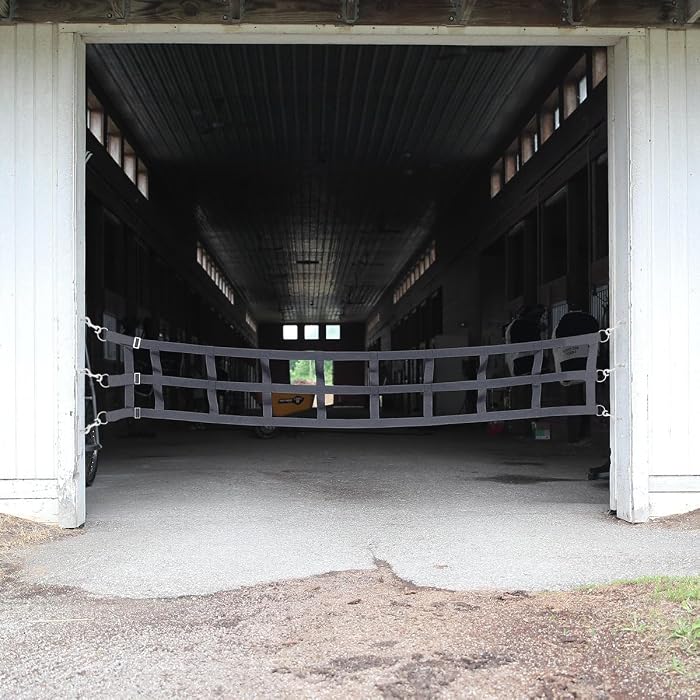
Twelve feet of webbing is not a stall-door barrier. It's what you clip across a barn aisle, over a double doorway, or between the posts of a run-in that's too wide for anything else here. Country Pride builds it from 2-inch heavyweight polypropylene with stainless steel D-ring ends and open-end snaps.

The appeal is that it's a strap and not a panel. It runs across the opening, clips to eyes on the posts, and comes off in a second when you want the whole width clear; ducking under is quicker still. Nothing solid to catch the wind or hold dust, and the stitching on the webbing is neat along its length.

What we value is the flexibility. One strap does the job of a gate that has to swing, and it rolls out of the way when the aisle is busy. The eye hooks that anchor it to the post are the one thing missing from the box, so add a pair to the order and have them in hand before the guard arrives.

Worth Noting

  • Eye hooks for the frame sold separately
Our Verdict

Buy this when the opening is wide, an aisle or a double door, and you want a strap that clips across it rather than a panel that fills it.

Check Latest Price
4

SmartEquine Stall Chain Best Chain-Style Guard

SmartEquine Stall Chain

Airflow and access

Field Score 85/100
Length
45.5 inches
Covering
1" wide rubber
Included
2 double-ended snaps
Screw Eyes
Sold separately
View on Amazon

Clip this across an open stall door and the whole doorway belongs to the horse again: head and neck out over the chain, air moving through, both your hands free to work inside. Forty-five and a half inches of rubber-covered chain and two double-ended snaps is the entire assembly.

The 1-inch rubber covering does more than look tidy. It keeps the chain from rattling against the door frame and chewing the paint where it swings, and it's easier on a hand that grabs it in passing than bare links would be. One hand opens it, which matters when the other one is holding a lead rope.

The snaps are the lightest part of the assembly, though, and a horse that leans its chest on the chain will find that out. If yours is a leaner, fit heavier snaps before the first week is over. Screw eyes for the door frame sell separately, so gather those too. For a horse that resents a closed door all winter, this is the pick we hand over without hesitation.

Worth Noting

  • Snaps are light for a horse that leans
  • Screw eyes sell separately
Our Verdict

For maximum air and one-handed access we keep coming back to the chain: two snaps, a rubber cover, and a doorway a horse can hang its head through.

Check Latest Price
5

Weaver Poly Stall Guard Best Webbing-Only Guard

Weaver Equine Stall Guard

Low barrier, airflow

Field Score 83/100
Height
18 inches
Webbing
2" polypropylene
Hardware
Nickel-plated snaps and slides
Width Range
36" to 48"
View on Amazon

Eighteen inches of drop is the whole idea here, and it's the shortest barrier in this guide. Weaver builds it from 2-inch black polypropylene webbing with nickel-plated snaps and slides, no mesh, no cloth, nothing to hold dust. We like it in a barn where a panel turns a doorway into a wall: the horse still has a bar across its chest, and the air above and below keeps moving.

Width adjusts from 36 to 48 inches on the slides, so it spans a standard stall door with the snaps taking up the rest. Cleaning is a wipe with a damp rag, which is the least fuss of anything here, since there's no panel to scrub and no mesh to dry out.

The trade-off is everything below that 18-inch bar. A horse that paws, steps at a gap, or has learned it can duck will have a lot of open air to work with, and this isn't the guard for that horse. For a calm one in a hot barn, the shorter drop is exactly the point.

Worth Noting

  • Short 18-inch drop leaves a wide gap below
  • Priced above the budget panel here
Our Verdict

We reach for this one in a barn where a panel makes the doorway feel like a wall; 18 inches of webbing holds the horse and keeps the air moving.

Check Latest Price
6

Tough 1 Rubber Stall Chain Best for Everyday Stall Doors

Tough 1 Heavy Rubber Coated Stall Chain

Everyday stall doors

Field Score 82/100
Length
43 inches
Weight
16 oz
Coating
Heavy rubber
View on Amazon

One pound of rubber-coated chain, 43 inches long, and that's the whole product. The specifications are short and honest: a heavy rubber coating over the links, 16 ounces of chain, 43 inches end to end.

What we appreciate is how little there is to it. It's the lightest thing in this guide, so hanging it at the end of the day is no chore, and the rubber coating takes the bang out of a door that's in and out all day. On a standard stall door the 43-inch run is about right; on a wide opening you want a longer chain or a second one.

Where it lands against the SmartEquine is length and detail: that one gives you 45.5 inches and a pair of snaps spelled out, while this is the plain chain. Have your snaps and screw eyes in hand when it arrives and it's a perfectly good barrier for a horse that respects a chain. This one, like every chain here, rewards a horse that doesn't test it.

Worth Noting

  • Shorter 43-inch span than the other chain here
Our Verdict

The lightest barrier here: a pound of coated chain for a standard stall door, best for a barn that opens and closes doors all day.

Check Latest Price

How We Tested Stall Guards in a Working Barn

We started by pulling every stall guard we could find from tack shops and farm suppliers, then cut the list by material, hardware type, and whether the length adjusts or the straps and snaps can be replaced on their own. Guards that only fit one doorway width, or that used fittings we couldn't source a replacement for, didn't make the cut. Twelve came home with us, spanning budget poly webbing up to heavyweight rubber-coated chain.

Each guard lived on a real stall for at least two weeks in a working barn with morning feed, night check, vet visits, and a farrier who expects to walk straight in. We hung them on stalls holding a draft cross, a petite pony, and a mare who leans, and we measured every one from latch post to wall to see how much adjustment was genuinely left at either end.

With a lead rope in one hand, we did up and undid every snap one-handed, noting whether it seated cleanly or needed a second fumble. We leaned our own weight against each guard to watch how the webbing stretched, how the stitching at the D-rings held, and whether the hardware bent or left a burr. After a month we hosed two of them down and left them in the sun to see whether the color faded or the fittings spotted, and we checked the snaps on the leaner's stall weekly for wear.

Six months in, the ones that held up did it quietly: no pulled stitching, no snap that fought back, no strap that ran out of adjustment on a wide doorway. They're still hanging, and we'll update if anything gives.

How to Choose a Horse Stall Guard

Panels, Webbing, and Chains

Three shapes cover the same doorway, and the difference is how much barrier you want between the horse and the aisle. A mesh panel like the Kensington's 21-by-34.5-inch guard, or the 1200D cloth on the Majestic Ally, fills the opening and catches a horse that pushes or leans. A webbing-only guard such as the Weaver is straps and nothing else: less to clean, more air moving, and no solid surface for a horse to press against. A rubber-covered chain is the most open of the three and the quickest to work one-handed.

Match the shape to the horse rather than to the barn's paint scheme. A horse that respects a bar does fine on a chain; one that tests everything you hang needs the panel.

Measure the Opening First

A stall guard is sized by the doorway, not by the horse. Add the panel width to the strap range at each end to get the spanned width, then check that figure against the jamb-to-jamb opening; the Majestic Ally, for example, lands between 51 and 61 inches. Height matters just as much. A panel that hangs about 34 inches deep crowds a low header and bunches at the floor, while an 18-inch webbing guard leaves the bottom of the doorway wide open.

The trap here is length. A 12-foot guard is a tool for aisles, run-ins, and double doors; hung on a four-foot stall door it becomes a loop of slack. Measure both dimensions before you fall for a pattern.

The Snap Is the Weak Link

Everything a horse does to a stall guard arrives at two small pieces of metal: the snap on each strap and the eye it clips to. A horse that leans its chest on the barrier puts a steady load through that joint, and lighter double-ended snaps can straighten under it. If your horse tests barriers, buy a guard with heavy hardware or budget for a set of heavier snaps on day one.

Then check the box for the mounting eyes. Some guards include the screw eyes that go into the door frame; others leave you to buy eye hooks separately, and finding that out after the guard arrives is how a ten-minute job turns into a second order.

Buy Something You Can Repair

Stall guards live in a wet, dusty, sun-bleached barn, and the webbing and snaps take the wear while the panel usually survives. A guard whose straps and snaps are replaceable, as they are on the Majestic Ally, stays in service after one part fails. We pay more attention to that than to a longer warranty, because the warranty runs out long before the guard does.

Frequently Asked Questions

Final Verdict

For most stalls, the Kensington is the guard we point people toward: the largest panel in this group, four D-ring tabs to spread a lean, screw eyes already in the box, and plaid patterns that look like they belong in the barn.

If your opening is wider than a stall door, twelve feet of Country Pride webbing is the better tool. If your horse simply resents a closed door all winter, clip the SmartEquine chain across it and let the air through.