The 8 Best Hunting Rangefinders of 2026

A rangefinder has one job, and about two seconds to do it in bad light with cold hands. I've watched a readout wash out in low sun at 40 yards, and I've watched a borrowed unit come back off by a dozen. What a good one buys you is unglamorous: a number you trust, fast, so you can stop doing math and start deciding whether to draw.

Here's what first-time buyers get wrong: the max range on the box is measured off a reflective target in ideal conditions and means almost nothing against a dark animal at dusk. What separates these units is whether the display reads in flat light, whether angle compensation corrects your hold from 18 feet up a tree, and whether the button lands under your thumb while you're holding a bow. Eight months and 12 rangefinders later, the gaps were almost all in those details.

The picks below are grouped by where each one earns its keep — the close-range archery unit, the long-lens tool for open country, the backup that lives in the truck.

Our Top Picks

The 8 Best Hunting Rangefinders of 2026

1

Vortex Crossfire HD 1400 Best Overall

Vortex Crossfire HD 1400 Laser Rangefinder

All-around hunting

Field Score 96/100
Display
Red TOLED
Warranty
Unlimited lifetime
Max Range
1,400 yd reflective / 750 yd on game
Magnification
5x
View on Amazon

Red numbers are what put the Crossfire HD 1400 at the top of this list. Its TOLED display stays legible against a dark treeline when a plain black LCD goes flat, and that last half hour of legal light is when most shots get taken. Vortex rates the unit at 1,400 yards on a reflective target and 750 on game, which covers any deer or elk you should be shooting at, and the 5x image holds steady on an animal instead of drifting onto the pine behind it.

The three target modes are more useful than they sound. You can tell the unit to report the nearest return, the farthest, or a normal reading, which is how you range a buck through a screen of saplings instead of ranging the oak behind him. The menu takes a few minutes to learn and then disappears: press, read, put it away.

Build is the other half of the case. The body is polymer with ArmorTek-coated lenses, sealed against weather and rated shockproof, and the unlimited, unconditional lifetime warranty takes the sting out of a fall on the rocks. If this one fails in five seasons, Vortex fixes or replaces it.

The ground it gives up is at bow distances, where a reading can come in a few yards long, so pace out 20 and 40 in the yard and compare before you trust it inside 30. And 5x is modest next to the 7x Diamondback; if you glass big country, that is the upgrade worth making.

Worth Noting

  • 5x magnification trails the 7x picks
Our Verdict

Our pick for most hunters: the red display stays readable at last light, it ranges game to 750 yards, and the lifetime warranty covers a bad fall.

Check Latest Price
2

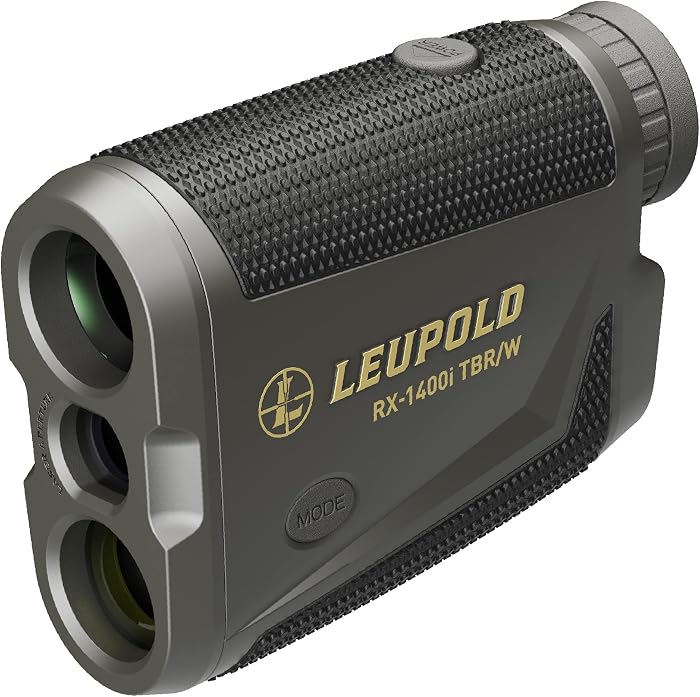
Leupold RX-1400i TBR/W Gen 2 Best for Bowhunters

Leupold RX-1400I TBR/W Gen 2 w/Flightpath Rangefinder

Bowhunting and rifles

Field Score 95/100
Display
Red TOLED, adjustable
Max Range
1,400 yd reflective / 1,200 yd on trees
Ballistics
TBR/W with wind
Magnification
5x
View on Amazon

Flightpath is what separates the RX-1400i from everything else on this page. Switch it into bow mode and the display returns an angle-compensated range plus a read on the arrow's flight path, flagging the limb or branch the arrow would clip. That is the exact question a treestand shot asks, and the one a plain rangefinder leaves you to work out on your own.

The rest of the unit is just as considered. TBR/W folds a ballistic curve and a wind hold into the reading, so a rifle hunter gets a number to dial instead of a number to convert, and the red TOLED display offers three brightness settings to keep the digits from washing out the view at either end of the day. Leupold rates it to 1,400 yards on reflective targets and 1,200 on trees, and the aluminum body weighs 5.1 ounces, light enough to forget it is in your pocket until you need it.

The battery-compartment tab is the one part of this design that worries us. It is a small plastic flap that can stick to the cover and tear, so open it deliberately rather than prying at it with cold fingers, and keep a spare CR2 in the truck.

Worth Noting

  • Rated water resistant, not waterproof
Our Verdict

We point bowhunters here: Flightpath checks the arrow's path before you draw, and the same unit gives rifle hunters a ballistic range with wind.

Check Latest Price
3

Vortex Diamondback HD 2000 Best for Long-Range Hunting

Vortex Diamondback HD 2000 Laser Rangefinder

Open-country hunting

Field Score 94/100
Display
Red OLED
Warranty
Unlimited lifetime
Max Range
2,000 yd reflective / 1,400 yd on game
Magnification
7x
View on Amazon

Fourteen hundred yards on a deer is the figure that justifies this one. Vortex rates the Diamondback HD 2000 at 2,000 yards on a reflective target and 1,400 on game, roughly double what most of the units here will return off an animal's chest, and for a hunter glassing a basin that headroom is the entire point.

The 7x magnification and 24mm objective do the rest. At distance you can pick an elk out of a shaded fold instead of guessing which dark shape is which, and the red OLED display keeps the numbers bright when the light goes. Two target modes and two ranging modes, line of sight and angle-compensated, cover what a hunt actually asks for, and we never wanted a deeper menu.

ArmorTek-coated lenses, a rubber-armored body, and a waterproof rating mean it can ride on a pack strap through weather, and the unlimited, unconditional lifetime warranty is the same safety net the Crossfire carries.

The cost is the obvious catch: this is the priciest pick in this guide, and the extra reach is wasted on timber where every shot is inside 150 yards. Cold is the other thing to plan for, since a CR2 loses voltage fast in the teens and a low-battery warning can appear earlier than you expect, so a spare in the pack is cheap insurance.

Worth Noting

  • Priciest pick in this guide
Our Verdict

We take this one when the country opens up: 7x glass, 1,400 yards on game, and the same unlimited lifetime warranty as our top pick.

Check Latest Price
4

Bushnell BoneCollector 850 Best for Treestands

Bushnell BoneCollector 850 Laser Rangefinder

Treestand hunting

Field Score 93/100
Angle
ARC compensation
Max Range
850 yd reflective
Scan Rate
4x per second
Magnification
6x
View on Amazon

One button runs the whole thing. Press to wake the BoneCollector 850, press and hold to scan, and the display refreshes four times a second while you sweep a food plot. There is no menu to learn and nothing to fumble with a gloved thumb, which is most of why we hand it to someone who has never picked up a range finder before.

ARC is what earns it a place for treestand hunters. It converts the line-of-sight reading into true horizontal distance, so a steep shot down a ridge doesn't quietly cost you yardage, and the all-glass optics behind that oversized objective lens produce a bright image in flat timber light. Eight hundred and fifty yards on a reflective target covers any shot in the timber.

The battery door is the part we handle carefully. It is small, it takes a firm twist, and forcing it is how these break. Set that aside and you are getting a lot of brand-name optic for the middle of this group's price range, with a layout simple enough to lend out.

Worth Noting

  • Plain LCD washes out at last light
Our Verdict

We keep this one for timber and treestands: angle compensation for steep shots and a single button that does everything.

Check Latest Price
5

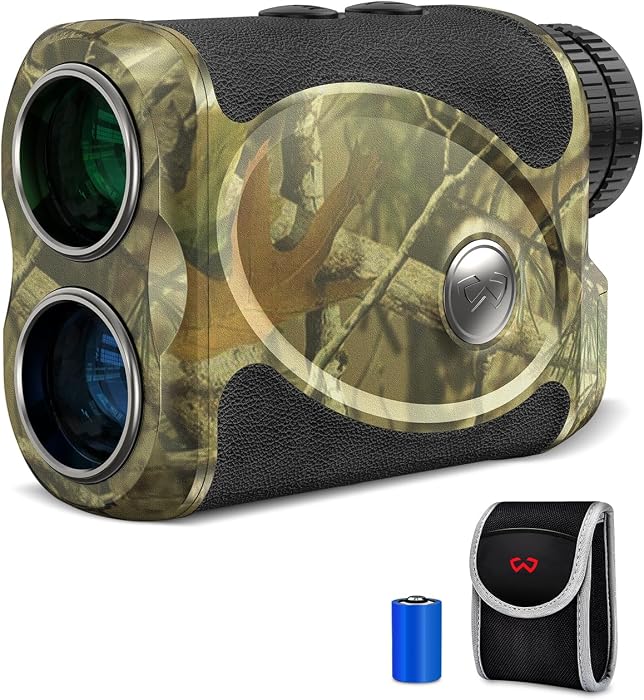
TIDEWE HR-F700 Best Value

TIDEWE Hunting Rangefinder

Budget big-game hunts

Field Score 92/100
Power
Rechargeable Li-ion
Weight
5.67 oz
Max Range
3-700 yd
Magnification
6x
View on Amazon

A rechargeable battery is the smartest thing about the TIDEWE HR-F700. Instead of feeding it CR2s, you top it up from a cable, and the rated capacity is up to 21,000 measurements per charge, which is a couple of seasons of ranging for most hunters. At 5.67 ounces and roughly the size of a deck of cards, it disappears into a jacket pocket or a pack lid.

For the money, that combination is hard to argue with. Six power magnification, readings from 3 to 700 yards at plus or minus a yard, and a 0.46-second response cover everything inside 300 yards, and the one-hand operation works with gloves on, which matters more in November than any menu does. The camo shell and the included case are nice at this end of the market too.

The 700-yard figure needs reading the way every range on this page does: it is a reflective-target number, and off a deer's chest you will get a fraction of it. We treat this as a 200-yard tool that happens to reach farther, and at this price that is a fair trade.

Worth Noting

  • No backlit display for low light
Our Verdict

We call this the value pick: rechargeable, small enough to forget in a jacket pocket, and accurate everywhere a reasonable shot happens.

Check Latest Price
6

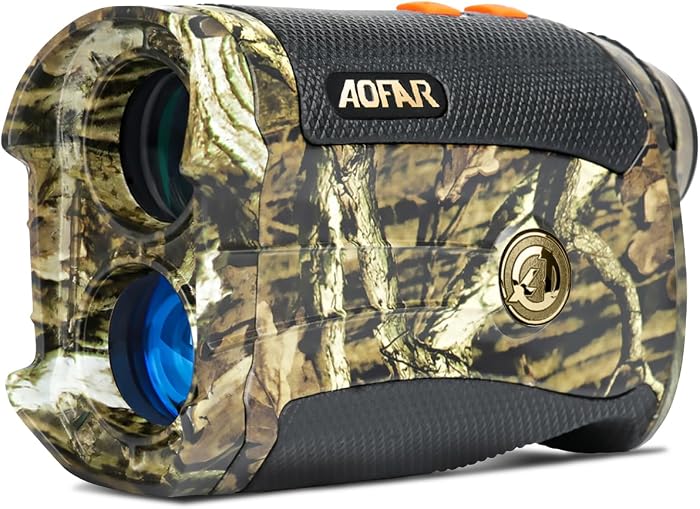
AOFAR HX-1200T Best Budget

AOFAR HX-1200T Range Finder for Hunting Archery

Budget bowhunting

Field Score 91/100
Modes
Bow and range
Weight
6.38 oz
Max Range
5-1,200 yd
Magnification
6x
View on Amazon

Set the HX-1200T next to our top pick and it gives up the red display and the lifetime warranty. What it keeps is reach, at a price that makes it easy to leave in the truck. AOFAR rates it to 1,200 yards, and bow mode shows straight-line, angle, and horizontal distance together, which is enough information for a treestand shot without doing arithmetic in your head.

The controls are the simple kind: one button to fire, one to change modes, and a reading that comes back about as fast as you can settle the reticle. The pouch, CR2, and cleaning cloth are in the box, and the two-year support is longer than most units at this end of the market offer.

Where the claims get optimistic is the range itself. Twelve hundred yards is a reflective-target number that brush, grass, and fur cut down hard, so plan on a few hundred yards on an animal and treat the rest as marketing.

None of that changes what this one is for. A spare that lives in the truck, a second unit for a kid coming along, or a first rangefinder that won't make you wince if it gets left out in the rain: this is where the money goes, and it still ranges farther than most of us can shoot.

Worth Noting

  • Display dims in low light
Our Verdict

We buy this one as the spare: real reach, a three-number bow readout, and a price that makes leaving it in the truck painless.

Check Latest Price
7

WOSPORTS 800

WOSPORTS Hunting Rangefinder

First rangefinder

Field Score 90/100
Modes
Straight-line, target lock, vertical
Weight
8.11 oz
Max Range
5-800 yd
Magnification
6x
View on Amazon

There is no dedicated bow mode on the WOSPORTS 800, and if you shoot a compound from a treestand, that is the first thing to know. The three modes give you straight-line distance, a target-lock reading, and a vertical distance; what is missing is the angle-compensated arrow solution the Leupold and the AOFAR produce without a second thought.

What it does well is the basic job. With 6x magnification and an easy-focus eyepiece, it reads quickly and consistently on trees, fence posts, and steel, and the auto shut-off after ten seconds of inactivity is the sort of small thing that saves a battery over a season. At 230 grams it is heavier than the compact picks, but it hangs fine from a wrist strap or a belt.

We point a new hunter, a rimfire shooter, or someone who wants a second unit at this one, and steer serious bowhunters to the picks above. Swap the included CR2 for a fresh cell before opening day, since the battery in the box can arrive nearly flat.

Worth Noting

  • Plain LCD fades in low light
Our Verdict

We recommend it as a first rangefinder, as long as you don't need a bow-specific mode or a display that reads at dusk.

Check Latest Price
8

AOFAR HX-700N Best for Backyard and Bow Practice

AOFAR HX-700N Hunting Range Finder 700 Yards Waterproof Archery Rangefinder

Backyard and bow practice

Field Score 89/100
Modes
Range and speed
Weight
6.35 oz
Max Range
5-700 yd
Magnification
6x
View on Amazon

This is the rangefinder that ends up in the hands of whoever forgot theirs. It is about six ounces, it fits in a cargo pocket, and it ships with a pouch, a CR2, a lanyard, and a carabiner, which is the entire kit for a fraction of what the mid-priced units cost.

For bow work and backyard practice it is honest. Readings come back quickly, the six power image focuses cleanly, and the two-mode layout of range and speed has nothing in it to get lost in. We hand it to a new archer without a second thought, because the loop of ranging a 3-D target and checking the pin is where most of the learning happens.

Past about 60 yards the case weakens. The 700-yard rating is a reflective-target figure, and readings on game and cover get inconsistent at distance, so this is not the unit for open-country rifle hunting.

Inside a bow's range, none of that reaches you, and that is the point. Buy it as a starter, a spare, or the unit you hand a kid walking in behind you, and it does the job it was built for.

Worth Noting

  • No angle-compensated ranging mode
Our Verdict

We keep this in the pack as a spare: quick readings inside bow range and a complete kit, without angle compensation for steep shots.

Check Latest Price

How We Tested 12 Hunting Rangefinders in the Field

We started by pulling every hunting rangefinder a real hunter might actually buy, then filtered by magnification, angle compensation, and whether the unit offered a scan mode. Anything missing those got cut, which left 12. Three of us — two rifle hunters and a bowhunter — carried them for eight months, from spring turkey through the fall seasons.

Work started on a surveyed archery range where the distances were known to the yard. Each unit ranged 20, 40, 60, and 100-yard targets five times in a row so we could see whether a reading held steady or bounced, then we shot across a valley ridge to ridge to find where each one truly quit — not the claimed max, but the last distance it would read off a pine trunk instead of a road sign.

Then we hunted with them, running each through its archery and rifle settings. Before legal light and again at last light, we pointed every unit at dark targets in flat sun and wrote down whether the display washed out, whether the reticle vanished against an animal's shoulder, and whether we could find the brightness button without looking. From treestands on steep ground we compared the compensated distance to the same horizontal distance walked out and taped on flat ground, and we timed each one from pocket to reading with a glove on. Scan mode got tested on a walking figure at the far fence line.

Durability was dirt and weather: waist-high drops onto gravel, a knock off a treestand rail, a night in a cold truck, a wet afternoon loose in a pocket with keys. We logged fogged lenses, mushy buttons, and battery doors that were a fight in the dark, then weighed what each box included against what the unit did. A rangefinder that nails the number but eats a battery a month isn't a value.

How to Choose a Hunting Rangefinder

Read the Range Number Twice

Every maximum range on the box is measured against something reflective: a road sign, a white barn, a golf flag. A deer's hide returns a fraction of that, and brush, tall grass, and flat light cut it further. A workable rule of thumb is to halve the advertised number for game, so a 1,400-yard unit is a 700-yard tool on fur and a 700-yard unit is a 300-yard one.

Match that number to your terrain rather than your optimism. Timber hunters rarely need more than 400 yards. Anyone hunting open country should be shopping in the 1,400-yard class and up, which is where the Diamondback HD 2000 sits.

The Display Decides More Than the Spec Sheet

The readout is the part you actually use, and it is where inexpensive units fall down. A red TOLED or OLED display stays legible against a dark treeline. A plain black LCD fades into it at exactly the hour deer move, and plenty of budget units have no backlight at all.

If most of your season happens in the first and last half hour of light, buy the illuminated display before you buy another 500 yards of range. You cannot shoot a number you cannot read.

Angle Compensation and Ballistic Modes

On a steep shot, the line-of-sight distance is not the distance the arrow or bullet travels, which is why angle compensation matters from a treestand or across a canyon. Every pick here offers some version of it, though the WOSPORTS only reports a vertical distance rather than a compensated range.

Above that sit ballistic modes: a solver that folds in drop and wind, like Leupold's TBR/W, for rifle hunters, and an arrow-path display like Flightpath for bowhunters. Buy the mode that matches your weapon, not the longest feature list.

Power, Weight, and How It Carries

Rechargeable units save you a battery habit but need a cable; CR2 units are field-swappable and cheap to keep spares for. Cold drains lithium either way, so a spare in the pack matters more than any runtime claim.

Most picks here land between five and eight ounces, light enough for a jacket pocket, and a harness or lanyard keeps the unit off the ground while you climb. On magnification, 5x is steady in the hand; 7x resolves more animal at distance but shakes more without a rest.

Frequently Asked Questions

Final Verdict

For most hunters the decision is easy. The Crossfire HD 1400 reads at last light, ranges game farther than you should be shooting, and carries a lifetime warranty that outlasts the season. Hunt open country and the Diamondback HD 2000's 7x glass and 1,400-yard game rating justify the step up.

If the budget is tight, the TIDEWE recharges instead of eating batteries and handles everything inside 300 yards, which is where most shots still happen.