The 9 Best Hygrometers of 2026

Humidity is the one thing in a house you can feel but can't see. It shows up as fog on the bedroom windows, a guitar that won't stay in tune, a musty smell behind the bookshelf, or static shocks off every doorknob. A hygrometer turns that guesswork into a number, and a good one costs less than lunch.

I've kept 15 of them running in my house and my team's for the past seven months, from palm-size models that stick to the fridge to app-connected sensors that ping your phone when the basement turns damp. Price turned out to be a poor predictor of accuracy. What separated the good ones was duller stuff: a display you can read across a room, a battery that doesn't die in six weeks, mounting that doesn't need a drill.

A hygrometer only measures the air where it sits, so one stuck on an exterior wall or above a heat vent can read several points off no matter how good the sensor is. The picks below are the ones that stayed steady after months of real placement.

Our Top Picks

The 9 Best Hygrometers of 2026

1

TempPro TP55 Best Overall

TempPro TempAir Digital Indoor Hygrometer Thermometer with Touchscreen

Everyday home monitoring

Field Score 95/100
Display
4-inch backlit LCD
Mounting
Tabletop, wall, or magnet
Humidity Accuracy
±2% RH
Temperature Accuracy
±1°F
View on Amazon

Humidity is one of those things you check in passing, often from across a room with your hands full. The TempPro TP55 is built for that: its 4-inch screen is the largest here, and the backlight makes the numbers legible in a dim hallway or before sunrise.

Display size is not just a numbers game. The TP55 pairs the big screen with front buttons and a 10-second refresh, so temperature and humidity are visible without squinting or tapping through menus. We like that the 24-hour and all-time high/low records sit on the main screen; that turns it from a glanceable gauge into something useful for spotting a damp basement trend.

Accuracy is rated ±1°F and ±2% RH, among the tightest humidity figures in this group. We also appreciated the three mounting choices: a stand for a shelf, a magnet for a fridge, or a wall mount. That flexibility is why it works in more rooms than the button-cell minis.

Nothing here is perfect. The 4-inch body takes up more shelf space than a mini, and the high/low records show the range but not when a spike happened. If you want a graph, the Govee app is the better tool; if you want a number you can read from the doorway, the extra footprint buys something real.

For us, the TP55 earns its place on a main-floor shelf because the big display and tight humidity spec remove the two small doubts that make people ignore a hygrometer: whether they can read it and whether they can trust it. The high/low records add the third thing we want—a sense of whether the room is getting worse.

Worth Noting

  • Larger footprint than mini gauges
Our Verdict

For a readable everyday gauge, we recommend the TempPro TP55: big backlit display, tight ±2% RH accuracy, and high/low records without an app.

Check Latest Price
2

TempPro TP49 2-Pack Best Multi-Room Value

TempPro TP49 2 Pack Digital Hygrometer Indoor Thermometer

Multi-room coverage

Field Score 94/100
Mounting
Tabletop, wall, or magnet
Pack Size
2 sensors
Refresh Rate
10 seconds
Humidity Accuracy
±2% to 3% RH
View on Amazon

Two rooms usually have two different humidity problems: the bathroom runs wet, the bedroom runs dry, and one gauge on a hallway shelf tells you neither. TempPro's TP49 two-pack is the simplest fix in this set: two compact sensors, each with the same 10-second refresh and the same three mounting options.

The specs are ordinary in the right way. Accuracy is rated ±1°F and ±2% to 3% RH, the screen uses large digits despite a body only a couple of inches tall, and the comfort face gives you a quick dry/comfort/wet read. There is nothing to configure, which is the point.

We think the pair is the best value here for covering two rooms without going smart. Both units can move between a stand, a magnet, and a hanging hole, so you can put one near a plant shelf and one on the fridge. The trade-off is that the display is not backlit, so a dark closet needs a flashlight.

The pair also arrives with batteries, so you can put one in each room before deciding whether you need more. The compact bodies tuck beside a plant tray or on a fridge door without becoming decor.

Worth Noting

  • No app or history graph
Our Verdict

We think the TempPro TP49 two-pack is the best value here for two-room coverage: compact sensors, big digits, and simple setup.

Check Latest Price
3

Govee H5075 3-Pack Best Smart Set

Govee Indoor Hygrometer Thermometer 3Pack H5075 with Bluetooth App Control

Smart phone alerts

Field Score 93/100
Pack Size
3 sensors
App History
20 days online
Connectivity
Bluetooth, 196 ft
Humidity Accuracy
±3% RH
View on Amazon

The appeal of Govee's H5075 set is not the number on the screen; it is the alert that reaches your phone when a room crosses the line you set. Three sensors in one box let you cover a bedroom, a wine corner, and a basement shelf without buying three separate displays.

We like the 3-inch screens more than we expected: the digits are big enough to read across a room, and the 2-second refresh keeps them from lagging behind a shower or a humidifier. The app is the real second display, with a short graph of recent readings and a comfort status for each sensor.

Accuracy is rated ±0.54°F and ±3% RH, which is competitive here. Setup is meant to take about a minute per sensor, and once paired each one reports separately. If you have ever wanted to know whether the basement gets damp overnight, the history view is more useful than a single high/low number.

The catch is Bluetooth, not Wi-Fi: you can check the sensors from another room, but not from the office across town. Three sensors also mean three batteries and three places to keep the app connected. The local screens matter more than the app on a day when your phone is charging in another room.

Worth Noting

  • Some units stop working within months
Our Verdict

Our smart-set pick is the Govee H5075 three-pack, which sends phone alerts across several rooms if Bluetooth range fits your home.

Check Latest Price
4

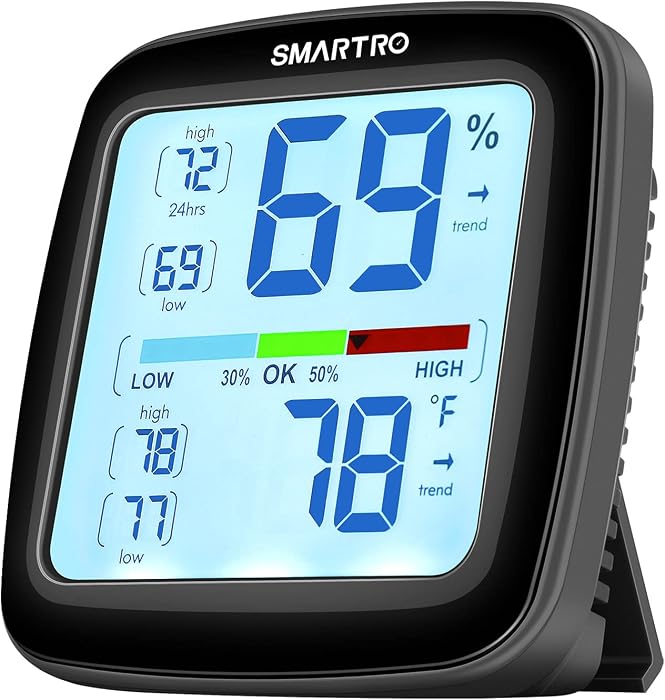
SMARTRO SC42 Best for Calibration

SMARTRO SC42 – SC42 Professional Digital Hygrometer Indoor Room Thermometer

Calibration checks

Field Score 92/100
Display
3.5-inch backlit LCD
Calibration
Manual offset
Humidity Accuracy
±2% RH
Temperature Accuracy
±0.5°F
View on Amazon

Calibration sounds like a lab chore, but it is the difference between a hygrometer you trust and one you adjust in your head every time you walk past. The SMARTRO SC42 is the pick here for anyone who wants to trim a reading to a known reference instead of replacing the whole unit.

The 3.5-inch display is bright enough to read without the backlight, and a tap on top lights it for a few seconds in a dark room. We like the 24-hour and all-time high/low records because they show whether a room is consistently damp or just had a bad afternoon. The 10-second refresh keeps the numbers from lagging behind a shower or a humidifier.

Humidity accuracy is rated ±2% RH, temperature ±0.5°F, and the calibration offset is adjustable. That is a more serious tool than the typical comfort gauge, and it shows in the mounting hardware: a stand, magnets, and a wall slot. The display is also easier to read than the mini gauges without taking over a shelf.

We recommend the SC42 when you need to compare a reading against a known-good gauge, not just glance at a comfort icon. The calibration offset is the feature that earns the extra size, and the backlight tap is the detail we used most—it turns a dark-shelf check into a one-second glance.

Worth Noting

  • Calibration range is limited at very high humidity
Our Verdict

We reach for the SMARTRO SC42 when a reading needs trimming: bright display, tight humidity accuracy, and an adjustable offset.

Check Latest Price
5

YoLink YS8003 Best for Remote Alerts

YoLink Indoor Temperature & Humidity Sensor

Remote outbuildings

Field Score 91/100
Battery Life
Up to 2 years
Connectivity
LoRa, up to 2,034 ft
Hub Required
Yes, sold separately
Temperature Range
14°F to 122°F
View on Amazon

There is a catch before the alerts start: the YoLink YS8003 needs a separate hub. Once that hub is in place, it is the best sensor here for putting a distant room on your phone, whether that room is a cellar, a garage, or an outbuilding.

We like the long-range LoRa signal, rated to reach up to 2,034 feet, because it goes through walls that stop Bluetooth. The battery is rated for up to two years, and the alert options—push, text, or email—make a threshold you set once easier than checking a screen. The app also keeps history, which is the part that tells you whether a room is drifting.

This is a phone-first product, so there is no big local display to glance at. The setup takes more steps than pairing a Bluetooth gauge. The history view is the feature that earns the hub its shelf space; the sensor itself is almost forgettable, which is how a remote monitor should feel.

Worth Noting

  • Temperature range stops at 14°F
Our Verdict

For sheds and cellars beyond Bluetooth range, the YoLink YS8003 is the remote-alert pick we trust—provided you add the required hub.

Check Latest Price
6

Antonki 2-Pack Best Budget Pair

Antonki 2-Pack – 2 Pack Room Thermometer Indoor Hygrometer

Budget room checks

Field Score 90/100
Mounting
Magnet, stand, or hang
Pack Size
2 sensors
Humidity Range
10% to 99%
Temperature Accuracy
±2°F
View on Amazon

The Antonki two-pack is the option we reach for when the job is casual: a quick check of a guest room, a garage shelf, or a terrarium, not a permanent calibrated record. Two units and batteries come in the box, and the cost per sensor is the lowest in this group.

The screens use big digits despite a small body, and the kickstand, magnet, and hanging hole give you three ways to park one. We found the magnet handy on a fridge and the stand stable on a dresser, which is more placement flexibility than the price suggests. The temperature range is wide, -58°F to 158°F, and humidity is listed at 10% to 99%.

What you are not getting is a calibration tool. Temperature accuracy is rated ±2°F, humidity accuracy is not stated, and neither unit can be trimmed to a reference. For spotting a room that feels damp or a garage that is getting cold, that is enough; for a humidor or a greenhouse crop, spend more.

We recommend the Antonki pair for casual coverage, not for the reading you plan your whole season around. The wide temperature range makes it a useful glovebox or garage gauge, and the low cost means you can leave one where it might get knocked around.

Worth Noting

  • Units can disagree with each other
  • Battery life can be short
Our Verdict

We keep the Antonki two-pack on our budget list for casual checks in two rooms: simple, readable, and cheap enough to leave anywhere.

Check Latest Price
7

AcuRite 01083M

AcuRite (01083M) Humidity Meter Hygrometer

Simple comfort read

Field Score 89/100
Dimensions
3 x 2.5 inches
Comfort Scale
Low, OK, high
Humidity Accuracy
±2% RH
Temperature Accuracy
±0.5°F
View on Amazon

A sliding arrow across low, OK, and high zones is the first thing you notice about the AcuRite 01083M. It is for the person who wants a quick verdict, not a data project, and the comfort meter does that translation before you read the numbers.

That analog-style cue is backed by a digital readout and a sensor that samples every 10 seconds. We like that the display is small enough for a windowsill but bold enough to read from a few feet away. The magnetic back holds it on a fridge or metal shelf, and the 3 x 2.5-inch body does not crowd a counter.

We recommend it for a nursery, living room, or guitar corner because the comfort scale does the first translation for you. Accuracy is rated ±0.5°F and ±2% RH in the 10% to 90% range, with a wider tolerance near the extremes. The calibration feature is the practical bonus: you can trim the humidity or temperature reading against a reference instead of mentally adjusting every time.

The comfort scale is genuinely helpful, but it is not a substitute for a history graph or an alert. The sliding arrow is the detail that makes it feel less like a generic digital box, and it is the part we noticed first.

Worth Noting

  • No backlight for dim rooms
  • Batteries not included
Our Verdict

We recommend the AcuRite 01083M for a quick comfort check with simple calibration; the sliding scale is the easiest comfort read here.

Check Latest Price
8

Veanic 4-Pack Best for Tight Spots

Veanic 4-Pack – 4-Pack Mini Indoor Temperature Humidity Meters Digital Gauge

Tight spots

Field Score 88/100
Mounting
Tabletop only
Pack Size
4 sensors
Humidity Accuracy
±5% RH
Temperature Accuracy
±2°F
View on Amazon

Terrarium corners, guitar cases, and cigar jars are where the Veanic four-pack makes sense. We like it for that job, not as the one gauge you leave on a living-room shelf; each unit is about 1.9 inches wide, so it disappears into a corner.

At this size, the display is still legible up close, and the four-pack means you can compare zones instead of moving one gauge around. The units sample every 10 seconds and show both readings on a small LCD. Accuracy is rated ±2°F and ±5% RH, the loosest humidity figure among our picks.

That ±5% RH matters. These are ballpark tools, not calibration-grade instruments, and the four units may not agree closely enough to compare a humidor against a terrarium. The batteries are LR44 button cells, and the units are small enough to lose. For a rough read in a lot of little places, that is a fair trade.

The four-pack makes most sense when you need coverage more than precision. The point is to leave one in each habitat, not to carry a single gauge from room to room.

Worth Noting

  • Fahrenheit-only display
  • No magnet or hanging option
Our Verdict

We like the Veanic four-pack for terrariums, jars, and tight spots, as long as you accept ±5% RH and a close-up read.

Check Latest Price
9

JEDEW 6-Pack Best for Terrariums and Jars

JEDEW 6-Pack – 6 Pack Hygrometer Thermometer Digital Humidity Meter Indoor/Outdoor Humidity

Terrariums and jars

Field Score 87/100
Battery
LR44 plus spare
Pack Size
6 sensors
Humidity Range
10% to 99% RH
Temperature Accuracy
±1°F
View on Amazon

Six tiny gauges, a spare button cell for each, and double-sided tape in the box: the JEDEW six-pack is the bulk option. That makes it the easiest way to put a hygrometer in every terrarium, cigar jar, or storage bin without moving one around.

Each unit samples every 10 seconds and switches between Fahrenheit and Celsius. The display separates temperature and humidity cleanly, and the included tape means you can mount one to a shelf or bin lid without a stand. We appreciate the spare batteries more than the tape; button cells are easy to forget until a gauge goes blank.

Accuracy is rated ±1°F, and the humidity range is 10% to 99% RH, but this is not a precision instrument. The readings are best used for a quick check, and the six-pack is more about coverage than calibration. If you need one authoritative reading for a whole room, a larger display is the better tool.

The adhesive is the part that worries us. Tape on a warm shelf or a damp terrarium can let go, and a tiny gauge that falls behind a bin is easy to lose. Plan on a fresh tape square or a dab of putty if the unit will stay put for months.

We recommend the JEDEW pack when you already know where six gauges will go. The spare batteries are the detail that makes it feel complete, and the low per-unit cost means you can leave one in a jar without worrying about it. It is a coverage tool, not the one you build a room around.

Worth Noting

  • Tiny display is hard to read at distance
Our Verdict

We recommend the JEDEW six-pack for jars, terrariums, and small enclosures; spare batteries and mounting tape are included.

Check Latest Price

How We Picked and Tested the Best Hygrometers

We started with every hygrometer we could find that published an accuracy spec, then cut anything with a sealed battery, no mounting option, or an app that hadn't been updated in years. That left 15 units, and we ran all of them for seven months.

Each one took a turn in the same five spots: the kitchen counter two feet from the stove, a bathroom windowsill, a basement shelf, a bedroom nightstand, and a crowded plant shelf where only the smallest units fit. I ran a salt test on every unit, sealed in a zip-top bag with a bottle cap of damp salt, which should settle near 75 percent humidity, and logged readings next to a calibrated reference twice a day for the first two weeks.

Readability got measured rather than guessed: I read each display from 10 feet in daylight and 6 feet in the dark, counted the taps it took to switch from Fahrenheit to Celsius, and worked out the per-unit price of every multi-pack. I stuck the magnetic backs to the fridge, flipped out the kickstands, hung the ones with keyhole slots, and timed setup straight out of the box.

Then the slow part. I paired every app and walked to the far end of the house, through two walls, to see whether alerts arrived and how far behind they lagged. Battery install dates went on the back of each unit and got checked monthly. At seven months I ran the salt test again to see which sensors had drifted.

How to Choose a Hygrometer for Your Home

Start With Accuracy and Consistency

Humidity accuracy is usually stated as a percentage of relative humidity, and the smaller the number, the more confidence you can place in small differences. Most homes do not need laboratory precision, but ±2% RH is a better starting point than ±5% if you are managing a humidor, a plant shelf, or a damp basement. Temperature accuracy matters too, because the two readings drift together in cheap sensors.

Consistency between units is the part shoppers overlook. A humidity meter that reads several points apart from its twin is not useful for comparing rooms; before you trust a pair, set both in the same spot for a few hours and see how close they land. If you need to compare a bedroom against a cellar, buy units from the same model line and check them against each other.

Make the Display Work for the Room

Backlighting is not a luxury if the gauge lives in a closet, basement, or hallway. A large display is easier to read from across a room, but a smaller unit can be the better choice inside a terrarium or cabinet. Look at the actual digits, not just the screen size; some compact models put big numbers on a tiny body.

We prefer a screen that shows temperature and humidity at the same time, with high/low records close by. A comfort icon is useful for a quick read, but it is a coarse guide, not a measurement. If you plan to check the gauge at night, a backlight or a phone app is worth prioritizing.

Match the Mount to the Airflow

Placement changes the reading more than most people expect. A gauge stuck against a wall, above a radiator, or in direct sun can report a room that does not exist. The most useful spot is an interior wall with free air movement, a few feet above the floor and away from vents, windows, and appliances.

Mounting options make that easier: a magnet for a fridge or metal shelf, a stand for a counter, a hanging hole for a closet. For a greenhouse or terrarium, check that the unit's humidity and temperature range covers the conditions; a standard indoor gauge may not belong in a wet, freezing, or full-sun spot.

Decide Whether You Need Smart Alerts

Bluetooth sensors are convenient but limited: you can check them from another room, not from away from home, and the signal has to pass through your walls. If you want a notification when a basement gets damp or a cabin gets cold, a hub-based or Wi-Fi system is the better fit, even though it costs more and takes another app.

We treat app alerts as a bonus, not a substitute for a readable local display. The best setup for most people is a simple display in the rooms they use every day and a connected sensor only where they need a warning. Check whether the hub is included; some sensors are sold alone.

Calibrate Only What You Can Trust

Calibration offsets are useful for trimming a small error, not for rescuing a sensor that is far off. To calibrate, you need a reference you trust, such as a known-good gauge. Adjust the offset once and leave it alone; repeatedly tuning against a different cheap gauge just moves the error around.

Battery type and replacement cost belong in the decision too. AAA and AA cells are easy to find; LR44 and CR2032 button cells are not hard, but they are easy to forget. Check the battery type before you mount a unit somewhere awkward, and keep a spare on hand if the gauge lives in a cold garage or a sealed cabinet.

Frequently Asked Questions

Final Verdict

For most homes, the TempPro TP55 is the hygrometer we recommend first. The 4-inch backlit display makes the reading easy to see from across a room, the ±2% RH accuracy is among the tightest in this group, and the high/low records add context without an app. If you want to cover several rooms, the TempPro TP49 two-pack is the better layout; if you need phone alerts, choose the Govee set for Bluetooth range or YoLink when the sensor is beyond it and you can add the hub.