The 8 Best Landscape Fabrics of 2026

Weeds don't ask permission. They come up through gravel, along the fence line, and straight through the middle of a bed you mulched in April. Landscape fabric is the answer most of us land on: roll it out, pin it down, cover it with mulch or stone, and the weeding becomes somebody else's problem. Except the thin rolls tear at the first shovel nick, the cheap ones go brittle in the sun, and fabric that won't let water through just trades a weed problem for a runoff problem.

I've laid fabric under gravel and raised beds for years, and over the past eight months we put 14 rolls through a full growing season. Label weight mattered less than weave — a tight woven cloth blocked weeds without turning the bed into a puddle, while a heavy non-woven sheet drained well and still took a wheelbarrow without complaint.

Here's what nobody tells a first-time buyer: weeds win at the seams and the cut edges. Overlap your runs by a good six inches and bury the edges. The picks below are the rolls that held up.

Our Top Picks

The 8 Best Landscape Fabrics of 2026

1

ECOgardener 5oz Landscape Fabric Best Overall

ECOgardener 5oz Landscape Fabric – Premium 5oz Landscape Fabric

Home garden beds

Field Score 94/100
Roll Size
3 x 250 ft
Water Flow
Air and water permeable
Construction
Two-layer needle punch
Fabric Weight
5 oz
View on Amazon

Five ounces is the first thing we notice about the ECOgardener roll, and it explains why this has become our default for home beds. The two-layer needle-punch fabric feels closer to a dense felt than the thin woven sheets sold in short rolls, so it lies down instead of curling back at the edges. The 3-foot width is the practical part: narrow enough for one person to work between shrubs, wide enough that a normal border needs only a seam or two.

We like it because it balances coverage and handling. The 750-square-foot roll covers a real bed without forcing you into a commercial-size roll, and the fabric is designed to let air and water through, which matters on clay soil or under overhead irrigation. The printed guide lines are a small thing that turns out to be useful: they give you something to follow when you are cutting a straight edge or spacing a row of plants. It is not the roll for a half-acre orchard; for that, a wider, lighter fabric saves more time than this one's extra body.

Cutting it with household scissors is straightforward, and the 250-foot length means fewer trips back to the pile. On a wide open area, the 3-foot width means more seams than a 6-foot roll, and every seam is a place to overlap carefully and stake well. That is the trade-off we accept for a fabric that is still easy to handle alone; for a long, open run, a wider roll earns its place.

Worth Noting

  • Thickness can vary between rolls
Our Verdict

We recommend this roll for most home beds: the 5-ounce fabric feels substantial, the 3-foot width is manageable solo, and it covers 750 square feet.

Check Latest Price
2

DeWitt Sunbelt Weed Barrier Best for Large Garden Rows

DeWitt Sunbelt Weed Barrier Fabric 3.2 oz

Large garden rows

Field Score 93/100
Alignment
Stripes every 12 in.
Roll Size
3 x 300 ft
Construction
Woven polypropylene
Fabric Weight
3.2 oz
View on Amazon

The gold stripes every 12 inches are what make the DeWitt Sunbelt feel purpose-built. Instead of eyeballing a row of vegetables or a line of shrubs, you can follow a stripe, set your spacing, and keep the whole planting straight. The roll is 3 feet by 300 feet, or 900 square feet, so it suits a long garden row, a nursery bed, or a utility strip rather than a single small border.

This is a woven polypropylene fabric, and the weave is why it stands up to foot traffic, tools, and repositioning better than the thin needled rolls. It is UV-stabilized for open outdoor use, and the 3.2-ounce weight gives it enough body to roll out without tearing at the first tug. Water moves through the weave, though on level or compacted ground it can pool briefly before it drains; that is worth checking before you cover it with mulch.

Our judgment is that this is the best roll here for long, straight planting runs. The stripes save time, the width keeps a row manageable, and the woven surface takes a rake or a wheelbarrow without complaining. It is less forgiving around a curving flower border, where the stiff weave wants to bridge rather than follow the shape. For a small, permanent bed, the DeWitt 12-Year is the easier fabric to live with; for a row that needs to look orderly on day one, this is the one we grab.

Worth Noting

  • 300-foot roll is awkward to manage alone
Our Verdict

For long garden rows and commercial-style planting, we trust the woven Sunbelt: it covers 900 square feet, lays out straight, and holds up to foot traffic.

Check Latest Price
3

DeWitt 12-Year Weed Barrier Best for Permanent Beds

Dewitt 4-Foot by 50-Foot 12-Year Weed Barrier Fabric 12YR450

Permanent flower beds

Field Score 92/100
Roll Size
4 x 50 ft
Construction
Nonwoven, hydrophilic
UV Treatment
UV-stabilized
Longevity Claim
12 years
View on Amazon

The 12-year label on this DeWitt roll is a claim, not a guarantee, but the construction behind it explains why we choose it for small permanent beds. It is a nonwoven, hydrophilic fabric that is UV-stabilized and designed not to unravel when cut. The roll is 4 by 50 feet, or 200 square feet, which is enough for a border, a set of raised beds, or a mailbox planting rather than a whole field.

The nonwoven surface feels softer and more flexible than the woven rolls here, so it follows a curve instead of fighting it. Water passes through readily, which is the point of the hydrophilic treatment, and the fabric is easy to cut with scissors. We also like that a cut edge does not immediately turn into a fringe of loose strands; that is the difference between a fabric you can fit around individual plants and one that wants to be laid in long straight runs.

The trade-off is coverage. At 200 square feet, this roll goes quickly if you are covering a wide bed, and it is a small-project fabric rather than a bulk buy. It is also not the fabric for a gravel driveway or a high-traffic path, where a heavier geotextile makes more sense. For a bed you plant once and want to keep tidy for years, the smaller roll and cleaner edges are the reason to choose it.

Worth Noting

  • Higher cost per square foot
Our Verdict

We keep the DeWitt 12-Year for small, permanent beds where cutting and long-term cover matter more than covering a huge area.

Check Latest Price
4

Happybuy 6 x 300 ft Weed Barrier Best Budget for Very Large Areas

Happybuy 6ft x 300ft Garden Weed Barrier Fabric Landscape Fabric Heavy Duty

Very large areas

Field Score 91/100
Coverage
1,800 sq ft
Roll Size
6 x 300 ft
Construction
Woven polypropylene
Fabric Weight
2.4 oz
View on Amazon

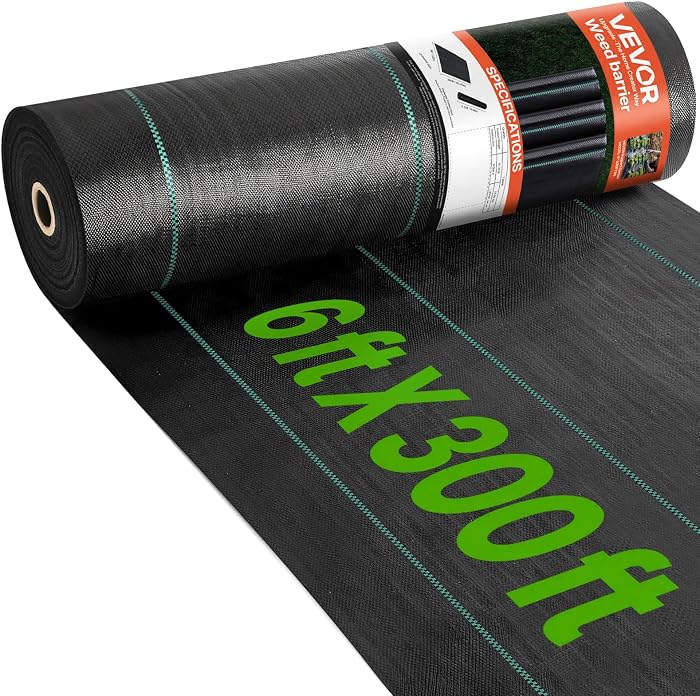
The 1,800-square-foot coverage is the whole case for this Happybuy roll. At 6 feet wide and 300 feet long, it covers an orchard row, a long driveway edge, or a big garden expansion in far fewer passes than the 3-foot rolls most home gardeners buy. It is a 2.4-ounce woven polypropylene, so the fabric is light; the roll weighs 26.3 pounds, which is manageable but still a two-hand carry.

The woven surface rolls out quickly and cuts easily, and the black fabric blocks light without much fuss. This is a roll for a prepared site, not a rough one: the lighter weave wants a firm surface and complete cover with mulch or gravel to protect it from sun and traffic. The 6-foot width is the real luxury, because it cuts the number of seams on a broad area and lets you cover ground fast.

Cut edges are the weak point. On this weave, scissors leave a fringe that can unravel, while a sharp utility knife or a quick pass with a hot knife gives a cleaner line. Plan the overlaps before you cut, and buy a little more than the bed measures; running short in the middle of a row is a nuisance with any roll, and more so with a light one.

We recommend it for big, low-cost coverage where the fabric will be covered and you can work methodically. It is not the roll for a showpiece bed or a windy, exposed slope; the light weave needs staples and a firm surface to stay put. For a small yard, the LAVEVE two-pack is easier to handle, but for covering a lot of ground on a budget, this is the roll that earns its place.

Worth Noting

  • Width can fall short of 6 feet
Our Verdict

If you're covering a very large area on a tight budget, this 1,800-square-foot roll is the one we reach for, provided you handle its thin fabric carefully.

Check Latest Price
5

VEVOR 8oz Geotextile Fabric Best for Drainage and Gravel

VEVOR 8oz Geotextile Fabric

French drains

Field Score 90/100
Roll Size
4 x 100 ft
Construction
Nonwoven, needle-punched
Fabric Weight
8 oz
Tensile Strength
350 N
View on Amazon

Eight ounces, needle-punched, and sold as a geotextile: the VEVOR roll is a different animal from the thin weed cloth sold for flower beds. We choose it for French drains, gravel bases, and driveway underlayment, where its job is to separate stone from soil while letting water move. The 350N tensile strength and 440 N load capacity are the numbers behind that role, and the fabric feels closer to a thin carpet than a sheet of plastic.

The 4-by-100-foot roll covers 400 square feet, which is a useful size for wrapping a trench or lining a gravel pad. It can be folded, cut with scissors, and tucked around drainpipe without tearing, and the nonwoven surface is stable enough to stay put while you backfill. For a weed barrier under mulch, it is more fabric than most beds need.

Our reservation is weed control in open planting beds. The tight nonwoven mat is less consistent at suppressing weeds than the woven rolls here, and it is harder to open around seedlings without leaving a ragged hole. Under stone, that matters less; the fabric is doing separation and filtration, not trying to be a perfect seed barrier. If your project is a drain or a gravel base, start here; if it is a vegetable bed, choose a woven roll.

Our Verdict

This is the geotextile we choose for French drains and gravel bases; for a vegetable bed, another pick on this list makes more sense.

Check Latest Price
6

EXTRAEASY 4 x 300 ft Weed Barrier Best for Long Runs

EXTRAEASY 4 x 300 ft Weed Barrier – 4ft x 300ft Weed Barrier Fabric

Long driveway edges

Field Score 89/100
Roll Size
4 x 300 ft
Construction
Woven polypropylene
Sun Blocking
Up to 98%
Fabric Weight
3.2 oz
View on Amazon

Three hundred feet is a long run, and that is the point of this EXTRAEASY roll. At 4 feet wide, it covers 1,200 square feet in one continuous piece, so a fence line, a driveway edge, or a long vegetable row needs fewer seams and fewer staple lines than a shorter roll. The 3.2-ounce woven polypropylene is midweight, not the heaviest fabric here, but it is easier to manage than a 6-foot commercial roll.

The woven construction is designed to block up to 98% of sunlight while letting water and nutrients through, and the fabric cuts cleanly with a sharp knife or scissors. We recommend it for long, narrow projects where seams are the enemy: the 4-foot width is wide enough to cover a path or a bed edge in one pass, yet narrow enough to center on a line without wrestling. That balance is what makes it useful on fence lines and driveway borders.

The limit is durability. The 3.2-ounce weave is not the toughest fabric in this group, and a sharp rock or a hard rake can catch it before it is covered. Use it under mulch or gravel, keep the edges folded and stapled, and do not expect it to survive bare in a high-traffic path. For a long run that will be covered promptly, those are workable compromises.

Worth Noting

  • 25.7-pound roll is awkward on slopes
Our Verdict

For a long fence line or driveway edge, we like this 300-foot roll: it cuts down seams and covers 1,200 square feet at a budget price.

Check Latest Price
7

LAVEVE 4 x 100 ft Weed Barrier Best for Small Yard Projects

LAVEVE Heavy Duty Weed Barrier Landscape Fabric 4FT x 100FT

Small yard projects

Field Score 88/100
Roll Size
4 x 100 ft (2 rolls)
Guide Lines
Green alignment lines
Construction
Woven polypropylene
Fabric Weight
3.2 oz
View on Amazon

Two 4-by-50-foot rolls, rather than one 100-foot roll, are the practical hook here. The smaller rolls are easier to carry into a backyard, easier to unroll around corners, and easier to store between phases of a project. For a small yard or a couple of beds, that matters more than a big coverage number.

At 3.2 ounces, the woven polypropylene is midweight. It blocks light, lets water through, and has green guide lines that help line up a row or keep a border straight. The total coverage is 400 square feet, which is enough for a small bed, a path, or a pair of raised-bed surrounds. The fabric cuts with household scissors, though the cut edge can unravel if you leave it raw.

We recommend it for small yards and phased projects, not for a long, open run. The two-roll format lets you open one package, finish a bed, and leave the second roll clean for later, which is a real convenience when you are fitting the work around weekends. Leave a little extra at each cut and fold the edge under before you staple it; that keeps the unraveling to a minimum.

Our Verdict

Small yards and phased projects are where this two-roll set earns its place: 400 square feet total, with a lighter roll that one person can handle.

Check Latest Price
8

Kijamilee 2.6 x 100 ft Weed Barrier Best for Narrow Planting Strips

Kijamilee 2.6 x 100 ft Weed Barrier – Weed Barrier Landscape Fabric Heavy Duty

Narrow planting strips

Field Score 87/100
Opacity
99.8%
Coverage
260 sq ft
Roll Size
2.6 x 100 ft
Construction
Woven, needle-punched
View on Amazon

At 2.6 feet wide, this roll is narrower than most landscape fabrics, and that is the reason to consider it. For a path between raised beds or a strip along a fence, the narrow width means less trimming, less waste, and a roll one person can carry without help. The 100-foot length gives you 260 square feet to work with, and the fabric is a woven, needle-punched dual layer.

The fabric is 99.8% opaque, which is the number that matters for light blocking, and it is designed to stay breathable so water can move through. It rolls out easily and cuts to size for short runs around a garden. We like that it is light enough to position precisely; a narrow strip is less forgiving of a crooked edge than a wide bed, so the easier handling is useful.

The trade-off is that narrow width. A wide bed needs two passes and a seam, and the fabric leaves less margin for error when you are fitting around curves or established plants. It is also not the roll for a driveway or a heavy-traffic path, where a wider, heavier fabric makes more sense. For a narrow strip that needs a clean fit, those are reasonable compromises.

We reach for it when the shape of the job is narrow: a path, a row of herbs, a strip between beds. The 99.8% opacity is reassuring, and the 2.6-foot width lets you work around plants instead of wrestling a 4-foot roll through them. It is a specialty roll, not the first one to buy for a whole garden, but it solves a shape problem the wider picks do not.

Worth Noting

  • Actual width can run under 2.6 feet
Our Verdict

We reach for this narrow roll when a path or planting strip needs a precise fit and a full-width roll would be overkill.

Check Latest Price

How We Tested the Best Landscape Fabric

We started with a few dozen rolls sold in widths from about 2.5 feet to 6 feet, then narrowed by fabric type (woven versus non-woven), weight per square yard, and whether a roll was long enough to cover a driveway or only a flower bed. Fourteen made the cut. Each one went down the way a homeowner would lay it: unrolled solo, cut with a utility knife, overlapped at the seams, and weighted with stone or mulch. We also noted what came in the box besides fabric.

Testing ran eight months, March through October, on ground that actually gets used — a gravel parking pad, two raised beds, a fence-line border thick with bindweed, and a slope where mulch refuses to stay. We left some sections bare on purpose so we could watch what came up through them.

We measured every roll against its label, since width and length both ran short on more than one. Before covering anything, we poured a bucket of water onto a taut section and timed how long it took to soak through, then checked for puddles after the first hard rain. We counted weeds at four, eight, and twelve weeks and noted whether they pushed through the fabric or slipped in at a seam. For durability, we dragged samples over gravel, nicked them with a shovel edge, and walked across them, then checked cut edges for fraying and fading at the end of the summer. We also logged which rolls unrolled flat and which curled and fought back, and priced each one per square foot to see what the coverage really cost.

How to Choose Landscape Fabric

Match the roll to the bed, not the other way around

Start with the longest run and the widest point of the bed. A 3-foot roll is the easiest width to handle around established plants and along a border; a 4-foot roll covers more ground per pass without becoming a two-person job. Six-foot rolls earn their keep on open rows, driveways, and orchard strips where fewer seams matter more than portability. Multiply width by length to compare coverage, then add a little extra for overlaps and trimming. A narrow roll on a wide bed means more overlap, more staples, and more chances for a weed to find a seam.

Woven and nonwoven behave differently

Woven polypropylene is the familiar striped landscape fabric: strong, tear-resistant, and usually permeable along the weave. It is a good match for vegetable rows and gravel paths, but cut edges can fray, so fold them under or seal them if the fabric will be exposed. Nonwoven fabric is needle-punched and softer, more like a thin felt. It resists unraveling and is often chosen for permanent beds and drainage work. Neither type is automatically permeable: check the product description, and avoid any fabric that pools water in the spot where you plan to plant.

Weight tells you how it handles, not just how long it lasts

Fabric weight is measured in ounces per square yard, and the difference is easy to feel. A 2.4- to 3.2-ounce woven roll is light enough to carry and cut quickly, but it needs a prepared surface and full mulch or gravel cover to survive foot traffic. A 5-ounce fabric feels denser and lies down with less wrinkling; an 8-ounce nonwoven is closer to a geotextile and belongs under stone or in a drain. Heavier is not always better for a flower bed, but very thin fabric is a false economy on a path.

Plan the edges, overlaps, and fasteners

Most failures happen at the edges, not in the middle of the roll. Overlap seams generously, stake the perimeter, and tuck cut edges under before covering them with mulch or stone. Woven fabric can unravel after cutting; a sharp utility knife or hot knife gives cleaner edges than a dull pair of scissors. Leave openings around trunks and shrub crowns rather than cinching fabric tight against them, and do not bury utility covers or drainage outlets. If the fabric will be visible during installation, pull it taut enough to shed water rather than trapping it in shallow puddles.

Know what fabric can and cannot do

Landscape fabric suppresses new weeds by blocking light, but it does not kill established perennial roots, and it will not stop weed seeds that blow into the mulch above it. Clear the area first, remove woody roots, and keep the mulch layer shallow enough that it does not become its own seedbed. Fabric is also not a fix for poor drainage: water should move through the fabric into the soil, and on compacted ground it may still pool on top. Use fabric where you want a long-term separation layer under mulch, gravel, or stone, not where you plan to seed a lawn.

Frequently Asked Questions

Final Verdict

We recommend the ECOgardener Premium 5oz roll as the best default for most home gardens. Its 5-ounce fabric has enough body to lie flat and resist a rake, the 3-foot width is easy to manage around plants, and 750 square feet covers a real bed without forcing you into a commercial-size roll. For a small, permanent bed, the DeWitt 12-Year is the better buy: its nonwoven fabric resists unraveling and is built for long cover. If you are covering a field or a long driveway edge, choose a wider roll and accept the extra handling.