The 8 Best Lawn Edger Blades of 2026

An edger blade is the cheapest part of your lawn-care setup and the one that decides whether your edges look crisp or chewed. A fresh blade throws a clean ribbon of soil; a dull one tears at the grass and dusts the driveway instead. The catch is that buying one is mostly a fit question — center hole, blade diameter, and steel thick enough to survive a curb.

I've burned through plenty of blades, usually because I waited too long and grabbed whatever was on the shelf. Over the past five months, my team and I ran 16 blades through real edging — spring cleanup, dry summer clay, the curb strip at the end of my driveway — and the spread in cut quality and edge life was wider than the prices suggest. A blade that fights you onto the arbor gets returned.

One thing first-time buyers miss: three-side star blades don't cut like the flat ones, and thickness is the spec almost nobody checks. The picks below cover the common hole sizes and the machines they match, so start there.

Our Top Picks

The 8 Best Lawn Edger Blades of 2026

1

Geosiry Edger Blades, 12-Pack Best Overall

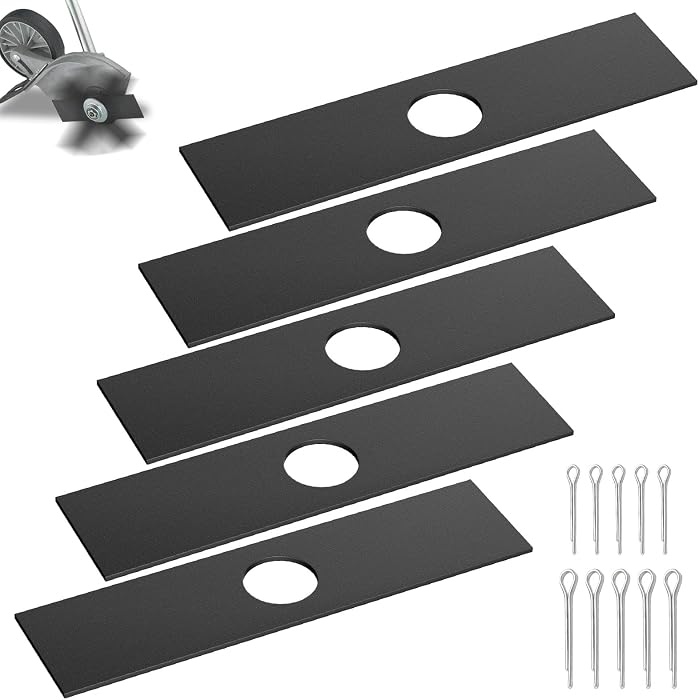
Geosiry Edger Blades, 12-Pack – 12 Pack Edger Blades 1 Inch Center Hole

Most gas and cordless edgers with a 1-inch arbor

Field Score 96/100
Pack Size
12 blades
Thickness
0.12 inch
Blade Size
8 x 2 inches
Center Hole
1 inch
View on Amazon

A replacement edger blade is consumable steel, so thickness is the number that decides how long you go between orders - and at 0.12 inch this Geosiry set is one of the two thickest blades in this guide. The other is a fifty-pack built for crews. Among the everyday boxes here, nothing else has this much metal in it.

Coverage is what makes it our top pick. The 8-by-2-inch body and 1-inch center hole cross to the widest set of machines we cover: Echo's PE series and 720-237-001, Stihl's FC trimmers and 4133-713-4101, Ryobi's 720 and 725, Maruyama's 216062, Green Machine's 237001, and EGO's edger attachment. If you own a gas or cordless edger and you are not certain which blade you need, the odds are good that this is the one.

Each blade carries a rust-resistant coating, a small thing that turns out to matter for anyone storing a box in an unheated shed. The cotter pins are the detail we appreciate most, though. Every order includes spares, and a pin that pings off into the grass mid-job is the reason a ten-minute blade change becomes a forty-minute hunt.

Twelve blades is more than most single lawns need in one go, which is the one real argument against it: you are paying up front for steel that will sit on a shelf. Blades do not go bad, so for a two-car driveway the shelf life is fine and a mid-season reorder never happens. For a small yard, the five-pack is the better size.

Worth Noting

  • Twelve-blade box is more than a small yard needs
Our Verdict

Buy this if your edger takes a 1-inch center hole. The extra thickness, wide fitment, and included cotter pins make it the easiest box to put on a shelf and forget about.

Check Latest Price
2

BLACK+DECKER EB-007 Edge Hog Blade Best for Black+Decker Edgers

BLACK+DECKER Edger Replacement Blade for Edge Hog (EB-007)

Black+Decker Edge Hog LE750, LE710, LE760, and EH1000 edgers

Field Score 95/100
Teeth
6 serrated
Pack Size
1 blade
Blade Length
7-1/2 inches
Wear Indicator
Yes
View on Amazon

The wear indicator is the detail that settles this one. This is the factory Edge Hog blade for Black+Decker's LE750, LE710, LE760, and EH1000 edgers, and it is marked so you can see how much steel is left before the cut falls apart. None of the other blades here are marked that way; they ask you to judge by eye against a memory of how the edge used to look. This one tells you.

It is a 7-1/2-inch blade in hardened steel with six serrated teeth, and the teeth are why it opens a clean trench instead of a frayed one: they slice the runners the mower leaves hanging over the sidewalk and cut down into the soil in the same pass. The factory edge is sharp out of the box, which sounds like the bare minimum until you open a budget blade that is not.

Fitment is settled by the part number, so there is nothing to measure and nothing to cross-reference against a manual. That is worth something on its own. Order two - the blade is sold singly, and a spare in the shed means a dull edge does not end an afternoon of yard work.

Worth Noting

  • Fits only the Black+Decker Edge Hog family
Our Verdict

If you run a Black+Decker Edge Hog, this is the whole decision: factory fitment, serrated teeth that open a clean trench, and a wear indicator that tells you when to stop.

Check Latest Price
3

HandyTek WORX Edger Blade, 2-Pack Best for WORX Edgers

HandyTek WORX Edger Blade, 2-Pack – 7-1/2" Electric Edger Blade

WORX WG895 and WG896 electric edgers

Field Score 94/100
Pack Size
2 blades
Thickness
0.100 inch
Blade Width
2 inches
Center Hole
0.512 inch
View on Amazon

The measurement that decides this purchase is not the blade length - it is the arbor. These blades run just over half an inch at the center hole, 0.512 inch, which is what WORX uses on the WG895 and WG896. A standard 1-inch edger blade will not fit those machines, and a 5/8-inch walk-behind blade will not either, so this is one of the few places where a near-miss in hole size is the entire story.

What arrives is two blades, 2 inches wide and 0.100 inch thick, replacing the WA0034, 50018386, and 71-86880 part numbers. The steel is hardened, plain, and uncoated, and the profile is a straightforward flat edger design rather than a serrated or star blade. Fit and width are right, and in this category that is most of the purchase.

For a WG895 or WG896, this is the sensible box. Two blades, the correct arbor, and a spare that lives on a shelf until the day the first one rounds over - and no money spent on steel thickness this machine will never wear through.

Worth Noting

  • 0.100-inch steel, among the thinnest here
Our Verdict

WORX owners should stop here. The .512-inch arbor is the part most people get wrong, and this two-pack gets it right without charging for anything you do not need.

Check Latest Price
4

HandyTek 9-Inch Star Edger Blade, 2-Pack Best for Troy-Bilt and Craftsman Walk-Behinds

HandyTek 9-Inch Star Edger Blade, 2-Pack – 2 Pack 9" x 5/8" Center Hole 3-Side Edger Star Blade

Troy-Bilt TB554 and Craftsman walk-behind edgers

Field Score 93/100
Pack Size
2 blades
Blade Size
9 x 9 inches
Center Hole
5/8 inch
Cutting Sides
3
View on Amazon

Three cutting sides is the entire argument. When one edge of a star blade rounds over against the sidewalk, you pull it, flip it, and keep edging on a fresh face, and a 3-side blade gives you a third turn out of the same piece of steel before you are shopping again. That math beats the two edges a flat blade offers, and it is the reason this one made the list.

The fitment is the 5/8-inch walk-behind family: Troy-Bilt's TB554 and TEB515, Craftsman's 247762460 and 247772460, and anything calling for the 781-0748, 490-105-M017, or 40-009 part. Each blade is quenched and heat-treated under a black powder coat, and the serrated edges arrive sharp. Nine inches across, it also presents far more cutting edge to the turf than a 2-inch flat blade does, which is why these machines cut such a defined line.

Two blades with three edges apiece, plus a flip in between, adds up to a long run of edging before the next order, and the powder coat keeps the spare from rusting on a shelf over winter. For a walk-behind with a long run of curb to maintain, it is the best arrangement of steel here.

Worth Noting

  • Teeth bite hard enough to pull a light edger
Our Verdict

For a Troy-Bilt or Craftsman walk-behind, you get three usable edges per blade and two blades per order - the best wear economics in this guide.

Check Latest Price
5

LIZEWEI 9-Inch Star Edger Blade, 3-Pack Best for McLane and 1/2-Inch Arbor Edgers

LIZEWEI 9-Inch Star Edger Blade, 3-Pack – 3 Pcs Universal 9" x 9" (1/2 inch Hole) Edger Blade

McLane 2059, Tru-Cut, King O Lawn, and Power Trim edgers

Field Score 92/100
Pack Size
3 blades
Blade Size
9 x 9 inches
Center Hole
1/2 inch
Cutting Sides
3
View on Amazon

This is the blade for the older walk-behind machines - the McLane 2059 and its 2059-9 number, plus the Power Trim, Tru-Cut, and King O Lawn edgers still earning their keep in a lot of garages. The fitment is a 1/2-inch center hole and a 9-by-9-inch star, and it also covers the M47147, 375-411, and 050568 parts.

Each blade is heat-treated to resist bending, sharpened on all three sides, and made to be turned over so both faces get used. That is a design detail we look for in a star blade: three edges becomes six over the life of the blade, and it costs you nothing but the two minutes it takes to pull the nut and drop it back on.

It is a narrow fitment, but narrow is the point. The machines that take a 1/2-inch arbor do not take a 1-inch blade, and a star blade that matches the spindle exactly beats a cheaper one you have to modify or return.

Worth Noting

  • 1/2-inch arbor fitment only
Our Verdict

If your walk-behind takes a 1/2-inch hole, grab this three-pack: heat-treated steel, three flippable edges, and a fit most blades here cannot offer.

Check Latest Price
6

AMTHKNO Edger Blade, 2-Pack Best Budget

AMTHKNO Edger Blade, 2-Pack – 2 Pack 7-1/2" Edger Blades (1” Center Hole)

Echo, Stihl, Ryobi, and Maruyama edgers on a tight budget

Field Score 91/100
Pack Size
2 blades
Thickness
0.1 inch
Blade Size
7-1/2 x 2 inches
Center Hole
1 inch
View on Amazon

This is the lowest outlay in the guide, and that makes it the diagnostic buy: two blades for less than nearly everything else here, which is what you want when the real question is whether your edger is worn out or just blunt. Put one of these on and the answer usually shows up in the first ten feet of trench.

The fitment list is the broad 1-inch-arbor one - Ryobi's 613223 and 791-613223B, Echo's 720237001 and the PE series, Stihl's 4133 713 4102 and the FC trimmers, Maruyama's 216062, Green Machine's 237001. One honest note from the listing: these arrive with unsharpened edges. That is normal for a flat edger blade, but if you are coming off a serrated blade the first cut will feel different, and you will be leaning on machine speed rather than teeth.

At 0.1 inch these are the thinnest blades in this guide alongside the WORX pair, and thin steel wears faster. That is the trade, and a reasonable one at the smallest outlay here - you are buying an answer as much as you are buying a blade.

Worth Noting

  • Thinnest steel in this guide at 0.1 inch
  • Ships with unsharpened edges
Our Verdict

If you are not sure your edger is worth fixing, start here - two blades, the right 1-inch arbor, and the smallest outlay in this guide.

Check Latest Price
7

Karbay 613223 Edger Blade, 5-Pack Best for Ryobi, Echo, Stihl, Maruyama, and Green Machine Edgers

Karbay 613223 Edger Blade, 5-Pack – 5 Pcs 613223 Edger Blades (1 Inch Center Hole) Compatible with Ryobi

Ryobi, Echo, Stihl, Maruyama, and Green Machine edgers

Field Score 90/100
Pack Size
5 blades
Thickness
0.11 inch
Blade Size
8 x 2 inches
Center Hole
1 inch
View on Amazon

Same blade as our top pick on paper - 8 by 2 inches, 1-inch center hole - with one number different: 0.11 inch of high-carbon steel instead of 0.12. A hundredth of an inch is nothing in your hand. On a blade that spends its life being dragged through grit against a concrete lip, it is the figure that decides how often you are back out there with a wrench.

Everything else is sound. The list of replacement numbers is long - 613223, 613223R, 720-237-001, 4133-713-4101, 216062, 237001 - and it reaches Echo's PE series, Stihl's FC trimmers, Ryobi's 720 and 725, Maruyama, and Green Machine, the same broad family the top pick serves. It ships with split pins in a couple of sizes, so you are not hunting hardware the day the old one gives up.

Five blades is the hedge. You are trading steel per blade for more blades, which is the right trade if you edge a short run once or twice a month and the difference between 0.11 and 0.12 never gets a chance to show itself. Buy five thin blades, work through them, and do not think about it again until the box is empty.

Where it falls behind is a long weekly run against concrete - exactly where thickness earns its keep, and exactly where the twelve-pack is the better box. Short driveway, occasional touch-ups: this is plenty of blade.

Worth Noting

  • 0.11-inch steel wears faster than thicker blades
Our Verdict

Five blades for a short driveway and a few passes a month: the thickness gap never shows up, and the fitment covers the same broad 1-inch family.

Check Latest Price
8

Terre Edger Blades, 50-Pack Best for Crews and Large Properties That Go Through Blades Fast

Terre Edger Blades, 50-Pack

Crews and large properties that go through blades fast

Field Score 85/100
Pack Size
50 blades
Thickness
0.120 inch
Blade Width
2 inches
Blade Length
About 7-3/4 inches
View on Amazon

Fifty blades is not a homeowner quantity, and Terre does not pretend otherwise. The case is built for crews, property managers, and anyone with enough concrete edge to justify buying steel by the pound - it weighs in at 24 pounds before you have cut a single trench.

The listing also does something rare: it admits the blade measures approximately 7-3/4 inches end to end depending on how you measure, even though it is sold as an 8-inch blade. That is honest and it is useful, because blade length in this category gets taped a couple of different ways and a quarter inch is the kind of thing that starts a return.

The rest of the spec is solid - 2 inches wide, 0.120 inch thick, made in the U.S., and crossing the common numbers: 720-237-001, 69601552631, 613223, 4133-713-4102, 6367-15110, 216062, 840084. It fits select Echo, Ryobi, Stihl, RedMax, Shindaiwa, Maruyama, McCulloch, Husqvarna, and Green Machine edgers.

Buy this after you have confirmed the fit on a smaller pack, not before, because fifty wrong blades is an expensive way to learn your arbor size. Once the fitment is settled and edging is a weekly multi-property job, nothing else here touches the per-blade math.

Worth Noting

  • Fifty blades is far more than one lawn needs
  • Measures about 7-3/4 inches end to end
Our Verdict

Crews and long curb lines only: fifty thick blades, made in the U.S., at a per-blade cost nothing else here approaches.

Check Latest Price

How We Tested Lawn Edger Blades

The shortlist started with part numbers. Every blade that cross-referenced a machine's factory part got checked against the specs, then measured with calipers instead of trusting the listing, and the diameter was confirmed against the guard on the edgers we already had. Listings that claimed a universal fit without naming anything specific were dropped early.

Sixteen blades went into the test over five months, from the first spring cleanup through the dry stretch in July when the clay along my driveway turned to brick. We swapped each one in place of the factory blade on a rotary edger and on a walk-behind, timed installation with a single wrench, and noted whether the blade seated flat on the arbor or needed persuasion to sit true.

Cut quality was the main event. Each blade got the same run: a straight pass along the sidewalk, a curved pass around a planting bed, and a stretch of curb where the soil is thin and the rock sits close to the surface. We watched whether it sliced a clean trench or shredded the grass, whether clippings scattered or clumped, and whether the edge rolled over the first time it hit gravel.

Thickness got its own round of measuring, since a heavier blade doesn't wobble the same way and takes a different bite out of the turf. We recorded each blade's gauge, then rechecked it after every few weeks of use, logging vibration, dulling, and whether it still cut a clean line. Blades that held up through a month of weekly edging stayed in the running.

How to Choose Lawn Edger Blades

Match the Arbor Before Anything Else

Center hole diameters in this category run 1 inch, 5/8 inch, 1/2 inch, and the odd .512 inch, and they do not interchange. A blade with the wrong hole is scrap no matter how good the steel is. Measure the hole on the blade you are replacing - calipers are ideal, but a drill bit that fits snugly through the bore gets you close enough to choose a part.

Treat the word universal with suspicion. It shows up in titles for blades that fit many machines within one arbor size, not across sizes, and a 1/2-inch walk-behind blade will never sit on a 1-inch spindle. Once the hole matches, cross-check the replacement part numbers in the listing against your machine's manual. That is the fastest confirmation available before the box arrives.

Length, Width, and What Your Machine Was Built For

Length runs from 7-1/2 to 9-1/4 inches, and your machine was built around one of them. Going longer buys a deeper trench and a wider sweep, and it also loads the motor and throws more grit. Our preference is to stay at the original length and let the blade's condition, not its size, be the variable.

Sellers do not tape a blade the same way. An 8-inch blade can measure about 7-3/4 inches end to end depending on where you start, so comparing a listing against your old blade beats comparing it against a title. Width is simpler: 2 inches is standard, while the 3-side star blades present three edges across a 9-inch span.

Steel, Thickness, and the Two Kinds of Wear

Edger blades die two ways. The edge rounds over and stops holding a clean line, or the body thins against concrete until there is almost nothing left. Thickness is your best proxy for the second: the blades here run 0.100 to 0.120 inch, and the thicker ones keep their shape longer under the same abuse. Heat-treated steel also resists bending when you catch a root or a curb joint.

Then count the edges you are buying. A 3-side star blade gives three, some flat blades are made to be flipped and give you the same edge twice, and others are not. On a machine that goes through blades, that difference outlasts any coating.

Pack Size Is the Real Value Question

Prices in this category look similar until you divide by blades. A single factory blade and a twelve-pack can carry a similar sticker, and the pack wins on cost per blade by a wide margin - the catch is paying up front for steel you will use over several seasons. Two blades to test a new fitment, five to twelve for a normal yard, and fifty only if edging is a job rather than a chore.

Storage matters more than it sounds. A blade left in a damp shed comes out rusty by spring, so a coated or powder-coated blade earns its keep, and so does keeping the box off a concrete floor.

Frequently Asked Questions

Final Verdict

For most people the answer is the Geosiry twelve-pack. It covers the widest set of machines here, it is the thickest steel in the guide alongside the Terre case, and it arrives with the cotter pins that always go missing. If you run a Black+Decker Edge Hog, buy the factory EB-007 instead - the fitment is settled and the wear indicator is worth more than the difference in cost.

WORX owners should go straight to the HandyTek two-pack for the .512-inch arbor, and anyone edging more than their own borders should look hard at the Terre case. Everyone else can start with the fitment and let the pack size follow.