The 6 Best Locking Pliers of 2026

The bolt was already half-rounded by the time I got to it — a rusted brake bracket on a Sunday afternoon with the parts store closed. What saved the job was a pair of locking pliers whose teeth actually bit. That's the promise of this tool and also its risk: a cheap pair slips, chews the head smooth, or locks down so hard you need two hands to release it.

My team and I spent four months working through 14 locking pliers — clamping, twisting, welding, wrestling rusted hardware — and the differences show up fast. Jaw shape matters more than overall size: curved jaws bite pipe and round stock, straight jaws hold flat and square stock. The adjustment screw counts just as much, since a fraction of a turn is the difference between a grip that holds and a jaw that pops off mid-job. And the name on the handle told us less than the teeth did.

The picks below earned their spot in the drawer, whether the job is a brake line, a weld, or a wobbly cabinet hinge.

Our Top Picks

The 6 Best Locking Pliers of 2026

1

IRWIN Vise-Grip 10-Inch Straight Jaw Best Overall

IRWIN VISE-GRIP Original Locking Pliers

All-around gripping

Field Score 96/100
Weight
16 oz
Jaw Style
Straight
Overall Length
10 inches
Adjusting Screw
Hex key
View on Amazon

Curved jaws get the attention, but the pair we hand someone first is this straight-jaw 10-inch IRWIN. Straight jaws sit flat against bar stock, brackets, sheet metal, and hex nuts, so the teeth bite across the whole face instead of rocking on a curve. For mixed repair around a shop, a trailer, or a fence line, that is the shape that does the most work, and it is why this pair is our default.

The feature we appreciate most is easy to overlook: the adjusting screw has a hex socket in its end. Turn it by hand to set the jaw gap, then put an Allen wrench in it when something keeps slipping and you need to crush down hard. The screw holds its setting, so a run of identical clamps does not need readjusting between parts. At 16 ounces and 10 inches overall, it is light enough to ride in a truck door pocket and long enough to lever a stubborn fastener.

What it does not do is wrap. Feed it pipe, tube, or a rounded linkage and the straight jaws make contact at two points, which is exactly where a curved jaw earns its keep — the Klein set and the 12-inch IRWIN below are the picks for that work. Flat stock, fasteners, and sheet metal it handles without drama.

Worth Noting

  • Straight jaws contact pipe at only two points
Our Verdict

Our pick for a first or only pair: straight jaws that bite flat stock and fasteners, plus an adjusting screw you can crank with a hex key.

Check Latest Price
2

IRWIN Vise-Grip 12-Inch Large Jaw Best for Large Round Work

IRWIN Vise-Grip Large Locking Pliers

Big round work

Field Score 95/100
Weight
1.49 lb
Jaw Type
Heavy-duty large jaw
Warranty
Limited lifetime
Overall Length
12 inches
View on Amazon

At 12 inches and just under a pound and a half, this is a two-hand tool. It is not going in a saddlebag, and it is more iron than you want over your head on a ladder. What the size buys is reach and a jaw opening wide enough to swallow a trailer coupler, a fence brace, or the body of a big pipe union.

Big, round work is where we point people to this pair. The jaws are wide and deep enough to bite around curved surfaces that a 10-inch straight jaw skates off, and the teeth are cut cleanly enough to hold without chewing up the part. The turn screw keeps its setting once you have dialed in the pressure, which matters when you are clamping the same diameter over and over — a run of pipe fittings, a set of gate frames.

Set it beside the 10-inch straight jaw and the difference is not quality, it is geometry: this one wraps, that one bites flat. Fasteners and sheet metal belong with the smaller pair; pipe, tubing, and heavy round stock belong here. It is also the pair that holds a weldment in place while you tack it, because the handles are bare alloy steel with no rubber sleeve to burn.

Worth Noting

  • Release latch can loosen with hard, repeated use
Our Verdict

The pair to grab when a seized trailer coupler or a fat pipe will not fit between smaller jaws — buy it for reach, not for carrying.

Check Latest Price
3

Klein Tools 38660 2-Piece Set Best Curved-Jaw Set

Klein Tools 38660 Curved Jaw Locking Pliers Set

Curved-jaw work

Field Score 94/100
Sizes
7 in and 10 in
Pieces
2
Release
Leverless quick release
Jaw Style
Curved
View on Amazon

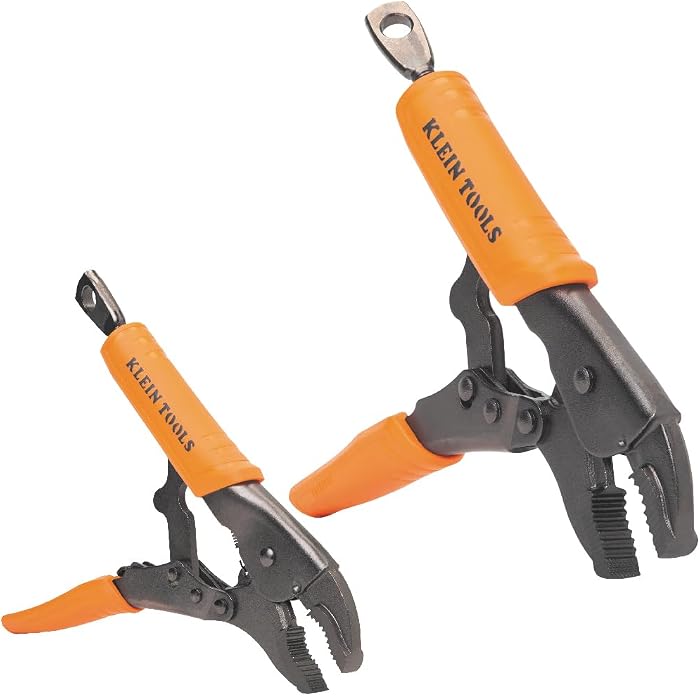
The release is the reason to pay more for the Klein set. There is no lever to flip — you squeeze the handles together and the jaws let go, so you never go hunting for a release tab under a work glove and you never pinch a finger doing it. On an afternoon of clamping and unclamping, that is the difference between a tool you keep picking up and one you leave in the drawer.

What you get is two curved jaws, 7 and 10 inch, with molded grips and a thumb knob for adjustment. Together the pair weighs 2.2 pounds, so this is a bag-and-bench set rather than a pocket one, and the grips are the most comfortable here — they hold up in a hard pull without going slick. There is also a hole through the adjusting screw, which takes a screwdriver shank when a clamp needs to be tighter than a thumb can make it.

Both jaws carry a rust-preventative coating, and the two sizes split naturally: the 7-inch goes in the tool bag, the 10-inch stays where the bench work is. Reach for the small one on hose clamps and bracket bolts, the big one on gate hardware and exhaust.

Worth Noting

  • No straight jaw in the set
Our Verdict

Our pick for curved jaws: two sizes, molded grips, and a release you can work with one gloved hand instead of a lever you have to find.

Check Latest Price
4

DURATECH 7-Inch Curved Jaw Best Budget Pick

DURATECH 7-Inch Locking Pliers

Budget second pair

Field Score 93/100
Size
7 inches
Weight
12.7 oz
Material
Chrome vanadium steel
Jaw Style
Curved with wire cutter
View on Amazon

There is nothing fancy here, and that is the appeal: a 7-inch curved jaw with a wire cutter, priced below everything else on this list, built for the small grabbing jobs that come up around a barn, a trailer, or a truck bed.

We like it best as the second or third pair — the one that hangs where the work happens so you are not walking back to the shop. The steel is heat-treated chrome vanadium, the jaws are curved for round and odd shapes, the release trigger pops one-handed, and the argyle texture molded into the handle keeps the tool from turning in a wet grip.

Seven inches is a short lever, though. A rusted bolt that a 10-inch pair walks off will beat this one, so treat it as the light grabber rather than a breaker-bar substitute. Two of these still cost less than one of the premium pairs here, which is the whole argument for scattering them around.

Worth Noting

  • Short 7-inch body limits leverage
Our Verdict

Our budget pick: a 7-inch curved jaw with a wire cutter that handles small jobs and earns a spot in the truck box or tack room.

Check Latest Price
5

WORKPRO 3-Piece Set

WORKPRO 3-Piece Locking Pliers Set

First toolbox

Field Score 92/100
Sizes
10 in, 7 in, 6-1/2 in
Pieces
3
Handles
Rubberized
Material
Chrome vanadium steel
View on Amazon

Three pairs — 10-inch and 7-inch curved jaw, plus a 6-1/2-inch straight long nose — for less than the Klein two-piece set costs. That arithmetic is the pitch, and it mostly holds up.

The steel is heat-treated chrome vanadium, the adjusting screws are knurled and turn easily, and the rubberized handles are the most comfortable thing in the box: they do not slip under a hard pull and they spare your palms on a long job. The long nose is the sleeper of the three, reaching into places the curved jaws cannot follow.

Three decent pairs beat one good pair only if you will use the shapes, and around a barn or a trailer that is usually true — a spare pair left clamped on a project while you fetch a wrench is its own kind of useful. Just do not hand this set to a welder: the rubber sleeves will not take spatter, so keep it at the bench, on the trailer, and in the toolbox.

Worth Noting

  • Clamp can give way under a hard load
Our Verdict

The set we suggest for a first toolbox or a truck: three shapes, comfortable handles, and enough tool to learn which pair you actually reach for.

Check Latest Price
6

Amazon Basics 5-Piece Set

Amazon Basics 5-Piece CR-V Locking Pliers Set with Wire Cutters

Full toolbox kit

Field Score 91/100
Sizes
5 in to 10 in
Pieces
5
Storage
Carrying case
Material
Chrome vanadium steel
View on Amazon

Five pairs and a molded case: 6.5- and 9-inch straight jaw, 5-, 7-, and 10-inch curved jaw, all with wire cutters. It is the broadest kit here, and it answers the question of which shape you need by handing you every shape at once.

The 5-inch curved pair is the smallest locking plier in this roundup, and it is the one that gets used on hose clamps, cable, and anything buried behind a panel. The 9- and 10-inch pairs do the heavy holding. Alloy steel in a plain silver finish, and a case that keeps five pairs sorted instead of rattling loose in a drawer.

For a first toolbox or a truck kit, breadth is worth more than finish. There is no brand-name polish here and no cushioned grip, but the sizes cover jobs a single premium pair cannot take in one bite, and a case that keeps the shapes together stops you improvising with the wrong one. The 7-inch curved is the pair you will wear the finish off; the rest earn their keep a few times a year, which is exactly when you are glad they are in the box.

Worth Noting

  • Handles do not open wide on thick stock
Our Verdict

The one to buy when you want every shape on hand at once: five pairs and a case for less than a couple of brand-name singles.

Check Latest Price

How We Tested Locking Pliers

We built the shortlist around what actually separates one pair from another: jaw shape and capacity, steel, the release mechanism, and whether a set gives you usable sizes or filler. After reading specs and owner feedback, we gathered 14 pliers and sets — a mix of single 6.5- to 12-inch tools, legacy tool brands, and budget multi-piece kits — and used them for four months on real jobs: a brake job in the driveway, a shutoff valve under the kitchen sink, a welding project on scrap angle iron, and a run of glued cabinet joints that needed clamping while the glue set.

Grip got the toughest work. We clamped each pair onto a rounded bolt head and a length of black pipe, then leaned on a breaker bar until something turned or slipped, watching for jaws that twisted off center or teeth that scarred the metal. The locking mechanism got its own look: we counted turns of the adjustment screw to reach a hold that stayed put but still released, then popped the lever with a gloved hand to see how much fight it gave. Where a wire cutter was built in, it went through bailing wire and a coat hanger.

Ease of use came down to small things — thumb knobs we could turn with oily fingers, release levers we could reach without shifting our grip. For durability, a few pairs sat out overnight, took salt spray on the screw threads, and went back to biting hardened bolts so we could check the teeth afterward. We also asked whether a set's extra sizes earned their drawer space or just added weight to the case. Every pick survived on the same three things: it bit, it held, and it let go.

How to Choose Locking Pliers

Match the Jaw Shape to the Work

Straight jaws are for flat work — bar stock, sheet metal, brackets, hex nuts — where the teeth can bite across a whole face. Curved jaws wrap pipe, tube, and rounded linkages. A long, straight nose reaches into an engine bay pocket or a hinge plate where nothing else fits. Most of us still call the whole family vise grips, but the jaw shape is what decides whether the tool holds or skates off.

For mixed repair, start with a straight jaw around 10 inches. If your days are spent on pipe, round stock, or fencing hardware, start curved. Chasing both means two pairs rather than one compromise: a straight jaw will not wrap a pipe, and a curved jaw rocks on a nut.

Length Is Leverage

A 7-inch pair fits a tool bag or a saddlebag and gives up leverage. A 10-inch pair is the size most people should own first: enough handle to break a rusted fastener loose, small enough to carry. A 12-inch pair is for seized trailer hardware, big unions, and pipe, and it is heavy enough that it will live on the cart rather than in your pocket.

Watch the small end of the market too. Four- and five-inch locking pliers are precision tools for tight work, and leaning on one like a full-size pair will disappoint you. Check jaw capacity alongside length — the opening, not the handle, decides what actually fits between the teeth.

Check the Release Before You Buy

The lock makes the tool; the release is what makes you use it. A classic trigger works fine but asks you to find a lever, often with gloves on. A leverless design lets go when you squeeze the handles together, which is quicker and pinches less on a long afternoon.

Look at the adjusting screw as well. A knurled screw you can turn with a thumb is the minimum; a hex socket or a hole that takes a screwdriver shank lets you add real clamping force on a part that keeps slipping. It should also hold its setting, so a run of identical clamps does not need readjusting between parts.

Steel, Grips, and Heat

Heat-treated alloy steel or chrome vanadium with hardened teeth is the standard, and a rust-preventative coating earns its keep on tools that live in a truck. Handles matter more than the spec sheet suggests: molded or rubberized grips are far kinder in a hard pull, but rubber and weld spatter do not mix.

If you weld or fabricate, keep a bare-steel pair at the bench and save the cushioned ones for everything else. Melting a handle off a set is an avoidable way to lose a tool you just bought.

Singles or a Set?

A set is the cheapest way to learn which shape you reach for, and a three- or five-piece kit outfits a truck or a first toolbox in one order. What you give up at the low end is per-pair refinement: teeth that are not cut as cleanly, clamps that slip under a hard load, grips that will not take heat.

If locking pliers come off the shelf weekly, buy one good pair in the size and shape you use most, then add a second shape when a job demands it. If you are stocking a vehicle or a barn shelf, a set covers more ground than three separate orders.

Frequently Asked Questions

Final Verdict

Start with the IRWIN 10-inch straight jaw. It is the shape that handles fasteners, brackets, and sheet metal, and the hex socket in the adjusting screw gives it more clamp than its size suggests. For most toolboxes that is the pair that ends the search.

If pipe and round stock are the work, the Klein two-piece set is the better buy: two curved jaws, the most comfortable grips here, and a release that works with one gloved hand. Stocking a truck or a barn shelf rather than a tool bag? The Amazon Basics five-piece puts every shape in one case, and the 5-inch curved pair handles the small jobs the others cannot reach.