The 4 Best Log Splitters of 2026

Every October, a load of rounds lands in my driveway and I remember two things: how good a fire feels in January, and how much I dislike swinging a maul. A log splitter takes over the part my shoulders used to do and turns an afternoon of work into an hour. The catch is that electric and gas machines live in different worlds.

Electric splitters run on a standard 15-amp outlet and handle the straight-grained rounds most of us burn; gas machines cost more, weigh more, and push through knotty elm without complaint. My team and I have run eight splitters over the past 10 months of wood prep, and what surprised me is how overrated tonnage is next to sturdiness — a well-built 6.5-ton machine that sits still beats a bigger one that shivers across the driveway.

What you're really buying is how many rounds you get through before your back gives out — cycle speed, a ram that returns on its own, a stand that doesn't rock. The picks below cover that whole range, from a machine you can carry to the pile to one you tow.

Our Top Picks

The 4 Best Log Splitters of 2026

1

BILT HARD 6.5-Ton Electric Best Overall

BILT HARD Log Splitter 6.5 Ton

Home driveway splitting

Field Score 91/100
Weight
98 lb
Cycle Time
18 seconds
Max Log Size
9.8 in. diameter × 20.5 in. length
Splitting Force
6.5 tons
View on Amazon

Six and a half tons sounds modest beside the gas machines here, and it is — but the tonnage badge isn't what decides whether a splitter earns its keep in a driveway. The window is what we check first. This one takes rounds up to 9.8 inches across and 20.5 inches long, which covers nearly every piece a woodstove or a fire pit will ask for, and at 98 pounds on 5.7-inch wheels it rolls out of a shed like a hand truck and back in when you're done.

What we watched while splitting was the rhythm: both hands on the controls, an 18-second stroke, the wedge backing out while you set the next round on the beam. Eighteen seconds is slow next to a gas machine, and it stops mattering after the first few rounds, because you spend the return stroke lining up the next piece. The two-hand control turned out to be a genuine safety feature rather than a fuss — after a dozen rounds the motion is automatic.

The reservation is how far the ram travels. It stops well short of the wedge, so a short round can ride to the end of its stroke with the last couple of inches still joined. Feed it rounds a foot or longer — which is what a stove takes anyway — and the gap costs you nothing. A pile of short, knobby chunks will send you back to the axe for the last inch, which is the one job the machine was supposed to take over.

Running on a cord is the quieter advantage. No exhaust means it works in a closed garage or under a carport beside the woodpile, the two places the wood actually sits in January. That's a small thing that turns into a large one around the fourth cold snap.

Worth Noting

  • Covered for only 90 days
Our Verdict

If you have an outlet within reach and a cord or two a season to get through, this is the splitter we point most people to: it handles stove-length hardwood without the noise, fumes, or pull-start of a gas machine.

Check Latest Price
2

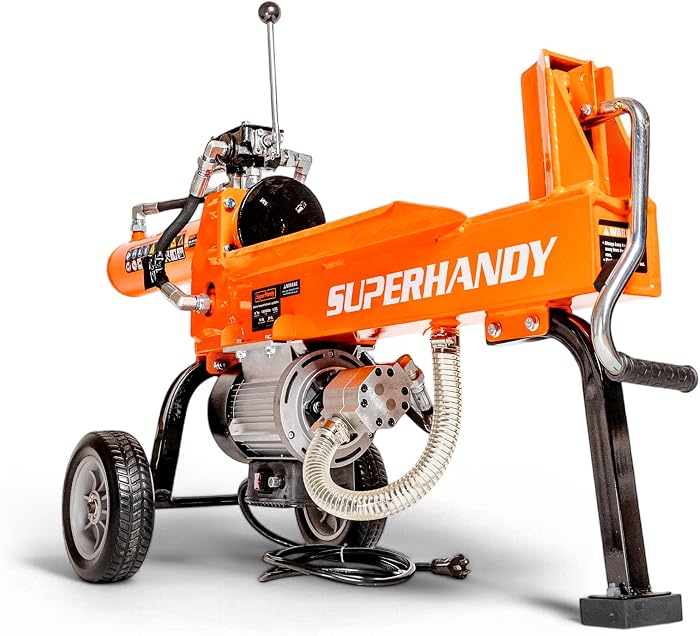
SuperHandy 14-Ton Electric Best Electric for Big Rounds

SuperHandy Hydraulic Log Splitter

Big knotty rounds

Field Score 87/100
Pump
10.5 GPM two-stage
Motor
15 amp, 1,800W
Weight
143.7 lb
Splitting Force
14 tons
View on Amazon

The rounds that stop a 6.5-ton splitter are usually not the big ones. They're the knotty, forked pieces a few inches across that a wedge has to tear rather than slice. Fourteen tons is what buys you through them, and this is the only electric here with more than twice the rated force of the small machines. The difference shows up in green oak, seasoned locust, and anything with a branch collar in the middle of it.

We also ended up liking the auto-return ram more than we expected to. At the end of each stroke the wedge backs off the log on its own, so you're not working a lever between rounds — one saved motion per cycle, over and over, for an afternoon. The 10.5 GPM two-stage pump is what makes 14 tons practical on a cord: it moves fluid fast to close the gap, then builds pressure for the split instead of crawling the whole way.

At 143.7 pounds it's a machine that lives where you park it. Roll it to the woodpile in spring and leave it there; getting it into a truck bed is a two-person job. It also pulls 15 amps, so give it a circuit that isn't already feeding a freezer and a shop vac. And if your wood is clean ten-inch ash, take the smaller machine — the extra tonnage here is for the rounds that fight.

Worth Noting

  • Power tapers off on the largest knotty rounds
  • Handle weld can let go under a hard pull
Our Verdict

Worth the step up if your wood runs to big, knotty rounds: 14 tons and an auto-return ram do work the 6.5-ton electrics stall on, provided you have a stout circuit and a level spot to wheel it to.

Check Latest Price
3

BILT HARD 35-Ton Gas Best for Serious Volume

BILT HARD 35 Ton Gas Log Splitter with Log Lift

High-volume firewood

Field Score 86/100
Engine
306cc, 10 HP
Weight
1,035 pounds
Max Log Size
24 in. length × 20 in. diameter
Splitting Force
35 tons
View on Amazon

The log lift is the feature that turns this from a big splitter into a workday machine. A hydraulic arm raises the round to the beam, so nobody on the crew is deadlifting an eighty-pound piece of oak onto a wedge at knee height. Everything around it is scaled to match: 1,035 pounds, 16-inch DOT tires, a 2-inch ball hitch, and 30.7-inch safety chains — which is to say it tows to the woodlot and stays there until the job is done.

Thirty-five tons through a 12-inch wedge is more force than most firewood ever needs, and the interchangeable 4-way and 6-way wedges are what make the tonnage pay. One pass turns a round into four or six pieces, so a 15-second cycle does the work of three strokes on a single-wedge machine. Behind both is an 18 GPM Bucher two-stage pump, and that combination is why this is the pick for a household heating with wood rather than lighting a fire pit on weekends.

Twenty-four inches of length and twenty inches of diameter is the other thing it buys. The electrics here top out around twenty inches, so a load of tree-service rounds gets cut down again before it gets split. Beyond that, it wants a flat place to live and a cover for the winter — and a fire pit used a few weekends a season doesn't need 35 tons, whatever the badge says.

Worth Noting

  • 1,035 pounds needs a hitch and a real tow vehicle
  • Engine vibration works the beam bolts loose
Our Verdict

The pick for a household that burns several cords a year: 35 tons, a powered log lift, and four- or six-way wedges make fast work of rounds that would stall everything else here.

Check Latest Price
4

PowerSmart 6.5-Ton Electric Best for Light-Duty Home Use

PowerSmart Electric Log Splitter

Light-duty home use

Field Score 78/100
Weight
101 lb
Warranty
Two years
Max Log Size
20 in. length × 10 in. diameter
Splitting Force
6.5 tons
View on Amazon

Two years of warranty on a machine that sits in a shed eleven months out of twelve is the detail that stands out here. Our top pick is covered for ninety days; this one is covered for two years, and on a tool you use hard for a few weekends and then ignore, that coverage is the difference between a repair bill and a phone call.

Underneath, it's the same formula as the top pick: a 15-amp induction motor, 6.5 tons, a horizontal beam, and a steel wedge, rated for rounds up to 10 inches across and 20 inches long. It weighs 101 pounds and rolls on wide rear wheels, and the double-rail leg frame makes it feel planted when you're shoving a heavy round against the wedge instead of skidding away from you.

It costs less than our top pick and the hydraulic fluid comes in the box, so the savings go toward a decent axe for the rounds that fight back. For a household splitting a couple of cords a season, that's a fair trade — and if the machine mostly sits until October, the coverage is the part you'll actually use.

Worth Noting

  • Rated for light-duty, home-scale use only
Our Verdict

A sensible small electric, backed by two years of coverage rather than ninety days; it suits a household splitting a few weekends a year, not a log truck.

Check Latest Price

How We Tested Log Splitters

We started with machines a homeowner could actually justify: electric splitters that run on a 15-amp household circuit, portable hydraulic units, and gas models for people heating with wood full-time. I read spec sheets and owner reviews, then filtered by tonnage, footprint, weight, and whether one person could move the machine alone. Eight made the cut, and we tested them for 10 months, from fall wood prep through the following summer.

Each splitter set up in my driveway beside the pile. I timed solo assembly out of the box, then fed every unit the same mix of rounds — straight ash, oak crotch pieces, stringy elm — and counted clean splits per 15 minutes. I timed the ram's full stroke from start to auto-return, logged how often the wedge stalled and had to be backed off, and noted whether pieces stayed on the beam or rolled toward my boots.

Long days expose different problems, so I ran each machine for a continuous hour on an 85-degree afternoon, listening for a motor that bogged down and checking whether the hydraulic fluid got hot enough to slow the cycle. For sturdiness, I dragged each one across gravel, loaded it into a truck bed, and watched the welds and stand flex while it pushed through a knot; the shakiest units walked across the driveway under load.

Ease of use came down to whether I could steady a round and work the lever with one hand while the other stayed free. For value, I weighed what each machine got through in an afternoon — real output, not the tonnage on the sticker — against the floor space it ate in the garage between seasons.

How to Choose a Log Splitter

Start With Where the Wood Is, Not the Engine

The first question isn't gas or electric, it's distance. An electric splitter has to be within cord's reach of an outlet; a gas one has to be fed, maintained, and stored with fuel that goes stale between seasons. If your rounds get dumped in the driveway and the garage is ten feet away, electric is simpler in every way that matters — no pull-start on a cold morning, no exhaust, no fuel sitting in a tank all summer.

If you split at the woodlot or at the back of the property, nothing electric will follow you there. That's the whole trade, and it's worth settling before you look at tonnage.

Tonnage Is a Ceiling, Not a Promise

A 6.5-ton splitter and a 35-ton splitter are rated for the same job and are nowhere near interchangeable. Tonnage measures the force the ram can bring to bear at its limit; what decides whether a particular round splits is how it fits the machine and how the grain runs. A small machine with a 9.8-inch window walks through straight-grained oak and stops dead on a knotty crotch piece that a 14-ton unit pushes apart without a pause.

Two-stage pumps are how smaller machines live with that ceiling: fast flow closes the gap, then high pressure takes over for the split itself. Buy for the wood you usually get, and keep a maul for the exceptions rather than paying for tonnage you'll use twice a winter.

Cycle Time and the Working Rhythm

Cycle times in this group run from 15 to 18 seconds, and the spread matters less than it looks, because you load the next round while the ram returns. An auto-return ram saves a lever stroke on every cycle, which is worth more over a cord of wood than two seconds of stroke time. Two-hand controls — one hand on the lever, one on the switch — feel clumsy for the first ten rounds and then become automatic, and they're the reason your hands never drift toward the wedge.

Weight, Height, and the Route to the Woodpile

Portable covers a 98-pound machine you roll on two wheels and a 1,035-pound machine you tow on a ball hitch, and listings don't always make the difference plain. Walk the route from storage to splitting spot — gravel, a step, a shed door — before you choose. Past roughly 150 pounds, a splitter is a wheel-it machine; past 500, it needs a hitch and a vehicle.

Working height matters just as much. A beam that sits at knee height means bending for every round, and a long session on a low machine is a backache you'll feel for two days.

What Wears Out, and What to Check Before the First Log

Hydraulic splitters are simple machines with a short list of failure points: hose fittings that arrive loose, fluid that's low from the factory, the wedge weld carrying all the stress, and a ram rod that bends when a machine is pushed past its rating. Before the first log, check that every fitting is snug and the reservoir is at the right level — some manuals list two different fluid quantities on two different pages, so trust the dipstick.

Keep the beam clean and the machine covered between uses, and weigh the warranty. Coverage across these picks runs from ninety days to two years, which is a real difference on a tool that sits idle for most of the year.

Frequently Asked Questions

Final Verdict

For most households the BILT HARD 6.5-ton electric is the splitter to buy: 98 pounds, an 18-second cycle, and enough force for the stove-length hardwood a house actually burns, with no fuel and no fumes in the garage.

Step up to the SuperHandy 14-ton if your wood runs big and knotty, or to the BILT HARD 35-ton gas machine if you're putting up several cords a year and have something that can tow a half-ton. If the woodpile is a pickup-load at a time and you want the warranty to outlast the novelty, the PowerSmart covers the same ground on better terms.