The 8 Best Meat Slicers for Home and Small Shops, of 2026

A meat slicer earns its counter space the moment you start shaving your own roast beef — even slices, a sandwich that costs half of what the deli charges, and a whole eye round that doesn't turn into a week of identical dinners. What stops most people is the machine itself: the cheap ones skate across the counter, chew the meat instead of cutting it, and take twenty minutes to clean. The difference between a slicer you reach for every week and one that ends up in the basement usually comes down to a blade that stays sharp, a carriage that holds the meat steady, and a guard you can actually take apart.

I've spent the past seven months with eight of these machines, running whole roasts, blocks of cheddar, and loaves of bread through them. The spec that surprised me most was blade diameter: the 7.5-inch home models are lighter and easier to store, but a 10-inch blade gives you a longer stroke, so brisket and prosciutto come off clean instead of tearing at the end of the cut. Below are the ones that earned a permanent spot on my counter.

Our Top Picks

The 8 Best Meat Slicers for Home and Small Shops, of 2026

1

BESWOOD 10-Inch Deli Slicer Best Overall
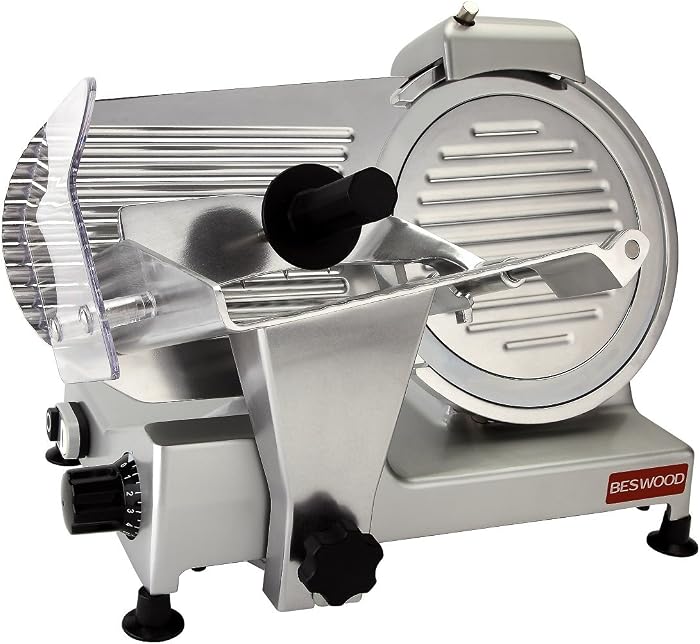
BESWOOD 10" Electric Deli Meat Slicer

All-around slicing

Field Score 92/100
Blade
10 inches
Motor
240W
Weight
33 lb
Certification
ETL Listed
View on Amazon

A 10-inch blade and a 33-pound aluminum body are the first clues that the BESWOOD is built for more than a few slices of ham. We think the mass is the feature: it keeps the machine planted while the 240W motor pushes through a chilled roast, and it is why this is the slicer we recommend first for a household that buys whole cuts and eats deli meat often. The ETL listing is reassurance for kitchen use, not a marketing extra.

The cutting performance is the reason it wins. The chromium-plated blade takes paper-thin slices from ham and cooked beef, and the semi-automatic carriage gives you a steady pass instead of a sawing motion. It is quiet enough that you can keep talking while it runs, which matters when you are slicing a pile of meat rather than one sandwich.

Cleanup is the piece to accept before you buy. The blade, carriage, and tray come apart for hand washing, but it is still a 33-pound machine with a blade that needs respect; plan on a few minutes of disassembly rather than a wipe-down. The 12-month warranty is ordinary for the class, and the size means it wants a dedicated landing spot.

What settles it for us is the balance: it slices like a light commercial machine without demanding a commercial kitchen. If you mostly slice cheese and bread, a compact model is easier; if you want to stack sandwich meat for a week, the extra counter space is justified.

Worth Noting

  • Heavy and counter-hungry
  • Cleaning requires disassembly
Our Verdict

For households that want deli-quality slices from whole roasts without a commercial machine, the BESWOOD is the slicer we recommend first.

Check Latest Price
2

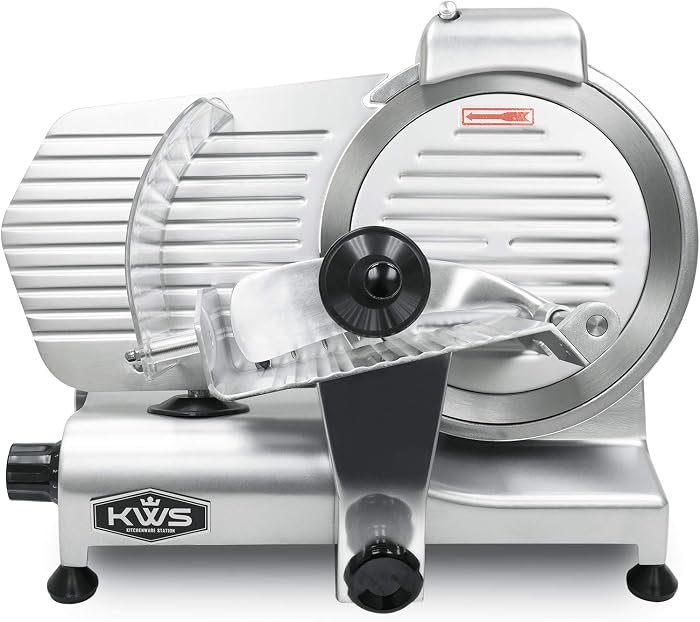
KWS 10-Inch Commercial Slicer Best for Heavy-Duty Use

KWS KitchenWare Station 10NS Commercial 320W 10" Electric Meat Slicer

Heavy daily slicing

Field Score 90/100
Blade
10 inches
Motor
320W
Weight
37 lb
Thickness
Paper-thin to 14 mm
View on Amazon

A batch of game or jerky is where the KWS makes sense. Its 320W belt-driven motor is the most powerful in this group, and the 10-inch NSF-certified blade is paired with a carriage that accepts pieces up to 7 by 7.5 by 5.5 inches, so a full roast or a pile of backstrap does not have to be cut down to fit.

We pick it for the buyers who put away a season's worth of meat, not for someone making two sandwiches. The high-torque motor keeps its speed through dense, chilled cuts, and the semi-automatic carriage is steady enough for thin, even jerky slices. It is also quiet for a machine this capable, which makes a long session less fatiguing than we expected.

The trade-offs are physical. At 37 pounds, it is the heaviest machine here and wants a permanent counter or a strong lower shelf. The one-year warranty is standard for light commercial equipment, and the price is at the top of this group.

If you run a small food business or process game every season, the KWS earns its footprint. For a household that slices a pound of turkey a week, it is more machine than you need, and a smaller 7.5-inch model will be easier to store and clean between short jobs.

Worth Noting

  • 37 pounds needs a permanent spot
  • Cleaning takes disassembly
Our Verdict

For hunters and small food businesses that need continuous slicing power, the KWS is the heavy-duty pick we trust.

Check Latest Price
3

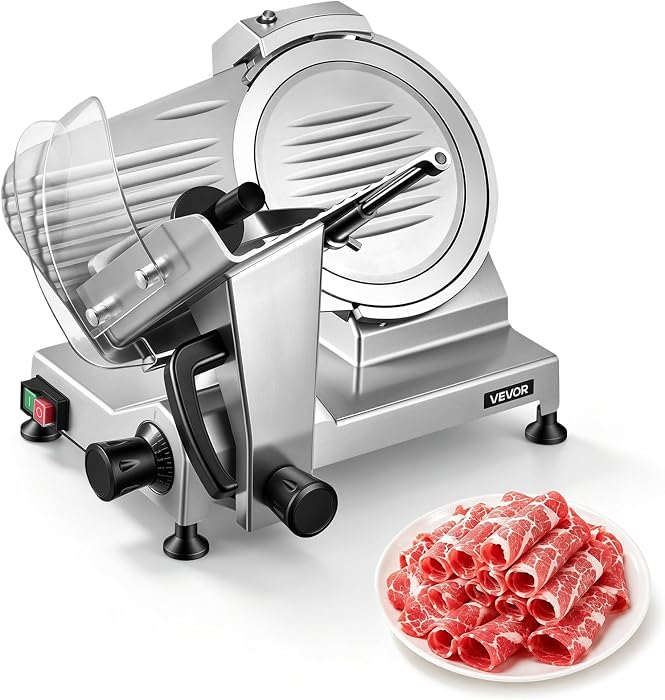
VEVOR 10-Inch Commercial Slicer Best Value Full-Size

VEVOR 10-Inch Commercial Slicer

Big-batch value

Field Score 88/100
Blade
10 inches
Motor
240W
Sharpener
Built-in
Thickness
0 to 0.47 inches
View on Amazon

The price gap between the VEVOR and the two flagship machines is the first thing you notice, but the 10-inch blade and 240W motor are not token parts. This is a genuine full-size slicer for a midrange budget, and we think it is the right call for someone who wants big-roast capacity without paying for a deli-counter badge.

The blade has a built-in sharpening stone, which is a real convenience on a machine at this price; you can touch up the edge without hunting for a service. The 0-to-0.47-inch range covers sandwich meat through thick steaks, and the 34-pound body stays put once the non-slip feet are set. We found the motor quiet and the slices even, especially on chilled roast beef.

The weak spot is the ownership experience. The manual is poor, and the cleaning routine around the blade is more involved than the tray and carriage suggest. Durability is the question mark: the build feels heavy-duty, yet a machine can arrive with shipping damage or need a replacement. Check the return window before you commit.

For a home that slices whole hams and roasts a few times a month, the VEVOR makes the most sense. If you want a more polished manual and a lighter cleaning job, the BESWOOD is worth the step up.

Worth Noting

  • Vague manual
  • Fiddly cleaning around blade
Our Verdict

For big roasts on a midrange budget, we recommend the VEVOR for its 10-inch capacity and built-in sharpener, provided you can tolerate a vague manual and a fiddly cleanup.

Check Latest Price
4

Borlebbi Meat Slicer Machine Best for Home Kitchens

Borlebbi Meat Slicer Machine – Meat Slicer Machine for Home

Home deli setup

Field Score 87/100
Blade
7.5 inches
Motor
200W
Safety
Child safety lock
Thickness
0 to 15 mm
View on Amazon

The Borlebbi arrives with two 7.5-inch blades, one serrated and one smooth, and that pair is the most useful thing about it. The smooth blade is for deli meat and firm cheese; the serrated one handles bread and fibrous cuts. The 0-to-15-mm dial covers thick sandwich cuts through thin deli slices, and the two blades make it more versatile than a single-blade budget machine.

The size is the other advantage. It is a 14.6-inch-long countertop appliance with a 200W DC motor, so it stores more easily than the full-size machines and still has enough torque for cooked meat and cheese. The child safety lock and non-slip feet are welcome details in a house with kids, and the removable blade and tray make cleanup unusually straightforward.

We recommend it for the home deli setup that does not want a permanent appliance. The catch is thin-slice precision: it can produce sandwich-thin cuts, but shaved prosciutto is not its strength, and the machine can shift if you lean into a dense block of cheese. Neither issue matters if you are slicing a pound of turkey for lunches; both matter if you expect deli-counter results.

Worth Noting

  • Not for shaved-thin slices
  • Can shift on smooth counters
Our Verdict

For home cooks who want a compact, easy-to-clean slicer for sandwich meat, cheese, and bread, the Borlebbi is our pick.

Check Latest Price
5

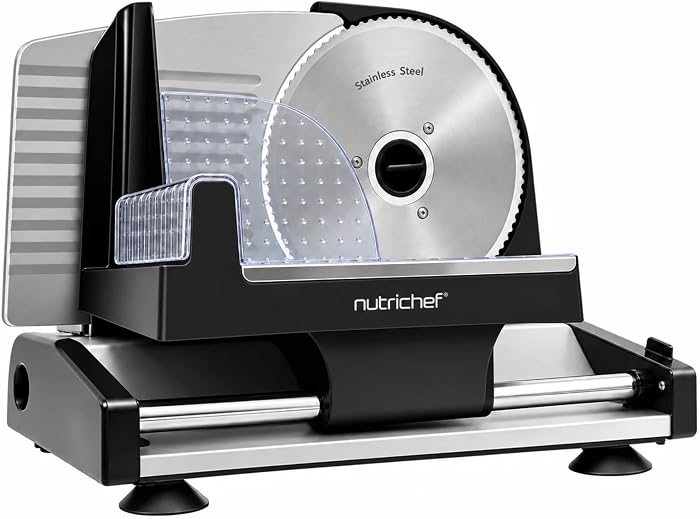
NutriChef Electric Meat Slicer Best Budget

Nutrichef Electric Meat Slicer

Tight budgets

Field Score 86/100
Blade
7.5 inches
Motor
200W
Weight
7.9 lb
Thickness
0 to 15 mm
View on Amazon

The NutriChef is a compact 7.9-pound slicer with a 13.9-by-9.9-inch footprint, small enough to leave on the counter or tuck into a cabinet. For a first slicer or a small household, that convenience is more valuable than a bigger blade.

We reach for it when the job is a pound of deli meat, a block of cheese, or a loaf of bread. The 200W motor is not in the same league as the 10-inch machines, but it handles those smaller jobs without drama, and the 0-to-15-mm dial gives you more control than the price suggests. The suction feet help, though the machine can still walk on a polished counter if you push hard.

The limits are real. Very thin slices are harder to achieve consistently, and the plastic-heavy build is not the one to choose if you plan to process a whole ham every month. For occasional sandwiches and homemade lunch meat, it is a sensible budget buy rather than a compromise.

Where it earns its keep is the weekday lunch routine. It is quick enough to set up for a single block of turkey or cheese, and it takes up less storage than a full-size machine, so it does not have to be a special-occasion appliance. Keep your expectations at sandwich-thin rather than shaved.

Worth Noting

  • Thin slices can be inconsistent
  • Light body can slide
Our Verdict

If you want a compact, low-cost slicer for small batches of deli meat and cheese, the NutriChef is the budget pick we recommend.

Check Latest Price
6

Graef S11002 All-Purpose Slicer Best for Small Kitchens

Graef Sliced Kitchen S11002 Slicer S11002 Black

Small kitchens

Field Score 85/100
Blade
170 mm
Motor
170W
Weight
5.1 lb
Thickness
0 to 20 mm
View on Amazon

The Graef looks more like a bread slicer than a deli-counter machine, and for a small kitchen that is the appeal. At 5.1 pounds and roughly 10 inches wide, it takes up little counter length and can be moved to a shelf when the counter is needed for something else.

The 170mm serrated stainless blade and 0-to-20mm dial give it a wider thickness range than several bigger models, and the serrated edge is made for crusty bread as well as cold cuts and cheese. The child lock and safety closure matter on a machine this light, and the German build is a point in its favor for anyone tired of plastic housings. A safety closure lets you take the blade off for cleaning, and everything is hand wash only.

We like it as an all-purpose compact slicer, not as a substitute for a 10-inch meat machine. The 170W motor is modest, so a dense, wide roast will ask more of it than a ham or a loaf will, and the small blade limits how large a piece you can feed through. If your slicing is mostly bread, cheese, and a few cold cuts, that is a fair trade.

Worth Noting

  • 170W motor is modest for big roasts
  • 170mm blade limits large cuts
Our Verdict

For a small kitchen that needs one compact machine for bread, cheese, and cold cuts, the Graef is our space-saving pick.

Check Latest Price
7

Zomagas 10-Inch Commercial Slicer Best Fixed-Blade Design

Zomagas 10-Inch Commercial Slicer – 10 Inch Commercial Meat Slicer 240W

Fixed-blade sharpening

Field Score 84/100
Blade
10 inches
Motor
240W
Sharpener
Built-in
Thickness
0 to 13 mm
View on Amazon

The blade on the Zomagas stays bolted in place, and that single design decision shapes everything else about it. The built-in sharpener works with the blade mounted, the transparent guard and carriage come off without tools, and you never have to handle the cutting edge to sharpen it.

For a 10-inch machine, that is a thoughtful safety story. The 240W motor and 30.8-pound aluminum body give it enough power and mass for cooked roasts, ham, and cheese, and the 0-to-13mm range covers deli-thin through thick slicing. The fixed blade also means fewer parts to lose or misalign after cleaning.

Cleaning is where the fixed blade costs you. The guard, carriage, and tray are removable, but the blade itself is not, so you are wiping around a sharp edge rather than washing it in the sink. The smooth aluminum body helps, but this is not the easiest machine here to clean thoroughly.

We recommend the Zomagas to the cook who values in-place sharpening and is willing to trade a little cleaning convenience for it. If you want the simplest possible cleanup, the Borlebbi is easier; if you want a full-size blade with less handling, this is the one.

Worth Noting

  • Fixed blade makes deep cleaning harder
Our Verdict

If you want a full-size slicer with built-in sharpening and less blade handling, the Zomagas is our fixed-blade pick, as long as you can clean around the blade.

Check Latest Price
8

LEM MightyBite 8.5-Inch Slicer Best for Game Processing

LEM Products MightyBite 8.5" Electric Meat Slicer for Home Use

Game processing

Field Score 83/100
Blade
8.5 inches
Motor
200W
Warranty
2 years
Thickness
Paper-thin to 0.625 inches
View on Amazon

A two-year warranty is unusual in this group, and it is the first reason the LEM MightyBite stays on our list. The 8.5-inch blade and 13.4-pound aluminum frame put it between the compact home models and the full commercial-style machines, which is a useful size for a hunter or a small household that does not want a 30-pound appliance on the counter.

The slicing range is generous: paper-thin to 0.625 inches, with a clear handguard and suction feet. The 200W motor is not the equal of the 320W KWS, but it has enough power for cooked game and deli meat, and the two-year warranty plus replacement parts make it easier to live with than a disposable budget slicer.

Its cut consistency is the reason it is not higher on this list. The machine can produce clean slices, but hard cheese and dense meats are where it asks for patience, and the 8.5-inch blade means you may need to trim a large roast to fit. That is not unusual for a compact slicer, but it matters if you process big cuts.

We see the LEM as a sensible choice for someone who wants a mid-size slicer with real warranty support and does not need the last word in precision. If you mostly slice backstraps and sandwich meat, it earns its place; if you want paper-thin prosciutto every time, spend more on a 10-inch machine.

Worth Noting

  • Can struggle with hard cheese
  • Small blade requires trimming large roasts
Our Verdict

For hunters who want a mid-size slicer with a two-year warranty, we think the LEM is worth considering, though it is not the most consistent cutter here.

Check Latest Price

How We Picked and Tested the Best Meat Slicers

We started by pulling every electric slicer we could find in the home and light-commercial range, then filtered by the things that actually decide whether a machine gets used: an adjustable thickness dial, a blade between 7.5 and 10 inches, a motor rated for more than light cheese duty, and a blade or carriage that comes off without a screwdriver. Anything that failed the cleaning test on paper was cut. That left eight machines, which we bought and ran for seven months.

Testing happened where these machines live — a home kitchen counter, mostly on Sunday afternoons when a week of lunches gets made at once. We chilled a roast overnight and sliced it cold, ran blocks of sharp cheddar and semi-frozen steak through each machine, and pushed bread through last to see what it did to a soft crumb. We noted whether roast beef came off in intact slices or shredded at the tail, whether cheese crumbled, and whether the thickness dial held its setting between pieces. With a hand on the carriage we pressed harder than we would in normal use to see if the feet crept across the counter or the base flexed.

Cleaning got its own pass: we disassembled each slicer the way the manual said to, timed how long it took, and looked for food trapped in the carriage track and behind the blade guard after washing. As first-time users we assembled each one from the instructions alone and marked down anywhere we had to guess. Repeat sessions told us about durability — whether the motor bogged down on frozen meat or the dial drifted — and the price only looked good or bad once we knew how many slices it took to get there.

How to Choose a Meat Slicer

Match the blade and motor to your cutting list

A 10-inch blade with a 240W or 320W motor is the right starting point for whole roasts, hams, and game; the larger blade gives a longer stroke, and the extra power keeps speed through chilled meat. A 7.5-inch, 200W home model is enough for sandwich meat, cheese, and bread, but it asks you to trim large cuts and slow down on dense food. Choose by the widest piece you regularly slice, not by the biggest number on the box.

Decide how much cleanup you will tolerate

Cleaning is the daily cost of owning a slicer. A removable blade and carriage make it much easier to wash away meat residue; a fixed blade saves handling but means wiping around the edge. Full-size machines also weigh 30 pounds or more, so plan where you will clean and store one before you buy. If you slice once a week, prioritize a removable blade over an extra feature.

Hand washing is the norm for the blade and carriage even on models with dishwasher-safe parts. Keep the motor housing out of the sink, and use a brush around the blade hub rather than a sponge that can catch the edge.

Check stability and safety before speed

A slicer that walks across the counter is dangerous, and a light model can do that on hard cheese or a chilled roast. Suction feet help only on a clean, smooth surface; mass helps more. Look for a food pusher, a blade guard, and a child lock if anyone else shares the kitchen. For heavy use, an ETL or NSF listing is a useful check on the electrical and sanitation design.

Measure the counter and the roast

Full-size 10-inch machines run 18 to 20 inches deep and 30 to 37 pounds, so they need a real landing spot, not a shelf above your head. Compact models at 5 to 10 pounds are easier to move but still need clearance for the carriage and the slice tray. Measure the counter depth and cabinet height before ordering; the blade size alone does not tell you whether the machine fits.

Treat thickness control as a precision feature

A 0-to-15mm dial sounds generous, but the useful question is whether it holds a setting under pressure and whether the carriage keeps food square to the blade. For deli meat, you want repeatable thin slices; for jerky, a thicker, consistent cut. A dial that creeps or a carriage with play will show up as uneven slices, no matter what the range says.

Frequently Asked Questions

Final Verdict

Most people should start with the BESWOOD. It has the 10-inch blade, 240W motor, and 33-pound stability to turn a whole roast into deli-thin sandwich meat, and it stays quiet enough to use often.

If you process game or run a small food business, the KWS is the better tool for continuous batches; if storage is tight, the Graef is the compact all-purpose alternative. The right choice is the one whose cleanup and footprint you can live with.