The 7 Best Multi-Fuel Camping Stoves of 2026

The fastest way to ruin a camping breakfast is a stove that won't light. Canister fuel loses pressure as the temperature drops, so the stove that boiled water happily in July can sputter and quit on a cold morning — which is why multi-fuel stoves exist. A good one runs on canisters when they're convenient and switches to liquid fuel or propane when they aren't, so the wrong fuel stops being a crisis.

I've cooked on enough of these to know the tradeoffs aren't obvious. A stove that roars like a jet boils fast and annoys everyone at camp by 6 a.m.; a featherweight that disappears into a jacket pocket can wobble under a full pot. Over eight months, my team and I cooked on nine multi-fuel stoves in wind, rain, and one memorably cold morning. Raw heat output is the spec people overrate — a decent windscreen does more for your boil time than a few thousand extra BTUs.

Below are the ones we'd pack again, whether you're feeding a family from a tailgate or melting snow at altitude.

Our Top Picks

The 7 Best Multi-Fuel Camping Stoves of 2026

1

Gas One GS-3400P Best Overall

Gas One GS-3400P Propane or Butane Stove Dual Fuel Stove Portable Camping Stove

Car camping, emergencies

Field Score 93/100
Fuel
8 oz butane or 16.4 oz propane
Weight
3.1 lb
Ignition
Piezo-electric
Max Output
8,000 BTU
View on Amazon

Butane or propane — the choice is made with your hand, not by buying a second stove. An 8-ounce butane cartridge seats into the slot under the burner; a 16.4-ounce propane cylinder threads onto the same fitting. That flexibility is the whole case for putting it first here: propane keeps pushing when a frosty morning has a butane canister barely producing vapor, and butane gives a steady, inexpensive flame for a calm evening at a level site. This is the stove we point people to when they're building a first camp kitchen, and the one that lives in the truck.

The listed 8,000 BTU is mid-pack on this page and plenty for a stockpot, a skillet of eggs, or a kettle, and the piezo ignition lights it with a click instead of a match. The detail we like most sits under the burner: a spring-loaded cartridge system that ejects a butane canister and cuts the gas if pressure climbs, rather than venting. You hope never to see it work.

At 3.1 pounds it's a table-and-tailgate stove, and it folds into a case smaller than a shoebox. It holds a flame in a breeze that would make a bare burner gutter, which matters more on a windy day than another thousand BTU. The fuel connection and the igniter are the two places a cheap stove gives trouble, so a soapy-water leak test at the fitting and a disposable lighter in the kit are cheap insurance.

Worth Noting

  • Bulk propane needs a separately sold hose
  • 3.1 pounds, so it stays near the car
Our Verdict

Start here. It takes the two canisters any hardware store sells, lights in one click, and costs less than anything else on this page.

Check Latest Price
2

Grill Boss 90057 Best for Big Pots

Grill Boss Dual Fuel Camp Stove

Big-pan cooking

Field Score 92/100
Fuel
8 oz butane or 16.4 oz propane
Weight
4.4 lb
Included
Propane conversion hose
Max Output
12,000 BTU
View on Amazon

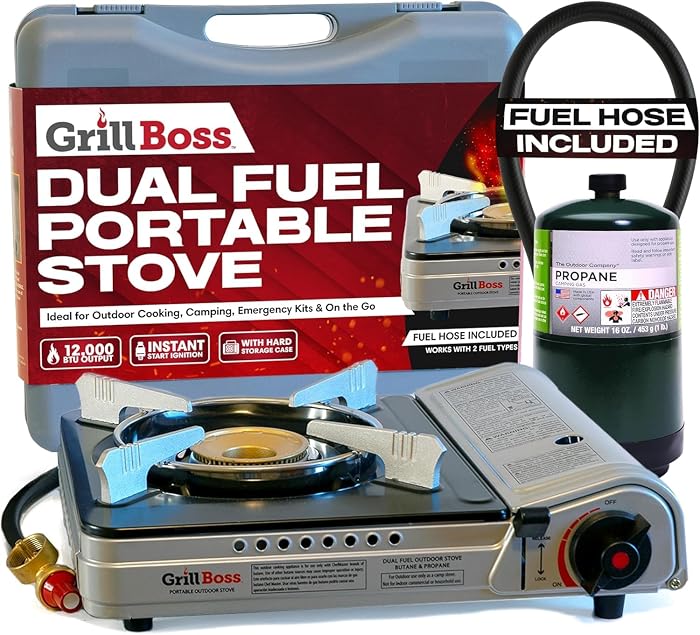
Twelve thousand BTU is half again what the Gas One delivers, and it goes through a wider burner that spreads heat across the bottom of a skillet instead of parking it in the middle. Add the double wind guard that wraps the burner and you have a stove that holds its temperature when the breeze picks up — the difference between a pan of bacon that cooks evenly and one that browns in a ring.

We reach for this one when more than two people are eating. The ignition is the smoothest here: turn the knob counterclockwise past a detent, the piezo clicks, and the burner catches without a lighter. It's also the only canister stove in this group that ships with the propane conversion hose, so a 1-pound cylinder connects without a trip to the hardware store.

Cooking is where the extra burner earns its keep. A flat-bottom wok or a 12-inch skillet sits on the supports without wobble, and turning the flame down keeps a stir-fry moving instead of scorching. Plan on leaving it near the vehicle, though — at 4.4 pounds this is a stove you move from tailgate to table and no further.

Worth Noting

  • Carry case is the flimsiest part
  • 4.4 pounds limits it to car camping
Our Verdict

If your camp meals run to a full skillet and a pot at the same time, this is the stove that keeps up — more flame and a wider burner than the canister stoves around it.

Check Latest Price
3

MSR WhisperLite Universal Best Hybrid for Backpacking

MSR WhisperLite Universal Compact Hybrid Fuel Camping and Backpacking Stove

Backpacking, any fuel

Field Score 91/100
Fuel
Canister, white gas, kerosene, unleaded
Weight
11.5 oz
Warranty
3-year limited
Cold-weather Feed
Liquid feed from canister
View on Amazon

Canister stoves have one failure mode, and it arrives with cold: as the canister chills, pressure drops and the flame fades with it. The WhisperLite Universal answers that by feeding liquid from an inverted canister, holding output steady through a frosty morning and down to the last of the fuel. Then it goes further — white gas, kerosene, and unleaded gasoline burn in the same stove, changed over with couplers and a fuel-specific jet. We pack it when we don't know what the next town sells.

At 11.52 ounces it's a backpacking stove, and the kit — pump, windscreen, heat reflector, small parts — disappears into a pack. The detail we appreciate most is the Shaker Jet: when soot from dirty fuel clogs the jet, you shake the stove and the cleaning needle does the work, which is the difference between cooking dinner and rebuilding a stove on a rock in the dark. Stainless legs and a three-year warranty suggest the same intent.

Two things to plan for. There's no igniter, so a lighter lives in the pot with the stove, and liquid-fuel mode needs a fuel bottle that isn't part of the kit. Priming is a skill rather than a chore after a few trips, and the labeled jets and keyed couplers make a canister-to-liquid switch quick at a resupply stop.

Worth Noting

  • No igniter
  • Fuel bottle for liquid mode not included
Our Verdict

The stove to pack when you don't know what the next town sells: canister, white gas, kerosene, or unleaded, at 11.52 ounces.

Check Latest Price
4

Optimus Polaris Optifuel Best for Cold Weather

Optimus Polaris Optifuel Multifuel Mountaineering Stove For Expedition

Cold-weather expeditions

Field Score 88/100
Fuel
Canister, white gas, kerosene, diesel, jet fuel
Weight
1.8 lb
Fuel Jets
One jet for all fuels
Max Output
3,300 W
View on Amazon

Seven fuels go through one jet: butane, isobutane, propane, white gas, kerosene, diesel, and jet fuel. No nozzle swaps, no envelope of small brass parts to lose in the dark, and no chance of holding the wrong jet when the only fuel for sale in town is the one you didn't plan for.

The rest of the design follows the same logic. A magnetic cleaning needle clears the jet from outside the stove, and four-season mode boosts output and shortens boils as the temperature drops — exactly when canister pressure is at its worst. The burner is rated at 3,300 watts, and the included windscreen is what makes that number mean something in wind. It is also 1.8 pounds, roughly two and a half times the WhisperLite Universal, and liquid fuel means priming before you cook.

We accept both of those costs, because the stove does the one thing that matters on a long trip: it takes fuel off the list of things that can go wrong. The FLIPSTOP pump, multitool, windscreen, heat reflector, and stuff bag all come in the box, which is the difference between a stove you can service in the field and one you can only use.

Worth Noting

  • 1.8 pounds, far above the hybrid MSR
  • Liquid fuel means priming before you cook
Our Verdict

Seven fuels through a single jet, plus a winter mode — this is the stove we trust when the temperature drops and the fuel is whatever's for sale.

Check Latest Price
5

MSR Dragonfly Best Flame Control

MSR Dragonfly Compact Liquid Fuel Camping and Backpacking Stove

Simmering real meals

Field Score 87/100
Fuel
White gas, kerosene, diesel, jet fuel, auto gas
Weight
14.1 oz
Pot Supports
Up to 10 in
Flame Control
Dual-valve simmer to boil
View on Amazon

The Dragonfly is loud. Not a hum — a roar with a hard edge to it, the kind that ends a conversation and announces dinner to the whole loop. Under the pot sits a suspended burner cup that runs hot and loses less heat to the ground than a burner sitting on a plate, and the noise is part of the package.

What the noise buys is control. Two valves, one for fuel and one for flame, take it from a blowtorch boil down to a simmer that will hold a tomato sauce without scorching it, and the pot supports open to 10 inches — wide enough for a real skillet or a stockpot that won't tip. It folds to a third of its working size and stows inside a two-liter pot.

Fuel is liquid only: white gas, kerosene, diesel, jet fuel, auto gas. There's no canister option, so this is a stove for someone who has decided to run liquid and wants the pump, windscreen, and Shaker Jet needle that come with it. Priming is part of the routine, not a one-time setup.

We think the trade is worth it if you actually cook. A stove that holds a genuine simmer turns a bag of noodles into something better and lets you fry fish without welding it to the pan, and the wide supports mean the pan doesn't wobble while you do it. If your camp menu is coffee and freeze-dried meals, you're paying for control you won't use and carrying a roar you don't want.

Worth Noting

  • Loud enough to hear from the next site
  • Liquid fuel only, no canister option
Our Verdict

The dual valve is the reason to buy: a simmer no other stove here can hold, and pot supports wide enough for a real skillet.

Check Latest Price
6

Roamix SV02 Best for Ultralight Trips

Roamix SV02

Ultralight trips

Field Score 80/100
Fuel
Butane, propane, isobutane
Weight
1.6 lb
Dimensions
5.9 x 4.3 x 5.9 in
Max Output
16,000 W
View on Amazon

At 1.6 pounds this is the lightest canister stove in the group, and it folds into a package that vanishes into a motorcycle pannier or a daypack's side pocket. The listing puts output at 16,000 watts, roughly four times the Gas One's rating, so treat that as a ceiling rather than an expectation — but a burner this small that will still take a large pot is the reason it's here.

Fuel is where it earns its place in a multi-fuel roundup. Butane, propane, and isobutane canisters all connect, and the included adapter lets it run from a 1-pound propane bottle when that's what the shelf has. The burner and pot supports fold flat, and the whole thing goes back in its bag without a puzzle.

Two reservations. The igniter is the part that gives out first on this stove, so a lighter in the kit keeps it working. And the legs are short and narrow — on a tilted site you'll want a flat rock or a table under it. For a light-and-fast kit where the stove is a means to coffee and a hot meal rather than the centerpiece of the evening, those are fair trades.

Worth Noting

  • Igniter is the first part to fail
  • Short legs want level ground
Our Verdict

At 1.6 pounds it is the lightest canister stove here, and it takes butane, propane, or isobutane — the pick for a pack where ounces are argued over.

Check Latest Price
7

nCamp Multi-Fuel Stove

nCamp Multi-Fuel Stove

Gathering your fuel

Field Score 79/100
Fuel
Wood, charcoal, hexamine
Weight
1.8 lb
Materials
Stainless steel and aluminum
Collapsed Thickness
1.5 in
View on Amazon

Twigs, charcoal, hexamine tablets: the nCamp burns what's already on the ground, which is the oldest kind of multi-fuel and the only kind that works when everything you brought has run out. It collapses into a package 1.5 inches thick, so it earns its place in a pack on the strength of what it doesn't ask you to carry.

The collapsible chamber is built to pull air up through the fire, and when it's working you get a real flame off a handful of sticks. Set a pot on the rack too early and the fire starves, and the smoke that follows will chase you around the site. Feed it small fuel, leave the pot off until the flames are established, and it settles down.

A twig fire in a small chamber won't match a gas burner for speed, and wind and wet fuel turn it into a project rather than a shortcut. It's the stove you bring when the fire is part of the evening, not when dinner is late and everyone is hungry.

One thing to check before you count on gas: nCamp lists this as the stove itself, so the propane burner it also describes is a separate piece of kit. Buy them together if that's the plan, or pack this one knowing that its fuel comes from the ground.

Worth Noting

  • Smokes when the pot starves the fire
  • Slow to boil and fussy in wind
Our Verdict

For backpackers who would rather gather fuel than carry it: flat-packed, under two pounds, and burning whatever is on the ground.

Check Latest Price

How We Tested Multi-Fuel Camping Stoves

We built the shortlist by reading specs and filtering hard. Any stove that claimed multi-fuel but only swapped between two canister blends got cut, and so did anything without meaningful flame control or wind protection — the two things that separate a stove you cook on from a stove you merely boil water on. That left nine models, ranging from a collapsible canister hybrid to a pump-driven expedition stove, and we spent eight months cooking on them.

Testing happened where these stoves actually live: car-camping weekends, a gusty trailhead at dawn, a rainy picnic table, and a run of cold mornings when we deliberately left canisters outside overnight to see how they behaved at first light.

We ran every stove on each fuel it accepts and timed the changeover, because a dual-fuel design is only worth paying for if you can switch with cold hands in the dark. We boiled a quart of water in still air, then repeated it behind a wind block to see how much the flame actually cared. Each burner got listened to at full tilt — some whisper, some roar — and we tried to hold a low simmer without the flame drowning out.

We set a full pot on every grate and pressed down on the edges to check for wobble, weighed each stove with its case on a kitchen scale, and fired the ignition over and over, gloves on, to learn whether the piezo or a match was the dependable option. Durability got judged the unglamorous way: dropped lids, scorched grates, field cleanings, and how much soot each fuel left behind. Value came down to whether the extra money bought something you'd actually notice on a Tuesday morning at a campsite.

How to Choose a Multi-Fuel Camping Stove

Know Which Kind of Multi-Fuel You're Buying

Most camp stoves sold as dual fuel take an 8-ounce butane cartridge and a 16.4-ounce propane cylinder. That is real flexibility — two formats, two price points, and propane that keeps working when butane slows in the cold — but both are liquefied petroleum gas, so it isn't expedition flexibility. The other family burns liquid: white gas, kerosene, diesel, even unleaded from a pump, alone or alongside canisters.

If your trips stay within reach of a sporting goods store, a butane and propane stove covers it, and the Gas One is the cheapest way in. If you'll be somewhere the fuel is whatever happens to be for sale, buy liquid.

Cold Weather Decides More Than Output Does

Butane stops vaporizing well as temperatures approach freezing, and a canister chills itself as it evaporates, so the flame fades exactly when you want it. Propane holds up much better, liquid fuel doesn't care at all, and a few stoves solve the problem by design: the MSR WhisperLite Universal draws liquid from an inverted canister, and the Optimus Polaris has a four-season mode that boosts output as the mercury drops.

For a late-season hunt or a high-country trip, that behavior matters more than another thousand BTU on the label. Pick the fuel system first and the burner second.

Match the Burner and the Pot Supports to How You Cook

An 8,000 BTU burner handles a kettle and a skillet without complaint. More output helps when the burner is also wider, spreading heat across the bottom of a pan instead of scorching a ring in the middle — that's the practical difference with the Grill Boss.

Pot supports matter just as much. They need to open wide enough for the pan you actually own, and a stove like the MSR Dragonfly, with supports sized for a 10-inch skillet or a stockpot, will hold what a compact stove would tip. If you boil water and eat, buy light. If you cook, buy support and a valve you can turn down.

Count the Whole System, and Check the Box

The stove is only half the purchase. A canister stove is self-contained — canister in, flame out — while a liquid-fuel stove needs a bottle and a pump, and often a fuel bottle that isn't included; the WhisperLite Universal's liquid mode is the example here. Add a bulk-tank hose on a budget dual-fuel stove and a case for a heavy one, and the packed weight and the total cost both climb.

Canisters also cost more per meal than white gas bought by the quart, which is why a stove used every weekend rewards the cheaper fuel.

Frequently Asked Questions

Final Verdict

For most camps, the Gas One GS-3400P ends the search: it burns the two canisters every hardware store and outfitter stocks, lights without a match, and leaves money for fuel. It is the stove we tell people to buy first, because the day it can't do the job is the day you already know you need something more serious.

That day looks like a late-season hunt, high country, or a trip where the next town might not have the right canister. Then the MSR WhisperLite Universal earns its price: 11.52 ounces, four fuels, and no guessing about resupply. Buy the Gas One to cook; buy the MSR to be sure you can.