The 7 Best Oscillating Multi-Tools of 2026

An oscillating multi-tool is what you reach for when nothing else fits. A motor rocks the blade side to side through a few degrees at high speed, so you can plunge into a floorboard or slice a nail flush to a doorframe without tearing out what's around it. It's also why shopping is trickier than it looks: two tools that look identical can behave like different machines once the blade hits oak.

I've burned through a cheap one in a single afternoon of flooring work, so I don't take cutting performance on faith. Over the past eight months my team and I ran 12 of these, corded and cordless, through subfloor, trim, tile, and pipe, and the differences that mattered were rarely the ones on the spec sheet. Voltage gets the attention; a blade change that needs a hex key will slow you down more.

Corded and cordless both earn a spot below, as do full kits and bare tools for anyone already invested in a battery platform. The right one depends on where you'll be cutting.

Our Top Picks

The 7 Best Oscillating Multi-Tools of 2026

1

DEWALT 20V MAX XR DCS356B Best Overall
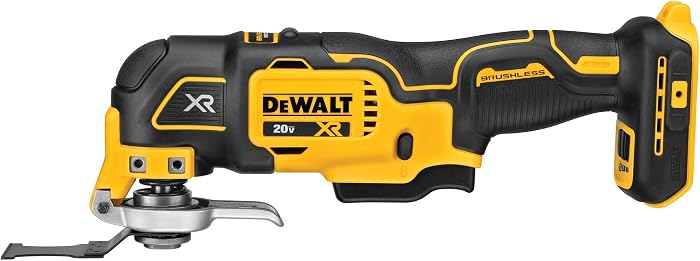
DEWALT 20V MAX XR Oscillating Multi-Tool Cordless

All-round use

Field Score 96/100
Weight
2.4 lb
Power Source
20V MAX battery (tool only)
Blade Changes
Tool-free quick-change
Oscillations Per Minute
0-13,000/ 0-17,000/ 0-20,000 OPM
View on Amazon

Three detented settings — 0-13,000, 0-17,000, and 0-20,000 OPM — do more for this tool than the trigger does. You click into a range that suits the material, then use the variable-speed trigger to feather the cut. That sounds minor until you're undercutting a door jamb: the low range keeps the blade from burning the paint, and the top range walks through pine without stalling. We think it's the best all-around multi-tool in this group for exactly that reason — it adapts to the job instead of the other way around.

The rest of the design is built around changing blades fast. The quick-change system locks a blade without a wrench, and the universal adapter takes most other brands' blades, so you aren't married to DEWALT's accessory line. There's an LED at the nose, which we used more than we expected under a sink. At 2.4 pounds the tool has heft, but the body is balanced enough for one-handed short cuts and steadier two-handed for long ones.

Battery life, not the motor, is the ceiling. The top speed setting is thirsty, and a long run of hardwood cuts sends you looking for a spare pack; plan on two packs if the tool is going to work a full afternoon. In our own use it has been the difference between finishing a run of baseboard trim in one go and breaking to charge.

Set against the other picks, the trade is clear. The Milwaukee M18 offers finer speed steps but makes you find a hex key at blade changes; the M12 Fuel is a pound lighter and wants lighter work. For one tool that has to handle trim, drywall, and sanding, this is the balance we keep coming back to.

Worth Noting

  • Bare tool; battery and charger cost extra
Our Verdict

Buy this one if you want a single tool for trim, plunge cuts, and sanding: three speed ranges, tool-free blade changes, and it shares batteries with DEWALT's 20V line.

Check Latest Price
2

Milwaukee M18 2626-20 Best for Speed Control

Milwaukee 2626-20 M18 18V Lithium Ion Cordless 18

Precise speed control

Field Score 95/100
Warranty
5 years
Speed Range
8,000 to 18,000 rpm
Power Source
18V M18 battery (tool only)
Speed Settings
12
View on Amazon

Blade changes here are not tool-free. There's no lever, so you undo a fastener with a hex key while the blade you want sits there waiting, and swapping between a wood blade and a scraper stops being a ten-second job. It's the one part of this Milwaukee that feels a generation behind the rest of the tool.

Everything in front of the blade is the opposite story. Twelve speed settings run from 8,000 to 18,000 rpm, and the dial is where this tool earns its place: slow for plastic and drywall so you're cutting instead of melting, fast for wood, with the setting holding where you left it. The all-metal gear case and rubberized grip make it feel like something you can lean on, and the LED sits on the head, which is where it actually lights the line. On control, we rank it at the top of this group.

Milwaukee lists around 40 minutes of battery life, which is a reminder to own a spare if you're cutting all afternoon. The five-year warranty is the longest of any pick here and covers the part that tends to fail. If M18 packs are already on your shelf, the extra speed steps are worth the annoyance at blade-change time; if they aren't, price the whole setup before you commit, because the tool itself is only part of it.

Worth Noting

  • Bare tool; M18 packs and charger sold separately
  • 2.9 pounds, heavier than the compact picks
Our Verdict

For matching speed to material: 12 settings from 8,000 to 18,000 rpm, an all-metal gear case, and a five-year warranty — provided M18 batteries are already in your shop.

Check Latest Price
3

DEWALT DWE315K Corded Kit Best Corded

DEWALT DWE315K Corded Kit

Shop and renovation

Field Score 94/100
Amperage
3 A
Max Speed
22,000 rpm
In The Box
Blades, sandpaper, tool bag, guide system
Power Source
Corded, 120V
View on Amazon

The guide that clamps to the head of this tool is the least glamorous thing in the box and the reason to consider it. Set it, and the blade stops at a fixed depth or height, so a run of vent cutouts or a row of door jambs comes out identical instead of by eye. Most multi-tools make you freehand that, and freehand is where a trim cut goes wrong.

Behind the guide is a 3-amp motor rated at 22,000 rpm with no pack to sag. That's the corded advantage in one sentence: through a long cut in hardwood the tool keeps the speed it started with, where a cordless one begins to labor as the battery drains. The kit is generous too — wood blades, sandpaper, a tool bag, quick-change, a dual-grip variable-speed trigger, and an LED.

For work that stays put — a basement, a shop, a renovation where the tool lives on a bench — this is the strongest corded option here, and the depth guide is a feature none of the cordless picks offer. As a first multi-tool for a house with one project and no outlet nearby, it's the wrong shape entirely.

The tool carries a three-year warranty, so register it the day it arrives and keep the receipt in the bag. In our own work it has handled trim, PVC, and a stubborn strip of oak flooring; the guide is the first thing we reach for when a cut has to repeat.

Worth Noting

  • Corded; needs an outlet at the work
  • Heavier in the hand than the 20V tools
Our Verdict

The corded choice for a shop or a long renovation: 3 amps and 22,000 rpm that don't fade, a guide for repeatable depth cuts, and a bag of blades to start with.

Check Latest Price
4

Milwaukee M12 Fuel 2526-20 Best for Tight Spaces

Milwaukee M12 Fuel 2526-20 – 2526-20 M12 Brushless 12-Volt Lithium-Ion Cordless Oscillating Multi-Tool

Overhead work

Field Score 93/100
Weight
1 lb
Speed Range
10,000 to 20,000 rpm
Power Rating
120 W
Power Source
12V M12 battery (tool only)
View on Amazon

A pound is the number that matters. The M12 Fuel body weighs about that before a battery goes on, and it changes which tool you pick up: overhead cuts, inside a cabinet, kneeling at a floor register. We found the small body puts the blade where a 2.4-pound tool runs out of room and your wrist runs out of patience.

Brushless motor, 10,000 to 20,000 rpm, a thumb dial you can move without looking, and a tool-free blade change — the accessory swap the bigger M18 makes you do with a hex key. For short cuts the power sits right there with the 18V tools; what a 12V platform asks in return is a smaller pack, so an afternoon of work means swapping batteries more often.

Keep it for what it's good at, though, because that's where it beats everything else here: this is the one we hand someone who has to cut above their head, and it's the one that stays in the bag when the work moves around a house.

Worth Noting

  • Bare tool; M12 batteries and charger sold separately
Our Verdict

The compact pick: a one-pound body with a brushless motor and tool-free blade changes, made for overhead cuts and cabinet corners where full-size tools won't fit.

Check Latest Price
5

CRAFTSMAN V20 CMCE501D1 Best Starter Kit

CRAFTSMAN V20 Cordless Oscillating Tool Kit Battery and Charger (CMCE501D1)

First-time buyers

Field Score 92/100
In The Box
2 blades, sanding platen, 4 sheets, bag
Speed Control
Variable speed dial
Battery Included
20V 2.0 Ah with charger
Attachment System
Tool-free universal
View on Amazon

Open the bag and you can make a cut. CRAFTSMAN includes a 2.0 Ah 20V battery, a charger, a wood blade, a wood-and-metal blade, a sanding platen with four sheets, and the bag itself — a list that matters because several picks on this page are bare tools that need a pack, a charger, and blades bought on top.

The tool is set up for someone new to the category: a variable-speed dial you set and leave, a tool-free universal attachment that takes standard blades, and an LED over the cut. It isn't bulky in the hand, which matters when you're learning to control a plunge cut into drywall. The 20V motor handles trim, vent cutouts, and a sanding patch without complaint.

For a household that doesn't own a 20V platform yet, this is the sensible entry point — nothing else to buy on day one, and enough tool that you'll still reach for it after the first project is finished. It's also the pick we hand to someone who has never used an oscillating tool at all, because the dial is easier to live with than a trigger while you learn.

Worth Noting

  • One 2.0 Ah battery, no spare in the kit
  • The storage bag is the weak link
Our Verdict

The kit to buy if you don't own a 20V battery yet: charger, pack, two blades, sandpaper, and a bag in one box, with controls that suit a first-time user.

Check Latest Price
6

WORKPRO 3.0 Amp Corded Kit

WORKPRO 3.0 Amp Corded Oscillating Multi-Tool Kit

Budget corded kit

Field Score 91/100
Amperage
3 A
Accessories
17 pieces with storage bag
Speed Settings
7, from 15,000 to 23,000 RPM
Oscillation Angle
3 degrees
View on Amazon

Seventeen pieces come in the bag: three wood and plastic blades, two wood-and-metal blades, a scraper, a sanding pad, and ten sheets of paper. For anyone who has never priced oscillating accessories, that bundle is the pitch — you can try a plunge cut, scrape off adhesive, and sand a patch without placing a second order.

The tool underneath is a competent corded unit: 3 amps, seven speeds from 15,000 to 23,000 rpm, a 3-degree oscillation angle, and a flip-lever quick lock that swaps blades in seconds. A corded motor also means the speed you set is the speed you get, which is more than a small battery pack can promise. We think it's the right buy for occasional trim, drywall, and sanding work where the tool stays near an outlet.

The blades are the part to plan around. They cut well on the first pass and then dull quickly — normal for bundled accessories — and the quick lock means dropping in better ones takes seconds. Budget for a couple of quality blades and the tool will feel like a different machine, one that cuts clean lines instead of chewing through them.

Worth Noting

  • Corded only; needs an outlet at the work
Our Verdict

A full corded setup for occasional trim, drywall, and sanding: seven speeds, a tool-free lock, and a bag of accessories, with blades you'll replace before long.

Check Latest Price
7

Hammerhead HAMT022 Best for One-Off Projects

Hammerhead 2.2-Amp Oscillating Multi-Tool with 1pc Flush Cut Blade

One-off projects

Field Score 90/100
Amperage
2.2 A
Warranty
2 years
Max Speed
20,000 OPM
Power Source
Corded
View on Amazon

Two saw blades, a sanding pad, three sheets, and an Allen key come in the box, and the tool is small enough to hold like a pencil. It's the cheapest way onto this list, and it's built for the person with one project: a piece of trim to undercut, a vent to open, a patch of drywall to cut out.

The 2.2-amp motor runs to 20,000 OPM with a variable-speed dial, and the universal collet takes standard blades, so a good blade fits it. We found the dial does most of the work — low for drywall and plastic where heat is the enemy, high for wood. It's louder than the bigger tools and it vibrates more, which is what less motor and less mass feel like in the hand.

The boundary is duty cycle. This is a weekend tool, not a jobsite tool: it's happiest in short bursts with a break between them, and it shouldn't be the plan for a full day of hardwood. Treated that way it has done everything we asked of a cheap corded tool, including cuts a handsaw would have turned into a half-hour job.

Spend accordingly. If the tool comes out twice a year, it will handle what you throw at it; if you expect monthly use, the WORKPRO's 3-amp motor and much larger accessory set are worth the step up.

Worth Noting

  • Corded only; no battery option
  • Two-year warranty, shortest of these picks
Our Verdict

For a single project or a twice-a-year drawer tool, this is the least expensive way in: 20,000 OPM, a speed dial, and a small body that fits under a cabinet.

Check Latest Price

How We Picked and Tested 12 Oscillating Multi-Tools

To build the list, we pulled every oscillating multi-tool we could find from the established power tool brands, then filtered by power source, price, and what comes in the box — a bare tool, or a kit with a battery, charger, blades, and a bag. Because shoppers split hard on that point (some want to stay inside a battery platform they already own, others want one box that works on day one), we made sure both kinds were represented. That left 12 tools, ranging from 12-volt compacts to full-size 20-volt models and two corded units, and we used them for eight months.

Every tool worked through the same rotation of jobs around my house and shop: undercutting a hollow-core door, then a solid oak one, so new flooring would slide under; notching baseboard around outlets; plunge-cutting a floorboard above a plumbing repair; flush-cutting finish nails; scraping adhesive off tile; and sanding cabinet face frames. We also cut PVC and aluminum trim, and buried a blade in a nail on purpose to see what each tool did when it hit metal instead of wood.

Every blade change got timed with a stopwatch, which is where quick-lock mounts separated themselves from hex keys fast. On the cordless tools we ran the battery flat on a continuous run of crosscuts and counted how many cuts we got before the light dimmed, and we noted whether the housing got too hot to hold during long scrapes. We checked each mount against universal-fit blades as well as the maker's own, and after each session we looked at the spindle for wobble and the teeth for rounding. Power showed up in the hard maple: the tools that stalled there also stalled in oak.

How to Choose an Oscillating Multi-Tool

Corded or Cordless Comes First

Corded tools hold their speed through a long cut and never ask you to buy a battery. Brushless cordless tools have closed most of that gap for short work, but they fade as the pack drains, and the pack is the real purchase. If the tool lives in one place — a basement, a shop, a renovation — a corded machine like the DEWALT DWE315K is the more capable tool for the money.

The trap is the sticker on a bare tool. An oscillating tool without a battery looks like the cheaper buy until you add a pack and a charger, and that math only works if you already own batteries on that platform. Check which packs are on your shelf before you compare anything else.

Speed Control Does the Real Work

A variable-speed dial or a multi-range selector is what lets one tool cut drywall without melting it and hardwood without stalling. Three fixed ranges, as on the DEWALT 20V MAX XR, are easy to find by feel with gloves on; a continuous dial, as on the Milwaukee M18, gives finer control. Either works. A single-speed tool doesn't.

Oscillation angle is the other figure worth reading: a wider swing moves more blade per stroke, cutting faster at the cost of a rougher edge and more vibration, while a narrow one is cleaner in delicate material. Amperage tells you less than the number suggests — a 3-amp motor and a 2.2-amp motor can feel very different depending on gearing, mass, and how the head is balanced.

Blades and the Accessory Mount

All but one of the picks here change blades without a wrench, and that matters more than it sounds: a typical session swaps between a wood blade, a scraper, and a sanding pad. A tool-free lever turns three swaps into seconds. A hex key turns them into a small project of their own.

The mount decides what you spend later. Universal adapters and collets take most brands' blades, which keeps you out of one maker's accessory line. And don't judge a tool by its bundled blade — a good blade makes a budget tool cut cleanly, and a cheap one makes a good tool feel weak.

Weight, Reach, and Duty Cycle

Where the cut is should decide what you carry. A pound in the hand, as with the Milwaukee M12 Fuel, is the difference between one-handed work overhead and giving up on it; 2.4 pounds and a larger head are steadier at bench height. Look at the nose, too — a slim head gets behind a toilet flange or into a cabinet corner where the body won't follow.

Then think about how hard the tool will work. A budget corded model and a brushless cordless one will both cut a door jamb; only one of them is built to do it all afternoon. Warranty length is a fair proxy — five years from Milwaukee, three from DEWALT and CRAFTSMAN, two from Hammerhead.

Frequently Asked Questions

Final Verdict

The DEWALT 20V MAX XR is the oscillating multi-tool we point most people to: three speed ranges, wrench-free blade changes, and the widest accessory flexibility of the picks here, with the honest caveat that you're buying into its battery line.

Already own M18 packs? The Milwaukee 2626-20 gives you finer speed control and a five-year warranty. Working at a bench with an outlet within reach? The corded DWE315K never fades and cuts to a set depth.