The 6 Best Pinless Wood Moisture Meters of 2026

A pinless moisture meter gives you a reading without leaving a hole. A plate on the back pushes an electric field a short way into the material, and the meter translates how much that field changes into a moisture number — so you can scan a finished floor, a wall, or a stack of air-drying boards without a trail of pin marks behind you. On refinished oak or a plank you've already planed, that's the whole point.

The catch is that these meters are only worth carrying if they repeat themselves. I've used ones that read 11 percent and then 14 percent on the same spot thirty seconds later, which tells you nothing about the wood and plenty about the electronics. Over the past six months my team and I have run 12 of them through real work, from a damp bathroom wall to a barn full of lumber.

One thing worth knowing before you shop: a pinless reading averages the material near the surface, and density, species, and even surface temperature nudge it around. You're hunting for differences — the wet corner, the one board in the stack that's heavier than its neighbors — more than a perfect absolute number. The picks below earned their spot by being steady, readable, and comfortable enough to hold through a hundred readings.

Our Top Picks

The 6 Best Pinless Wood Moisture Meters of 2026

1

General Tools MMD7NP Best Overall

General Tools Digital Moisture Meter MMD7NP

Whole-home scans

Field Score 92/100
Depth
Up to 3/4 inch
Power
9V battery
Display
2-inch backlit LCD
Wood Range
0–53% softwood, 0–35% hardwood
View on Amazon

The two-inch display and three-color bar graph are what make the General Tools MMD7NP our default pinless meter. You can read the number from arm's length, and the color bar changes before the digits do, so a slow sweep across a wall tells you where to stop. We also value the separate settings for softwood, hardwood, drywall, and masonry; they keep you from comparing a joist reading to a drywall reading as if they were the same thing. Add the audible alert and 3/4-inch sensing depth, and it covers the wall, trim, and subfloor checks most of us start with.

A pinless meter is a comparison tool, and this one rewards a light, flat hand. Tilt the plate or press over a screw head and the reading will move; hold it flush and scan the same area twice, and you get a steadier picture. We treat the first pass as a map: find the high spot, then come back and compare it with a known-dry section a few feet away. The auto-calibration keeps that routine simple, and the backlight is useful in a basement corner.

The 9V battery is included, so the meter is ready out of the box, though we keep a spare alkaline in the tool bag because a meter that quits mid-scan is useless. The auto-calibration keeps setup simple, and the backlight is useful in a basement corner. For a wall scan, that combination is hard to beat.

Worth Noting

  • No pin mode for thick stock
Our Verdict

We recommend the General Tools MMD7NP as the default pinless meter for homeowners and remodelers: clear display, useful material settings, and a 3/4-inch reach without pinholes.

Check Latest Price
2

Proster PST199-P Best Value

Proster Pinless Moisture Meter 3/4" Depth Color Alarm Non-Destructive

Value-minded buyers

Field Score 91/100
Depth
Up to 3/4 inch (19 mm)
Alerts
3-color LED and audible
Display
Backlit color LCD
Wood Range
5–75%
View on Amazon

The Proster looks like a budget meter until you turn it on. The backlit color LCD, three-color LED bar, and audible alarm give you three ways to notice a wet spot, and the display is easier to read in a dim basement than the plain monochrome screens on several meters here. The kit also includes a storage bag and a 9V battery, so there is no extra stop before you start scanning.

What earns it a runner-up spot is the balance of depth and alerts: it reads to 3/4 inch, covers 5-75% in wood and 5-70% in wall and masonry, and lets you select the material instead of guessing. We like sweeping a wall with the color bar in view and then pressing hold when the bar peaks. The alarm is loud enough to use without watching the screen, which matters when you are on a ladder or leaning into a closet.

The included 9V is the weak link. Swap it for a fresh alkaline before a big inspection; a cheap battery can make a good meter look unreliable. Once that is done, the Proster is as ready for a basement sweep as the meters costing more.

Worth Noting

  • Heavier than pocket meters at 270 grams
Our Verdict

The Proster is our value pick: color display, clear alarms, and 3/4-inch pinless scanning for less than the top pick.

Check Latest Price
3

RDINSCOS MT28 Best Budget

RDINSCOS MT28 – Pinless Moisture Meter for Wood Digital Wall Moisture Detector

Tight budgets

Field Score 90/100
Power
9V battery
Weight
5.2 oz
Accuracy
±5%
Flashlight
Built-in LED
View on Amazon

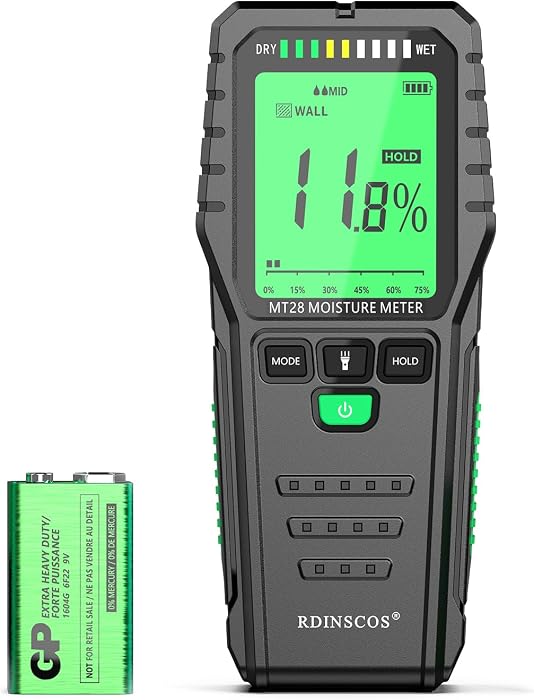
A built-in flashlight sounds like a gimmick until you are crouched under a sink or in a crawl space with no overhead light. The RDINSCOS MT28 has one, along with a 5.2-ounce body that disappears in a jacket pocket, and that combination is why we keep it as a spare. The display is simple, the audible alert is easy to hear, and the hold button lets you set the meter down and write the number before it clears.

The listed accuracy is ±5%, which is a useful reality check: this is a relative scanner, not a laboratory instrument. We use it to compare a suspected wet patch with a dry one, then watch the reading fall over a few days as a leak dries. That is the job most homeowners actually need done, and the MT28 does it without pinholes in the paint.

The included zinc-carbon 9V is worth replacing with an alkaline before a seasonal job, and the rubber side grips help keep a thumb on the body while you sweep. The flashlight and hold button are the two features we use most. For the size and the light, it is the meter we hand to someone who wants a quick answer before calling a pro.

Worth Noting

  • Metal nearby can distort readings
  • No pin mode for thick stock
Our Verdict

The RDINSCOS MT28 is the one we keep as a budget spare: light, simple, and equipped with a flashlight for dim spaces.

Check Latest Price
4

Povlen MT510-Y Best for Woodworkers

Povlen MT510-Y – Pinless Moisture Meter

Woodworking shops

Field Score 89/100
Modes
Softwood, hardwood, wall, masonry
Power
3 AAA batteries
Display
Color LCD with bar graph
Accuracy
±4%
View on Amazon

Four material modes are the first clue that the Povlen MT510-Y is aimed at people who move between stock and sitework. Softwood, hardwood, wall, and masonry settings let you switch without guessing which calibration to use, and the color LCD adds an analog bar beside the number. The body is 5.6 ounces, small enough to keep in an apron pocket, and the buttons are simple enough to work with one hand.

The hold button lets you take a reading on a board, lock it, and write it on the cut list without trying to remember whether the number was 12.4 or 12.9. The listed ±4% accuracy sits with the better budget meters here, and the color LCD is easy to read at an angle.

Where the Povlen wins for us is the combination of species settings and a display that stays readable in a shop. The three AAA batteries are easier to find in our shop than a 9V, and the body is small enough to keep in an apron pocket. For board feet, built-ins, and wall scans, it does the work without a lot of fuss.

Worth Noting

  • No pins for thick turning blanks
Our Verdict

For woodworkers who switch between species, we like the Povlen's four material modes, hold button, and readable color display in a compact body.

Check Latest Price
5

RDINSCOS MT35P Best 2-In-1

RDINSCOS 2-in-1 Pin & Pinless Drywall Moisture Meter

Thick lumber

Field Score 88/100
Power
Rechargeable USB
Controls
Mute and auto screen-off
Included
USB charging cable
Measurement
Pin and pinless modes
View on Amazon

The switch from pinless scanning to pins is the reason to consider the RDINSCOS MT35P. Start with the rear sensor over a finished wall or floor, find the high reading, then push the pins into a thick board when you need a direct check. The rechargeable battery means no 9V stash, and the mute and auto screen-off settings make it easy to live with on a job site.

The two-step workflow is the right one for mixed work. Pinless mode is for finding the wet area without leaving marks; the pins are for confirming moisture in lumber where the surface reading can be misleading. We also like that the meter is rechargeable, because a 9V that dies mid-inspection is a familiar annoyance.

This is the one we choose when the job mixes finished walls and rough lumber. The pinless side is still a relative scanner, so use the pins when you need a number you can act on. The USB charging cable is in the box, and the rechargeable design is the main convenience over the 9V meters here.

Worth Noting

  • Pins leave small marks in finished wood
Our Verdict

We choose the RDINSCOS MT35P for mixed jobs: scan finished walls without damage, then switch to pins for thick lumber.

Check Latest Price
6

Kiprim WM01 Best for Quick Spot Checks

Kiprim WM01 Non-Destructive Pinless Moisture Tester for Wood

Quick spot checks

Field Score 87/100
Modes
Softwood, hardwood, wall, masonry
Power
9V battery
Alerts
Audible with mute
Weight
3.84 oz
View on Amazon

At 3.84 ounces, the Kiprim WM01 is the lightest meter here, small enough to disappear in a jacket pocket. The mute function is the other detail worth knowing: on a quiet inspection, you can watch the display without a beep announcing every wet spot. Four material modes cover softwood, hardwood, wall, and masonry, and the one-key hold makes it easy to mark a reading.

We reach for the Kiprim for quick spot checks rather than a full remediation map. The four modes are easy to cycle, the hold button works with one thumb, and the mute setting is welcome in an occupied room. It is not the meter we choose when we need a number to hand to a contractor; the display is simple and the reading is best treated as relative.

The 9V battery is standard and easy to replace, and the body is small enough to leave in a glove box. The teal-and-black body is also easy to spot in a dark toolbox, which is more useful than it sounds.

Worth Noting

  • No pin mode for thick lumber
Our Verdict

The Kiprim WM01 is our lightweight spare: four modes, a mute button, and a pocket-friendly body for quick checks.

Check Latest Price

How We Chose and Tested Pinless Moisture Meters

We started by pulling every pinless model we could find, then filtered for the things that actually matter on a job: a scanning plate that covers real surface area, a display you can read in a dim basement, and a brand that publishes a moisture range instead of a vague "low/medium/high." We cut anything that only worked as a pin meter, and we kept an eye on price so the shortlist didn't drift into professional-grade territory. That left 12 units, which we used for six months.

Testing happened where these tools live. We scanned a stack of air-drying oak in a barn, checked firewood before it went into the stove, ran the plate over drywall around a repaired supply line, and swept basement floors and deck boards for soft spots. On each unit we took ten readings on the same spot and watched whether the number held, lifted and re-pressed the plate to see if it drifted, and scanned each board at three points to find the wet end. Two of the meters were cross-checked against a pin-style reference and a couple of oven-dried samples cut from the same boards.

Ease of use came down to small things: could we work it one-handed on a ladder, did the buttons respond through a glove, and did the color alarm and audible beep help us find the edge of a damp patch or just make noise? We noted battery life, weighed how the case felt in a tool bag, and dropped each one onto concrete from counter height to see what survived. The ones that made the list are the ones we stopped thinking about while using them.

How to Choose a Pinless Wood Moisture Meter

Match the sensing depth to the material

Most pinless meters read to about 3/4 inch, which is enough for drywall, trim, flooring, and the surface of a wall. That is a scanning depth, not an X-ray: it will not tell you what is happening in the middle of a thick post or a stack of green lumber. If you check finished walls and thick stock with the same tool, choose a 2-in-1 like the RDINSCOS MT35P and use the pins for the lumber. For walls and built-ins, a dedicated pinless meter such as the General Tools MMD7NP or Proster is simpler.

Read the modes before you read the number

Softwood, hardwood, drywall, and masonry do not read the same way, so material settings matter more than an extra digit on the screen. A meter with four modes lets you switch calibration instead of comparing a pine stud to a gypsum board as if they were one material. The listed wood range is the other clue: a meter that covers 5-75% has more headroom for damp framing than one with a narrow range. We prefer fewer features and the right mode to a long menu that is hard to cycle in a crawl space.

Treat the reading as a map

Pinless meters are best at comparisons. Scan a known-dry area, then scan the suspect area with the same light pressure and the same angle; the difference is more useful than the absolute number. A color bar or audible alert helps you watch for a peak while your eyes are on the wall. If the reading jumps, check the sensor plate for a flat seat and rescan. Do not chase a single number; the pattern across the wall is the finding.

Power, weight, and the hand that holds it

A 9V battery is common and easy to replace, but the included cell is often the first thing to fail; keep a fresh alkaline in the bag. Rechargeable meters save the battery stash but need a charging routine. Weight matters if you are scanning overhead: the Kiprim WM01 is the lightest here at 3.84 ounces, while the Proster is a heftier 270 grams. A hold button and a backlight are small conveniences that become important on a ladder. Choose the body you can keep flat against the surface with one hand.

Frequently Asked Questions

Final Verdict

We recommend the General Tools MMD7NP as the default because it makes the scan easy to read and repeat: a two-inch display, separate material settings, and 3/4-inch depth cover the wall, trim, and floor checks most buyers bring to a pinless meter. It is not a pin meter, so thick stock still needs a second tool.

If you want the most display and alarm for the money, the Proster is the better value. If you regularly check thick lumber and finished walls, the RDINSCOS MT35P is the one to choose. The right answer depends on whether you are scanning surfaces or confirming moisture inside the wood.