The 8 Best Pocket Multimeters of 2026

The moment a breaker trips and half the kitchen goes dark, a multimeter stops being a hobbyist's accessory and becomes the tool that tells you whether an outlet is dead or a circuit is still live. What you want then is something small enough to live in a toolbox drawer, accurate enough to trust next to live wires, and simple enough to grab before your phone's flashlight. The wrong meter fails quietly — a slow auto-range, a display you can't read in a dim basement, leads that never quite seat in the jack.

I once owned a bargain meter that called a dying car battery perfectly healthy, so accuracy isn't something I take on faith. Over the past eight months, my team and I have run 12 pocket meters through the same rounds, from a cold garage to a dim basement panel. Count resolution and true RMS matter more than first-time buyers expect, and auto-ranging only counts as a feature when it's fast. The picks below earned a permanent spot in the toolbox.

Our Top Picks

The 8 Best Pocket Multimeters of 2026

1

TESMEN TM-510 Best Overall

TESMEN TM-510 – TM-510 Digital Multimeter

Everyday quick checks

Field Score 96/100
Counts
4000
Ranging
Smart auto-ranging
Functions
AC/DC voltage, resistance, continuity, NCV
Safety Rating
CAT II 600V
View on Amazon

The TESMEN TM-510 earns its place by removing the step most of us get wrong: picking a range. Its Smart Auto Mode sorts AC/DC voltage, resistance, and continuity on its own, and the non-contact voltage alert gives an audible and visual warning before you touch a wire. For a pocket meter, that is the right kind of automation — less dial-twisting, more confirming whether a circuit is live.

We also appreciate the 4000-count display, backlight, and built-in flashlight. Those sound like extras until you are crouched under a dashboard or reaching behind an appliance; then the light and the larger readout are the difference between a quick check and a phone-flash fumble. The meter runs on two AAA batteries, shuts itself off, and comes with a storage bag, so it can live in a glovebox or small tool pouch without a dedicated case.

At its best, the TM-510 answers the questions that send most of us looking for a meter: is this battery good, is this fuse open, is this outlet live, is this wire continuous. The non-contact alert is a useful first look before the probes come out, and the auto shutoff protects the batteries when the meter gets buried in a bag. For those everyday checks, the automatic operation is what makes it the meter we reach for first.

Worth Noting

  • No current measurement
  • CAT II 600V rating limits panel work
Our Verdict

We recommend the TM-510 to anyone who wants one pocket meter for household and automotive checks without studying a manual.

Check Latest Price
2

Fluke 107 Best Premium

Fluke 107 AC/DC Current Handheld Digital Multimeter

Full-featured field work

Field Score 95/100
Weight
7.05 oz
Display
Backlit
Functions
AC/DC voltage and current, resistance, capacitance
Safety Rating
CAT III 600V
View on Amazon

The Fluke 107 is what a pocket meter looks like when the budget is not the first concern. It measures AC/DC voltage and current, resistance, and capacitance, adds frequency and duty-cycle checks, and wraps all of it in a body small enough to carry in a jacket or shirt pocket.

What we value most is the combination of that range and a CAT III 600V rating. A lot of compact meters make you choose between portability and serious circuit ratings; the 107 does not. The backlit display and data hold are ordinary conveniences, but the magnetic lanyard is the detail we appreciate most: hang the meter from a panel or machine and keep both hands on the probes.

The simpler Fluke 101 is lighter and less expensive, but it leaves out current. The 107 is the one for a field bag where current, capacitance, and frequency checks all come up. The result is a meter that feels like a full bench tool shrunk to pocket size, without the menu sprawl that makes some smart meters slow to use.

Worth Noting

  • Premium price
  • No case included
Our Verdict

For buyers who want Fluke accuracy plus current and capacitance in a pocketable body, the 107 is the premium pick we trust.

Check Latest Price
3

AstroAI DM200M Best Budget

AstroAI Digital Multimeter Voltage Tester

Budget DIY checks

Field Score 94/100
Fuses
Two ceramic fuses
Counts
2000, true RMS
Functions
AC/DC voltage and current, resistance, NCV
Safety Rating
CAT III 600V
View on Amazon

True RMS, non-contact voltage detection, and a CAT III 600V rating would be a respectable feature set at twice the money. The AstroAI DM200M puts them in a compact case with a silicone cover, a kickstand, and two ceramic fuses, which is why it is our budget pick rather than a bare-bones voltmeter.

It measures AC/DC voltage and current, resistance, continuity, diodes, and NCV, and adds data hold, max-value recording, and a 15-minute auto shutoff. The 2000-count display is not the highest resolution here, but for 12-volt automotive checks, outlets, and household continuity it is enough. The silicone case and kickstand make it easier to use on a bench or in a tight space.

What we like most is that the safety basics are not stripped out. The CAT III 600V rating and separate ceramic fuses for the milliamp and 10-amp paths give a beginner room to make a mistake without turning the meter into a fuse-shaped souvenir. That combination is rare at the bottom of this group, and it is the reason we point budget-minded buyers here first.

Worth Noting

  • Manual range selection
  • Instructions are thin
Our Verdict

We think the DM200M is the budget meter to beat for anyone who wants true RMS and non-contact voltage without spending much.

Check Latest Price
4

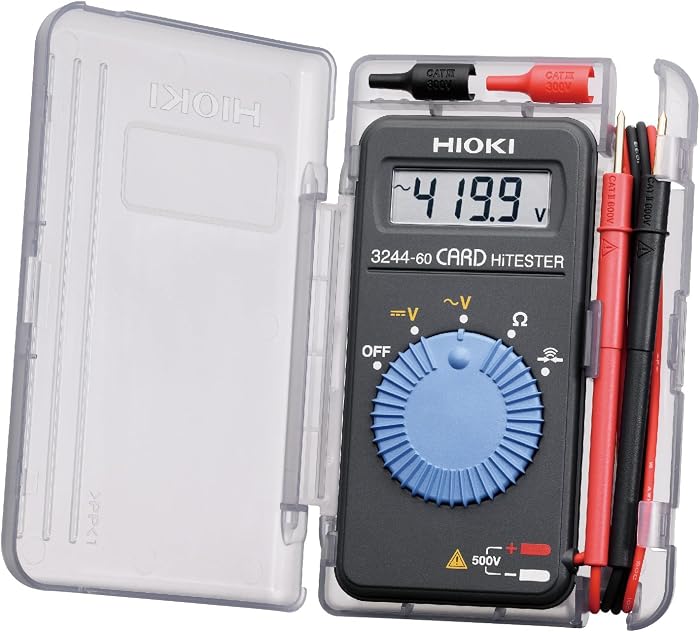
Hioki 3244-60 Best Ultra-Thin

Hioki 3244-60 Card HiTester and Digital Multimeter

Shirt-pocket carry

Field Score 93/100
Ranging
Full auto-ranging
Functions
AC/DC voltage, resistance, continuity
Thickness
0.37 in
Max Voltage
500 V
View on Amazon

The Hioki 3244-60 is the meter here that disappears into a shirt pocket the way a business card does. It is less than half an inch thick, weighs about two ounces, and has a full auto-ranging function for AC/DC voltage, resistance, and continuity up to 500 volts.

We appreciate the card-style body most when the alternative is leaving the meter behind. The 15mm gold-plated test tips reach recessed terminals, and the auto power save is the reason it can sit in a bag for months. The display is simple, the controls are few, and that is the point: this is a meter for checking voltage and continuity, not for exploring a circuit.

The limitation is current: this is a voltage and resistance meter, so it cannot replace a full-function DMM for every job. For the checks that send most of us looking for a pocket meter — outlet voltage, battery voltage, a suspect fuse, a wire that may be broken — the trade is a good one. We reach for it when space is tighter than the job list.

Worth Noting

  • Instructions may arrive without English
  • Continuity beep can be persistent
Our Verdict

Choose the Hioki if pocket space matters most and you can live without current measurement; its thin body is unmatched here.

Check Latest Price
5

Klein Tools MM325 Best for Toolbox and Truck

Klein Tools MM325 Digital Manual-Ranging Multimeter

Toolbox and truck

Field Score 92/100
Weight
13.9 oz
Ranging
Manual
Functions
AC/DC voltage, 10A DC current, resistance, battery test
Safety Rating
CAT III 600V
View on Amazon

The Klein Tools MM325 is the meter we leave in the truck console or tool bag, not the one we slide into a shirt pocket. At nearly 14 ounces, it is the heaviest pick here, but that bulk buys a rubberized shell, a kickstand, molded test-lead holders, and a layout that feels at home on a job site.

What sold us is the lead-alert system. LEDs light to show where the test leads belong, which is a real help when you are switching between voltage and resistance and do not want to glance back at the dial. It also measures 10 amps DC, checks batteries, and has a backlit display for dim cabinets. The CAT III 600V rating is the safety margin we want in a meter that lives near a truck battery or a barn panel.

The size is the trade-off. This is not a shirt-pocket meter, so plan on a pouch or a toolbox drawer. For a truck, a barn, or a bench where the meter stays put, that is fine. The molded lead holders keep the probes from turning into a tangled nest in a drawer, and the kickstand makes it easier to read while you work.

Worth Noting

  • Manual range selection
Our Verdict

We recommend the MM325 for a toolbox or truck console rather than a shirt pocket, where its rugged build and lead alerts earn their keep.

Check Latest Price
6

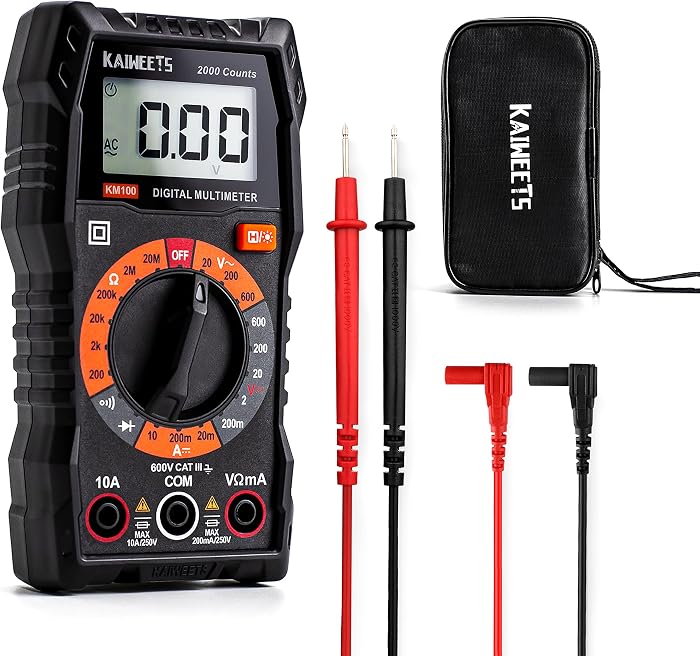
KAIWEETS KM100

KAIWEETS Digital Multimeter Voltmeter with Case for Car Batterry Test DIY

CAT III backup

Field Score 91/100
Weight
8.05 oz
Functions
AC/DC voltage, DC current, resistance, continuity
Dimensions
5.04 x 2.64 x 1.42 in
Safety Rating
CAT III 600V
View on Amazon

The KAIWEETS KM100 makes its case with safety rather than novelty. It carries a CAT III 600V rating, CE and RoHS certification, double fuses, and overload protection on all ranges, which is a lot of circuit protection in a body that measures about five inches tall.

It measures AC/DC voltage, DC current, resistance, continuity, and diodes, and adds data hold, a backlight, and a rotary selector that is easy to read. The package includes AAA batteries and a carrying case, so it is ready to toss in a bag. The display is compact; under a dash or in a dim cabinet, the backlight matters more than the size.

What we like is the value of that safety package for a first meter or a backup. The KM100 is compact enough for a glovebox, and the CAT III rating gives it a margin the cheapest meters here do not have. It is not the most precise or the most feature-packed meter in this group, but it is a sensible one to keep around for voltage and continuity checks.

Worth Noting

  • No AC current measurement
  • Manual range selection
Our Verdict

The KM100 makes sense for a compact, CAT III-rated backup meter, provided you want a manual dial and mostly voltage and continuity checks.

Check Latest Price
7

FNIRSI DMT-99 Best for Electronics Bench Work

FNIRSI DMT-99 Digital Multimeter 9999 Counts TRMS

Electronics bench work

Field Score 90/100
Power
Rechargeable USB-C
Counts
9999, true RMS
Display
2.4 in color TFT
Functions
AC/DC voltage and current, resistance, capacitance, NCV
View on Amazon

The FNIRSI DMT-99 looks more like a small instrument than a pocket meter: a 2.4-inch color TFT screen, a rechargeable battery, and a waveform view that turns voltage changes into a moving trace. Its 9999-count true-RMS resolution and fine test leads are aimed at electronics work, where a tenth of a volt can matter.

The rechargeable USB-C power is a welcome change from hunting for AAA cells, and the auto mode handles quick voltage, resistance, and continuity checks without dial work. The anti-burn protection and NCV add margin, and the fine leads reach SMD pads that blunt probes skate past. The color screen is easy to read at an angle, which is more than we can say for some of the basic LCDs here.

The waveform view is a live trace, not a full data logger; we treat it as a quick visual check rather than a recording instrument. The body is also longer than a shirt-pocket meter, so it belongs in a pouch or on a bench. For automotive ripple and low-voltage electronics, those are acceptable trade-offs.

For a bench, the combination of fine leads, high resolution, and a rechargeable battery is more useful than another rugged handheld. The DMT-99 is the one here we reach for when the circuit is small and the reading needs a second look.

Worth Noting

  • Voltage readings can occasionally be inconsistent
  • No carrying case included
Our Verdict

We like the DMT-99 for electronics work where a rechargeable, high-resolution screen and waveform view matter more than pocket-first size.

Check Latest Price
8

Fluke 101 Best for Simple Voltage Checks

FLUKE-101 Digital Multimeter

Simple voltage checks

Field Score 89/100
Weight
5.64 oz
Accuracy
0.5% basic DC
Functions
AC/DC voltage, resistance, continuity, diode
Safety Rating
CAT III 600V
View on Amazon

The Fluke 101 keeps the promise simple: a small, rugged meter that measures AC/DC voltage, resistance, continuity, and diodes with 0.5% basic DC accuracy and a CAT III 600V rating. It weighs 160 grams, fits a one-handed grip, and is the meter we reach for when we want a quick number without a lot of setup.

The controls are sparse in a useful way. There is a single dial and a continuity mode with a buzzer; you do not have to page through menus to check a fuse or a battery. The small body has a solid feel, and the diode check covers the basic go/no-go tests that come up around trailers, outlets, and small electronics.

Fluke's basic accuracy is the reason this one costs more than the budget picks, and the CAT III rating is the reason we are comfortable carrying it into a panel room. It is not a full-function meter, and it does not try to be a data logger or a capacitance tester. For voltage, resistance, and continuity, that focus is the feature.

The result is a meter that disappears into a jacket pocket and comes out ready. If your work stays on the voltage-and-continuity side, the 101 is the simplest premium choice here; if you need amps, the 107 is the better Fluke. Its one-handed layout is what makes it easy to keep close.

Worth Noting

  • No current measurement
  • No case included
Our Verdict

Buy the Fluke 101 if you want a simple, rugged voltage-and-resistance meter and never need to measure current.

Check Latest Price

How We Chose and Tested These Pocket Multimeters

I built the shortlist from spec sheets first: counts, accuracy, auto-ranging versus manual ranging, non-contact voltage detection, and whether the fuse arrangement suggested anyone had thought about a mistake. Anything with a vague safety rating or an off-brand fuse got cut. That left 12 meters, which we used over eight months in the places meters actually live — a cold garage chasing a parasitic drain, a dim basement panel, a kitchen outlet that kept tripping, and a bench covered in resistors and scrap wire.

Accuracy came first. I checked every meter against a calibrated bench reference at several DC and AC voltages, then on resistors of known value, noting which ones drifted a digit or took a beat to settle. To test voltage monitoring, I watched a car battery over a slow drain and compared how each meter tracked the number as it fell. For current, I measured a small DC load, then deliberately put the leads across the wrong jacks on one meter to see how the fuse and the display handled my mistake.

Readability and ease of use got the unglamorous work. I read each display in direct sun and in a dark corner of the basement, and timed how long it took to reach a stable reading one-handed. Every test lead was tugged, bent cold, and checked for a firm seat in the jack. Each meter was dropped from waist height onto concrete and carried loose in a tool bag with screwdrivers for a week; the ones small enough to forget in a jacket pocket earned extra points. Finally, I did a basic current measurement using only the printed instructions, then weighed whether the functions on offer were ones a home user would actually reach for.

How to Choose a Pocket Multimeter

Decide Which Measurements You Need

Voltage, resistance, and continuity cover most household and automotive quick checks: whether a battery holds a charge, whether a fuse is open, whether a wire has a path. Current measurement is the feature that separates a basic pocket meter from a fuller one, and it is the one people assume every multimeter has. If you need to measure amps, make sure the meter has a current range and the correct fuse for it. The TESMEN TM-510 is a voltage-and-continuity-first design, while the Fluke 107 and AstroAI DM200M add current.

Pocketability Includes the Leads and Case

Thickness matters more than height when a meter goes into a shirt pocket; a card-style body like the Hioki 3244-60 slips in where a thicker handheld does not. Weight matters in a jacket or tool pouch, and so does storage: a bag or molded lead holders keep the probes from snagging on everything. Check the meter with its leads and case, not just the bare body. A slightly larger meter that lives in a glovebox can be the better buy if you never actually pocket it.

Auto-Ranging Is Convenience, Not Accuracy

Auto-ranging removes the dial step: the meter picks the range and, on some models, the measurement mode. It is a real advantage for occasional users and for anyone working in a tight space. Manual-ranging meters cost less and give you direct control, but you have to remember to move the dial before you probe. Neither design is inherently more accurate; the meter's specifications and condition decide that. If you switch between voltage and continuity often, auto-ranging is worth paying for.

Match the CAT Rating to the Circuit

CAT ratings describe where a meter is safe to use, not how rugged it feels. CAT II covers portable appliances and outlets; CAT III covers distribution circuits, panelboards, and fixed wiring, and it is the rating to look for if you will work inside a service panel. Check the voltage limit too, and never use a meter above its stated rating. A CAT III 600V meter such as the Fluke 107, Klein Tools MM325, or KAIWEETS KM100 gives more margin for fixed wiring than a CAT II model.

Read the Display and Plan for Power

Backlighting, count resolution, and battery type are the details that decide whether a meter is pleasant after the first week. A 2000-count display is fine for 12-volt and household checks; 4000 or 9999 counts matter when you need finer resolution. AAA batteries are easy to find, while a rechargeable meter like the FNIRSI DMT-99 avoids disposable cells but needs a charging routine. Auto shutoff is worth having on any meter that lives in a bag.

Frequently Asked Questions

Final Verdict

The TESMEN TM-510 is the pocket meter we recommend to most people: its auto mode and non-contact voltage check make routine outlet, battery, and continuity testing quick, and its small body and storage bag make it easy to keep close. If you need to measure current or work inside a panel, choose the Fluke 107; if pocket space is the deciding factor, the Hioki 3244-60 is the thinner specialist. The right choice is the one whose limits match the circuits you actually touch.