The 5 Best Pressure Washers of 2026

Driveway grime doesn't look like a problem until you try to scrub it. A broom gets the leaves, a hose rinses the dust, and that gray film along the tire tracks stays right where it was — until one pass of a fan spray lifts it and leaves a clean stripe you can see from the street. That stripe is the whole point: siding, fences, pavers, wheels, the grill grate you'd quietly given up on.

Spec sheets push you toward the biggest PSI number on the box, and that's only half the story. Flow — gallons per minute — is what actually carries the dirt away, so a 3,000-PSI machine with a stingy pump loses to a lower-rated one moving real water. The nozzle matters just as much; the wrong tip etches a deck in one careless second.

I've been blasting my own deck and driveway for years, and over the past eight months my team put 10 machines through the same dirty concrete, from battery handhelds to gas bruisers. We timed assembly out of the box, hauled them over curbs by the hose, and kept notes on what loosened, leaked, or quit. The picks below earned their spot, whether you're rinsing off patio furniture or reclaiming a whole driveway.

Our Top Picks

The 5 Best Pressure Washers of 2026

1

Westinghouse ePX3500 Best Overall

Westinghouse ePX3500 Electric Pressure Washer

Most home cleaning

Field Score 93/100
Weight
19 lb
Max Flow
1.76 GPM
Hose Length
25 ft
Max Pressure
2,500 PSI
View on Amazon

The ePX3500 earns its place by refusing to act like a heavy piece of outdoor equipment. At 19 pounds and 16.5 inches tall, it tucks onto a shelf, then rolls out on four quick-lock wheels that steer 360 degrees. We like that low center of gravity for driveway work: the hose tugs, the wand swings, and the unit stays planted instead of tipping. The 25-foot braided hose and onboard 20-ounce soap tank mean fewer trips back to the spigot and a place to park detergent for siding or car soap.

On paper, 2,500 max PSI and 1.76 max GPM put it in the useful middle of this group. The rated numbers are lower—2,000 PSI and 1.2 GPM—which is the figure to trust for continuous work, and it's enough for concrete patios, fence lines, and muddy trucks without blasting paint off trim. We also appreciate the auto-stop pump: release the trigger and the motor rests, which is easier on the pump and your ears. The five quick-connect nozzles cover the usual spread, and the steel wand extends to 17.5 inches for reach under a car or along a gutter line.

The three-year limited warranty is a useful backstop. If your driveway is long enough that a 25-foot hose feels short, the gas WPX3400 is the better fit. The 20-ounce soap tank is easy to rinse, and the onboard nozzle holders keep the tips with the machine.

Worth Noting

  • Early unit failures are the weak spot
  • Rated flow is modest for big surfaces
Our Verdict

For most yards, we make the ePX3500 the default: 2,500 max PSI in a 19-pound, four-wheel body that rolls around cars and patios without a gas can.

Check Latest Price
2

Westinghouse WPX3400 Best Gas

Westinghouse WPX3400 Gas Pressure Washer

Large rural yards

Field Score 91/100
Engine
212cc gas
Weight
63 lb
Max Flow
2.6 GPM
Max Pressure
3,400 PSI
View on Amazon

Gas power changes the job list. The WPX3400 runs a 212cc Westinghouse engine and an axial cam pump at 3,400 PSI and 2.6 GPM, which is the kind of output that turns a mossy driveway or a weathered fence into a weekend project instead of a multi-day one. The steel frame, 12-inch never-flat wheels, and 25-foot abrasion-resistant hose are built for being dragged around a yard, and the five quick-connect nozzles cover everything from a narrow pencil stream to soap.

We like the starting routine: choke, prime, pull, and the engine settles into a steady idle. The 0.5-gallon soap tank is small enough to rinse clean and big enough for a siding job, and the wand and gun storage keep the parts together between uses. At about 63 pounds, it is not a machine you carry up stairs; the big wheels make it a roll-around tool, and that is the right trade for this much pressure.

Gas is a commitment, but the WPX3400 makes it a manageable one: the engine starts without a fight, the controls are easy to reach, and the steel frame takes a knock. For a rural property with a long driveway, a fence line, and no convenient outdoor outlet, the extra power is worth the routine. The three-year limited warranty is a useful backstop, and the 12-inch wheels roll over gravel and grass between jobs.

Worth Noting

  • Requires fuel and oil maintenance
  • Louder than electric picks
Our Verdict

When the job is a long driveway or fence line, we trust the WPX3400: 3,400 PSI and 2.6 GPM, a 212cc engine that starts easily, and a stout steel frame.

Check Latest Price
3

LWQ S5 Best Budget

LWQ S5 – Pressure Washer

Budget car cleaning

Field Score 86/100
Weight
16.6 lb
Max Flow
2.5 GPM
Hose Length
21 ft
Max Pressure
2,030 PSI
View on Amazon

The LWQ S5 is the budget pick, and it earns that role by keeping the essentials: a 2,030 PSI pump, 2.5 GPM flow, four quick-connect nozzles, and a foam cannon in a 16.6-pound body. We like the two-roller base and anti-tip foot for moving around a car or a patio; it is not as planted as the four-wheel Westinghouse, but it is easy to pick up and store. The hose is longer than the compact body suggests, and the onboard nozzle holders keep the tips from disappearing in the garage.

For a first pressure washer or a second unit for car duty, the performance is honest. It has enough flow to rinse a sedan and enough pressure to lift dirt from concrete, though it is not the tool for a whole driveway of set-in stains. The quick-connect tips switch without tools, and the foam cannon is the detail that makes weekend car washing feel less like a chore. We also appreciate that the hose and cord store on the body; the compact footprint is the reason it can live on a shelf instead of taking over a corner.

The LWQ is not the tool for a whole driveway of set-in stains or a rural fence line; it is the affordable, portable option for smaller jobs. The 21-foot hose is the practical limit, and a longer hose is the first upgrade if you work around a big vehicle.

Worth Noting

  • Plastic spray gun is the weak point
Our Verdict

The LWQ S5 is our budget pick for light-duty cleaning: 2,030 PSI and 2.5 GPM in a 16.6-pound body, with quick-connect nozzles and a foam cannon.

Check Latest Price
4

KEEPAK Cordless Best Cordless

KEEPAK Cordless – Cordless Pressure Washer

Cordless small jobs

Field Score 79/100
Weight
2.18 lb
Max Flow
3.0 GPM
Batteries
Two 4.0Ah
Max Pressure
1,450 PSI
View on Amazon

There is no cord, no gas can, and no spigot required. The KEEPAK is a handheld battery washer with a 1,450 PSI pump, a 6-in-1 nozzle, and a foam cannon, and it ships with two 4.0Ah batteries in a hard case. The kit also includes adapters for a bucket, pool, or garden hose, which is the detail that makes it useful for an apartment balcony, a car in a storage lot, or a patio far from an outdoor tap.

We like it for the jobs that never justify dragging out a full-size machine: washing a car, rinsing patio furniture, cleaning a mud mat, or knocking pollen off a porch. At 2.18 pounds, it is light enough to carry in one hand, and the two batteries give you a practical buffer—about 30 minutes of continuous use on a full charge. The flow is enough for rinsing and soapy car work, and the 6-in-1 nozzle saves you from hunting for a tip.

It is not a driveway machine. The pressure is light for set-in concrete stains, and 1,450 PSI will not replace a full-size unit on a dirty driveway. The hard case and compact body are the reason it earns a spot in this set: it goes where a corded or gas washer cannot, and it turns a quick rinse into a five-minute setup instead of a 20-minute production. The case keeps the hose, nozzle, and batteries together, which matters when the kit lives in a trunk.

Worth Noting

  • Runtime limits bigger jobs
Our Verdict

We like the KEEPAK for small jobs and places without a spigot: 1,450 PSI, two 4.0Ah batteries, and a 2.18-pound body that fits in a hard case.

Check Latest Price
5

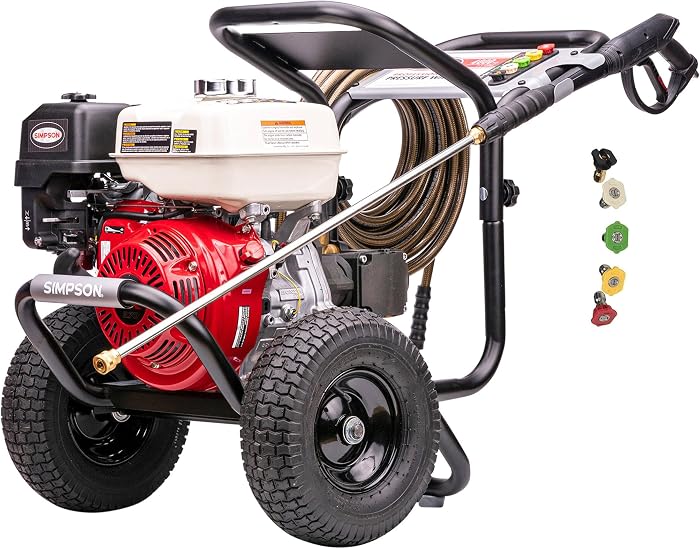
Simpson PS60869 Best for Heavy-Duty Contractor Work

Simpson PowerShot 4000 PSI Gas Pressure Washer

Heavy-duty contractor work

Field Score 78/100
Engine
Honda GX270
Weight
120 lb
Max Flow
3.5 GPM
Max Pressure
4,000 PSI
View on Amazon

Four thousand PSI is more than most driveways need. The Simpson PowerShot PS60869 is aimed at contractors and property owners with a rotation of heavy jobs: stripping a deck, prepping siding, cleaning equipment, or pushing a surface cleaner across a long concrete run. The 3.5 GPM flow matters as much as the pressure—it carries debris away instead of just blasting it loose—and the AAA triplex pump is the commercial-grade part that separates this from the homeowner gas units here.

The Honda GX270 is the other reason to step up. It starts on the first or second pull, runs at a steady speed, and has the low-oil shutdown that protects an expensive engine. The welded steel frame, 13-inch pneumatic tires, and 50-foot Monster hose are built for a job site, not a suburban shed; the longer hose means fewer repositioning moves around a house. Five quick-connect nozzles and a 3/8-inch hose connection cover the usual work, and the thermal relief valve is a useful safeguard on long runs.

The trade-offs are plain: 120 pounds and a premium price. This is not the machine for a once-a-year patio rinse, and it is not the one we hand to a first-time buyer. For someone replacing a worn-out contractor unit or maintaining a rural property with serious cleaning, the PowerShot's output, Honda engine, and triplex pump make it the most capable gas model in this group. The 13-inch tires roll over gravel and curbs, but this is a machine that lives on a trailer or in a shop, not on a shelf.

Worth Noting

  • Not for sale in California
Our Verdict

For contractor-level work and big rural properties, we point to the Simpson PowerShot: 4,000 PSI, 3.5 GPM, a Honda GX270, and a 50-foot hose.

Check Latest Price

How We Tested the Best Pressure Washers

We started by pulling together the electric, gas, and battery machines with a real following, then cut the field on what the listings actually promised: rated flow, quick-connect nozzle sets, onboard soap tanks, hose length, and whether the unit had wheels worth rolling. Anything that couldn't survive a close read of its own spec sheet never made it to a tank fill.

Ten machines made the cut, and each stayed in rotation for eight months. The first session with a new unit was always the same: I assembled it alone with a stopwatch running, filled the soap tank, and ran it across the same oil-stained square of concrete so every machine had a common baseline to beat.

From there it went to work on real jobs — the driveway and the apron in front of the garage, a graying cedar fence, vinyl siding, patio pavers, car wheels and rubber floor mats, the grill grate. We swapped nozzles with the trigger locked out to feel how stiff the connections were, watched how the wand kicked when we stepped down to a narrow tip, and noted whether a machine tipped toward us when we dragged it up a curb.

Durability got its own running tally: every hose kink, leaky fitting, cracked nozzle, and pump that ran hot, plus how the handle felt after a full tank. Value came down to one question — did the price buy more clean per hour, or just a bigger number on the box?

How to Choose a Pressure Washer

Read Rated Pressure, Not Just Max PSI

Max PSI is the peak a pump can hit; rated PSI is the number it can hold for a full job. The gap matters. The Westinghouse ePX3500 lists 2,500 max PSI but 2,000 rated PSI, and that lower figure is the honest one for a concrete patio or a muddy truck. For cars, siding, and patio furniture, a well-sorted electric in the 2,000-to-2,500 PSI range is enough; for long concrete runs or set-in stains, look at the 3,000-to-3,400 PSI gas models, where flow rises too. GPM carries the dirt away, so we prefer a balanced 2.0-to-2.6 GPM gas unit over a peak-pressure number with a trickle of water.

Choose Electric, Gas, or Battery by Your Outlet

Electric is the easy default for a suburban yard: no fuel, no pull start, and quieter operation. The trade is a cord and a limit on reach; you need a GFCI outlet and a hose that reaches the work. Gas earns its keep on rural property, long driveways, and jobs where you cannot plug in. It brings more pressure and flow, plus fuel, oil, and noise. Battery units are the third option: low pressure, short runtime, and no cord or spigot, which makes them useful for car rinses and balconies. Match the power source to the setting before you compare PSI.

Weight and Wheels Decide Whether You Actually Use It

A 19-pound compact electric is easy to carry up a step and store on a shelf. A 63-pound gas unit rolls on big wheels but stays on the ground floor. A 120-pound contractor machine is a trailer or shop tool. Before you buy, think about the path from storage to the job: gravel, curbs, stairs, and a narrow gate all change the answer. Four wheels and a low center of gravity make a small electric feel steadier than its weight suggests; 12-inch pneumatic tires make a gas unit manageable across rough ground. If you have to lift it, buy lighter.

Budget for the Hose, Nozzles, and Warranty

The accessories are where a cheap pressure washer starts to feel cheap. A 25-foot hose is common; a 50-foot hose on the Simpson is a real convenience because you move the machine less. Quick-connect nozzles are easier to swap than threaded tips, and an onboard soap tank saves a separate bottle. A three-year warranty on the Westinghouse models is meaningful, because pumps and hoses are the parts that fail first. We also check whether the hose and cord have onboard storage; a kit that stays together is a kit you use more often.

Frequently Asked Questions

Final Verdict

For most homes, the Westinghouse ePX3500 is the pressure washer to buy. It has enough rated pressure for cars, patios, and siding, and the 19-pound four-wheel body is easy to store and move. If your property runs to a long driveway or a fence line and you have no convenient outlet, the gas WPX3400 is the better tool; if you need contractor-level output, the Simpson PowerShot earns the step up.