The 8 Best Probiotics for Horses

The morning a horse walked away from a full bucket of grain, I knew something was off — and by the next day, the stall told the rest of the story. Horses do most of their digesting in the hindgut, a living vat of bacteria and yeast that antibiotics, a flush of spring grass, or a long haul can knock sideways. A probiotic won't fix a bad diet, but a good one steadies the mix.

Over the past six months we've fed 12 formulas — granules, pellets, powders, and apple-flavored chews — to everything from a hard-keeping senior to a pony who'd eat anything. The back label says more than the front: formulas that name their strains and guarantee live counts beat the ones that just print the word on the tub. And the best scoop in the barn is worthless if your horse sifts it to the bottom of the bucket, so we judged these on what actually got eaten as much as on what's inside.

Our Top Picks

The 8 Best Probiotics for Horses

1

Probios Feed Granules Best Overall

Probios Feed Granules for Horses

Daily maintenance

Field Score 94/100
Form
Granules
Daily Serving
5 gm per head
Container Size
5 lb
View on Amazon

Five grams a day is the entire instruction, and it changes the math. A five-pound tub at five grams a day works out to roughly fifteen months of doses for one horse. Put that next to a two-pound tub dosed at a thirty-gram scoop, which is about a month of feeding, and the two purchases stop looking anything alike.

We keep coming back to it because that small dose actually gets eaten. Granules stir into soaked beet pulp or a dampened ration and stay there instead of sifting to the bottom of the pan, and the taste is bland enough that a mare who turns her nose up at everything else will still clean the bucket. Nothing on this list is easier to keep up with on a dark winter morning, and consistency is most of what a daily probiotic has to offer.

What you give up is information. The label promises live, naturally occurring microorganisms and stops there — no species list, no CFU count — so if you like comparing cultures by the number, this is not the tub that lets you. The flip side is that it is labeled for foals at the same five-gram rate as adults, which means one product and no half-dose arithmetic when a weanling joins the barn.

Worth Noting

  • No CFU or species count on the label
Our Verdict

The one we recommend first: a five-gram daily dose, a tub that runs about fifteen months, and a taste bland enough that fussy mares clean it up.

Check Latest Price
2

HealthyGut Probiotics for Horses Best One-Month Starter

HealthyGut™ Probiotics for Horses Dietary Supplement

One-month trial run

Field Score 93/100
Form
Powder
Supply
30 days
Daily Serving
1 tablespoon (medium and large horses)
Probiotic Species
20
View on Amazon

Twenty species of probiotics in a single scoop is the longest list any pick here prints, and it arrives with a prebiotic in the same powder. That combination is why we point first-time buyers here: you get a broad blend plus the fiber that feeds it, rather than a single strain on its own.

The tub is deliberately small — 8.5 ounces, thirty days at a tablespoon for a medium or large horse and half that for a small one. That is a feature, not a limitation. You find out inside a month whether your horse eats it and whether anything changes, and you are not storing five pounds of the wrong answer in the feed room.

It is also the least expensive of the picks with a listed price, which makes the trial easy to justify. The ingredients are quality- and purity-tested to human-grade standards, and the formula is aimed at horses in light to moderate work, so a horse in hard training belongs on the Purina pellet instead. The listed flavor is milk, an odd note for a feed bucket, but the powder disappears into a damp ration either way.

Worth Noting

  • Dosed for light-to-moderate work, not hard training
  • Eight-ounce tub empties fast in a multi-horse barn
Our Verdict

A broad twenty-species blend with a prebiotic, packaged as a defined month — the low-risk way to find out if a probiotic helps your horse.

Check Latest Price
3

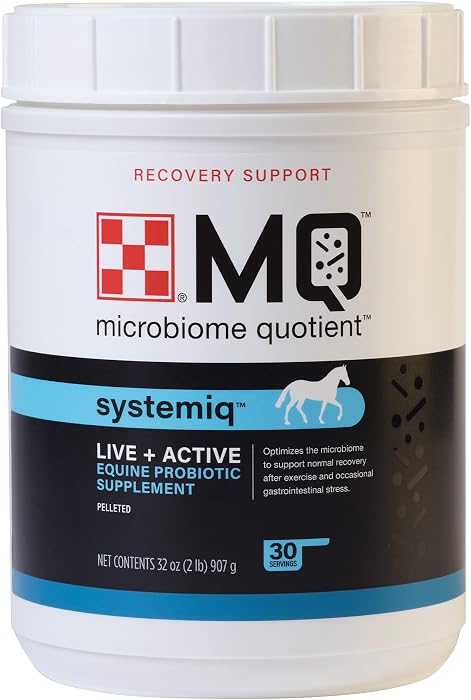
Purina Systemiq Best for Hard-Working Horses

Purina® Systemiq™ Probiotic Horse Supplement

Hard-working horses

Field Score 92/100
Form
Pellet
Live Cultures
Bacillus coagulans (GBI-30, 6086), 10 billion CFU per 30 g scoop
Container Size
2 lb
View on Amazon

Ten billion CFU per thirty-gram scoop, from one named strain: Bacillus coagulans GBI-30, 6086. No other pick here puts a per-serving culture count on the label — the rest give a species list, a CFU-per-gram figure, or nothing at all — and per-serving is the number that actually compares across products.

It is a pellet, which has a practical advantage beyond neatness. Pellets ride in the grain where you can see whether they were eaten, and a horse that leaves them behind tells you something a powder stirred into mash never will. The pitch is narrow and specific — research on hindgut health and fecal consistency in horses stressed by exercise — and the formula is aimed at that horse rather than at everyday maintenance.

That focus is why it earns a place, and also why it is not our top pick. Two pounds is about a month of feeding for one horse, and you are paying for a single well-documented strain rather than a broad blend. For a competition horse in full work that is a fair trade; for a retired paddock horse it is more than you need. Use the scoop that comes in the tub — a kitchen tablespoon will not get you to thirty grams, and the CFU figure only means something at the labeled dose.

Worth Noting

  • Far higher cost per day than the bulk picks
Our Verdict

Buy it for a horse in hard work: it is the only pick that states its CFU per serving, and the pellet shows you whether it got eaten.

Check Latest Price
4

SmartPak Gut Pellets Best for Sensitive Stomachs

SmartPak Gut™ Pellets

Sensitive stomachs

Field Score 91/100
Form
Pellet
Servings
60
Key Herbs
Marshmallow root, slippery elm bark, aloe vera gel extract
Container Size
2.7 lb
View on Amazon

Marshmallow root, slippery elm bark, and aloe vera gel extract are the three names to read on this label. They are not probiotics; they are the coating, soothing botanicals people reach for when a horse is sore in the stomach, and putting them in the same pellet as a prebiotic and probiotic blend is the whole idea.

That makes it a different product from the rest of this list rather than a fancier version of it. A horse that goes off feed on the trailer, gets gassy and tight after grain, or has a history of gastric irritation is the horse it is built for. A horse with loose manure and no other complaint does not need the herbs.

The pellet form does the practical work: sixty servings in a 2.7-pound tub, and the pellets ride in the grain bucket where you can see whether they disappeared. They are also easy for a fussy horse to sort out, so if yours sifts his feed, dampen it or mask with a little applesauce rather than assuming the dose went in.

We reach for this one when the problem is the front of the gut rather than the back. The herbs are there for the horse that is uncomfortable after grain, where a plain probiotic is aimed at manure and hindgut function. It is the pick to try when you have already run a straight probiotic for a month and the gastric signs have not budged.

Worth Noting

  • Costs more per pound than the bulk powders
Our Verdict

For a horse that ties up after grain or quits eating on the road, the soothing herbs make this worth the premium over a plain probiotic.

Check Latest Price
5

Probios Horse Soft Chews Best Treat-Form Option

Probios Horse Soft Chews

Hand-fed, no measuring

Field Score 90/100
Form
Soft chews
Count
60 chews
Flavor
Apple
Container Size
1.32 lb
View on Amazon

Some horses will not eat powder. Not hidden in beet pulp, not stirred into a soaked senior feed — they sift, they sniff, they walk away and leave the bucket full. For that horse, an apple-flavored soft chew is the entire solution: a disc you hand over the stall door, sixty to a bag, no measuring and no water.

The texture is the part that matters. These are soft enough that a horse can take one without bolting it, and firm enough that they survive a coat pocket or a grooming box on a trailer. Nothing needs mixing, which means nothing gets refused at the last second because the bucket smelled wrong.

The catch is that there is no masking a chew. If your horse does not like the flavor he will spit it out and you will know immediately, which is why we suggest one bag before you commit to the three-pack. You will also pay more per dose than a powder costs you, and in exchange you get the one thing a tub cannot give you: a dose that works at a showground with no bucket, no scale, and no half-eaten feed to throw out.

Worth Noting

  • Costs more per dose than powder
Our Verdict

For the horse that sifts powder out of his feed, this is the answer — an apple chew you hand over the door, sixty to a bag.

Check Latest Price
6

Ramard Total Pre & Probiotic Best for Bulk Prebiotic Feeding

Ramard Total Pre & Probiotic – Total Prebiotic & Probiotic Equine Formula

Bulk prebiotic feeding

Field Score 89/100
Form
Dispersible powder
Prebiotic
Chicory inulin
Live Cultures
50 million CFU per gram
Container Size
5 lb
View on Amazon

If the top pick is the plain workhorse, Ramard is the tub with its numbers printed on the label: 50 million CFU per gram and chicory inulin, a plant prebiotic that passes through the stomach into the hindgut and feeds the cultures once they land there. That pairing is the most complete bulk formulation here, and it is the reason this one stays on the list at the highest listed price in the set.

Dispersible is the right word for the powder. It clouds into water rather than sitting in a lump, so soaked beet pulp or a mash carries it evenly through the feed instead of leaving a chalky residue in the corner of the bucket. The flavor is citrus, which is a stronger smell than the plain granules carry.

What you are paying for is a formulation argument rather than something you will notice in the bucket. For a horse on a plain diet with limited forage, an extra fiber source for the hindgut is worth something real. For a horse already on good hay and a balanced ration, the cheaper granule does the same daily job without the premium.

Worth Noting

  • Highest listed price in this set
Our Verdict

Buy it if you want a stated CFU count and a prebiotic in one bulk tub and do not mind paying the most here to get both.

Check Latest Price
7

Formula 707 Digestive Health

Formula 707 Digestive Health – Digestive Health Supplement for Horses

Loose manure

Field Score 88/100
Form
Pellet
Includes
Prebiotics, probiotics, and enzymes
Container Size
8 lb
View on Amazon

Enzymes are what separate Formula 707 from most of this list. Alongside the prebiotics and probiotics, the pellets carry digestive enzymes meant to help break down roughage — the piece aimed at how well a horse actually uses his hay, not just at what is living in his hindgut.

We like it best for the horse with loose manure in a busy barn, because the whole thing goes in as a pellet. There is no dust in the bucket and no powder settling at the bottom of the pan, and eight pounds is the largest tub here, which means fewer reorders and less chance of running out in the middle of a show week.

The trade-off is control. It is a fixed blend of prebiotics, probiotics, and enzymes, so you cannot turn up the culture dose without turning up everything else — if isolating the probiotic matters to you, buy a straight powder instead. It is milled in-house in Colorado by a company that has been at this since 1946, which is the kind of dull reliability a feed-room staple should have.

Worth Noting

  • Fixed blend, so you cannot adjust the probiotic alone
Our Verdict

For a horse with loose manure and a full calendar, the enzyme-plus-culture pellet is the least fussy scoop in this guide.

Check Latest Price
8

Manna Pro Opti-Zyme

Manna Pro Corp 1000082 Manna Pro Opti-Zyme Microbial Digestive Supplement

Everyday barn supplement

Field Score 87/100
Form
Meal
Supply
48 days for one mature horse
Includes
Probiotics, viable yeast, and enzymes
Container Size
3 lb
View on Amazon

Forty-eight days for one mature horse out of a three-pound tub — that is the number Manna Pro puts on Opti-Zyme, and it is a useful one. It tells you the serving is small and the meal-form powder stretches, which is what you want from something you scoop into every feed through a long winter.

The formula is broader than a straight probiotic. Live yeast and enzymes sit alongside the bacteria, aimed at digesting hay and grain better rather than only seeding the gut, and it will tell you plainly that the goal is holding body condition on the feed a horse is already getting.

It is also the pick that leans oldest. Nothing here is age-specific, but this is the one we reach for with a senior horse holding condition on a normal ration, where the goal is squeezing more out of the feed he already eats rather than fixing an acute problem.

Our reservation is dose transparency. It is a blend, so the probiotic portion is only part of what is in the scoop, and if you are chasing a specific CFU number, Systemiq is the one to buy. For everyday barn use the meal form and the 48-day run are the appeal — this is a supplement you can feed without thinking about it. One practical note: it is often filed with poultry supplies rather than horse supplements, so search the name instead of browsing the equine aisle.

Worth Noting

  • Blend makes the probiotic dose hard to isolate
Our Verdict

The everyday barn supplement: bacteria, yeast, and enzymes in one meal-form scoop that covers a mature horse for 48 days.

Check Latest Price

How We Tested 12 Probiotics for Horses Over Six Months

We started with two dozen formulas on paper and narrowed to 12 by reading guaranteed analyses instead of front-of-tub claims: named bacterial and yeast strains, stated live counts, an expiration date, whether prebiotic fiber or yeast cultures were paired with the bugs, and a scoop size that added up to the serving count on the label. Anything that couldn't tell us what was inside got cut. We also priced each one by the day rather than by the tub, since a five-pound pail disappears fast at two scoops a day.

Testing ran six months at a 20-stall barn and two backyard horses. The panel was deliberately awkward: a 22-year-old hard keeper with bad teeth, a mare coming off a course of antibiotics, a young gelding on spring grass, and a pony who treats every bucket like a challenge. Each formula went into the same routine — soaked beet pulp in the morning, a handful of grain at night — one at a time, about four weeks apiece.

At each feeding we noted whether granules or powder dissolved into wet feed or sank and got left behind, whether the horse cleaned up or walked away, how long prep took at 6 a.m. with cold fingers, and whether the scoop held its stated dose without a scale.

For digestibility we logged manure consistency, appetite, hay intake, and girthiness weekly, comparing weeks on a formula to weeks off it. A running cost sheet tracked the real cost per horse per day, because servings per container and actual days per tub rarely matched. The ones that stayed in rotation were the ones horses ate without fuss and whose labels held up scoop for scoop.

How to Choose a Probiotic for Your Horse

Start With the Form Your Horse Will Eat

Granules and powders vanish into a dampened feed; pellets sit in the grain where you can see them; chews and gels are hand-fed and need no bucket at all. The trap is assuming a horse that sifts his feed will take a powder. He will not, and a five-pound tub of uneaten supplement is an expensive way to learn it.

If your horse is a sifter, start with a chew or a pellet, or plan to soak the feed so the powder clings instead of settling in the corner of the pan. A horse that bolts his grain is the easy case — almost anything works.

Count Days, Not Pounds

Two tubs can sit side by side at similar prices and hold wildly different amounts of actual feeding. What decides it is the daily serving: a five-gram scoop and a thirty-gram scoop are six times apart, so the same weight of powder can cover a year in one product and a month in another.

Before you compare anything, find the serving size on the label, divide the container by it, and ask how many days you are buying. A product that will not tell you its serving size is one you cannot cost out, and that is reason enough to keep looking.

Read the Culture Numbers Carefully

Supplements quote their cultures three ways: CFU per gram, CFU per serving, and a count of species. They do not line up. Fifty million CFU per gram sounds larger than ten billion per scoop until you notice the scoop is thirty grams and the two numbers land in the same neighborhood.

The only figure that compares across products is CFU per daily serving. A long species list tells you nothing about how much of anything is in the scoop, and a guaranteed live count at the end of shelf life is worth more than a number taken at manufacture.

Decide Whether You Want Extras

Once you have a live-culture base, the extras are what separate one tub from another. Chicory inulin and other prebiotics feed the cultures you are paying for, live yeast and digestive enzymes target how well a horse breaks down hay and grain, and marshmallow root, slippery elm, and aloe work on the stomach lining rather than the hindgut.

Our preference is to pick the extra that matches the problem you are actually solving. Gastric discomfort points to the herbs, a horse that drops weight on good hay points to enzymes, and a horse coming off antibiotics points to a prebiotic pairing. Paying for all three at once only makes sense if you have all three problems.

Know When a Probiotic Isn't the Answer

Probiotics earn their place around predictable stress: travel, showing, a feed change, weaning, deworming, or a course of antibiotics. They are not a treatment for colic. A horse that is pawing, sweating, rolling, or off feed needs a veterinarian now, not a scoop of powder, and the same goes for severe or bloody diarrhea.

Keep the tub for the ordinary disruptions and keep the vet's number for everything else. A supplement that is safe enough to feed daily is, by the same token, not strong enough to manage a crisis.

Frequently Asked Questions

Final Verdict

Probios Feed Granules is the probiotic we recommend first. Five grams a day out of a five-pound tub is roughly fifteen months of support for one horse, the granules disappear into a damp feed, and it is bland enough that a fussy mare cleans the bucket — which is most of what a daily probiotic has to get right.

If your horse is in hard training rather than maintenance, buy Purina Systemiq instead; the published CFU count and the research behind it are worth the shorter tub. And if you are not ready to commit to five pounds of anything, HealthyGut gives you a defined month to find out whether this helps your horse at all.