The 6 Best Reciprocating Saws of 2026

A reciprocating saw turns demolition into a decision: one squeeze of the trigger and a nailed-in deck board or a four-inch limb stops being a problem. The catch is that the category splits in two. Corded saws chew through anything within reach of an outlet; cordless ones follow you up a ladder and out to the back fence, right up until the battery fades halfway through a post.

We ran 12 saws through eight months of deck teardowns, a basement replumb, and plenty of storm cleanup. A brushless motor and a variable-speed trigger read like brochure copy until you're starting a cut in PVC and don't want the blade to grab, and weight only registers once you're cutting overhead — two pounds is nothing on the first cut and everything on the twentieth.

Worth knowing before you shop: most of these sell as bare tools, so the battery platform you're already on often decides the saw for you. The picks below cover corded and cordless both, and each one earned its spot on a specific kind of job.

Our Top Picks

The 6 Best Reciprocating Saws of 2026

1

DEWALT 20V MAX XR DCS367B Best Overall
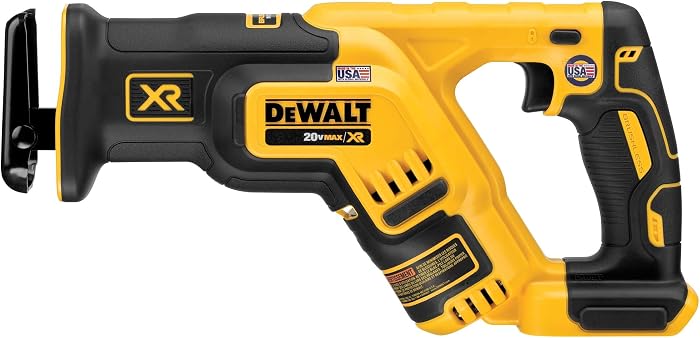
DEWALT 20V MAX XR Reciprocating Saw Cordless

All-around cordless cutting

Field Score 97/100
Weight
5.4 lb
Stroke Length
1-1/8 in
Overall Length
14.5 in
Blade Positions
4-position
View on Amazon

The 14.5-inch body slips between studs and into the corner of a cabinet, where a full-size saw turns into a wrestling match. The four-position blade clamp lets you turn the blade for a flush cut instead of contorting your wrist, and the compact shape keeps the saw close to the work.

With a 1-1/8-inch stroke and 2,800 rpm, the DCS367B has enough bite for framing lumber, PVC, and light metal, and the brushless motor keeps it from feeling strained in a long cut. We like the balance: at 5.4 pounds it is light enough to control overhead, but it still has the two-handed shape that keeps a demolition blade from wandering. For most property and demolition work, this is the reciprocating saw we recommend first. Runtime is the part to plan around. The saw is bare, and a compact battery is not the pack for a morning of cutting; pair it with a 4.0 Ah or larger pack.

The four-position clamp is the feature we kept coming back to. Being able to index the blade in 90-degree steps is the difference between a clean flush cut and a gouged surface, especially when you are working against a floor or a wall. The LED is useful in a cabinet or under a sink, and the tool-free blade changes are quick enough that you will actually switch to the right blade.

Worth Noting

  • Bare tool; battery and charger extra
Our Verdict

The DCS367B is the saw we recommend first for most property and demolition work: compact enough for tight cuts, strong enough for the tougher ones, and built around the 20V MAX packs you may already own.

Check Latest Price
2

Milwaukee M18 FUEL Hackzall 2719-20 Best One-Handed

Milwaukee 2719-20 M18 FUEL Hackzall (Bare Tool)

One-handed tight-space work

Field Score 96/100
Speed
4,500 rpm
Weight
3.97 lb
Voltage
18 V
Stroke Length
7/8 in
View on Amazon

If you have ever held a branch with one hand and reached for a saw with the other, the Hackzall is the shape you want. We pick it for one-handed work because the body is short, the center of gravity sits close to your grip, and the 7/8-inch stroke keeps the blade from bucking when you only have one arm on the tool. It is the saw we take for pruning, PVC, and cuts inside a cabinet.

The brushless motor has more power than the stroke suggests. It handles light metal, plastic pipe, and branch cleanup without feeling like a toy, and the anti-vibration handle is a real comfort when you are working overhead. The trade is speed in heavy material: a full-size saw with a longer stroke removes more wood per pass. We accept that because the Hackzall gets into places the bigger saw cannot reach, and the one-handed control is worth more than the lost aggression on the jobs we use it for.

The tool-free blade clamp is quick enough to switch from a pruning blade to a metal blade without hunting for a wrench, and the LED is useful in a cabinet or under a sink. The 4-pound body does not wear you out on a ladder. It is not the saw for framing a deck, but for the cuts that happen at arm's length, it is the one we reach for.

Worth Noting

  • Bare tool; battery and charger extra
Our Verdict

The Hackzall is the one we reach for when the cut is overhead, one-handed, or in a tight spot; it trades some stroke length for control.

Check Latest Price
3

DEWALT 12-Amp DWE305 Best Corded

DEWALT Reciprocating Saw

Corded demolition power

Field Score 95/100
Amps
12 A
Weight
8 lb
Power Source
Corded electric
Stroke Length
1-1/8 in
View on Amazon

The DWE305 is a corded saw with a 12-amp motor and a 1-1/8-inch stroke, and it does not care how many cuts are left in the pack. It has the sustained pull for pressure-treated lumber, pipe, and demolition, and the 0-2,900 spm trigger gives you a slow start for a precise notch and full speed for a rough tear-out. We reach for it when the work stays near an outlet.

At 8 pounds, the saw feels planted on a bench or a sawhorse. We like the way the mass helps keep the blade in the kerf during a horizontal cut, and the rubber overmold gives you something to hold onto. It is a two-handed tool, and the 19-inch length is not meant for a cabinet interior. That is the trade for the power.

The four-position blade clamp and keyless lever are simple to use, and the pivoting shoe helps keep the blade seated as you change depth. For a shop or a demolition site with power, it is the strongest corded value in this group.

Worth Noting

  • Cord limits where you can work
  • Heavy at 8 pounds
Our Verdict

The DWE305 is the corded saw we choose for sustained demolition and pressure-treated lumber; it gives you unending power as long as the outlet is close.

Check Latest Price
4

Makita 18V LXT XRJ05Z Best Long-Stroke Cordless

Makita XRJ05Z 18V LXT Lithium-Ion Brushless Cordless Recipro Saw

Heavy yard cuts

Field Score 94/100
Speed
0-2,300 / 0-3,000 spm
Weight
8.2 lb with battery
Stroke Length
1-1/4 in
Overall Length
17-1/4 in
View on Amazon

The 1-1/4-inch stroke is the longest in this group. It removes more material per pass than the compact saws, and the two-speed motor lets you start in low for metal or plastic before stepping up for wood. The soft start and long stroke pull a pruning blade through a stump cut with a controlled feel.

The 8.2-pound ready weight gives the saw a planted feel in a fence post or a root ball, and the 17-1/4-inch length gives you leverage. It is a two-handed tool, and the mass works in your favor at ground level. The tool-less blade change and adjustable shoe are welcome because you will switch between pruning and demolition blades.

The 18V LXT platform is the other consideration. With a 4.0 Ah or larger pack, it has the runtime for a serious yard session. We choose it for stumps, fence posts, and heavy cordless cuts where the extra stroke matters more than the lighter weight of a compact saw.

Worth Noting

  • Heavy at 8.2 pounds with battery
  • Bare tool; battery and charger extra
Our Verdict

The Makita XRJ05Z is the long-stroke cordless saw we choose for stumps, fence posts, and heavy yard cuts, as long as you can handle its 8.2-pound ready weight.

Check Latest Price
5

Milwaukee M18 FUEL Sawzall 2821-20 Best Full-Size Cordless

Milwaukee M18 Fuel Sawzall Brushless Cordless Reciprocating Saw

Full-size cordless demolition

Field Score 93/100
Speed
3,000 rpm
Weight
6.8 lb
Voltage
18 V
Blade Change
Lever-actuated
View on Amazon

The 2821-20 is the full-size counterpoint to the Hackzall: more saw, more weight, and a two-handed stance. We pick it when the cut is through a 4x4, a pile of limbs, or a demolition wall and we want the saw to do the work rather than the battery. The M18 Fuel motor has the torque to keep a demolition blade moving, and the 6.8-pound body stays planted in a long cut.

The lever-actuated blade clamp is one of those details that becomes obvious after the third blade change. It is fast, and the metal-reinforced battery connection keeps the pack tight when the saw is vibrating through a tough cut. We also appreciate the LED for work under a sink or inside a cabinet. This is a Sawzall in the traditional sense: a two-handed tool with a long enough body to lean into.

Runtime is the caveat. This saw is thirsty, and a compact battery is not the right pairing; use a 5.0 Ah pack or larger if you have a lot of cutting to do. It is also not the tool for one-handed pruning. For heavy cordless demolition and big limb cleanup, it earns its place.

Worth Noting

  • Heavy for overhead work
  • Bare tool; battery and charger extra
Our Verdict

The M18 Fuel Sawzall is the full-size cordless saw we choose for heavy demolition and big limb cleanup; it has the power and the weight to match.

Check Latest Price
6

WORX 20V AXIS WX550L Best for Light-Duty Yard Work

WORX Cordless Reciprocating Saw & Jigsaw

Light-duty yard work

Field Score 92/100
Modes
Jigsaw and reciprocating
Weight
4.6 lb
Battery
Included
Voltage
20 V
View on Amazon

The WX550L is a different shape from everything else here. It is a jigsaw and a reciprocating saw in one, with a head that pivots so you can get the blade into a corner or flush against a board. The 4.6-pound body, included battery and charger, and tool-free mode changes make it a low-friction first saw. It is not a full-size reciprocating saw, and it does not pretend to be.

The 20V motor and 4,500 rpm are enough for branches, PVC, and laminate, and the pivoting head is the detail that makes it useful in a tight spot. We found the trigger control easy to modulate for a slow start, and the included blades give you a way to try both modes without buying extras. The saw is happiest in light material; a pressure-treated 4x4 or a day of demolition is outside its comfort zone.

The kit is the practical argument. Battery, charger, and blades are in the box, so it is the easiest saw here to start with if you do not already own a battery platform. We recommend it for trimming, quick repairs, and small outdoor projects, with the understanding that it is a light-duty tool.

Worth Noting

  • Battery life is short for sustained cutting
Our Verdict

The Worx WX550L is the light-duty 2-in-1 we recommend for yard trimming and quick repairs, as long as you keep the work small and the battery charged.

Check Latest Price

How We Tested Reciprocating Saws

We started with the saws that actually turn up on job sites and in garage shops, then filtered by the details that change how a tool feels in hand: a brushless motor, tool-free blade changes, an adjustable shoe, and whether the saw ships as a bare tool or a kit with a battery and charger. That narrowed a long list from brands like DeWalt, Milwaukee, Makita, and Worx down to 12 saws, which we used for eight months.

Cutting performance got most of our attention. We timed each saw through 2x10 pressure-treated lumber, four-inch PVC, copper pipe, and pallet wood with nails still in it, noting whether the blade chattered, the shoe flexed, or the motor bogged and kicked back when the kerf pinched. Then we switched to a pruning blade and took down limbs, which is where the compact saws pulled ahead and the heavy ones got old fast.

Battery life we measured the boring way: same pack, same 2x10, cutting until the saw quit, counting the passes. Every cordless model was weighed bare and again with its battery on, then held overhead through a run of limb cuts to see how long before our arms started to drop — a spec-sheet ounce feels like a pound at shoulder height.

Blade changes happened with work gloves on, because that's how they happen in real life, and we noted which clamps held a blade dead straight and which let it wander. We feather-tested every variable-speed trigger on PVC, where a soft start keeps the blade from grabbing, and finished by tallying what actually comes in the box, since a bare tool and a full kit are two very different values.

How to Choose a Reciprocating Saw

Match the Saw to the Cut

Stroke length is the clearest split. A one-handed saw like the Milwaukee Hackzall uses a 7/8-inch stroke for control in tight spots; a full-size saw with a 1-1/8-inch or 1-1/4-inch stroke removes more material per pass and is the better choice for stumps, fence posts, and demolition. If most of your cuts are overhead or one-handed, give up some stroke and take the lighter body.

Handle shape matters as much as the number. A compact two-handed saw like the DEWALT DCS367B fits between studs without turning into a one-handed tool, while a full-size corded saw has the length and mass to lean into a horizontal cut. Choose the shape that matches the position your body will be in.

Corded or Cordless

Cordless saws have improved enough that the choice is less about power than runtime and platform. A bare tool is the cheaper entry if you already own the batteries; if you do not, add a pack and charger to the real cost before you compare prices. A 4.0 Ah pack is a reasonable starting point for a compact saw, and a full-size saw wants 5.0 Ah or more.

Corded power still makes sense for a shop or a demolition site with an outlet. The DEWALT DWE305's 12-amp motor pulls through pressure-treated lumber without a battery curve, and you never stop to swap a pack. The trade is a cord and 8 pounds in your hands.

Weight, Balance, and Reach

An 8-pound saw feels stable on a sawhorse and heavy after ten minutes overhead. A 4- to 5.4-pound compact saw is easier to control at arm's length, but it may need two hands for a long cut. If you cut branches or work from a ladder, a one-handed model is worth the shorter stroke.

Check the length as well as the weight. A 14.5-inch body fits between studs and into a cabinet; a 17-1/4-inch saw gives you leverage but is not the tool for a tight interior cut.

Blade Changes and Control

A four-position blade clamp is worth having. It lets you index the blade for a flush cut against a floor or wall, and it is the difference between a clean cut and a gouged surface. Tool-free changes matter because you will switch between wood, metal, and pruning blades more often than you expect.

Look for a variable-speed trigger and a pivoting shoe. The trigger lets you start slow in metal or plastic; the shoe keeps the blade seated as the cut deepens. An LED is useful in a cabinet, but it is not a reason to choose one saw over another.

Frequently Asked Questions

Final Verdict

For most buyers, the DEWALT DCS367B is the saw to start with. Its 14.5-inch body and four-position clamp make tight cuts easier, and the 1-1/8-inch stroke gives it enough power for framing, PVC, and light demolition. If you cut overhead or one-handed, the Milwaukee 2719-20 Hackzall is the better shape. If the work stays near an outlet, the corded DEWALT DWE305 gives you sustained power without a battery curve.