The 7 Best Router Tables of 2026

A router table is a simple idea: flip the router upside down, bolt it to a table, and run the wood past a fence instead of pushing it through the wood. That flip is what turns a fussy handheld router into something closer to a small shaper — repeatable profiles, square dadoes, fingers well clear of the bit. Over eight months, my team and I put 11 router tables through real projects, not staged cuts.

Here's what first-time buyers learn the hard way: the top and the fence do more for your results than the router bolted into them. A top that flexes under a heavy router throws off every cut, and a fence that drifts out of parallel is worse than no fence. Dust collection earns its keep too — an open table fills the shop with chips in minutes.

Check that your router mounts to the plate, and that assembly doesn't eat a Saturday. Price matters less than whether it stays put, holds its settings, and survives a trip to the driveway. The picks below earned their bench space.

Our Top Picks

The 7 Best Router Tables of 2026

1

Bosch RA1181 Router Table Best Overall

BOSCH RA1181 Benchtop Router Table 27 in. x 18 in. Aluminum Top with 2-1/2 in.

All-around bench work

Field Score 91/100
Weight
30 lb
Top Size
27 x 18 in.
Dust Port
2-1/2 in.
Top Material
Aluminum
View on Amazon

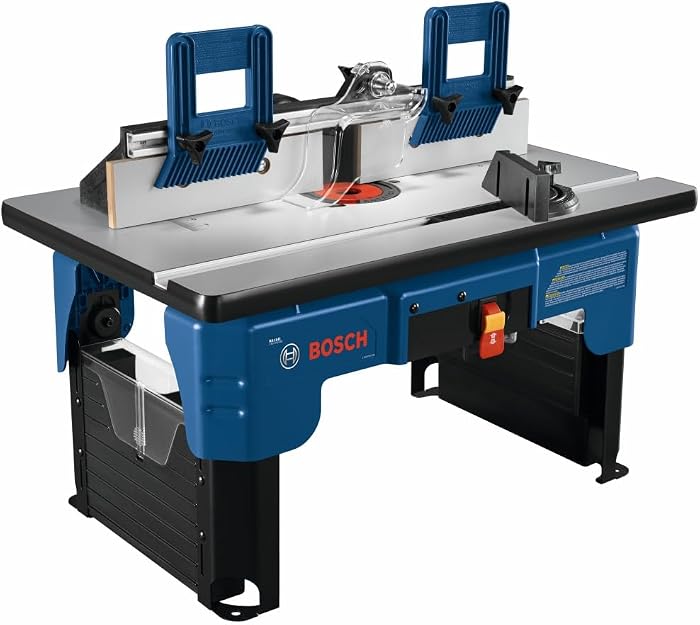
Most tables at this price hand you a sheet of MDF and a plastic insert. The RA1181 gives you a 27-by-18-inch aluminum top with a machined plate dropped into it, and that one change is why it is the table we recommend first. Aluminum does not swell in a damp garage, does not chip out at the miter slot, and does not wear into a dip where the insert sits. We have run everything from a quarter-inch roundover to a panel-raising bit across ours and never found a low spot.

The fence is what we kept coming back to. It is tall, with adjustable MDF faceplates and featherboards that clamp to the fence or down to the table, so a two-inch-tall workpiece still has something solid to ride against. Height adjustment happens above the table, which means depth changes without crawling underneath, and the 2-1/2-inch port takes a shop-vac hose straight on. Chips go in the hose instead of across the shop, and that alone keeps the table in use.

The plate sits on levelers, and getting it flush takes a straightedge and a couple of passes. Ours drifted slightly after a few hours of vibration and needed another five minutes with a screwdriver. That is the nature of a leveling-screw plate rather than a flaw, but check it before a cut that matters rather than after one.

Where it lands against the rest of this list is simple: the Kreg has the better fence, the SKIL kit is cheaper if you still need a router, and neither of those has an aluminum top. For a shop that wants one table assembled and ready for everything from a chamfer to a cabinet door, the top is the argument.

Worth Noting

  • Plate pattern does not fit every router base
  • Assembly and squaring take patience
Our Verdict

We recommend it to anyone who already owns a router: the aluminum top stays flat, the fence has real adjustment, and the dust port fits a shop vac.

Check Latest Price
2

SKIL RT1323-01 Router Kit Best Router Table and Router Kit

SKIL RT1323-01 Router Table and 10Amp Fixed Base Router Kit

First-time buyers

Field Score 90/100
Table Top
26 x 16 in. MDF
Fence Length
24 in.
Router Speed
10,000–25,000 rpm
Included Router
10 amp fixed base
View on Amazon

The kit costs less than the Bosch table on its own and arrives with the router in the box: a 10-amp fixed-base unit with soft start, a speed dial that runs from 10,000 to 25,000 rpm, and 2.0 horsepower behind it. The matching matters as much as the price. SKIL drilled the plate for its own base, so there is no compatibility question and no new holes to drill before the first cut.

Above-table adjustment is the feature we used most. The tool drops through the plate and you raise or lower the bit in place, which turns a fiddly depth change into a ten-second job instead of a reach underneath the table. The 24-inch fence has adjustable MDF faces and two featherboards, the router comes with both 1/4- and 1/2-inch collets, and a dual-sided bit case latches into the side of the table so the bits live with the machine.

The base wants clamping or bolting before you push anything long through it. Left free, the table walks and flexes; clamped to a bench, it behaves like a much bigger machine. Ten amps is plenty for dados, rabbets, and edge profiles, and deep panel cuts want light passes and a slow feed rather than one heavy bite.

Worth Noting

  • MDF top can chip around the miter slot
  • 26 x 16 in. top is tight for long stock
Our Verdict

Buy this if there is no router in your shop yet: one box, a capable 10-amp motor, and bit changes you make from above the table.

Check Latest Price
3

Kreg PRS2100 Router Table Best Fence and Insert Plate

Kreg Bench Top Router Table

Precision bench work

Field Score 88/100
Fence
Aluminum with T-slots
Mounting
Clamps to a workbench
Table Top
30 x 19-1/4 in.
Insert Plate
Level-Loc levelers
View on Amazon

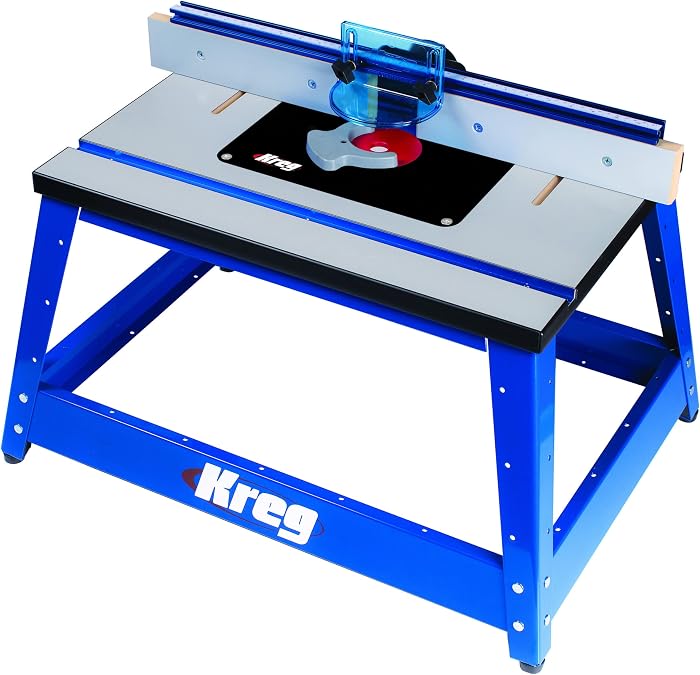
There are no legs on the PRS2100. It is a 30-by-19-1/4-inch top with an aluminum fence and an insert plate, and it clamps to whatever bench you already own. For a shop that has a solid surface and no floor space for another footprint, that is not a compromise — it is why the table stays out and ready, because it never needed a stand.

The fence is where the money went. Aluminum with T-slots down the face and the top, sliding faces that lock with levers, and jointing capability: with the jointing rods and a straight bit you can true an edge on the table instead of walking to the jointer. Snug the levers and it holds square. Leave them loose and it will drift mid-cut, which is worth saying out loud because it is the one habit this fence punishes.

The insert plate rides on Level-Loc levelers, so you set it flush once and check it occasionally rather than fighting it every session. The top is edge-banded MDF with a low-friction micro-dot skin that lets stock slide instead of dragging, and the whole table lifts off the bench and onto a shelf when the project is finished.

What we keep coming back to is repeatability. Nothing on this table is the cheap version of the part. The fence locks square, the plate sits flush, and the dust port is built into the fence where the chips actually are. You supply the bench and the clamps, and in exchange you get the most precise table in this group.

Worth Noting

  • No stand; you supply the bench and clamps
  • Assembly directions are thin on detail
Our Verdict

Worth the step up if you have a solid bench: the best-engineered fence here, and an insert plate that stays flush.

Check Latest Price
4

Bosch RA1141 Router Table Best Portable

BOSCH RA1141 26 in. x 16-1/2 in. Laminated MDF Top Portable Jobsite Router

Small shops and storage

Field Score 87/100
Legs
Folding
Top Size
26 x 16-1/2 in.
Dust Port
2-1/2 in.
Top Material
Laminated MDF
View on Amazon

Folding legs are the entire idea here. The table sets up on a driveway, a job site, or the end of a garage, then folds and stands against the wall. Bosch ships it assembled, so the first cut is minutes away instead of an evening away, and the whole package weighs under 32 pounds.

The click mount is what sold us. The router clicks into the plate rather than bolting to it, so bit changes happen from above and there is no plate to level. The job that eats an afternoon on other tables simply is not part of this one. Onboard storage holds bits and wrenches on the machine, which means fewer trips to the drawer mid-project.

It is a light table, and light has consequences. On a smooth floor the legs walk, and anything longer than a couple of feet wants the whole thing clamped or bolted to something heavier. Where it shines is small work: trim, dados, roundovers, and anything better done outside than in a closed shop.

Worth Noting

  • Plastic miter gauge feels flimsy
  • Laminated MDF top is softer than aluminum
Our Verdict

Our pick for a garage that has to be a garage again by dinner: it folds away, and the click mount spares you plate leveling.

Check Latest Price
5

POWERTEC 71402V Router Table Best for Compact Shops

POWERTEC 71402V Router Table

Compact shops

Field Score 83/100
Stand
Steel
Top Size
24 x 16 in.
Fence Length
24 in.
Leveling Points
Eight
View on Amazon

Count what comes in the box: a 24-by-16-inch laminated MDF top on a steel stand, a 24-inch fence with an adjustable bit guard, a featherboard, a reversible flip stop, a starting pin, four reducer rings, and eight leveling points for the plate. That is the most complete package here at its price, and it is exactly what a compact shop needs — a table that arrives ready to make a cut rather than a top you have to build around.

The eight leveling points are the detail we care about. They let you bring the insert plate flush with the top instead of living with a lip that catches a workpiece on every pass, and the four rings — solid, 1 inch, 1-7/8 inch, and 2-5/8 inch — close the gap around small bits so stock stays supported near the cutter. The flip stop is the other useful touch: it swings out of the way for through cuts and back into place for repeat work.

The 24-by-16-inch top is the number to think about. Rails, stiles, dados, and roundovers are comfortable on it; a long board wants an outfeed stand at the back. The steel stand makes it steadier than a plastic base, and at 27.5 pounds it is a two-hand move between benches rather than a one-hand carry.

Worth Noting

  • Compact 24 x 16 in. top limits long stock
Our Verdict

The most complete box here: a table, a steel stand, a fence with a flip stop, and four reducer rings for compact-shop money.

Check Latest Price
6

SKIL SRT1039 Router Table Best for SKIL Router Owners

SKIL SRT1039 Benchtop Portable Router Table for SKIL Routers RT1323-00

SKIL router owners

Field Score 82/100
Weight
24.2 lb
Table Top
26 x 16 in. MDF
Bit Storage
Dual-sided, integrated
Fence Length
24 in.
View on Amazon

Two features make this little table worth a look. A dual-sided bit case latches into the side of the machine, so the bits live with the table instead of in a drawer full of sawdust, and the height adjustment works from above the plate with the supplied tool. On a crowded bench, both of those save more time than they cost.

The 26-by-16-inch MDF top and 24-inch fence are the same working surface as the kit version — adequate rather than generous. Rails, stiles, dados, and edge profiles are comfortable; a long board is not, and the table is light enough that it wants clamping down before you find out why. What we appreciate is that nothing here feels like an afterthought: an aluminum miter gauge slot, three insert rings, and a starter pin for curve work without the fence.

The plate is drilled for SKIL's own fixed-base routers, and while other bases can be adapted, that usually means drilling the plate. Check your router's base pattern first, because this is the one table here that assumes a brand. Otherwise, look at the RYOBI below — same idea, different hole pattern, a little more money.

Worth Noting

  • Plate is drilled for SKIL router bases
  • MDF top is prone to edge chips
Our Verdict

The value pick for anyone already running a SKIL router, with above-table adjustment and bit storage built into a small table.

Check Latest Price
7

RYOBI A25RT03 Router Table Best for Tight Budgets

RYOBI Universal Router Table A25RT03

Tight budgets

Field Score 81/100
Frame
Metal
Weight
28 lb
Dimensions
18-1/4 in. W x 32 in. H
View on Amazon

The lowest price here buys a metal-framed table that stands 32 inches tall and weighs 28 pounds — light enough to move, heavy enough that it does not shimmy while you push a board across it. The fence is where the surprise is: the measurement markings read true against a tape, and squaring it takes a minute rather than a project.

It comes with the usual kit — fence, featherboard, guard, miter gauge — and going together is a short job with ordinary hand tools. Where it sits in this group is the simple end. The design is plain, the setup is brief, and what you are paying for is a rigid frame rather than a long feature list.

The word universal is doing a lot of work in the name. The insert plate is patterned around Ryobi's own routers, and other brands often mean drilling new holes, so pull your base plate and compare before you order. What we noticed is that nothing about the frame feels like a first table: it holds a router still, the fence stays where you set it, and it does everything a beginner needs while they work out what they actually want.

Worth Noting

  • Plate pattern favors Ryobi routers
Our Verdict

A sturdy metal-frame table at the lowest price here — worth it if a Ryobi router is already on your shelf.

Check Latest Price

How We Tested Router Tables on Real Projects

We started with a list of about 40 tables sold by the major tool brands and narrowed it by what actually varies: top material and flatness, fence design, plate and router mounting compatibility, dust ports, and price. Tables that quietly locked you into one router brand got cut early. From there we bought 11 and set them up on the same bench.

Each table was assembled from the box on a timer, using only the tools in the box, and we noted the ones that needed a second person or a trip to the hardware store for bolts. Then it went to work on a run of shop cabinets — roundovers, dadoes, and raised-panel profiles in oak and plywood — clamped to a workbench in the garage, with two of them carried out to a driveway for a weekend job. We checked fence parallel with a square, then with a dial indicator after every fence adjustment, and noted how much slop each one's adjusters gave us.

Stability was judged by feel and by evidence: vibration at the fence during a heavy cut, whether the table walked across the bench, and whether the plate stayed flush after we swapped routers in and out. We mounted three different routers into each plate to see how universal "universal" really was. Dust ports got hooked to the same shop vac, and we weighed how much ended up in the bin versus on the floor. Before we called anything durable, we folded and unfolded the legs, knocked the fences out of square and reset them, and left a couple of tables in a hot garage for the summer.

How to Choose a Router Table

Start With Your Router, Not the Table

Most of the tables here expect you to supply the router, and each arrives with a predrilled plate that covers a list of popular bases rather than every base. Pull the base plate off your router and compare its hole spacing to the pattern in the listing before you order. Drilling a new pattern into an aluminum plate is a normal job, but it is one you want to plan for rather than discover on assembly night.

A kit with the router in the box removes the question entirely. That is why we point anyone buying a first setup toward one: the maker has already matched the base to the plate, and the money you spend goes to a router instead of to a plate you drill yourself.

Top Size and Material

The surface has one job: stay flat, and stay that way. Aluminum resists the dings and chips that MDF collects around the miter slot, and it does not wear into a dip where the insert sits. A laminated MDF top costs less and works well if you treat it decently and clamp the table down so it is not flexing under every cut.

Size is about support as much as area. A 24-by-16 top is comfortable for rails, stiles, and dados; a 30-by-19 or 24-by-32 surface gives a long board somewhere to land on the way out. If the work you have planned is longer than the top, budget for roller stands at the same time you buy the table.

The Fence and the Height Adjustment

Two controls do most of the work. A fence with sliding faces, T-slots, and locking levers lets you offset the infeed side for jointing and clamp featherboards where they matter; a fence that shifts when you lean on it will ruin a cut no matter how flat the top is, so check that the levers genuinely lock it down. Jointing rods are a small addition that turns the fence into an edge-straightening tool.

Height adjustment from above the plate means you change depth with the bit in place instead of reaching underneath with a wrench. We rank that convenience above almost any other feature on a table that gets used weekly, because it is the adjustment you make on every single project.

Bench, Legs, or a Folding Stand

Where the table lives decides which design you buy. A bench-top unit clamps to a workbench and stores flat, which suits a shop that already has a solid surface and no floor to spare. A table with folding legs sets up anywhere and folds away, at the cost of some rigidity that you recover by clamping it down.

If the table will never move, weight is your friend: a heavier stand and a bigger top keep long stock steadier. Whatever you choose, the table has to be rigid before the cut, not after it.

Dust Collection and the Small Extras

Routing throws more chips than most people expect. A 2-1/2-inch port takes a shop-vac hose without an adapter, and a port built into the fence catches debris where it is actually generated rather than letting it pile up behind the bit.

Reducer rings close the gap between a small bit and the plate opening so a workpiece cannot dip in at the edge, and a starting pin is what makes curve work without a fence controllable. Featherboards and bit storage are worth having. A miter gauge is the accessory that is usually an afterthought in the box.

Frequently Asked Questions

Final Verdict

For most shops, the Bosch RA1181 is the table to buy. The aluminum top stays flat, the fence has real adjustment, and the dust port fits the hose you already own — the three things that decide whether a table gets used or collects clamps.

If there is no router on your shelf yet, buy the SKIL kit instead: one box, matched parts, no compatibility question. Either way, put your next purchase into bits rather than accessories.