The 8 Best Rust Converters for Metal Restoration of 2026

Rust doesn't stop at the surface, and neither should your fix. A converter turns iron oxide into a stable, paintable surface so you can skip the wire brush and keep the metal out of the scrap pile. The catch is that some formulas turn rust black and call it a day, while others leave a finish that paint won't grip, dry tacky, or wash away in rain. Over the past eight months, we've tested 12 rust converters on a garden gate, trailer hitch, and hand tools, comparing sprays, brush-on liquids, and gallon-size pours.

The difference shows up in the details: how completely the rust converts, how fast it dries to a topcoat, and whether the finished patch looks like a repair or a scab. We also weighed cleanup and value—a gallon that skins over in the can is no bargain—and checked adhesion with a scratch test after curing. A good converter doesn't just hide rust; it gives you a surface you can paint and forget about. The picks below are worth keeping on the shelf.

Our Top Picks

The 8 Best Rust Converters for Metal Restoration of 2026

1

Rust-Oleum Rust Reformer Spray Best Overall

Rust-Oleum 248658-3PK Rust Reformer Spray

General rust repair

Field Score 95/100
Form
Oil-based aerosol
Topcoat
After 24 hours
Dry Time
20–40 min tack-free
Container
3 × 10.25 oz cans
View on Amazon

The underside of a trailer or the inside of a wheel well is exactly where a rust reformer earns its keep: you can see the rust, but you cannot easily sand it back to bare steel. That is why the Rust-Oleum Rust Reformer spray is our top pick. The oil-based aerosol bonds with rusted metal and leaves a flat black, paintable surface, and the any-angle nozzle lets you spray upward or upside down into frame rails and bracket edges. We kept reaching for it on the awkward spots where a brush was the wrong tool.

The 3-pack is the practical format. Each 10.25-ounce can is small enough to keep on a shelf and big enough for spot repairs, and the cans dry tack-free in 20 to 40 minutes. The flat black finish also worked in our favor: it looks like a primer coat, so a topcoat can go on without a lot of fuss. The 24-hour topcoat window is worth planning around, especially if the metal will see weather or road salt.

This is not a gallon for a whole frame. Three cans will handle brackets, seams, and touch-ups, but a long trailer frame will eat through them fast, and the spray pattern can drift onto nearby paint. We treat it as the can that stays in the shop for small and midsize jobs, not the one for a full restoration.

Worth Noting

  • Small cans run out on full frames
  • Topcoat must wait 24 hours
Our Verdict

For small-to-midsize rust repairs in awkward spots, this is the spray we trust to leave a flat black, paintable surface without a full sanding job.

Check Latest Price
2

Corroseal Rust Converter & Metal Primer Best for Large Trailers and Frames

Corroseal Rust Converter & Metal Primer

Large frames

Field Score 93/100
Form
Water-based latex primer
Coverage
200–250 sq ft per gallon
Full Cure
24 hours
Application
Brush, roll, or spray
View on Amazon

A trailer frame is a different job from a bracket. It is long, awkward, and usually too big for a spray can, so the product has to go on with a brush or roller and cover a lot of steel without thinning out. Corroseal is built for that scale: a gallon of water-based converter and latex primer in one, applied at 8 to 10 mils wet for 200 to 250 square feet per gallon.

We reach for Corroseal when the job is too big for aerosols and we want water cleanup at the end. It brushes, rolls, or sprays, and soap and water cleanup is a real advantage on a weekend project. The color change is useful, too: it goes on like a latex primer and darkens as it works, so you can see where you have been.

The catch is adhesion. It bonds well when the surface is clean and the instructions are followed, but it can peel if grease, oil, or a glossy layer is left underneath. On a trailer or truck frame, degrease and scuff first, then topcoat exposed areas. That extra step is the difference between a primer that lasts and one that flakes.

Worth Noting

  • Can peel if prep is rushed
  • Needs a topcoat in exposed areas
Our Verdict

A gallon of water-based converter and primer in one makes this the practical choice for trailer frames and other large steel projects where soap-and-water cleanup matters.

Check Latest Price
3

Ospho Metal Treatment Best for Auto Body Prep

Ospho Metal Treatment Gallon

Auto body prep

Field Score 92/100
Form
Liquid
Size
1 gallon
Dry Time
12 hours
Compatibility
Most vehicle paints
View on Amazon

There are two kinds of rust converter: the paint-like product that leaves a black film, and the thin treatment that soaks into pits and prepares the steel for primer. Ospho is the second kind. It is a liquid metal treatment for cars, trucks, boats, RVs, and equipment, and it is compatible with most vehicle paints, decals, wiring, and hoses.

We used it as a prep step rather than a finish. It goes on like water, which lets it reach into pitted areas a brush-on primer would bridge over, and a gallon goes a long way on a frame or a set of suspension parts. The 12-hour dry time means it is not a last-minute product, but the working time is predictable.

Ospho earns its place as our auto-body prep pick because it does the job a converter should do before paint: it attacks the rust in the pits and leaves a surface that primer can grip. It is not our choice for a stand-alone coating on a trailer that sees road salt. It is thin, it can drip on vertical panels, and it can leave a chalky white film when overapplied, so wipe or rinse per the label before topcoating.

Worth Noting

  • Drips on vertical panels
  • Can leave chalky residue
Our Verdict

This is the prep-step converter we choose for pitted auto-body steel, where a thin liquid needs to reach into rust before primer goes on.

Check Latest Price
4

JENOLITE Epoxy Rust Converter Aerosol Best Fast-Acting Spray

JENOLITE Epoxy Rust Converter Aerosol

Fast spot repairs

Field Score 91/100
Form
Epoxy aerosol
Size
16.9 fl oz
Coverage
Up to 21.5 sq ft
Conversion Time
15 minutes
View on Amazon

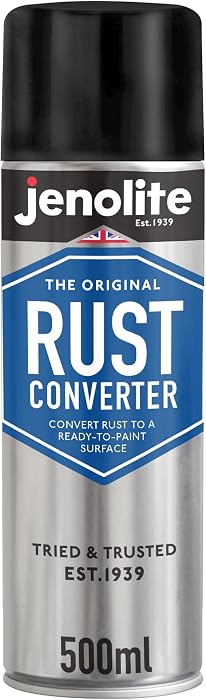
Fifteen minutes is the promise that makes the JENOLITE epoxy aerosol worth a place in the shop. Shake it, spray it on rusted metal, and the surface darkens as the conversion takes place; the epoxy then seals the area against moisture and oxygen. For a small bracket, a seam, or a chip on a mower deck, that speed is the whole point.

We found the aerosol easiest to control in short bursts. The 16.9-ounce can covers up to 21.5 square feet, which is enough for spot repairs but not a whole frame. The epoxy formulation is different from a water-based converter: it leaves a harder film, and the matte finish is ready for a topcoat after the full 24-hour cure.

On heavy, flaking rust, this is a spot treatment, not a miracle. The epoxy coats what it reaches, so wire-brush the loose scale first; otherwise you are sealing a crust rather than converting sound metal. The small can also makes it a poor value on large surfaces.

Worth Noting

  • Small can covers only spot repairs
  • Heavy scale needs wire brushing first
Our Verdict

For small, accessible rust spots that need to be sealed fast, this epoxy aerosol is the quickest can in the group.

Check Latest Price
5

Seymour Rust Converter Best Budget Aerosol

Seymour 16-45 Rust Converter

Budget touch-ups

Field Score 90/100
Form
Aerosol
Color
Black
Topcoat
After 24 hours
Dry Time
10 minutes
View on Amazon

Budget cans are usually a compromise: thin coverage, a sputtering nozzle, or a finish that needs more work than the rust did. The Seymour rust converter avoids most of that. It is the least expensive aerosol in this group, and it still does the basic job: penetrate rust on iron and steel, turn it into a black primer, and cut down on wire brushing and sanding.

We keep Seymour for small touch-ups where a low-cost can makes sense. It dries to the touch in about 10 minutes and accepts a topcoat after 24 hours, so a repair on a gate, a trailer tongue, or a tool can move along quickly. The finish is a low-sheen black that looks tidy on its own, which is more than we expected from a can at this end of the group.

The spray performance is the weak spot. The nozzle can be hard to control, and the can works best in short passes rather than a heavy coat. That is a small annoyance on a spot repair and a bigger one on a large panel.

Worth Noting

  • Nozzle can be hard to control
  • Best for small touch-ups only
Our Verdict

This is the budget can we keep for quick touch-ups, where a low-cost aerosol and a fast-drying black finish matter more than perfect spray control.

Check Latest Price
6

JENOLITE Rust Converter Liquid Best Low-Odor Brush-On

JENOLITE Rust Converter Liquid

Low-odor brush work

Field Score 89/100
Form
Water-based liquid
Size
16.9 fl oz
Rinse
Not required
Coverage
3–4 sq m
View on Amazon

Low odor matters when you are treating a gate, a tool, or a piece of patio furniture in the garage. The JENOLITE liquid converter is water-based, non-flammable, and low odor, and it does not need a rinse after application. That makes it the easiest of these to live with on a small indoor-adjacent project, provided you still ventilate the space.

The 16.9-ounce bottle covers about 3 to 4 square meters, or roughly half what a 1-liter bottle would. We liked brushing it into corners and seams where a spray would miss, and a little goes a long way. It turns rust into a blue-black compound and leaves a surface that can be primed or painted.

This is our low-odor brush-on pick because it gives you control and cleanup without a solvent headache. It is not the strongest choice on heavy, pitted rust: the water-based film can leave rust showing through, so wire-brush first and plan a second coat. The small bottle also makes it a poor fit for a full frame.

Worth Noting

  • Can leave rust showing on heavy pitting
  • Small bottle limits large jobs
Our Verdict

For a low-odor, water-based converter that brushes into corners without a rinse step, this is the small-job pick we reach for first.

Check Latest Price
7

FDC Rust Converter Ultra Best for Very Large Surfaces

FDC Rust Converter Ultra

Very large surfaces

Field Score 88/100
Form
Oil-based liquid
Size
1 gallon
Coverage
500 sq ft
Full Cure
48 hours
View on Amazon

Five hundred square feet is a big claim for a gallon, and it is the number that makes FDC worth a look on a dumpster, a truck frame, or a long run of railing. The coverage figure is for smooth, nonporous metal, though, not the pitted, flaking rust most of us are actually treating.

The formula is an oil-based liquid that goes on with a brush, roller, or spray. It converts rust to an inert coating that seals out moisture, and the 48-hour full cure is a schedule item rather than a surprise. On a large surface, the lower cost per square foot is the real attraction.

We found it works best in a thick coat on sound, wire-brushed rust. It goes on thin and cures hard, and the black finish is a useful primer layer. On heavily pitted areas, a second coat is the safer call.

FDC is the gallon we choose when sheer surface area matters more than a flawless finish. It is not the cleanest converter in this group: the finish can dry unevenly, and some heavy rust can still show through, so budget for touch-up. If you need a predictable black primer on a smaller frame, Corroseal is the easier recommendation; if you are coating a lot of rough steel, FDC stretches further.

Worth Noting

  • Finish can dry unevenly
  • Rough rust cuts coverage sharply
Our Verdict

A high-coverage gallon for very large, sound steel surfaces, as long as you accept an uneven finish and budget extra product for rough rust.

Check Latest Price
8

Brunox Epoxy Rust Converter

Brunox 1813021 BEPOXY1000 Epoxy Rust Converter 1 L

Slow-cure restoration

Field Score 87/100
Form
Epoxy liquid
Size
1 liter
Full Cure
7 days
Viscosity
Medium to high
View on Amazon

A seven-day full cure is either a dealbreaker or a scheduling detail, depending on the project. Brunox is a 1-liter epoxy rust converter with a medium-to-high viscosity, so it stays where it is brushed rather than running off a vertical panel like a thin acid treatment.

The epoxy formula is aimed at heavy rust restoration: it bonds to the rusted surface and converts it, and the 1-liter bottle is a useful size for a bench project or a set of parts. The clear liquid lets you see the metal underneath, which helps on intricate pieces where a black primer would hide the surface.

The cure time is the trade-off. Seven days is a long window before the coating is fully cured, so this is not the product for a repair you need to paint and put back into service the same weekend. It suits a restoration that can sit.

Brunox is the slow-cure option we keep for restoration work, not the can we grab for a quick trailer touch-up. The thick liquid is easier to control than a watery converter, and the 1-liter bottle matches a bench project. If the job needs to be painted and back in service quickly, the JENOLITE epoxy aerosol is the better fit.

Worth Noting

  • Seven-day full cure slows the job
Our Verdict

A slow-cure epoxy liquid for restoration work that can sit for a week, not for a repair you need to paint and put back into service quickly.

Check Latest Price

How We Tested Rust Converters

We built the shortlist by reading labels and spec sheets for aerosols, brush-on liquids, and gallon-size pours, then narrowing to products that clearly stated whether they needed a separate primer and what surface prep they required. We bought 12 units across sizes and price points, from small spray cans to gallons, and tested them over eight months.

The testing happened where rust actually lives: a steel garden gate, a utility trailer, a wheel arch on an old truck, hand tools left out in the yard, and cast-iron patio chairs. For each unit, we removed only the loose scale, applied it per the label, and noted how evenly it sprayed or brushed on, how quickly it flashed off, and whether the rust turned black or stayed visible. We also watched for clogged nozzles, drips, and any gritty residue, and checked whether the one-step primer claim held once the patch dried.

After curing, we scratched each patch with a coin and pressed tape across it to see if the finish lifted; then we topcoated half the patches and left the rest bare through rain and sun. We timed cleanup—whether a brush rinsed clean or needed solvent—and tracked how far each container went, since value here is coverage, not sticker price. The strongest performers converted tight rust in one pass, accepted a topcoat without sanding back to bare metal, and kept rust from creeping back at the edges; the weakest dried glossy, stayed tacky, or peeled in sheets.

How to Choose a Rust Converter

Match the Chemistry to the Rust

Epoxy converters are the most sealing of the group: they leave a harder film and suit heavy, pitted rust where you want a barrier. Water-based latex converters, like Corroseal, are easier to clean up and cover large frames with a brush or roller. Thin metal treatments, like Ospho, are prep products: they soak into pits and leave a surface for primer rather than a thick coating. Pick the chemistry by what the metal needs next, not by the label's biggest claim.

If the part will be topcoated and see weather, an epoxy or latex primer is the safer base. If you are prepping bare steel for a paint job, a thin treatment does more useful work.

Choose the Form Around Access

An aerosol is the right tool for a frame rail, a seam, or the inside of a wheel well because you can spray at angles a brush cannot reach. A brush-on liquid gives you control on flat panels and lets you work the product into pits; a gallon with a roller is the fast way across a trailer frame. The trap is buying a can for a project that needs a gallon. Check the stated coverage and match it to your actual square footage, not to the size of the rust spot.

Buy Coverage for Rust, Not Smooth Steel

Coverage numbers are usually quoted on smooth, nonporous metal. Rust is neither. Pitted, flaking steel drinks more product, and a figure like 500 square feet per gallon can shrink sharply on a rough truck frame. Add a margin of 20 to 30 percent for heavy rust, and plan a second coat on badly pitted areas. A bargain gallon that runs out halfway through the frame is not a bargain.

Prep, Cure, and Topcoat

Most failures start before the converter goes on: grease, oil, loose paint, and flaking rust keep the product from reaching sound metal. Degrease, wire-brush, and wipe dry. Then respect the cure window. A surface that is tack-free is not necessarily ready for a topcoat; 24 hours is common, and some products ask for 48 hours or more. Acid-based and solvent-based converters need gloves, eye protection, and ventilation; water-based formulas are easier indoors but still need airflow.

Frequently Asked Questions

Final Verdict

For most rust repairs around a truck, trailer, or shop, we reach for the Rust-Oleum Rust Reformer spray. It is the easiest way to get a flat black, paintable surface on awkward metal, and the any-angle nozzle does work a brush cannot. If you are coating a full trailer frame, Corroseal is the more sensible gallon; if you need speed on small parts, the JENOLITE epoxy aerosol gets there in minutes. Start with the job size, then pick the form.