The 9 Best Salt Spreaders of 2026

There's a February morning that makes the case for a spreader better than any ad: a bag of ice melt fused into a brick, a glaze of ice across the walk, and a back already sore from the last storm. A good spreader ends that argument. It meters salt evenly in winter so you don't scorch the grass along the driveway, then lays fertilizer and grass seed at a steady rate in spring.

The things that separate a good one from a frustrating one rarely make the box. It's whether the gate opens when your gloves are wet, whether material drops in clumps or in a steady curtain, and whether you can keep it out of the flower beds — that's what edge control is for. Over about 10 months we ran 12 spreaders through a winter of ice melt and a spring of fertilizer and seed.

Size matters as much as anything: a hand shaker suits a stoop and a short walk, a push broadcaster a suburban driveway, a pull-behind or tailgate unit a long lane. The picks below span that range, and every one of them shares a gate you can trust and a pattern you can see.

Our Top Picks

The 9 Best Salt Spreaders of 2026

1

Scotts EdgeGuard Mini Best Overall

Scotts Turf Builder EdgeGuard Mini Broadcast Spreader

Driveways and walks

Field Score 93/100
Setup
No assembly; folding handle
Hopper
Poly with agitator
Spread Control
Broadcast with EdgeGuard side shield
Coverage Per Fill
Up to 5,000 sq. ft. of product
View on Amazon

Salt is the one thing you want a spreader to be stingy with, and the EdgeGuard flap is why this one tops our list. Drop the shield on the side facing your grass and the broadcast pattern stops at the pavement edge instead of sailing into the bed. On a drive lined with turf on one side and mulch on the other, that flap is what keeps April from turning into a patch-and-seed project.

Nothing about it needs a screwdriver. It comes out of the box calibrated, the handle folds down so it hangs on a hook in the garage, and the poly hopper and agitator feed ice melt, rock salt, seed, or fertilizer with nothing to change but the dial. We ran a granular ice melt through it and then coarse bagged rock salt, and the agitator kept the coarse stuff moving instead of bridging over the opening.

The pattern isn't perfectly symmetrical; one side runs a little heavier than the other. Overlapping each pass by a couple of feet evens it out, and on a driveway that's a habit worth having anyway. What surprised us is how little material it takes to do the job. A light setting laid down an even scatter, and a full hopper carried us a lot further than we expected.

The hopper is the smallest of the walk-behind picks here, so if your drive is long enough that you're hauling a bag out halfway through, jump to the EdgeGuard DLX below and get three times the capacity for the same routine.

Worth Noting

  • Plastic wheels skid on packed snow and gravel
Our Verdict

We keep coming back to this one: it needs no assembly, folds flat on a shelf, and its edge shield keeps ice melt where it belongs, on the pavement.

Check Latest Price
2

Scotts EdgeGuard DLX Best for Long Driveways

Scotts Turf Builder EdgeGuard DLX Broadcast Spreader for Seed

Long driveways

Field Score 89/100
Hopper
Poly with agitator
Weight
10.9 lb
Spread Control
Broadcast with EdgeGuard side shield
Coverage Per Fill
Up to 15,000 sq. ft. of product
View on Amazon

Three times the hopper of the Mini is the whole argument for the DLX. Fifteen thousand square feet of product per fill against the Mini's five thousand, which on a long drive or a corner lot is the difference between one pass and a refill in the cold.

Everything we liked about the smaller Scotts carries over. It arrives calibrated, the EdgeGuard flap shields the turf side, and 10.9 pounds is light enough to carry to a shelf one-handed. Where it separates itself is stamina. We filled it once for a full driveway plus both side yards and never went back to the bag, which is exactly what you're paying the extra for.

The weak spot is the hardware. The control cable and the edge-guard flap are plastic, and a hard knock against a rutted, frozen drive can snap the cable and leave you spreading with a manual workaround. Lift it rather than drag it and store it indoors, and it holds up fine; leave it outside full of salt and the salt wins.

Worth Noting

  • Gate doesn't seal fully with fine material
Our Verdict

Buy this one when the Mini's hopper is too small: same edge shield, same zero-assembly setup, with room for a long drive and a corner lot.

Check Latest Price
3

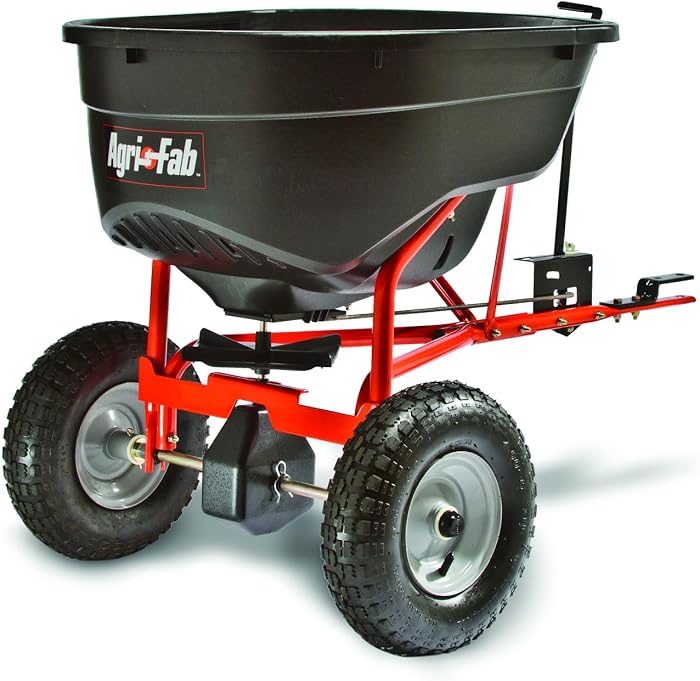
Agri-Fab 45-0548 Push Spreader Best for Heavy Ice Melt

Agri-Fab 45-0548 130 lb. Commercial Push Spreader

Heavy ice melt

Field Score 86/100
Tires
13 x 5 in. pneumatic
Hopper Capacity
130 lb
Axle And Impeller
Stainless steel
Coverage Per Fill
1/2 acre (25,000 sq. ft.)
View on Amazon

This is the most expensive push spreader in our group, and the reason is underneath the hopper: a stainless steel axle and impeller shaft. Everything else here is steel under a powder coat, and powder coat chips. Salt finds the chip. On a tool that lives in a garage from November to March, that difference is the whole ballgame.

The rest is built for volume. A 130-pound hopper and up to a half acre between fills, 13-by-5 turf-tread pneumatic tires that roll over a gravel apron instead of digging into it, and a direct steel rod for flow control with no cable to freeze or snap. We pushed a full hopper across a rutted drive and it tracked straight and steered without fighting back.

Assembly is where it asks for patience. It arrives as a pile of hardware, the drawings assume you've built something like this before, and the smart move is to sort every bolt by size before you start turning wrenches. Give it an evening rather than twenty minutes.

Worth Noting

  • Gearbox is the weak point under heavy loads
Our Verdict

If salt is what goes in the hopper all winter, this is the push spreader we point you to: stainless where it counts and built heavy.

Check Latest Price
4

Agri-Fab 45-0463 Tow-Behind Best for Large Properties

Agri-Fab Pull Behind Broadcast Spreader for Seed

Large properties

Field Score 85/100
Hitch
Universal riding-mower hitch
Spread Width
10 to 12 ft.
Hopper Capacity
130 lb
Coverage Per Fill
Up to 1/2 acre (25,000 sq. ft.)
View on Amazon

When the paved area is longer than you want to walk with a hopper, pushing stops being reasonable. That's the case for a tow-behind, and this Agri-Fab is the one we keep hitched. It connects to a standard riding-mower hitch, and the 130-pound hopper covers up to 25,000 square feet, half an acre, between fills.

Ten to twelve feet of spread width means a long drive takes two passes instead of six. The 13-by-4 pneumatic tires and the 1-inch steel frame stay planted over frost heaves, and the universal hitch fits Craftsman, Husqvarna, Cub Cadet, and most other tractors without an adapter. We towed it behind a garden tractor and had to think about it exactly once, at the hitch.

Assembly is where this one asks for patience. The hardware comes bagged by size, but the drawings assume some mechanical appetite and a couple of callouts are easy to misread, so lay everything out and dry-fit before you tighten anything. Once it's together, the enclosed gearbox and the three-year limited warranty make it feel like the last hitch spreader you'll need to buy.

Worth Noting

  • Flow lever is a reach from a tractor seat
Our Verdict

For a long lane or a couple of acres, hitching 130 pounds of salt behind the mower beats pushing it around all afternoon.

Check Latest Price
5

VEVOR 100 lb Broadcast Spreader Best for Narrow Spreads

VEVOR Broadcast Spreader 100 lbs Capacity Walk-Behind Push Spreader Black

Narrow spreads

Field Score 84/100
Tires
13 in. pneumatic
Flow Control
30-scale, infinite adjustment
Spread Width
0 to 9.8 ft.
Hopper Capacity
100 lb. (56 L)
View on Amazon

Nearly every walk-behind here throws ten to twelve feet. This one is built to run from closed down to about nine and a half, which sounds like a step backward until you're laying ice melt along a fence line with a flower bed on one side and a parked car on the other.

A broadcast spreader throws in a fan, and the fan doesn't stop at property lines. Being able to dial the VEVOR down under ten feet is why it stays in our recommendations: material goes where you aimed it, and on a tight drive that beats a wider pattern you'd never use. The 13-inch pneumatic tires roll over a frost-broken apron without bogging, and the 30-scale control gives finer steps between settings than the on/off gates on the truck-mounted units.

Most of the frame arrives pre-installed, which shortens an assembly job that usually eats an afternoon, and the sealed gearbox and rust-resistant hopper are the right materials for a tool that gets put away wet. We haven't put enough salt through this one to talk about its pattern the way we can the Scotts models; the case for it rests on the width, the tires, and the control.

Worth Noting

  • Smaller 100-pound hopper means more refills
Our Verdict

Narrow, controlled, and steady on gravel: the walk-behind we like for fence lines, raised beds, and drives where a wide throw makes a mess.

Check Latest Price
6

CHAPIN 8740A Hand Shaker Best Handheld

CHAPIN 8740A 64 oz All-Season Hand Shaker Spreader

Steps and porches

Field Score 83/100
Capacity
64 oz
Empty Weight
11.2 oz
Lid Openings
Three sizes (small, large, wide)
View on Amazon

Nobody salting a full driveway should buy this. It's a 64-ounce bottle, and 64 ounces goes about as far as the front walk and a set of steps before you're back at the bag. What it does is the work a push spreader can't reach: the threshold, the porch, the strip along the foundation, the ramp at the back door.

We ended up keeping the Chapin by the door and refilling it from the bag, which is the highest compliment a tool this plain can get. The lid twists between three openings, small for fine ice melt and diatomaceous earth, large for rock salt and sand, and the wide screw top means you can fill it from a scoop without hunting for a funnel. The handle is sized for a gloved hand.

Its second life is the garden. Ours has run diatomaceous earth down a row of squash and fire ant granules around a foundation, jobs where a spinning spreader is overkill and a measuring cup is too imprecise. Empty, it weighs a hair over eleven ounces, so carrying it in one hand while you work a border isn't a project.

Our Verdict

The tool for the ten feet between the garage door and the sidewalk, the shaker we reach for when hauling the push spreader out is more work than the job.

Check Latest Price
7

Buyers ATVS100 ATV Spreader Best for ATV Owners

Buyers Products ATVS100 100 lb ATV Rear Rack Mount Broadcast Spreader

ATV owners

Field Score 82/100
Mount
ATV rear utility rack
Weight
18 lb
Spread Width
Up to 30 ft.
Hopper Capacity
100 lb
View on Amazon

The deciding question with a rack spreader isn't the hopper, it's the rack. This one bolts to an ATV's rear utility rack through slotted brackets, which is a universal answer to a question every ATV answers differently. Measure your rack, check its load rating against a hundred pounds of salt plus the spreader, and plan to spend an hour with a wrench.

Once it's mounted, the enclosed 12-volt motor throws a path up to 30 feet, a best-case figure on a calm day, and the manual feed-gate regulator lets you cut the flow at the hopper before you climb back on. The rain cover is a small thing that matters more than it sounds: a damp load of rock salt sets into one solid block, and a covered hopper is the difference between spreading and chipping.

We like it for driveways and long gravel lanes because the throw covers ground fast, and the polyethylene hopper shrugs off the corrosion that eats steel. The plastic is the honest caveat: the brackets, feed plate, and levers are the light-duty parts and cold makes them more brittle, so mount it once, snug everything down, and don't leave it hanging off the rack through the off-season.

Worth Noting

  • Clogs with damp sand or wet blends
Our Verdict

If a four-wheeler already lives in the shed, this turns it into a salt truck: bolt it to the rack, wire it, and drive.

Check Latest Price
8

SaltDogg TGSUVPROA Tailgate Spreader Best for Pickups and SUVs

SaltDogg TGSUVPROA Tailgate Spreader – Buyers Products TGSUVPROA SaltDogg Tailgate Salt Spreader

Pickups and SUVs

Field Score 81/100
Mount
2-inch hitch receiver
Weight
70 lb
Spread Width
Up to 30 ft.
Hopper Capacity
4.4 cu. ft. (331 lb.)
View on Amazon

A gravity tailgate spreader relies on the load falling through a gate, and rock salt does not always feel like falling. This SaltDogg adds an auger to push material to the spinner, which is the difference between a spreader that feeds and one that dribbles. The 4.4-cubic-foot poly hopper swallows a lot of salt, and the whole unit hangs off a 2-inch receiver on an SUV or a half-ton truck and up.

The part we appreciate most is the in-cab control. Variable auger speed from the driver's seat means you can lay a heavy band at the bottom of a hill and thin it out at the top without stopping, and the 9-inch spinner throws up to 30 feet, which handles a wide apron in one pass. For a long rural drive or a small commercial route, the volume is the point.

Two conditions come with it. It's built for dry, free-flowing number-one rock salt, so a damp bagged blend will bridge in the hopper, and salt left in it while you drive will find its way out the bottom. And the auger is the part that corrodes, so empty the hopper and hose the works down after every use; once the auger is rough, it jams.

Worth Noting

  • Seventy pounds to lift onto a receiver solo
Our Verdict

The step up for someone with a truck, a long driveway, and no interest in pushing: 331 pounds of salt, in-cab speed control, and a 30-foot throw.

Check Latest Price
9

Yhtpouqe Hand Spreader Best for Spot Treating

Yhtpouqe Hand Spreader – Hand held Spreader

Spot treating

Field Score 80/100
Capacity
80 oz
Included
Scoop and garden gloves
Lid Openings
Three adjustable sizes
View on Amazon

Two things come in this box that don't come in most: a plastic scoop sized to the bottle's mouth and a pair of rubberized work gloves. Neither is exciting, and both are why we stopped borrowing a cup from the kitchen to fill the thing.

The bottle itself is 80 ounces, larger than the Chapin above, and the lid works on the same principle: twist it and pick one of three openings, small for fine ice melt, large for rock salt and sand. The handle is broad enough for a gloved hand. Lay a band down a walk and around a set of steps and you're done in a few minutes, with the lid screwed back on and the whole thing stowed behind the seat.

Where it gives ground is precision. Three openings are three openings, with no dial and no way to feather the flow between small and medium when you're working close to a threshold or a door mat. For open pavement that's fine; for a tight line along a foundation we still reach for something with a control we can adjust in smaller steps.

Worth Noting

  • Three fixed openings, no fine flow adjustment
Our Verdict

The shaker we keep in the truck bed: a bigger bottle than most, plus a scoop and gloves so you can fill it straight from the bag.

Check Latest Price

How We Tested the Best Salt Spreaders

The shortlist started with research. We gathered every spreader a homeowner might realistically buy — a hand shaker you hold in one hand, push broadcasters, pull-behinds, and a tailgate unit that takes two people to mount — and read the spec sheets against owner reviews, dropping anything without an adjustable flow gate or that couldn't handle salt, sand, and seed. Twelve made the cut.

Assembly came first: I timed each one from box to first usable pass, working alone with whatever tools were in the box. One went together in eight minutes; another had a diagram that sent me back to the hardware bag twice. Then I filled each hopper with a weighed amount of material and made passes at three gate settings over a marked 500-square-foot strip, weighing what was left to see how close the spreader came to the rate printed on the bag. To check distribution, I lined shallow pans across the swath and weighed what landed in each — uneven spread shows up there long before it shows up as a stripe in the lawn.

The rest happened in the cold. Over roughly 10 months — a winter of ice melt and a spring of fertilizer and grass seed — I worked a 60-foot gravel driveway, a concrete sidewalk loop, and a half-acre lawn, running gate levers with winter gloves on to see what was actually reachable. I left units out through freeze-thaw cycles, hosed them off, and checked metal parts for rust and poly hoppers for cracks. At the end I weighed price against hopper capacity and hardware — a cheap spreader isn't a bargain if the gate seizes by year two.

How to Choose a Salt Spreader

Match the Spreader to the Pavement and the Machine You Own

Start with the shape of the job. A hand shaker handles steps, porches, and the strip between the garage and the sidewalk. A walk-behind push spreader covers a driveway, a front walk, and a corner lot. A tow-behind belongs on a property measured in acres, behind a riding mower that's already in the shed. An ATV rack spreader and a hitch-mounted tailgate unit are for people with a four-wheeler or a truck plus a long lane or a small commercial route.

The trap is buying for the biggest thing you might ever spread. A 130-pound walk-behind is genuinely tiring on a two-car drive, and a shaker is useless on a quarter mile of gravel. Measure the paved area once, add the walks, and buy for that number.

Read Capacity in Square Feet With Suspicion

Spreaders are rated two ways: pounds of material, or square feet of coverage. The square-foot figure is quoted for a lawn product, not for deicer. Rock salt and calcium chloride are denser than fertilizer prills, and a sand blend is heavier still, so a hopper rated at 15,000 square feet of lawn food covers considerably less ground with ice melt.

We compare hoppers by weight whenever the listing gives it. A 130-pound hopper is a serious salt load for a walk-behind, 100 pounds is a step down, and a 5,000-square-foot rating is a driveway and a walk rather than a lot. Size it so you finish the job on one fill; nobody wants to be pouring from a bag at 20 degrees.

Flow Control Is Where Cheap Spreaders Fall Down

Rock salt sits in a bag in a cold garage and takes on moisture, and a plain gravity gate with nothing behind it will bridge over the opening and stop feeding. Look for an agitator in the hopper, an auger that pushes material to the spinner, or a hopper grate that keeps chunks and debris out of the gate. The second half of flow control is a gate that closes completely, so you can shut off at the garage apron instead of salting the street.

Buy dry material, store it in a sealed bin, and break up clumps before they go in. In a wet climate that habit matters more than which spreader you pick.

Spread Width, Aim, and Overlap

Ten to twelve feet is the usual walk-behind throw and it's right for open pavement. Next to beds, a fence line, or a parked car it's too much, which is where a narrower maximum width or a side shield earns its place. Scotts puts its EdgeGuard flap on both of the walk-behinds we recommend, and it's the reason we reach for one of them on a drive with turf down one side.

Whatever the width, overlap each pass by a few feet and walk at a steady pace. A broadcast spreader lays down a fan with soft edges, and the stripes that show up on a driveway are usually a walking-speed problem rather than a spreader problem.

Frequently Asked Questions

Final Verdict

The Scotts EdgeGuard Mini is the salt spreader we recommend for most driveways: no assembly, a handle that folds flat on a shelf, and an edge shield that keeps ice melt off the grass where it does the most damage. For a drive long enough to empty a hopper mid-job, the EdgeGuard DLX carries three times as much through the same routine.

And if there's a truck in the driveway and no interest in pushing, the SaltDogg hitch unit is the step up.