The Best Shooting Ear Protection of 2026

A single rifle shot on an indoor line can peak above 150 decibels, loud enough to do permanent damage in an instant. But total silence isn't the goal — you still need to hear the range officer, your buddy behind you, and the car pulling into the lot.

I've spent enough afternoons beside a rifle with a muzzle brake to be picky about my ears, and the two-day ringing that followed the last time I borrowed a friend's muffs settled it. Over the past eight months, my team and I have run 14 sets of muffs and plugs through their paces, from bare-bones passive pairs to electronic models with Bluetooth.

Here's what I'd tell a first-time buyer: the noise reduction rating on the box is measured with a perfect seal, and the arms of your safety glasses lift the cushion just enough to lose a chunk of it. Fit isn't a soft concern, either — a muff that pinches gets shoved up onto your head or taken off, and a bulky pair stays home. The picks below are the ones I'd hand to a friend.

Our Top Picks

The Best Shooting Ear Protection of 2026

1

Walker's Razor Slim Electronic Best Overall

Walker's Razor Slim Electronic Muff

All-around range use

Field Score 97/100
Style
Electronic over-ear
Storage
Folds flat
Audio Input
3.5 mm jack
View on Amazon

The Razor Slim is the least expensive electronic pair in this guide, and it does not behave like a budget item. Its microphones pull in voices — a range officer, the shooter waiting behind you, your own boots on gravel — while the shot itself drops to something you can stand next to all afternoon. The Howard Leight Impact Sport costs considerably more and earns that money on rifle work, but the electronic part is the part that changes a range day, and this pair gets it right.

We were struck by how little there is to operate. Volume goes up and down on a control you can find by feel with the muffs still on your head, with no menu and nothing to look at. A 3.5 mm input takes music or a phone call between stages, and the muffs fold flat enough to disappear into a side pocket of a range bag.

Where it earns its keep is the in-between: the talk, the walk to the target, the wait. We wore ours over foam plugs on an indoor line and still heard the officer clearly, which is the trick a passive muff cannot manage at any price. Plugs for the shot, amplification for the people — that's how we use them most.

Comfort holds up over a long day. The headband is padded, the cups are soft enough to forget between strings, and the hinge still feels tight rather than sloppy after a lot of folding. Of everything here, these are the muffs we kept reaching for when we weren't testing anything in particular.

Worth Noting

  • Mics lift wind and indoor fan noise
  • Cups can crowd a high rifle stock
Our Verdict

We recommend the Razor Slim to nearly every shooter: it amplifies voices, quiets gunshots, and folds into a range bag.

Check Latest Price
2

Howard Leight Impact Sport Best for Rifle Hunters

Howard Leight by Honeywell R-01526

Rifle and shotgun

Field Score 96/100
Style
Electronic, folding
Included
2 AAA batteries, 3.5 mm cord
Noise Reduction
22 dB NRR
Microphone Cutoff
82 dB
View on Amazon

Stock clearance is the reason the Impact Sport exists. The earcups are cut thin and shaped so a shotgun comb or a rifle stock can sit against your cheek without levering the muff off your ear — a failure the bulkier passive picks in this guide can't do much about. It's the pair to reach for when the shot matters more than the session.

The electronics are the other half of it. Directional microphones lift ambient sound up to 82 dB and shut the amplification off above that, so voices and brush come through and the shot doesn't. The handoff is quick: between strings, conversation resumes immediately rather than swimming back through a muffled lull, which is the difference between a useful electronic muff and a novelty. Two AAA batteries and a 3.5 mm cord come in the box, and the whole thing folds compactly.

Twenty-two decibels is the lowest rating here, and we treat that honestly. Outdoors, behind a shotgun or a rifle with the muffs seated properly, it's plenty. Indoors on a busy line, it's the pair you wear over foam plugs. What the money buys is a seal that survives a cheek weld, and after a season of that the rating stops being the headline.

Worth Noting

  • Firm headband clamp and smallish cups
Our Verdict

We spend the extra on these for rifle and shotgun work, where a thin cup that keeps its seal beats a higher rating that doesn't.

Check Latest Price
3

Decibel Defense 37 dB Best for Loud Indoor Bays

DECIBEL DEFENSE Ear Protection

Highest Noise Reduction

Field Score 95/100
Sizes
Regular and XL
Style
Passive, folding
Weight
12.8 oz
Noise Reduction
37 dB NRR
View on Amazon

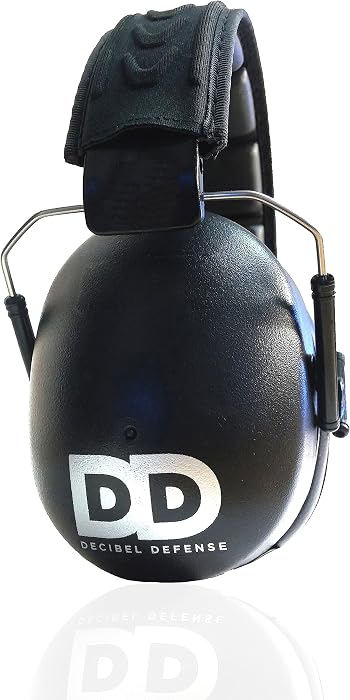
Thirty-seven decibels is the highest noise reduction rating in this guide, and it isn't a marketing round number. It's the difference between a concrete bay that leaves your ears ringing and one you can spend an afternoon in. These are passive — no microphones, no batteries, nothing to switch on — and stripping out the electronics is exactly how the rating gets this high for the money.

Two sizes, which is rarer in this category than it should be. The Regular band is snug on an average head, built that way so the foam can hold a seal, and the XL adds extension for anyone who has ever been told they have a big head. When in doubt, order the XL: a passive muff that doesn't seal is a warm hat.

The rest is plain in a way we appreciate. The band is padded, the muff folds, and there's nothing to fail except the foam. We keep coming back to the number, though. Nothing else here comes close on raw attenuation, and for indoor work, muzzle brakes, or a block-walled range, that is the specification that decides the purchase.

Worth Noting

  • Firm foam presses on safety-glasses temples
Our Verdict

Our pick when the walls are concrete and the line is loud: 37 dB of passive protection, in a Regular or an XL band.

Check Latest Price
4

TradeSmart Ear & Eye Kit Best Kit for New Shooters

TradeSmart Shooting Ear & Eye Protection Kit

New shooters

Field Score 94/100
Style
Passive
Glasses
Anti-fog, UV400
Includes
Muffs, glasses, plugs, case
Combined Rating
38 dB NRR
View on Amazon

Range bags fill up with orphan gear: one muff, someone else's plugs, a pair of glasses with a scratched lens. The TradeSmart kit arrives as a single hard case with a place for all of it — padded folding muffs, anti-fog UV400 safety glasses, foam plugs, and a lid that clips shut with a real snap.

The glasses are the part we didn't expect to like. They sit over prescription frames without pushing the muffs off your ears, which is the usual failure of cheap range glasses, and the muffs themselves are comfortable passive cups with enough padding for a two-hour session.

The 38 dB on the box is a combined figure — plugs seated, muffs over them — not the muffs alone. That's the honest way to rate a kit and it doubles as instructions: foam first, cups second. These are passive, so don't expect to hear a whisper across the line.

What makes the kit worth buying is the case rather than any single piece inside it. Gear that stays together gets taken to the range; gear that doesn't gets left on a shelf. This is the least fussy version of that lesson we've come across in shooting kit.

Worth Noting

  • Foam plugs arrive squashed and stiff
Our Verdict

We like it as the one-and-done answer for a new shooter: muffs, glasses, plugs, and a hard case in a single purchase.

Check Latest Price
5

Peltor Sport Tactical 500 Best with Bluetooth

Peltor Sport Tactical 500 Bluetooth Hearing Protection Ear Muffs

Bluetooth range days

Field Score 93/100
Style
Electronic over-ear
Batteries
3 AAA
Bluetooth
Yes
Noise Reduction
25 dB NRR
View on Amazon

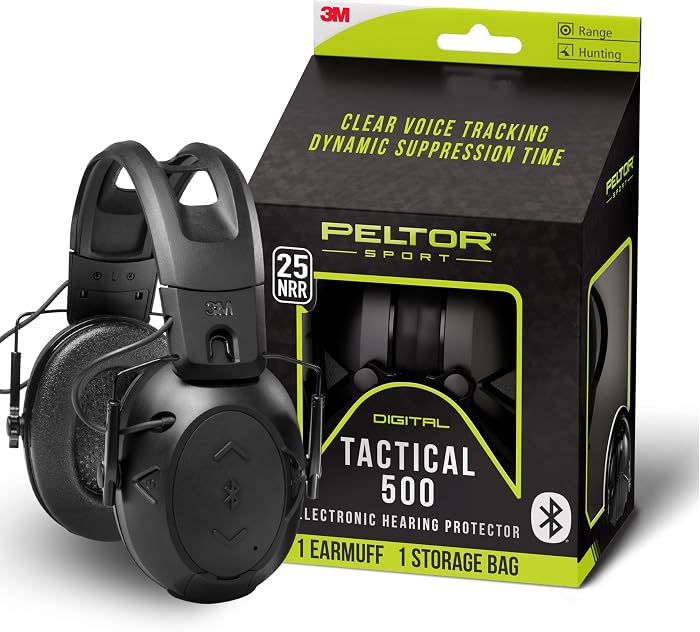
Bluetooth inside a pair of shooting muffs sounds like a gimmick until you've spent a slow afternoon on a static line or a long shift as a rangemaster. Pair the Tactical 500 to a phone and you get music, a podcast, or a phone call, with the muffs cutting in over the audio whenever something loud happens.

The suppression is adaptive rather than a fixed clamp: the electronics measure the impulse and adjust, and the recessed microphones with voice tracking favor speech over wind. On a line with several shooters that translates into hearing the instruction and not the breeze.

Twenty-five decibels is mid-pack here. It's a genuinely protective muff and comfortably above the Howard Leight's 22, but it sits well below the Decibel Defense's passive 37, and it's the most expensive thing in this guide. The money buys features, not attenuation — decide which one you're shopping for before you check out.

Comfort is where they earn their keep on a long day: the cups are generous, the band spreads the load, and there's no ear fatigue after a couple of hours in the sun. They take three AAA batteries, which you supply, so keep a spare set in the bag.

Worth Noting

  • Pivot plastic can crack when stretched wide
  • Bluetooth audio can sound hollow
Our Verdict

For the shooter who wants a podcast between strings: Bluetooth, adaptive suppression, and clear voice tracking in one muff.

Check Latest Price
6

PROHEAR 016 2-Pack Best for Two Shooters

PROHEAR 016 Shooting Ear Protection Earmuffs 2 Pack

Two shooters

Field Score 92/100
Pack
2 earmuffs
Style
Passive, folding
Included
Carry bags
Noise Reduction
26 dB NRR
View on Amazon

Two pairs for roughly what one midrange muff costs is the pitch, and it holds up. One set lives in the range bag, the other on a partner's head or in the barn, and nobody spends the afternoon in borrowed muffs that have already been on someone else's head.

The muffs themselves are honest passive gear: wide, soft cups, an adjustable band with enough travel for a teenager and an adult, and a fold-flat hinge with a drawstring bag for each pair. They're the sensible buy for a partner, for the truck, and for the guest who turns up without gear.

Worth Noting

  • 26 dB is modest protection for indoor bays
Our Verdict

We like the two-pack for anyone outfitting a partner: two 26 dB passive muffs, two bags, one purchase.

Check Latest Price
7

Pro For Sho 34 dB

Pro For Sho 34dB NRR Ear Protection

Budget backup pair

Field Score 91/100
Style
Passive, low-profile
Weight
7.2 oz
Certification
ANSI S3.19, CE EN 352-1
Noise Reduction
34 dB NRR
View on Amazon

Seven ounces and a shell under five inches across: this is the smallest muff here, small enough to live in a glove compartment or a jacket pocket, and it still carries a 34 dB rating — second only to the Decibel Defense in this group.

The number is certified, not just printed on the box: ANSI S3.19 and CE EN 352-1, with the listing noting an OSHA-adjusted 31 dB. That's why we're comfortable pointing someone at a muff this inexpensive for indoor pistol work, where the rating only helps if the cushion actually seals.

Two details earn it a place beyond the price. The cups conform around safety-glasses temples rather than riding on top of them, and the size range covers big kids as well as adults, which makes a pair a reasonable family spare. It's a plain muff with no electronics, and for the money that's the point.

Worth Noting

  • Snug out of the box and tight on larger heads
Our Verdict

The budget pick we trust for indoor pistol work: certified 34 dB of protection for very little money.

Check Latest Price
8

Peltor Tri-Flange Earplugs

Peltor Sport Tri-Flange Corded Reusable Earplugs

Doubling up

Field Score 90/100
Pack
3 pairs
Style
Corded, reusable
Washable
Yes
Noise Reduction
26 dB NRR
View on Amazon

There are afternoons when muffs are the wrong tool: a hot day in a layout blind, a quick zeroing session at the truck, a borrowed rifle handed over with no gear. A corded plug that hangs around your neck and goes in in two seconds gets worn. A muff left in the truck does not.

The tri-flange design is why these are worth carrying. Three soft polymer flanges seal without the roll-and-hold routine foam needs, they're washable, and at 26 dB they're rated as highly as several of the muffs here — which means a plug in your pocket is not a compromise. Seat them so the outer flange rests at the opening of the canal; pushed deep, the ridges can't do their job and the pressure starts to ache.

Worth Noting

  • Cord can break with steady use
Our Verdict

Reusable 26 dB plugs that go in without rolling foam — three pairs, corded, and washable.

Check Latest Price

How We Picked and Tested Shooting Ear Protection

We started by pulling every set of earmuffs, electronic muffs, and reusable plugs with a stated noise reduction rating and a real review history, then cut the list by form factor, price, and whether a pair could plausibly survive a season in a range bag. Bundles that threw in eye protection or spare plugs got a closer look, since most shooters end up buying those anyway. Fourteen units made the final cut, and we lived with them for eight months.

Most of that time was spent at an indoor range with bare concrete walls, three lanes down from someone shooting a braked rifle, noting whether each shot landed as a dull thump or a crack that made us flinch. We ran the same check mowing the yard and ripping boards on a table saw. On every electronic pair we held a normal conversation with the muffs on, listening for voices that sounded natural rather than robotic and for the moment the compression cut out.

Comfort got the least glamorous test: two-hour sits with safety glasses on the whole time, checking for pressure behind the ears, trapped heat, and a headband dent that lingered after we took them off. Three of us with different head sizes did the fitting, cupping our hands over each muff to hear whether the seal broke. We folded every pair down and packed it next to a staple gun in a range bag, and dropped a few onto concrete on purpose.

Batteries got swapped, volume dials got worked with gloves on, and a few pairs spent a week in a hot trunk to see what warped. The reusable plugs were rolled, inserted, and worn through full sessions, since a plug that never seats properly is just a small piece of foam.

How to Choose Shooting Ear Protection

Passive or Electronic: Pick by What You Need to Hear

Passive muffs are foam, plastic, and a good seal. Electronic muffs add microphones that lift quiet sound and cut out above a threshold — they don't block more noise, they give back what a passive muff takes away. So decide what you need to hear, not which one looks more advanced.

Alone on a static line, or working indoors, put the money into attenuation. Hunting, instructing, or shooting with a group where a command or a partner's voice matters, electronic is worth the premium, and the Walker's Razor Slim is the least expensive convincing version of it in this guide.

Read the Rating Honestly

An NRR is measured in a lab with a perfect seal, and it isn't a linear scale — the gap between 22 and 37 matters more than the arithmetic suggests. The trap is addition: a kit billed as a combined 38 dB is rating foam plugs and muffs together, which is a legitimate figure but not one muff's number plus another's.

Mid-20s suits outdoor pistol and shotgun work. Low-30s is where concrete bays, muzzle brakes, and long indoor sessions stop being unpleasant. Above that, fit is doing more of the work than the number is.

Fit Decides Whether Any of It Works

Cups have to sit entirely over the ear, and the band has to hold them there without clamping hard enough to ache. Head size splits this group: the Decibel Defense comes in Regular and XL, the Pro For Sho runs snug by design, and a large head will feel the Howard Leight's clamp. Safety glasses are the other seal-breaker, since a thick temple arm lifts the cushion.

Buy from somewhere you can return, and flex a stiff band before the first session rather than during it. A muff that doesn't seal is decoration.

Clear the Stock, Then Choose the Form

Rifle and shotgun work punishes a tall cup. The stock rides up the shell and levers the muff off your ear exactly when the seal matters, which is the entire case for a low-profile shell like the Howard Leight's — and why it stays in this guide on a modest 22 dB.

For hot days, still-hunting, or any session where muffs fight a hat or a call, a corded plug rated in the mid-20s is protection you'll actually keep in. The two combine: plugs under muffs is the standard indoor answer.

Batteries, Cords, and What Wears Out First

Electronic muffs eat AAA batteries and none of them warn you before the sound fades, so keep a spare set in the bag and treat a muff that suddenly sounds quiet as a battery problem first. On reusable plugs, the cord is the first thing to fail.

Store muffs folded with the band relaxed rather than stretched over a mirror or a receiver, wipe the cushions instead of washing them, and replace the pads once they harden. Those habits cost little and add seasons.

Frequently Asked Questions

Final Verdict

We recommend the Walker's Razor Slim Electronic to most shooters. Voices come through, gunshots don't, and it folds into a range bag for less money than any other electronic pair here.

If your cheek spends the season on a rifle stock, the Howard Leight Impact Sport's thin earcups are worth the step up. If the walls are concrete and the line is loud, skip electronics and take the Decibel Defense's 37 dB.